Prepare Tabletop RPG Scenes Faster for Game Night
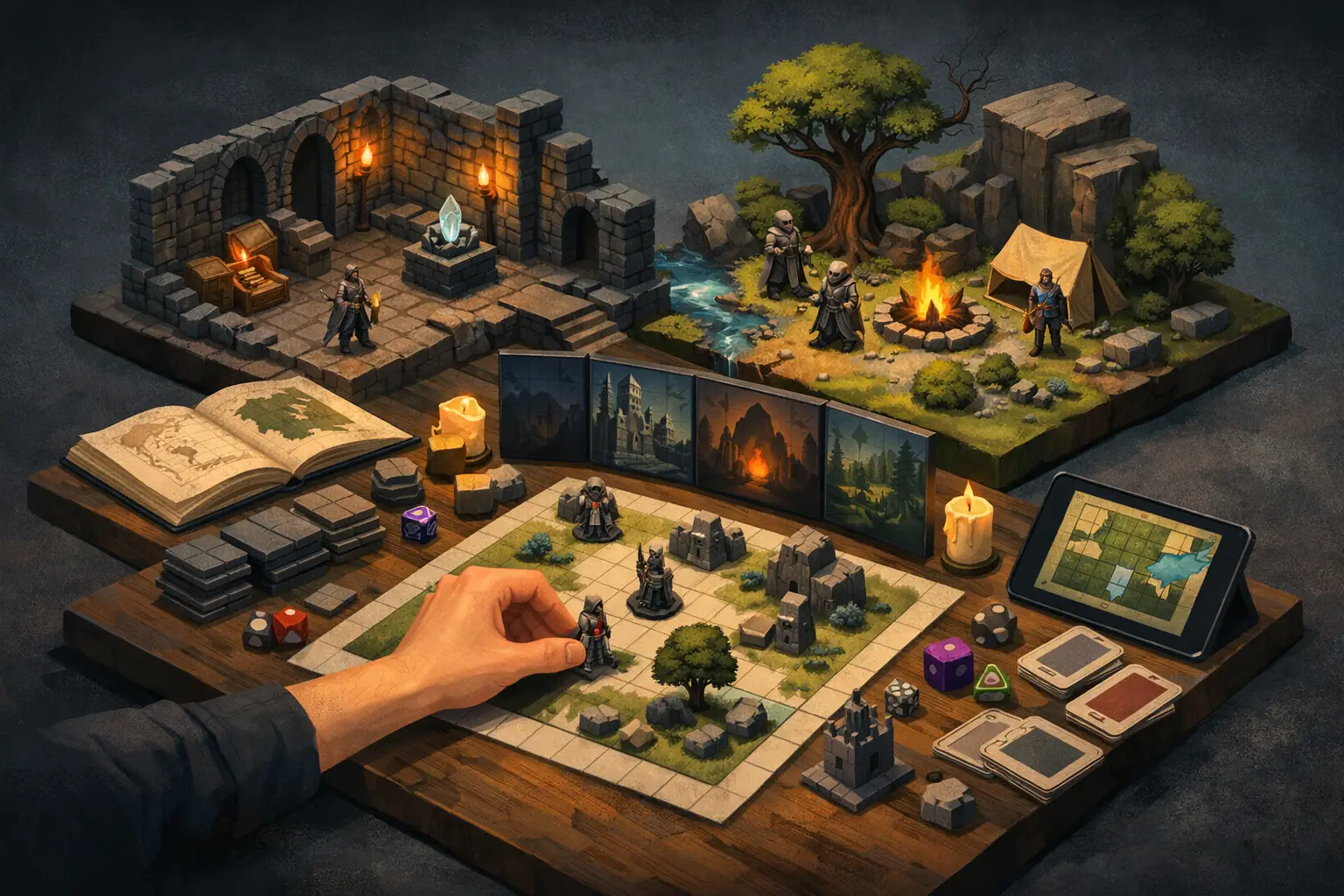
The choir hall beneath Ashwarren Keep has gone silent, and that silence is worse than the chanting. The high priest stands at the altar with both hands on the Silence Bell's cradle, and the last ward-stone is cracking under his palm. The rogue wants to pick the vestry lock behind the altar. The cleric wants to hold th…
The choir hall beneath Ashwarren Keep has gone silent, and that silence is worse than the chanting. The high priest stands at the altar with both hands on the Silence Bell's cradle, and the last ward-stone is cracking under his palm. The rogue wants to pick the vestry lock behind the altar. The cleric wants to hold the stair so the priest can't retreat. The wizard wants to bring the ceiling down before the Bell ever rings. If you prepare tabletop RPG scenes faster by writing a page of boxed text and a fixed encounter order, that moment can become a burden instead of a choice.
Fast preparation is not thin preparation. It is preparation that gives you enough structured material to adjudicate decisions, preserve continuity, and let player agency change what happens next. The goal is not to predict the session. It is to know what is true when the players arrive, what pressures are moving, and what can change.
Start With Scene State, Not a Script
A scene is not a location description followed by combat. It is a live situation with people, resources, risks, and an unresolved question. Before writing narration, establish the state you need to run it.
For a typical 5E-compatible scene, capture four things:
- Immediate pressure: What forces action now? Rising water, a patrol, a collapsing ceiling, an expiring bargain, or a rival closing in.
- Stake: What is gained, lost, protected, exposed, or delayed if the party acts or hesitates?
- Actors and motives: Who is present, what do they want, and what will they do if left alone?
- Change triggers: What events alter the scene state, whether caused by player choices, failed checks, spent time, or loud magic?
That is enough to run a negotiation, infiltration, chase, investigation, or battle without drafting every exchange in advance. It also separates useful prep from decorative prep. A paragraph about moss-covered brick may establish tone. A note that the brickwork hides a smugglers' air shaft changes player options.
Write the state in language you can scan while speaking. "Vestry door has two iron locks, warded against forced entry. The ward-stone cracks a little further with every verse of the chant. Two acolytes guard the stair and will bargain to save their own lives before the Bell rings." Those facts create decisions. They also tell you what must remain consistent when the scene becomes complicated.
Give Every Scene a Question
The strongest fast-prep question is usually not "Can the party win?" It is "What will the party sacrifice, reveal, or risk to get what they want?"
A siege scene might ask whether the characters save the outer district or preserve the secret tunnel needed to evacuate civilians. A royal hearing might ask whether they expose a useful ally to clear an innocent name. A dungeon chamber might ask whether they seize the relic before the fire reaches the archives.
This question does not force an answer. It gives your scene a center. When players propose an unexpected plan, evaluate it against the stakes and current state rather than trying to steer them back to the route you outlined.
That distinction matters. A prepared outcome narrows agency. A prepared tension gives agency something meaningful to act upon.
Use One Clear Hook
Open with a concrete change, not a lore briefing. "The captain's seal is broken." "The bridge has lost its center span." "A familiar voice calls from behind the sealed door." The first image should tell players that the scene is already in motion.
Then pause. Ask what they do. You can reveal more through observation, questions, and consequences. This improves pacing because players engage with a problem before receiving a speech about it.
Prepare Branches as Consequences, Not Paths
Many GMs lose time by mapping every possible route through a scene. The better approach is to prepare a small number of consequence branches tied to major approaches.
In the choir hall, the party may negotiate with the acolytes, force the vestry door, search for the collapsed stair, or retreat and seek another entrance. You do not need four separate scenes written in full. You need to know what each approach changes.
Negotiation with the acolytes may buy time, but it does not stop the priest's chant. Forcing the vestry door may save time but shatter what remains of the ward-stone's seal. The collapsed stair may bypass the door but costs resources and splits the group. Retreat may preserve safety while letting the Bell finish its work uninterrupted.
Notice that none of these branches is "success" or "failure." They produce a new state. That is the core of resilient scene design.
A failed Stealth check should not automatically mean, "The guards attack." It might mean the guards bar the exit, send a runner for reinforcements, or identify one character's insignia. Choose the consequence that makes the situation sharper without nullifying the attempt.
Pre-Decide What Requires Adjudication
Fast scene prep also means knowing which rulings deserve attention. Not every action needs a check, and not every uncertain action needs the same type of consequence.
Before the session, flag the likely pressure points: the unstable ledge, the guard captain's suspicion, the warded vault, the ritual's timing, and the social cost of using forbidden magic. For each one, note the relevant ability, skill, defense, or rule interaction. You do not need a legal brief. You need enough grounding to make a fair call without stopping the table for ten minutes.
When dice are called for, the resolution should be independent from the narration. Dice resolve in code, never by the model. Whether the roll succeeds or fails, your narration should reflect the actual result and the established scene state, not invent a favorable percentage or reverse an inconvenient outcome.
This is especially useful for social scenes. A high Persuasion result can change an NPC's willingness, reveal leverage, or earn a temporary concession. It does not erase a sworn oath, rewrite a witnessed betrayal, or turn a disciplined enemy into a loyal friend. Motivation still matters.
Build a Reusable Scene Card
You can prepare most scenes in five to eight minutes with a compact card. Keep it short enough to use during play:
Opening image: The first sensory fact and immediate change.
Objective and stake: What the party likely wants and what makes delay or failure costly.
State: NPC motives, visible threats, hidden facts, clocks, terrain, and available resources.
Likely approaches: Two to four approaches players may take, each with a consequence that changes the state.
Escalation: What happens if the party stalls, makes noise, spends resources, or draws attention.
Carry-forward detail: One fact that can matter later, such as a witness, a debt, a recovered symbol, or damage to a faction's plans.
The carry-forward detail is easy to overlook, but it is how scenes become campaigns. A scene that ends cleanly and leaves no trace can be satisfying. A scene that leaves a scar, obligation, clue, or enemy memory gives the next session material to grow from.
Forecast the Scene Before You Run It
A quick forecast catches problems that polished prose will not. Ask yourself: What happens if the party refuses the obvious hook? Can they make a meaningful choice before initiative? Is there a failure state that stops play cold? Does one approach trivialize every other approach? Will the scene take longer than the session can support?
This is where scene forecasting earns its place. The Dungeon Trainer's Scry tool is designed to identify probable narrative branches, pacing risks, and failure points before they hit the live table. It does not decide the scene for you. It helps expose where your current state lacks a consequence, where a clock has no teeth, or where an NPC has no credible response.
Use that review to remove dead ends, not to eliminate uncertainty. A branch can be dangerous, costly, or surprising. It should still move the campaign.
Let Preparation End Before Play Begins
There is a point where adding detail stops helping. If you know the scene's pressure, stake, actors, state changes, and likely rulings, you are ready. Save the names of every dockworker, the complete speech of the baron, and the exact route through all twelve tunnels for the moment they become relevant.
The best prepared scene feels alive because it has room to react. Players should be able to flood the chamber, bribe the guards, burn the map, make a reckless bargain, or walk away and leave a problem behind them. Your prep should not prevent those choices. It should make their consequences clear, fair, and worth remembering.
When the Silence Bell finally rings true and the high priest reels back from the altar, you do not need a script. You need a world that knows Ashwarren sleeps a while longer, and what the players earned to make that true.
References
Alexander, J. (n.d.). Don't prep plots. The Alexandrian. https://thealexandrian.net/wordpress/4147/roleplaying-games/dont-prep-plots
Artwork on this page was generated using AI.
This work includes material taken from the System Reference Document 5.2.1 by Wizards of the Coast LLC and is licensed under the Creative Commons Attribution 4.0 International License (https://creativecommons.org/licenses/by/4.0/).
Related reading
- When a Plot Hook Fails: Lessons from a Tavern Job Gone Wrong
Not every plot hook lands perfectly. Examining what happens when players reject or ignore a hook reveals essential lessons for designing more resilient adventures.
- Plot Hook vs. Narrative Hook: When Story Meets Gameplay
Plot hooks and narrative hooks both pull audiences into stories, but they serve different purposes at the tabletop. Understanding when and how to use each type creates more engaging sessions.
- 15 Plot Hook Templates Game Masters Can Use at Any Table
Ready-to-use plot hook templates help Game Masters prepare faster and run more engaging sessions. These fifteen proven frameworks work across settings, systems, and experience levels.