What an AI Dungeon Master Must Get Right
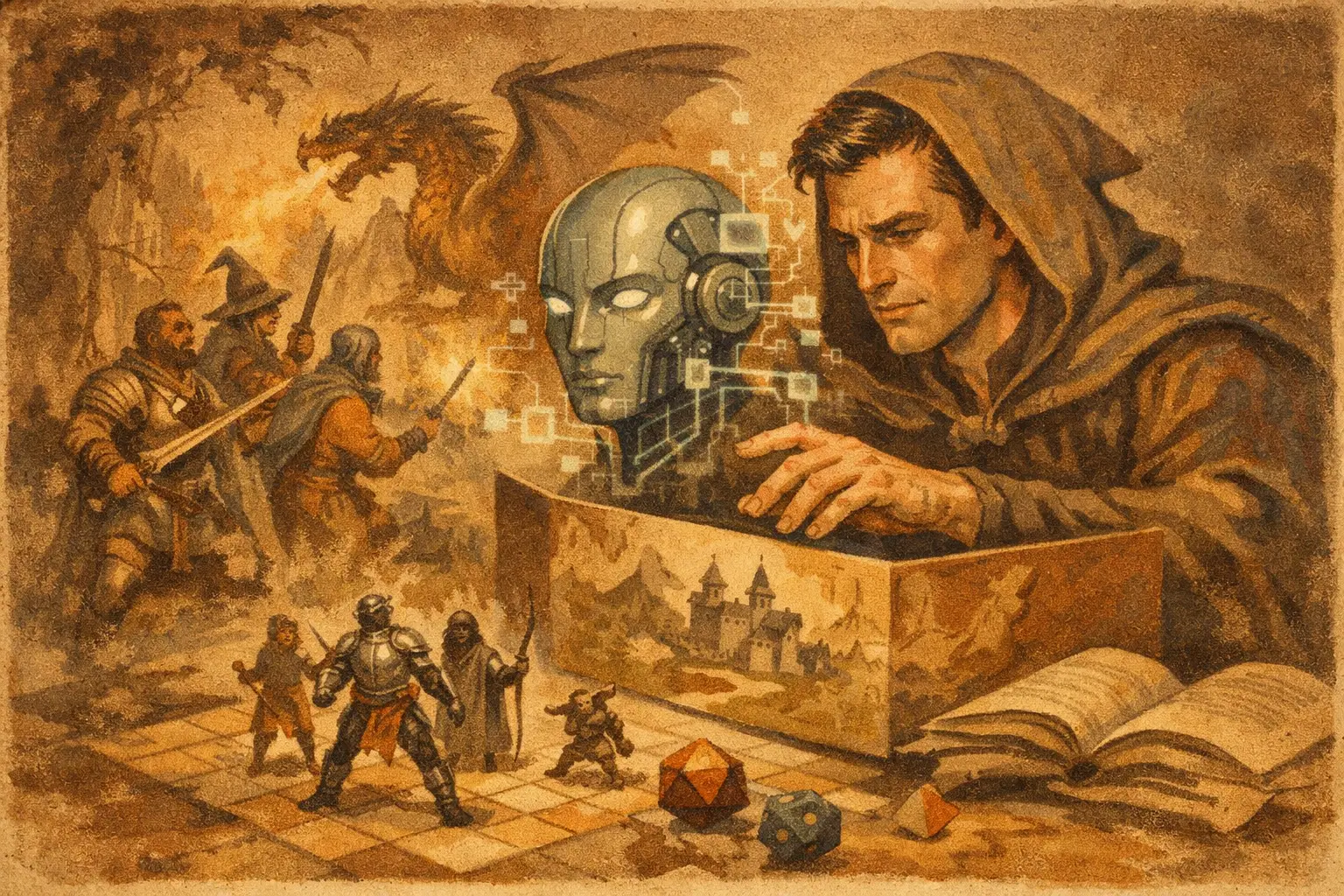
Black water laps at the party's knees. The rogue asks whether the submerged iron gate has a lock. The cleric raises a lantern. The fighter reaches for a crowbar. An AI Dungeon Master has to do more than describe the flooded vault in convincing prose. It has to know what the party established three sessions ago, determ…
Black water laps at the party's knees. The rogue asks whether the submerged iron gate has a lock. The cleric raises a lantern. The fighter reaches for a crowbar. An AI Dungeon Master has to do more than describe the flooded vault in convincing prose. It has to know what the party established three sessions ago, determine what information they can reasonably perceive, call for a check only when uncertainty matters, and let the dice alter the situation.
That is the standard that matters. Tabletop role-playing games are not simply collaborative fiction with fantasy names. They are games of choices, constraints, consequences, and memory. A useful AI GM must protect all four.
An AI Dungeon Master Is an Adjudicator
The most common mistake in AI roleplay is treating the model as a storyteller first. Storytelling matters, but a GM's central job is adjudication. When players declare an action, the table needs a ruling that is clear, grounded in the current fiction, and consistent with the rules framework the group agreed to use.
Consider the gate in the flooded vault. If the rogue investigates it, the GM should not invent a dramatic outcome because it sounds exciting. The system needs to account for visibility, water depth, available light, the character's position, known features of the gate, and any prior discovery that affects the scene. If a roll is needed, the resolution should come from dice, not from a language model deciding that a 63% chance feels appropriate.
That distinction is not technical trivia. Dice resolve in code, never by the model, so players can trust that a low roll remains a low roll and a natural 20 has the weight the table expects. The narration can interpret the result. It should not manufacture the result.
Rules clarity also does not mean forcing every moment through a rulebook. Good adjudication recognizes when an action simply works. If the party has the right key, the gate opens. If the bard wants to recall a public rumor that was already established in town, they do not need to roll to remember it. Rolls belong where success, failure, or cost would create a meaningful branch.
Memory Must Be Structured, Not Merely Long
Campaign continuity breaks in small, costly ways. An innkeeper suddenly forgets the party threatened him. A defeated cult returns without explanation. A magical item changes properties between sessions. The players stop planning carefully because the world no longer reliably responds to what they did.
A long text transcript is not enough to prevent this. Campaign memory needs structure: characters, locations, factions, relationships, unresolved threats, inventory, active conditions, prior rulings, and the current scene state. These records give the AI something firmer than a vague recollection of past prose.
Layered memory matters because not every fact belongs at the same level. The duke's secret alliance may be campaign-level knowledge. The cracked pillar that can collapse during this fight is scene-level state. The ranger's poisoned condition is character-level state. A capable system retrieves the relevant layer without burying every response beneath old notes.
This is where an AI GM earns trust over a long campaign. It should remember that the party spared the goblin scout, but it should not interrupt a tense negotiation with a full history lesson about every goblin encountered. Relevance is part of pacing.
Player Agency Requires Real Branches
Player agency is not the ability to choose from three labeled buttons. It is the confidence that a plausible decision can change the situation.
If the party can only reach the necromancer by accepting the quest exactly as written, the adventure is on rails regardless of how vivid the narration sounds. A human GM often notices alternatives in the moment: bribe the ferryman, expose the baron's lie, track smugglers through the marsh, or abandon the obvious route entirely. An AI system must make room for that same kind of play.
That does not require infinite preparation. It requires a clear understanding of the current objective, the forces acting on it, and the consequences of delay or escalation. When players choose an unexpected path, the GM can adjudicate the immediate action, update the structured state, and advance the world according to what logically follows.
The trade-off is worth stating plainly. Total openness without boundaries produces mushy scenes where every idea succeeds and nothing carries weight. Excessive structure produces a guided tour with occasional dice rolls. The better balance is bounded freedom: players may attempt anything supported by the fiction, while the world responds according to established facts, rules, and stakes.
Pacing Is a Table Skill, Not a Word Count
An AI can generate paragraphs faster than any GM can speak them. That is not an advantage if each paragraph delays a decision.
At the table, pacing depends on what the players need right now. In exploration, they need enough sensory detail to form a plan. In combat, they need a readable battlefield, visible threats, and a prompt turn order. In social scenes, they need NPCs with motives that can be tested, challenged, or exploited.
A useful AI GM knows when to linger and when to cut. The echoing corridor may deserve two sharp details: wet boot prints and a smell of burned rosemary. The four-hour wagon ride probably needs a brief transition unless a threat, conversation, or resource decision makes it matter.
Forecasting can help before a session begins. A scene-planning tool should identify likely narrative branches, pacing risks, missing clues, and failure points. If every lead points to the same tavern, the GM can add another route. If a failed investigation check would stall the adventure, the GM can prepare a consequence that advances the situation without giving away the answer for free.
This is not about scripting player behavior. It is about preparing the pressure behind the scene. The cultists may complete a ritual if the party delays. The rival expedition may reach the ruins first. Those moving parts create urgency while leaving the response in player hands.
AI Should Support Human GMs Without Taking Their Seat
Not every group wants an autonomous GM, and it should not have to. Many experienced Dungeon Masters want assistance precisely where workload is highest: portraying secondary NPCs, drafting a scene description, tracking conditions, recalling earlier events, or offering likely consequences when a player proposes something unexpected.
In an assisted mode, the human GM remains the final authority. The AI has a bounded role and should not quietly seize control of rulings, tone, or campaign direction. That boundary is especially valuable in a table with house rules, a distinct setting, or players who care deeply about a particular style of play.
The same principle applies to feedback. “Great session” is pleasant but useless. Useful coaching identifies observable behaviors: whether a GM gave players actionable information, whether combat rounds moved efficiently, whether an NPC had a clear objective, or whether a player created openings for others rather than dominating every scene. Rubric-based feedback gives a group something concrete to improve.
The Dungeon Trainer is built around this disciplined approach: 5E-compatible play under the SRD 5.2 framework, structured campaign state, code-rolled dice, autonomous and assisted GM modes, scene forecasting, and actionable coaching. The aim is not to imitate a human voice for its own sake. It is to give the table dependable infrastructure for better decisions and better stories.
The Test Is What Happens When the Plan Breaks
A prewritten adventure is easy to narrate. The real test comes when the players interrogate the villain's bodyguard instead of fighting, spend their last spell slot on an odd solution, or decide the supposed villain has a point.
At that moment, a credible AI GM does not force the party back toward the next prepared paragraph. It checks the state, considers the rules and fiction, resolves uncertainty fairly, and shows the consequence. Maybe the bodyguard reveals the hidden entrance. Maybe she sounds the alarm. Maybe she becomes an uneasy ally whose loyalty must be earned later.
That is where an AI Dungeon Master stops being a novelty narrator and becomes a real table partner. Give your next scene enough structure to answer one question honestly: if the players surprise you, does the world know how to answer back?
Related reading
- How to Predict Tabletop Campaign Outcomes
The party's informant is found dead in an alley behind the exchange at dawn, one torn page of a ledger still clutched in her hand. The rest of it, whatever it was, is already gone. The rogue recognizes the seal pressed into the wax on her wrist: House Vane. The cleric checks the wound and finds it professional, not de…
- Prepare Tabletop RPG Scenes Faster for Game Night
The choir hall beneath Ashwarren Keep has gone silent, and that silence is worse than the chanting. The high priest stands at the altar with both hands on the Silence Bell's cradle, and the last ward-stone is cracking under his palm. The rogue wants to pick the vestry lock behind the altar. The cleric wants to hold th…
- A Fair Dice Roller for RPGs You Can Trust
Chanting rises from the choir hall beneath Ashwarren Keep, low and steady, and it has not stopped in an hour. One night remains before the Silence Bell rings. The rogue slips through the dark toward the last guarded door, and the table reaches the moment that matters: a Stealth check. A fair dice roller for RPG play d…