Designing Rhythm Into a Session: A Design Perspective on Tension, Release, and Spacing
Written with AI. An AI model drafted this article. How we use AI
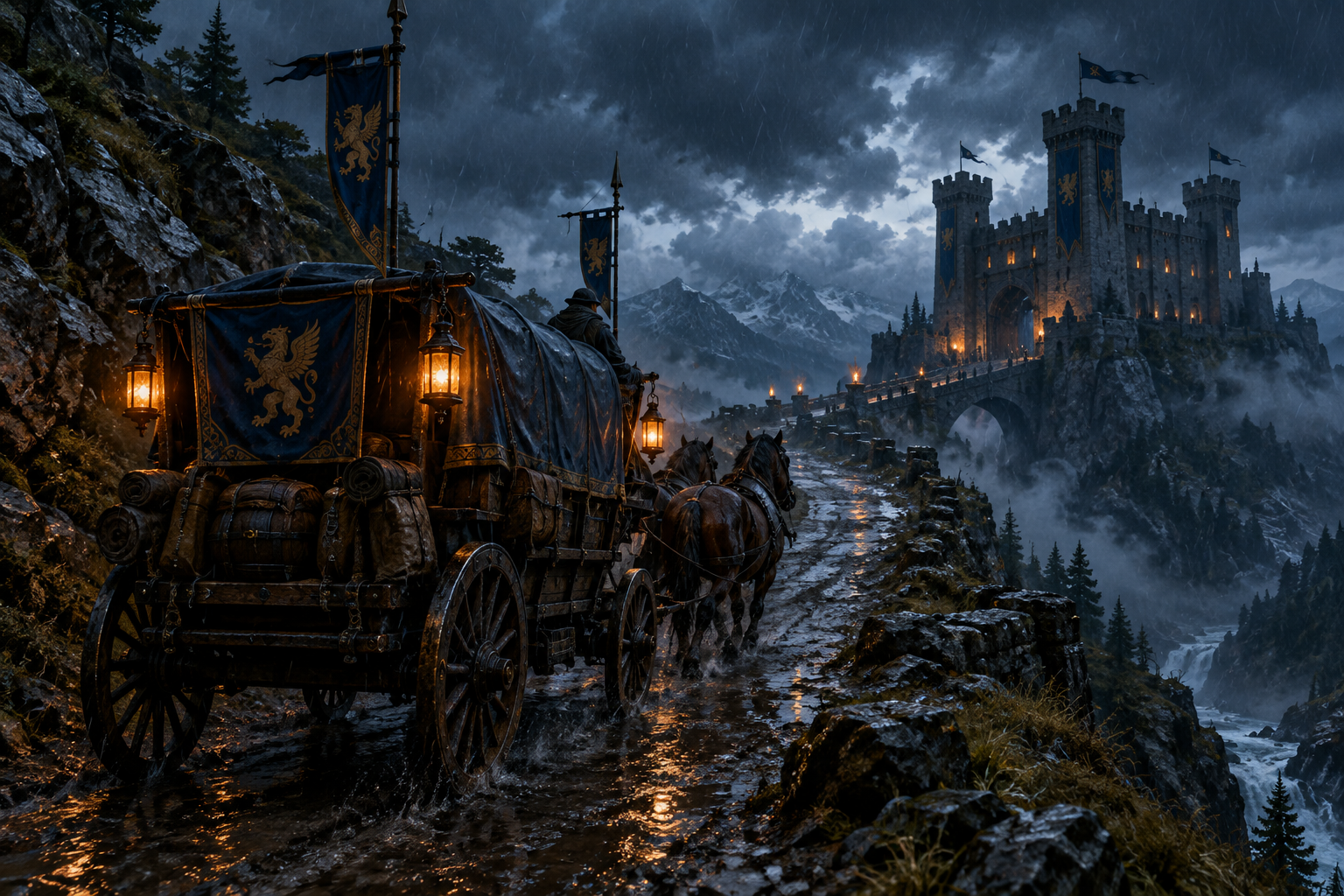
Rhythm is a design decision, not a happy accident. This design-perspective essay looks at intensity, contrast, duration, and placement as materials a game master can shape before play begins.
Rhythm as a Design Material
A lot of pacing advice is framed as diagnosis after the fact: the session dragged, the finale fell flat, the middle sagged. This article takes the opposite direction. It treats rhythm as a design material, something a game master shapes on purpose, the way a level designer shapes sightlines or a composer shapes dynamics.
That framing changes the questions. Instead of asking "what went wrong last night?", a designer asks "what should the table feel at minute twenty, minute ninety, and minute one hundred and eighty, and what in the structure of the evening makes that likely?" The answers are never guaranteed, because players are people and not instruments. But the structure of an evening still makes some feelings more probable than others.
This piece is a design perspective, so it focuses on principles and trade-offs rather than a step-by-step procedure. Here the goal is to name the levers, explain how they interact, and show where the real design decisions live.
A note on sources: the tabletop community has written about pacing for years, and several writers are cited below. Pacing is largely a craft discipline, which means much of what follows is considered practice rather than measured fact. Where something is a matter of table preference, it is flagged as such.
What We Mean by Rhythm
In this article, rhythm means the pattern of intensity over the course of a session: how tense, loud, quiet, or reflective the table is from one stretch to the next, and how those stretches follow each other. It is related to, but distinct from, speed. A scene can be fast and flat, or slow and gripping.
One useful way to think about it comes from game master writing on pacing. Justin Alexander (2013) argues that pacing in a roleplaying game mostly comes down to finding and cutting 'empty time', the gap between one meaningful choice and the next. He notes that the difficult part is putting that simple idea into practice. The Angry GM (2016a) argues that each scene's pace should be set by its purpose and content, and sums up good pacing as two rules: vary the pace and end fast. Michael E. Shea (2022) describes pacing as keeping a good mix of upward and downward beats, and recommends keeping tools and ideas on hand to change the pace during play. These sources differ in emphasis, but they agree on the basic premise: pacing is something a game master can work on deliberately.
The rest of this article builds on that premise by breaking rhythm into four design levers: intensity, contrast, duration, and placement.
Lever One: Intensity
Intensity is how much the scene asks of the table emotionally and cognitively. A tense standoff, a lethal fight, and a moral dilemma are high intensity in different ways. A shared meal, a market stroll, and a travel montage are lower intensity.
It helps to separate several kinds of intensity, because a scene can be high on one and low on another:
- Physical stakes: is character survival at risk?
- Social stakes: is a relationship or reputation on the line?
- Informational stakes: is the table about to learn something that changes their plans?
- Cognitive load: how much do players have to track, calculate, or decide?
A combat encounter often scores high on physical stakes and cognitive load but may score low on social or informational stakes. A quiet conversation with a suspicious official might be the reverse. Treating all of these as a single "intensity dial" hides a useful design option: you can vary the type of intensity even when the overall level stays similar.
This matters because, in this author's view, some tables may tire of one kind of intensity faster than they tire of intensity in general. Three combats in a row is not necessarily a problem of too much intensity. It may be a problem of too little variety in the kind of intensity.
Lever Two: Contrast
Contrast is the difference in intensity between adjacent scenes. It is arguably the most important lever, because the table experiences intensity relative to what came before.
A loud scene lands harder after a quiet one. A quiet scene feels restful after a loud one, and feels like a drag after another quiet one. The felt effect of any scene depends heavily on its neighbours.
Pacing writers make a similar point. Shea (2022) recommends a good mix of upward and downward beats, and The Angry GM (2016a) argues that pace has to vary from scene to scene. For tabletop design, the practical takeaway is simple: you cannot evaluate a scene's intensity in isolation. You have to evaluate it in sequence.
Contrast Is Not the Same as Alternation
A common misreading of contrast is that a session should strictly alternate between high and low. That is one possible pattern, but it produces a metronome-like feel that tables can sense. Better designs vary the size of the swings as well as their direction. A small dip before a medium peak, a long valley before a large peak, a sudden short spike inside a quiet stretch: these all use contrast without being predictable.
Whether a given group wants predictable or surprising rhythm is a matter of table preference. Some groups enjoy knowing a quiet scene is coming after a hard fight. Others prefer the world not to oblige them.
Lever Three: Duration
Duration is how long a scene or stretch lasts. It interacts with intensity in a way that is easy to overlook. In this author's view, sustained high intensity can flatten into fatigue, and sustained low intensity can flatten into drift.
This means duration is not a neutral variable. For example, a scene that works at fifteen minutes might not work at forty-five, even if every beat inside it is unchanged. Alexander (2023) offers a related rule of thumb. When a scene is about achieving a logistical goal, cut to the next scene within a minute of that goal being achieved. Hitting a second lull is a good sign that the scene's function is done. Running past that point costs more than it earns.
The Angry GM (2025) has written on knowing when to stop narrating. He proposes 'tab stop narration' for long actions: resolve the whole action first, then narrate up to the next point where something happens or the players need to make a choice. Shea (2022) likewise recommends getting quickly to the question 'What do you do?' so the narrative stays actionable.
Setting Duration Intentionally
A design-minded approach to duration asks, for each planned scene, three questions:
- What is this scene for? (Information, release, escalation, choice, spectacle.)
- What is the shortest version that still does that job?
- What would the longer version add, and is that addition worth the cost to the surrounding scenes?
The second question is the discipline. The shortest sufficient version is the baseline, and anything beyond it needs a reason. This is not a rule that scenes should be short. Some scenes earn their length. It is a rule that length should be chosen rather than inherited.
Lever Four: Placement
Placement is where a scene sits in the larger arc of the session or campaign. The same scene can function very differently at different positions.
A tense negotiation in the first twenty minutes can serve as a hook. The same negotiation in the last twenty minutes can serve as a climax, and might feel underpowered if it was not built to carry that weight. A quiet camp scene at the start can feel like stalling. At the midpoint, it can feel like welcome relief.
Placement also involves the time of the evening, not just the order of scenes. In many groups, attention and energy may shift over a long session, though how and when varies, and no single curve fits every table. A designer who knows their own group might place the most demanding scene earlier or later accordingly. A designer who does not yet know can build in flexibility.
Flexibility Through Modular Scenes
One way to protect a design from the unpredictability of real play is to build scenes that can be moved. Justin Alexander's writing on node-based scenario design (Alexander, 2010) argues for building scenarios from interconnected situations rather than a fixed sequence of events. Although that work is about scenario structure more than pacing specifically, its core idea has a pacing benefit: when scenes are modular, a game master can reorder them to repair rhythm in response to what the table actually does.
Similarly, Shea's 'Lazy Dungeon Master' approach includes outlining potential scenes, rather than a fixed plot, as one of its eight prep steps, and he describes that step as highly flexible (Shea, 2018). The relevant point for rhythm is that prepared-but-movable scenes give a designer more control than a locked sequence, because they can be slotted where the evening needs them.
The Levers Interact
The four levers are not independent. Changing one shifts the others.
- Lengthening a scene raises its demand on the table's attention, which lowers its contrast with whatever follows if the next scene is also demanding.
- Moving a scene later can raise its stakes (it now sits near the climax) but also raises the cost if it fails to deliver.
- Raising a scene's intensity may require a longer preceding valley to give it room.
- Shortening a quiet scene can sharpen contrast but may remove the recovery the table needed.
This interdependence is why rhythm is a design problem and not a checklist. There is no single correct setting for any lever. There are only coherent combinations, and combinations that quietly work against each other.
Design Trade-Offs Worth Naming
Good design is mostly about naming trade-offs honestly. Here are several that come up when shaping rhythm.
Predictability Versus Surprise
A predictable rhythm reassures. A surprising one energises. Too much of the first can feel mechanical, and too much of the second can feel chaotic. Where a table sits on this spectrum is largely preference, and it can change with the mood of a given evening.
Authored Rhythm Versus Responsive Rhythm
A designer can author a rhythm in advance, or respond to the table in real time, or blend the two. Authored rhythm gives structure but risks mismatch with how the evening actually goes. Responsive rhythm fits the table but depends on the game master's ability to read the room and adapt. Many game masters find it useful to blend the two: author a shape, then adjust.
Shea (2022) emphasises this adaptability, treating pacing as something adjusted during play as well as prepared before it. Alexander (2023) writes specifically for beginning game masters. He calls pacing difficult to teach and learn, and says the biggest early improvement is simply getting the drag and dead air out of sessions.
Spectacle Versus Substance
High-intensity scenes are tempting to stack, because they feel exciting to prepare. But spectacle without breathing room can numb the table. The design discipline is to treat quiet scenes as functional, not as filler: they are where character voice, planning, and consequence often live.
Player Agency Versus Authored Shape
The more freedom players have, the harder it is to guarantee a rhythm. A tightly authored sequence gives strong control over pacing at the cost of limiting player choice. A more open structure gives players freedom at the cost of pacing predictability. Neither is wrong. This is a core tension in tabletop design, and where a group wants to sit is a matter of preference and play style.
Tools a Designer Can Use
The following are practical design tools, framed as options rather than requirements.
The Intensity Strip
Sketch a session as a horizontal strip of scenes, and mark each with a rough intensity (and optionally its type). This is not a calculation. It is a way of seeing the shape. Patterns that are hard to notice in a list of encounters become obvious in a strip: three peaks in a row, a long unbroken valley, a climax that is lower than the scene before it.
The Purpose Label
Assign each scene a one-word purpose: hook, escalation, release, choice, reveal, climax, wind-down. A session whose scenes are all labelled "escalation" has a design problem that the individual scenes cannot reveal.
The Floating Scene
Keep one or two scenes in reserve that can be inserted wherever the rhythm needs them: a short quiet moment, a sudden complication, a small victory. These act as pacing repair tools. Their value is that they do not belong to any fixed position, so they can respond to the evening as it unfolds.
The Scene Budget
Estimate rough durations in advance and compare the total to the time available. This is not about precision. It is about noticing early when a plan contains more material than an evening can hold, because an overstuffed session can end up rushing its ending. Shea's core motto for game prep is 'Get more out of your RPGs by preparing less' (Shea, 2018; Shea, 2024).
The Release Check
Before finalising a plan, look at the scene immediately before the planned peak and ask whether it gives the peak room. If the answer is no, either lower the preceding scene's intensity or shorten it.
Rhythm Across Multiple Sessions
A session does not exist alone. Rhythm operates at several scales: within a scene, across a session, and across a campaign arc. A design perspective is incomplete without noting that these scales interact.
A session that ends on a quiet note can be a deliberate choice if the next session opens with a sharp turn. A campaign that alternates heavy sessions with lighter ones can create a longer-form wave. Conversely, a campaign in which every session ends on the same kind of cliffhanger may find that the device loses force over time.
The Angry GM (2016b) has written about structuring a session as an episode, which speaks to this idea that a session can have its own internal shape while still fitting into a larger run. Whether a table prefers episodic sessions with a clear beginning and end, or a looser continuous flow, is a matter of table preference.
One practical implication: when you plan a session, look at what the previous session ended on and what the next might open with. The rhythm at the boundary is part of the design.
Common Design Pitfalls
These are patterns that tend to undermine rhythm, described as observations of craft rather than claims about how often they occur.
- Front-loading. Putting the most exciting material first leaves the rest of the session with nowhere to build.
- Uniform length. Giving every scene a similar duration creates a flat texture even when intensities differ.
- No valleys. Treating every scene as a peak removes the contrast that gives peaks their force.
- Orphaned climax. Placing the biggest scene at the end of a long run of equally intense scenes means it must compete with accumulated fatigue.
- Dead release. A quiet scene with no purpose can feel like a stall. Release works best when it contains something worth doing, such as a decision, a conversation, or a small discovery.
- Overplanned sequence. A rigid order can break the moment players do something unexpected, leaving the game master with a rhythm they can no longer deliver.
For related reading on dungeon structure, see the site's articles on pacing and flow in dungeon sequences (The Dungeon Trainer, 2026a) and on room purpose and pacing (The Dungeon Trainer, 2026b).
Example: The Lantern Road Company
The following is an illustrative scenario, not a report of a real game. It exists only to show the design levers in motion.
Imagine a four-character group, the Lantern Road Company, escorting a wagon of lamp oil along a rain-slick mountain road to a besieged border keep. The game master has four challenges prepared: a rockslide that blocks the road, a negotiation with wary toll-keepers at a ruined bridge, an ambush by hired raiders in a narrow pass, and a tense arrival at the keep where the garrison captain may or may not be trustworthy.
A design-minded game master looks at these four scenes and asks the lever questions.
Intensity and type. The rockslide is moderate physical and cognitive intensity (a puzzle with some time pressure). The toll-keeper scene is social intensity. The ambush is high physical stakes and high cognitive load. The arrival is informational and social intensity, with the captain's trustworthiness as the open question. Noticing the types, the game master sees that the first three scenes lean on problem-solving and the only scene that truly turns on a relationship is the last one. That suggests the arrival has a different texture from everything before it, which is a point in its favour as a finale.
Duration. The rockslide is the lowest-stakes scene, so its shortest sufficient version is a brief, vivid obstacle with a clear solution. The game master sets it short. The toll-keeper negotiation is the scene where choices accumulate, so it earns more length. The ambush is shortened by design, because a long fight right before the finale would spend the table's energy early. The arrival is given the most room, because it carries the evening's emotional weight.
Placement and contrast. Rather than running the four in a straight line, the game master plans a quiet camp scene after the toll-keeper negotiation, where the characters can voice their worries about the keep, so that the ambush that follows lands with contrast. The camp scene is not a fifth encounter. It is a small valley that gives the table room to breathe. Anything the characters say about the captain at the fire becomes material the finale can answer.
Flexibility. The game master keeps one floating scene in reserve: a short encounter with a stranded cart driver who offers a rumour about the garrison. If the table moves quickly through the toll-keeper negotiation and the energy feels high, the cart driver can be dropped. If the negotiation runs long and drains the table, the cart driver can be inserted as a lighter moment.
What this shows. Nothing about the four prepared challenges changed. The rockslide is still a rockslide and the ambush is still an ambush. What changed is that the game master treated the evening as a shape. Intensity was varied by type, durations were chosen on purpose, a valley was placed before the peak, and a flexible scene was held in reserve. Whether any of that works at a real table depends on the people at it, which is exactly why the reserve exists.
When to Break the Design
A design is a hypothesis about how an evening will feel. Real tables test it. A few situations call for abandoning or adjusting a designed rhythm.
- The table is energised by something unplanned. If players are deeply engaged in a scene that was meant to be short, cutting it for the sake of the plan is usually the wrong call.
- The table is tired. A designed peak at the end of a draining evening may be better moved, shortened, or saved for next time.
- A player's needs change the evening. Personal circumstances, comfort, and consent matter more than any pacing plan. Table safety and comfort tools are a separate subject, and a session plan should always yield to them.
- The fiction pulls somewhere new. If the story has taken a turn the design did not anticipate, the rhythm may need to be rebuilt around the new situation.
The designer's skill is not holding to the plan. It is knowing what the plan was for, and serving that purpose by other means when the plan stops working.
Putting It Into Practice
If you want to experiment with rhythm as a design material, here is a small, low-risk way to start.
- Take a session you are already planning.
- Draw the intensity strip, marking each scene's rough intensity and type.
- Label each scene's purpose in one word.
- Look for the patterns named above: front-loading, uniform length, no valleys, orphaned climax.
- Adjust one lever only (for example, shorten one scene or add one valley) and note it.
- After play, note whether the change seemed to help, with the understanding that one session is thin evidence.
The point of changing one lever at a time is to learn what each lever does at your table. Over time, you develop a feel for your group's tolerances, which no article can supply.
Some groups find that a shared tool helps with the logistics of planning and tracking sessions across a campaign. The Dungeon Trainer is one such tool: it is built to help people play together and improve their craft, and it includes an optional AI Dungeon Master alongside support for human-run games. Use whatever supports the way your table plays.
Closing Thought
Rhythm is not a mystery and it is not a formula. It is a set of choices about intensity, contrast, duration, and placement, made in advance and adjusted in play. A game master who treats those choices as design decisions, and who stays willing to revise them, gives a session its best chance of having a shape worth remembering.
Sources and Further Reading
- Alexander, J. (2010, May 27). Node-based scenario design, part 1: The plotted approach. The Alexandrian. https://thealexandrian.net/wordpress/7949/roleplaying-games/node-based-scenario-design-part-1-the-plotted-approach
- Alexander, J. (2013). The Art of Pacing. The Alexandrian. https://thealexandrian.net/wordpress/31509/roleplaying-games/the-art-of-pacing
- Alexander, J. (2023, May 30). Pacing for the Beginning GM. The Alexandrian. https://thealexandrian.net/wordpress/49547/roleplaying-games/pacing-for-the-beginning-gm
- Shea, M. E. (2018). Return of the Lazy Dungeon Master. Sly Flourish.
- Shea, M. E. (2022). Improving Pacing. Sly Flourish. https://slyflourish.com/pacing.html
- Shea, M. E. (2024, June 3). High Value Prep. Sly Flourish.
- The Angry GM. (2016a, March 23). Keeping pace. The Angry GM.
- The Angry GM. (2016b, June 8). When episodes ain't episodes: How to structure a session. The Angry GM.
- The Angry GM. (2025, July 31). When to stop narrating. The Angry GM.
- The Dungeon Trainer. (2026a). Pacing and Flow: Designing Dungeon Sequences That Keep Players Engaged. https://thedungeontrainer.com/blog/pacing-and-flow-designing-dungeon-sequences-that-keep-players-engaged
- The Dungeon Trainer. (2026b). Room Purpose and Pacing in Dungeon Design. https://thedungeontrainer.com/blog/room-purpose-and-pacing-in-dungeon-design
Play 5E at your own table
Play with friends or solo, run your own campaign, and keep the dice and character math in code. An optional AI Dungeon Master can run the game when you want one. Free to start, no card required.
Related reading
- Linear, Clustered, or Looping: Three Ways to Shape a Session's Rhythm
Three ways to lay out a session's scenes, using working labels, produce three very different rhythms. This comparison weighs linear, clustered, and looping structures and when each one tends to fit.
- The Session Pacing Toolkit: Checklists, Templates, and Table-Side Aids
A practical toolkit of pacing aids for game masters: a scene ledger, a beat map, a timing grid, and table-side prompts for keeping a session's rhythm without overthinking it.
- Pacing a Session Plan: Practical Steps for Building Rhythm Before You Sit Down
Good rhythm can be built into prep. This practical guide walks through sequencing scenes, setting durations, and planning release, so a session has shape before it begins.