Linear, Clustered, or Looping: Three Ways to Shape a Session's Rhythm
Written with AI. An AI model drafted this article. How we use AI
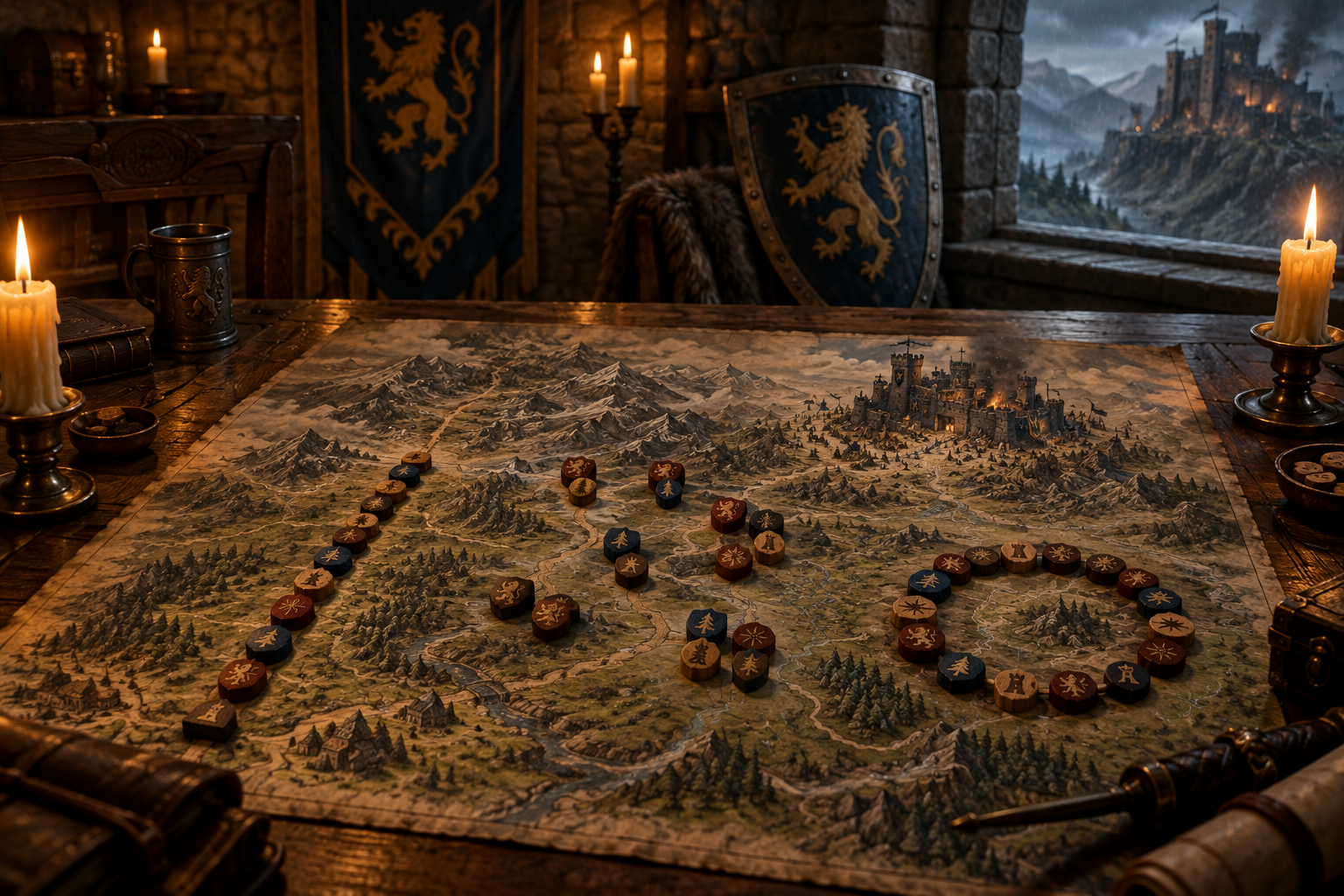
Three ways to lay out a session's scenes, using working labels, produce three very different rhythms. This comparison weighs linear, clustered, and looping structures and when each one tends to fit.
Many game masters can probably feel the difference between a session that flows and one that stalls, even without a vocabulary for the layout underneath. Before anyone rolls a die, a session already has a shape. Scenes are arranged in some order, with some connections between them, and that arrangement quietly decides how tension builds, where the table gets to breathe, and how much freedom the players have.
This article compares three shapes a session plan can take: linear, clustered, and looping. It is a comparison, not a verdict. Each structure has real strengths, each has predictable weak points, and which one fits is partly a matter of your story, your players, and your own habits. Where the sources below make a specific claim, it is attributed. Where the answer is table preference, that is said plainly.
Why session shape matters
Pacing is often discussed as a matter of speed. This article argues that arrangement matters just as much. The Alexandrian's discussion of pacing frames it as something a game master can think about deliberately rather than leave to chance (Alexander, 2013). Mike Shea's notes on improving pacing similarly treat it as a craft concern that can be addressed through preparation and table awareness (Shea, 2022).
A useful way to think about it: scenes are the bricks, and structure is the floor plan. Two game masters can prepare identical scenes and end up with very different evenings because the floor plan differs. Who decides what happens next? Can scenes be skipped? Can they be revisited? Does the order change when the players surprise you? These questions are structural, and each of the three shapes answers them differently.
Defining the three shapes
These three labels are working definitions for this article, not established terminology from a single rulebook. Other writers may use different words for similar ideas.
Linear
A linear session is a chain. Scene A leads to scene B leads to scene C. The order is fixed in advance, and each scene assumes the previous one happened. The game master knows roughly what the evening will contain and in what sequence.
Clustered
A clustered session is a set of scenes grouped by theme, location, or purpose, with the order left open. The players move between the clusters by their own choices. Within a cluster, scenes may be loosely sequenced, but the clusters themselves are not chained.
This resembles what The Alexandrian calls node-based scenario design: scenes (nodes) are linked by clues pointing to other nodes, so players can move among them in more than one order instead of following a single plotted sequence (Alexander, 2010a). The comparison is a loose one. Node-based design is a broader approach to scenario construction, and this article uses the clustered idea only as one session-level layout.
Looping
A looping session returns to a place, person, or problem more than once, with something changed each time. The same tavern, rival, or locked door appears early, again in the middle, and again near the end, and what the players know or can do differs at each visit. The structure is a spiral more than a line.
Looping is perhaps the least standardized of the three labels, and some tables may arrive at it by accident when a recurring character or location keeps mattering.
Linear structure
What it does well
Control over rhythm. Because the order is known, a game master can deliberately place a quiet scene after a loud one, a short scene before a long one, and a finale where it will have the most room. In this article's view, deliberate rhythm and sequencing are easiest to apply when the sequence is yours to set.
Low overhead during play. There is little to decide at the table. The next scene is already chosen, so attention can go to voices, description, and the players.
Clean escalation. A chain can build tension steadily, because each scene can assume the weight of the previous one.
Good for time-boxed play. Some game masters find that a one-shot or convention-style slot benefits from a structure that guarantees the ending will be reached.
Where it struggles
Fragility. If one link breaks, the chain breaks. When players skip a scene, solve a problem unexpectedly, or head the wrong way, the game master must either patch the gap or steer players back, and steering can feel heavy-handed (Alexander, 2010c).
Reduced agency. The more fixed the order, the less the players' choices decide what happens next. Alexander's essay on not preparing plots argues against prepping a predetermined sequence of events and recommends prepping situations instead. The concern behind it is relevant here: a plotted sequence depends on players behaving the way the plan expects (Alexander, 2009).
Uneven attention. If a scene in the chain is weak, there is nowhere else for the table to go.
When it tends to fit
Linear shapes tend to suit short sessions, tightly themed one-shots, heist or escort structures where the route is the point, and tables that enjoy a guided, cinematic feel. They also suit newer game masters who want fewer moving parts. Whether that is the right trade is a table preference.
Clustered structure
What it does well
Resilience. Because the clusters are not chained, a missed or skipped scene does not break the evening. Players can approach the material in a different order than planned and the session still holds together.
Player-driven rhythm. The table chooses what to do next, which often produces natural variety: a group that has just finished something tense may choose something calmer.
Reusable prep. Unused clusters can often be carried to the next session, so less preparation may go to waste.
Natural fit for exploration. Dungeons, regions, and settlements often lend themselves to clustered layouts. The Alexandrian's dungeon-design essays discuss how interconnected structures give players meaningful routes and choices (Alexander, 2010b).
Where it struggles
Rhythm is harder to control. If the table picks three loud clusters in a row, nothing in the structure prevents fatigue. The game master has fewer levers for placing release, and may have to introduce it from inside a cluster.
Decision overhead for players. A table that likes being told where to go may find open choice tiring. Some groups stall when asked "what do you want to do?" too often.
Weaker built-in climax. With no fixed order, a dramatic peak cannot be guaranteed. The finale may arrive early, late, or not at all in a given session.
Possibly heavier prep. Some clustered designs mean more material prepared.
When it tends to fit
Clustered shapes tend to suit sandbox-leaning tables, ongoing campaigns where unused material can carry forward, investigation scenarios, and groups that value choosing their own path. Mystery and investigation design leans on this idea in a related way: Alexander's three clue rule is about ensuring that players have more than one route to a conclusion, which is a close cousin of clustered thinking (Alexander, 2008).
Looping structure
What it does well
Meaning through return. Revisiting a place or person lets the players see what their choices changed. A returning toll-keeper who remembers how the company behaved is more memorable than a new one.
Economy. A few well-developed locations and characters can carry a whole session, which reduces the amount of new material to invent and the amount of new information for players to absorb.
Built-in contrast. The same setting can be calm on the first visit and tense on the second. Contrast is arguably one of the main ingredients of rhythm; Shea, drawing on Robin Laws, recommends mixing upward and downward beats to keep players interested (Shea, 2022). A loop provides contrast without adding new scenery.
Emotional payoff. Echoes and callbacks can be a satisfying way to give a story weight, and a loop makes them easy to build deliberately.
Where it struggles
Risk of repetition. If nothing changes between visits, the loop feels like a stall. The structure only works if each return is different in a way players can notice.
Depends on player attention. A loop assumes the table cares about the recurring element. If the players ignore the rival or skip the town, the structure has no spine.
Harder to prepare in advance. What changes between visits often depends on what the players did, so some of the work happens during or after play rather than before.
Pacing within a single session is limited. A full loop may take several sessions to complete, so within one evening it may read more like a motif than a shape.
When it tends to fit
Looping shapes tend to suit campaigns with a home base, recurring antagonists, slow-burn mysteries, and tables that enjoy continuity and callbacks. It combines well with either of the other two shapes, which is part of why it deserves a place in the comparison.
Side-by-side comparison
The table below summarizes tendencies, not rules. Individual tables will differ.
| Question | Linear | Clustered | Looping |
|---|---|---|---|
| Who decides scene order? | Game master | Players, within limits | Shared; driven by returns |
| Rhythm control | High | Moderate to low | Moderate |
| Resilience to surprise | Low | High | Moderate |
| Player agency over sequence | Lower | Higher | Moderate |
| Prep reuse | Lower | Higher | Moderate |
| Guaranteed climax | Easiest | Hardest | Depends on the loop |
| Table-side decisions for GM | Fewer | Possibly more; disputed for dungeons (Alexander, 2010b) | Moderate |
| Typical natural fit | One-shots, guided scenarios | Sandbox, exploration | Campaign play, recurring cast |
A few observations follow from the table.
First, no column wins every row. The structure that gives the most control gives the least resilience, and the structure that gives the most agency gives the least guaranteed shape. This is a trade, not a ranking.
Second, the three shapes are not mutually exclusive. A session can be linear inside a cluster, or loop back to a linear chain. Treating the labels as ingredients rather than categories is often more useful than choosing one.
Third, the cost of a structure falls on different people. Linear shapes cost the players some agency. Clustered shapes cost the game master some control. Looping shapes cost both some predictability. Which cost a table is willing to pay is a conversation worth having.
Choosing a shape: questions to ask
Rather than a flowchart, here are questions that tend to clarify the choice.
How long is the slot? A single fixed evening leans linear, because the ending has to be reachable. An open-ended campaign leans clustered or looping, because unused material can carry over.
What does this table enjoy? Some groups love a guided story. Others want to pick their own route. Many want both at different moments. The honest answer is often learned by watching how a group behaves when given a choice, and by asking them.
What is the scenario about? A journey with a destination suggests a line. A place to explore suggests clusters. A relationship or rivalry suggests a loop.
How much can you comfortably improvise? Some game masters find that clustered structures ask more of them in the moment, though Alexander argues that a non-linear dungeon is not appreciably harder to run than a linear one (Alexander, 2010b). If improvisation is a strength, that cost is low. If it is not, a lighter structure may serve better.
What went wrong last time? If the last session sagged, the cause may be structural. Revisiting how the scenes were arranged is often more productive than adding more content.
Hybrids worth knowing
Pure forms may be less common than blends. A few common blends:
Linear spine, clustered middle. A fixed opening and a fixed finale with an open middle. This keeps a guaranteed shape while giving players a stretch of real choice. It is one possible compromise between control and choice.
Clustered with a looping anchor. A home base or recurring contact that players return to between forays. The anchor supplies continuity and a natural place for release.
Looping with a linear escalation. The same location visited repeatedly, with each visit raising the stakes in sequence. This gives callbacks and escalation together.
Parallel lines. Two linear threads that the players can alternate between. This offers some choice while keeping each thread controlled.
Common mistakes when picking a shape
Choosing by habit. It is easy to default to whatever structure you first learned. That is not wrong, but it is worth noticing when a session's trouble stems from a shape that does not suit the material.
Mistaking more choice for better play. Open structures can feel liberating to design and exhausting to play if the table wants direction. Choice is a tool, not a virtue in itself.
Mistaking control for quality. A tightly controlled line can look polished on paper and feel brittle at the table if the players are not carried along.
Forgetting the release. In any shape, a stretch of calm is a design decision. Clustered tables in particular may need the game master to place release deliberately, since the structure will not do it automatically.
Over-relying on one shape for a whole campaign. Different sessions and different arcs can reasonably use different shapes. Variety in structure is itself a form of rhythm.
Example: The Lantern Road Company
The following is an illustrative scenario, not a report of a real game. It shows how the same material behaves under three different shapes.
Imagine the Lantern Road Company, four characters escorting a wagon of lamp oil along a rain-slick mountain road to a besieged border keep. The game master has four pieces of material: a rockslide that blocks the road, a negotiation with wary toll-keepers at a ruined bridge, an ambush by hired raiders in a narrow pass, and a tense arrival at the keep where the garrison captain may or may not be trustworthy.
As a linear session. The game master fixes the order: rockslide, bridge, pass, keep. The chain suits a journey, and it lets the game master place a short camp scene between the bridge and the pass so the ambush has contrast. The risk is clear. If the company talks its way past the toll-keepers and then decides to circle around the pass, the chain frays. The game master must either improvise a replacement or nudge the company back onto the road. The upside is that the arrival at the keep is guaranteed to land last, with the whole evening's tension behind it.
As a clustered session. The game master instead treats the road as a set of linked places. The rockslide and the bridge are both obstacles, and the pass and the keep are both dangers. The company, perhaps scouting from the rockslide, can choose whether to approach the bridge first or look for a hidden trail toward the pass. The order is theirs. Resilience improves: whichever route they pick, there is material waiting. The cost is rhythm control. If they choose the pass before the bridge, the ambush may arrive without any lull, so the game master must introduce release from inside the scene, perhaps by having a wounded drover slow the company down or by letting the weather close in.
As a looping session. Here the game master picks one element to return to. The toll-keepers at the ruined bridge are met early, and the company crosses with a grudging agreement. After the ambush in the pass, the road forces a second crossing, and the toll-keepers react to what the company did. Perhaps they heard about the raiders, or perhaps the company's earlier bargain now matters. The keep's captain is introduced through a message the toll-keepers carry. The bridge is the same, but its meaning has changed, which supplies contrast without new scenery.
Notice that none of these is the single right answer. The linear version gives the cleanest climax. The clustered version gives the most freedom. The looping version gives the most resonance. A table that loves guided adventure might prefer the first, a table that loves planning might prefer the second, and a table that loves consequences might prefer the third. A hybrid, such as a linear road with a looping bridge, would also be reasonable.
A short note on tools
Structure is easier to manage when it can be seen. Some game masters sketch a quick map of scenes and connections, and some use shared notes so the table can see the roads between places. Nothing in the comparison above depends on any particular tool.
Putting it into practice
If you want to experiment with these shapes, a low-risk way to start:
- List the scenes or situations you have prepared for the next session.
- Draw the connections between them. Is it a line, a web, or a circle?
- Mark where release is supposed to happen. If you cannot find it, the structure may need adjusting.
- Ask what happens if the players ignore your intended order. If the answer is "the session breaks," consider whether a more resilient shape would help.
- After play, note which shape the session actually took, which may differ from the plan, and what that suggests for next time.
There is no requirement to commit to a single shape for life. Treat the structure as a decision you can revisit each week.
Summary
Linear, clustered, and looping structures each answer the question of how a session's scenes relate to one another, and each produces a different rhythm. Linear shapes favor control and a guaranteed ending. Clustered shapes favor resilience and agency. Looping shapes favor continuity and meaning through return. Most real sessions blend them.
The best choice depends on the length of the slot, the preferences of the table, the nature of the material, and the comfort of the game master. Where those factors point in different directions, that is a table-preference call, and it is worth making on purpose rather than by default.
Sources and Further Reading
- Alexander, J. (2008, May 8). The Three Clue Rule. The Alexandrian. https://thealexandrian.net/wordpress/1118/roleplaying-games/three-clue-rule
- Alexander, J. (2009, March 23). Don't Prep Plots. The Alexandrian. https://thealexandrian.net/wordpress/4147/roleplaying-games/dont-prep-plots
- Alexander, J. (2010a). Node-Based Scenario Design. The Alexandrian.
- Alexander, J. (2010b). Xandering the Dungeon. The Alexandrian. https://thealexandrian.net/wordpress/13085/roleplaying-games/xandering-the-dungeon
- Alexander, J. (2010c, May 27). Node-based scenario design, part 1: The plotted approach. The Alexandrian. https://thealexandrian.net/wordpress/7949/roleplaying-games/node-based-scenario-design-part-1-the-plotted-approach
- Alexander, J. (2013). The Art of Pacing. The Alexandrian. https://thealexandrian.net/wordpress/31509/roleplaying-games/the-art-of-pacing
- Shea, M. E. (2022). Improving Pacing. Sly Flourish. https://slyflourish.com/pacing.html
Play 5E at your own table
Play with friends or solo, run your own campaign, and keep the dice and character math in code. An optional AI Dungeon Master can run the game when you want one. Free to start, no card required.
Related reading
- The Session Pacing Toolkit: Checklists, Templates, and Table-Side Aids
A practical toolkit of pacing aids for game masters: a scene ledger, a beat map, a timing grid, and table-side prompts for keeping a session's rhythm without overthinking it.
- Designing Rhythm Into a Session: A Design Perspective on Tension, Release, and Spacing
Rhythm is a design decision, not a happy accident. This design-perspective essay looks at intensity, contrast, duration, and placement as materials a game master can shape before play begins.
- Pacing a Session Plan: Practical Steps for Building Rhythm Before You Sit Down
Good rhythm can be built into prep. This practical guide walks through sequencing scenes, setting durations, and planning release, so a session has shape before it begins.