Why Sandbox Campaigns Fail: Five Common Mistakes and How to Avoid Them
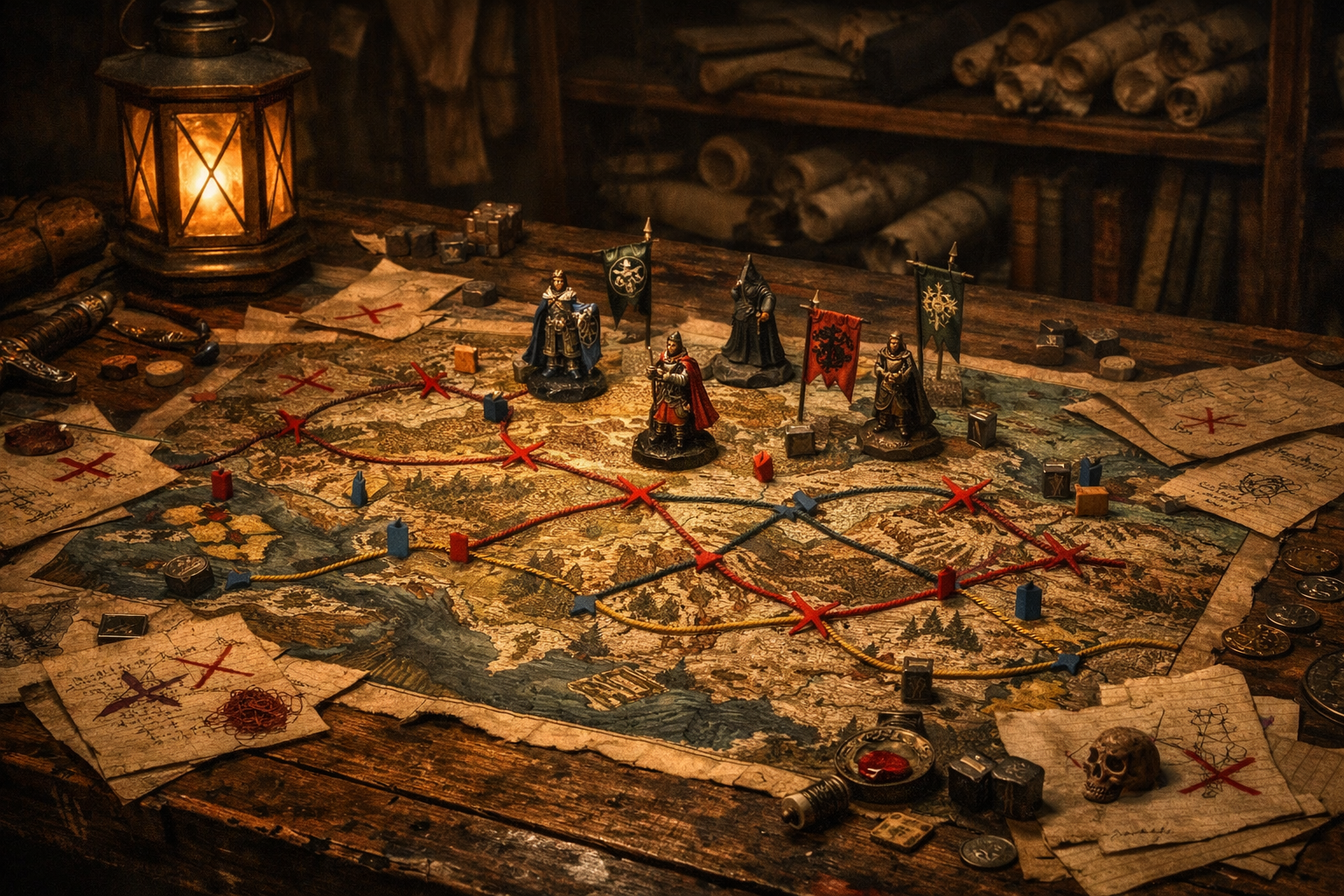
Sandbox campaigns promise player freedom but often collapse into confusion or drift. Learn the five structural mistakes that derail open-world play and practical techniques to maintain momentum, coherence, and engagement without sacrificing player agency.
Sandbox campaigns offer the promise of meaningful player freedom: a responsive world where parties chart their own course, pursue goals they choose, and shape outcomes through their decisions. When they work, sandbox play can produce memorable tabletop experiences that no one at the table could have fully predicted in advance. When they struggle, they can collapse into aimless wandering, frustrated players, or Game Masters who feel they have built elaborate worlds no one engages with.
The gap between those experiences is not entirely random. Sandbox campaigns can run into recurring structural problems that Game Masters can identify and address. This article examines five common mistakes that can derail open-ended play and provides practical techniques for maintaining momentum, coherence, and engagement without sacrificing the player agency that defines sandbox campaigns.
The Core Tension in Sandbox Design
Sandbox play creates a design tension. Game Masters must prepare enough material to support player freedom while avoiding excessive effort on content the players may never encounter. Players need enough freedom to generate their own goals while also receiving enough information and context to make meaningful choices.
This tension is manageable, but it often benefits from different preparation and facilitation techniques than a tightly plotted campaign. Problems frequently arise when assumptions designed for a predetermined sequence of events are applied to a campaign in which players are expected to determine their own direction.
For this article, a functional sandbox is one in which players can establish or choose meaningful goals, their decisions create consequences, and the setting responds to what they do and sometimes to what they leave unresolved.
That does not mean every faction must be simulated every day or every ignored adventure must become a catastrophe. The goal is not exhaustive world simulation. The goal is enough continuity and responsiveness that player decisions feel consequential.
Mistake One: Preparing Plots Instead of Situations
One common sandbox failure occurs when a Game Master prepares a predetermined sequence of story events while presenting the campaign as player-directed.
In a tightly plotted campaign, the Game Master might design a sequence of events: the villain executes a plan, complications arise at particular moments, and the story moves through planned developments toward a resolution. This structure can work well when the group has agreed to that style of campaign.
Problems arise when the players have been promised strategic freedom but the planned sequence requires them to make particular choices.
Justin Alexander's well-known scenario-design advice describes this distinction as preparing situations rather than plots. A plot specifies a sequence of events. A situation establishes circumstances, participants, goals, locations, and resources, then allows subsequent events to depend on what the player characters actually do (Alexander, 2009).
Sandbox campaigns are especially compatible with situation-based preparation. Instead of determining what will happen, establish what is happening: active forces pursuing goals, resources distributed throughout the environment, and relationships between factions that create pressure and opportunity.
The difference is structural. A plot may depend on player characters arriving at specific scenes or producing particular outcomes. A situation can continue to exist when players approach it from an unexpected direction, ignore it, negotiate with participants, or disrupt it entirely.
When a campaign promises sandbox agency but repeatedly forces events back onto a predetermined sequence, players may begin to recognize that their strategic decisions have less influence than expected. That mismatch between stated freedom and actual campaign structure can damage player investment.
How to Prepare Situations Instead
Situation-based preparation begins by identifying active forces in the setting and establishing their goals, capabilities, resources, and constraints.
A bandit company, for example, does not need a predetermined encounter sequence. It needs a reason for operating, leadership, resources, territory, objectives, and likely actions if no one interferes.
For each major situation, consider defining:
- The central conflict or opportunity
- Factions or individuals involved and their goals
- Important resources and locations
- What participants are currently attempting
- What is likely to happen without player intervention
- Consequences that could affect other parts of the setting
This framework supports improvisation because the Game Master understands the underlying situation well enough to extrapolate from unexpected player actions.
A timeline can be useful, but it is not mandatory for every situation. Use one when timing matters.
For example, if bandits are raiding farmsteads and the players pursue something else, the situation might progress. Additional farms could be attacked, refugees might arrive in town, merchants could change their routes, or a local authority might attempt its own response.
The important principle is not that every situation must advance according to a rigid calendar. It is that significant unresolved situations can change when sufficient fictional time passes.
This creates a responsive world in which the choice to pursue one problem instead of another can matter.
Mistake Two: Failing to Telegraph Information
Meaningful choice requires usable information.
When players know almost nothing about available situations, threats, opportunities, or likely consequences, their choices become closer to guessing than decision-making. Too little information can also cause players to become passive because they are unsure what they can meaningfully pursue.
Game Masters can underestimate how much information players need. The GM sees the entire campaign environment. Players experience only what reaches their characters through description, investigation, NPCs, and consequences.
In a tightly directed adventure, the structure itself can guide attention toward relevant elements. A sandbox usually needs more deliberate ways for information to circulate because the players are expected to decide what deserves their attention.
Establishing Information Networks
Useful sandbox information can arrive through several channels.
Rumors and news: Taverns, markets, travelers, town criers, guild halls, religious institutions, merchants, and other social spaces can expose characters to developments elsewhere in the setting. Individual rumors can be incomplete, biased, outdated, or false, but players should receive enough reliable information to identify possible courses of action.
Patron relationships: NPCs with their own agendas can approach the party with proposals, warnings, intelligence, or requests. A patron does not automatically turn a sandbox into a linear campaign. Players can still evaluate the offer, negotiate, refuse it, investigate independently, or pursue another objective.
Physical evidence: The environment communicates information. Tracks, abandoned camps, damaged roads, burned buildings, unusual patrols, refugees, price changes, and altered trade routes can reveal developments without an NPC explicitly explaining them.
Consequences of inaction: When an unresolved situation changes, let the players discover some of the consequences. Perhaps the bandits they ignored now control an important bridge, or a political dispute has shifted because another faction acted first.
These developments provide information as well as consequences.
Information can also arrive in layers. Characters hear a rumor, investigate it, compare sources, and uncover complications. This gives players opportunities to reduce uncertainty before committing significant resources.
The objective is not perfect information. Uncertainty can be valuable. The objective is enough information to make choices intentional rather than arbitrary.
Mistake Three: No Starting Momentum
A sandbox does not need to begin with absolute openness.
Starting with the party in a town square and asking, "What do you want to do?" can work when the players already understand the setting and have strong character goals. For a newly formed party in an unfamiliar campaign, however, that opening can produce paralysis instead of freedom.
Players may not yet know enough about the world to establish meaningful priorities. They do not understand the factions, dangers, opportunities, relationships, or locations that will eventually make self-directed play possible.
Providing initial momentum does not undermine sandbox structure. The distinction is between giving players something to react to and predetermining what they must do afterward.
Creating Initial Situations
Effective sandbox openings can provide immediate context while leaving long-term direction open.
In media res: Begin with the characters already dealing with an immediate situation. They might be defending a caravan, escaping a dangerous location, searching ruins for a missing associate, or responding to an accident. Once the immediate situation resolves, what they pursue next remains open.
Localized crisis: A problem in the starting settlement requires attention or is difficult to ignore. A warehouse fire spreads through the district, a prominent merchant has been murdered, or refugees arrive describing conflicting versions of a nearby threat.
The party is free to determine how deeply to become involved, but the event introduces locations, people, factions, and conflicts.
Patron with an immediate opportunity: An NPC established through character creation or Session 0 offers work. Completing, refusing, or investigating that job exposes the party to a larger set of possibilities.
The key is that the opening should ideally branch rather than funnel.
The initial situation gives the players context. Its aftermath gives them choices.
This structure allows players to learn enough about the setting to begin generating goals of their own.
Mistake Four: A World That Does Not React
A sandbox becomes less convincing when player actions rarely affect anything beyond the immediate encounter.
Situations do not need constant simulation, but significant actions should have logical consequences when appropriate. Factions can adapt, communities can respond, relationships can change, and unresolved situations can sometimes progress.
Without that responsiveness, choices may begin to feel isolated. Defeating smugglers changes nothing. Supporting one faction has no influence on another. Ignoring a growing threat produces no change. Eventually, the campaign can begin to resemble a collection of disconnected encounters waiting for the characters to activate them.
Implementing Dynamic Situations
Two useful techniques are situation timelines and faction reactions.
Neither needs to be complicated.
For a situation where time is important, a simple progression might look like this:
Week one: Bandits raid isolated farms. A local militia attempts a response and suffers losses.
Week two: The bandits establish a better-defended camp. Some residents leave the region.
Week three: A local lord begins preparing a larger response. The bandits attempt to interfere with supplies and reconnaissance.
Week four: The conflict reaches a new stage based on the strength, information, and decisions of the participants.
These developments should advance according to in-game time, not simply because another real-world session occurred.
If three sessions represent only one afternoon, little may change elsewhere. If one session covers a month-long journey, substantial developments may occur.
Timelines also do not need predetermined outcomes. At week four, the Game Master can resolve what happens using the capabilities and circumstances already established instead of deciding the outcome before play.
Faction reactions work similarly.
If the characters disrupt a smuggling route, the smugglers might:
- Investigate who interfered
- Abandon the route
- Increase security
- Attempt negotiations
- Pressure an informant
- Hire another faction for help
- Decide that replacing the lost operation is more important than retaliation
Which response makes sense depends on the faction's goals, resources, knowledge, and temperament.
This creates consequences without requiring the Game Master to prepare a decision tree for every possible player action.
Track What Matters
A responsive world does not require tracking every NPC or simulating the entire setting.
Track developments that are likely to matter to the players or affect important situations.
A simple campaign journal might record:
- Day 12: Party intercepts smuggler shipment.
- Day 13: Smugglers realize shipment was lost.
- Day 15: Smugglers learn witnesses saw the party nearby.
- Day 17: Faction begins using a secondary route.
- Day 19: Contact warns party that someone is asking about them.
This is enough to create continuity without turning campaign management into accounting.
Mistake Five: Overwhelming Scope Without Focus Points
Sandbox campaigns can also struggle because of excessive scope.
A Game Master may build a continent containing intricate political systems, dozens of factions, hundreds of locations, multiple religions, ancient civilizations, and simultaneous crises.
The problem is not worldbuilding itself. The problem is presenting too much of it as equally important before players have a reason to care.
Freedom becomes difficult to use when every direction contains twenty unfamiliar possibilities.
Players benefit from enough scope to choose their own direction while still having identifiable situations, relationships, locations, or pressures around which they can orient themselves.
Creating Focus Through Constraints
Constraints do not necessarily reduce agency. Well-designed constraints make the available agency easier to understand and use.
Geographic focus: Begin in a manageable region. A valley containing several settlements, wilderness locations, and competing factions can support extensive player freedom without requiring everyone to understand an entire continent.
The campaign can expand later.
Temporal pressure: Some situations can have deadlines. A succession council will convene in three months. A trading season ends in six weeks. A faction plans to complete a ritual at the next lunar eclipse.
The deadline does not dictate the players' response. It simply means the situation will not remain unchanged forever.
Social anchors: Relationships give characters reasons to care. Connections to an NPC, family, guild, settlement, religious order, military unit, merchant house, or other organization can make otherwise abstract situations personally relevant.
Reputation and consequence: Actions can affect future opportunities. A party that repeatedly supports one merchant faction may find its rival less trusting. Characters known for protecting common citizens may be welcomed in some places and treated cautiously in others.
These connections help individual situations feel like parts of the same campaign instead of isolated adventure modules.
Scope can then expand as player actions create connections to larger events.
A local trade dispute might expose regional political tensions. An isolated smuggling route might connect to a distant organization. A religious controversy might reveal a broader theological conflict.
The world grows with the campaign instead of requiring the entire setting to become immediately relevant.
Example: The Merchant's Ledger Campaign
A campaign beginning in the trade city of Harwick illustrates how these techniques might work together.
The Game Master establishes three active situations rather than a predetermined story:
- A rivalry between merchant houses competing for a lucrative shipping contract.
- A smuggling operation moving restricted arcane components through the docks.
- A religious dispute creating tension between orthodox and reformist temples.
Each situation has participants, goals, resources, and possible developments.
The merchant houses have three weeks before bids are submitted, and several houses are attempting to undermine their competitors.
The smugglers receive shipments roughly every five days and are trying to expand their network.
The religious dispute may intensify when a reformist priest plans a controversial public ritual in two weeks.
These are starting conditions, not predetermined scenes.
The campaign begins in media res. The party witnesses an assassination attempt against a representative of one merchant house.
How the party responds is up to the players.
They might save the target, chase the attacker, investigate the victim, avoid involvement, turn evidence over to authorities, sell information to a rival, or use the chaos for another purpose.
The incident nevertheless exposes them to one of the campaign's active situations.
Information channels make the other situations discoverable. Merchant representatives, dockworkers, smugglers, city officials, temple members, and ordinary residents can provide different pieces of information.
The party begins investigating the smuggling operation.
During that time, the merchant competition does not necessarily pause. One house might gain an advantage through bribery or negotiation because the party was pursuing something else.
When the players return their attention to the merchant conflict, the circumstances have changed.
Their own actions also create consequences.
Disrupting smugglers may cause that faction to change tactics. Supporting one merchant house may influence relationships with competitors. Public support for one side of the religious disagreement can affect how members of the other group perceive the party.
None of those reactions require a predetermined campaign plot.
The campaign maintains focus through geography, primarily Harwick and its surroundings, and through the relationships the party develops.
As situations resolve or expand, the campaign's scope can grow organically. Merchant competition may connect to regional trade politics. Smuggling may expose a wider criminal organization. Religious disagreement might reveal political or theological conflicts elsewhere.
Player choices determine which of those possibilities becomes important.
Maintaining Sandbox Campaigns Long-Term
Avoiding early structural problems is only part of running a long-term sandbox. Open-ended campaigns benefit from ongoing maintenance that preserves information, consequences, and continuity.
Regular Information Updates
Provide opportunities for players to learn what is happening beyond their current objective.
NPC conversations, letters, travelers, rumors, government announcements, trade disruptions, changing prices, faction representatives, and visible environmental changes can all carry information.
These updates can:
- Remind players about unresolved situations
- Reveal consequences of previous decisions
- Show that factions have continued acting
- Introduce new opportunities
- Make distant areas of the setting feel connected
Not every update needs to become an adventure hook. Some can simply make the world feel active.
Consequence Tracking
Keep brief records of decisions likely to matter later.
When the party supports a faction, antagonizes someone influential, exposes information, abandons an ally, destroys an important resource, or changes the balance of a conflict, record it.
Then ask:
- Who knows what happened?
- Who benefits?
- Who loses?
- Who is capable of responding?
- Does anyone care enough to respond?
- How quickly could that response occur?
That final question is important. Not every action needs a dramatic consequence.
A coherent sandbox reacts logically, not constantly.
Faction Development
Factions can pursue goals through broad stages such as planning, action, response, and reassessment.
If a plan succeeds, the faction may exploit its success.
If it fails, the faction may retreat, adapt, negotiate, seek new resources, or change priorities.
The exact structure is less important than maintaining continuity between what a faction wants and what it does.
Player-Generated Goals
Encourage players to pursue objectives that did not originate with the Game Master.
Players might decide to:
- Establish a business
- Research a historical mystery
- Build a stronghold
- Recruit followers
- Gain political influence
- Find a missing relative
- Map unexplored territory
- Hunt a particular creature
- Recover a lost artifact
- Create an alliance between factions
Player-generated goals are especially valuable in sandbox campaigns because they turn agency from a choice among GM-created opportunities into genuine self-direction.
They also tell the Game Master where preparation is most likely to matter.
Recognizing and Recovering from Sandbox Drift
Even a well-designed sandbox can lose momentum.
Players might become overwhelmed by options, disagree about priorities, forget important information, or gradually begin waiting for the Game Master to provide direction.
Possible warning signs include:
- Long discussions about possible objectives with little movement toward a decision
- Players repeatedly asking what they are "supposed" to do
- Important factions or situations being forgotten because players no longer remember why they matter
- A lack of visible consequences from previous actions
- Players showing less interest in the available choices
- Sessions repeatedly defaulting to activities no one seems particularly invested in
None of these automatically means the campaign is failing. A party can happily spend many sessions dungeon crawling, exploring wilderness, managing a business, or pursuing a single objective.
The important question is whether the players still feel engaged and able to make meaningful choices.
Recovering Momentum
If the campaign has lost direction, several techniques can help.
Introduce an immediate development: Something changes in the party's current environment. This gives everyone a concrete situation to react to.
Bring consequences to the players: A faction they previously helped or harmed contacts them. An unresolved decision resurfaces. Someone affected by their past actions arrives with new information.
This is particularly effective because it reinforces the idea that earlier choices mattered.
Refresh the information landscape: Give the players an updated picture of important developments.
For example:
"The northern road has reopened, the council election is four days away, and three caravans have disappeared along the river. Which of those, if any, does the party want to investigate?"
This does not require them to choose from the list. It restores context.
Conduct a party council: Step outside character for a short conversation about campaign direction. Ask what situations interest the players, what they have forgotten, what feels stagnant, and what their characters want to accomplish.
This is not a failure of immersion. It is campaign maintenance.
Sandbox drift can often be corrected by restoring information, consequences, and shared understanding of available options.
Tools for Sandbox Game Masters
Simple organizational tools can help manage open-ended campaigns.
Timeline or Calendar
Track:
- Current in-game date
- Important deadlines
- Travel time
- Scheduled faction developments
- Past events that may have future consequences
Do not schedule everything. Track developments where timing actually matters.
Faction Status Sheet
For important factions, record:
- Current objective
- Key NPCs
- Important resources
- Allies and enemies
- Current relationship with the party
- Recent actions
- Likely next move
Update it only when something changes.
Rumor and Information Lists
Prepare a small collection of:
- Confirmed news
- Unverified rumors
- Biased accounts
- Outdated information
- Deliberate misinformation
- Leads tied to active situations
The distinction between those categories helps prevent rumor systems from becoming arbitrary.
Consequence Notes
When the party makes a major decision, record:
- What happened
- When it happened
- Who knows
- Who was affected
- What reaction, if any, seems plausible
These notes can be digital, written on index cards, or stored directly in campaign-management software.
Regional Maps With Situation Markers
A map can show where major situations, factions, hazards, routes, and points of interest currently exist.
This is particularly useful in exploration-focused sandboxes, but it is not a requirement of sandbox play generally.
Sandbox Play and West Marches
Sandbox campaigns are sometimes discussed alongside West Marches campaigns, but the terms should not be treated as interchangeable.
Ben Robbins' original West Marches campaign was deliberately built around three major structural features:
- No regular play time. Players organized sessions.
- No fixed party. Individual sessions drew from a larger pool of players.
- No overarching plot. Players chose where they wanted to go and what they wanted to accomplish (Robbins, 2007).
The third feature is strongly sandbox-oriented, but the scheduling and rotating-party structure are specific characteristics of West Marches play rather than requirements for sandbox campaigns generally.
A traditional weekly D&D group with the same four players every session can still run a sandbox campaign.
West Marches is therefore best understood as one influential model of player-directed campaign play, not as the definition of sandbox play itself.
When Sandbox Play Is Not the Answer
Not every table wants a highly player-directed sandbox.
Some groups prefer:
- Strong narrative pacing
- Clearly framed objectives
- A serialized adventure path
- Fewer strategic campaign-level decisions
- Stories built around predetermined conflicts
- More guidance from the Game Master
Those preferences are legitimate.
The 2024 Dungeon Master's Guide discusses multiple approaches to campaign planning and specifically emphasizes establishing campaign expectations with the players, including through Session 0 (Wizards of the Coast, 2024).
The important issue is alignment.
A tightly structured campaign can work extremely well when everyone wants it. A sandbox can work extremely well when players want responsibility for determining direction.
Problems often emerge when the Game Master believes the campaign is a sandbox while the players expect the next objective to be presented to them, or when players expect meaningful strategic freedom while the Game Master has already determined the campaign's required sequence.
Discuss these expectations before or during play.
Campaign structure should serve the people at the table rather than an abstract idea of the "correct" way to play.
Building Your First Sandbox Campaign
If you are preparing your first sandbox campaign or restructuring one that has lost momentum, begin with constrained scope and clear information.
Initial Preparation
- Define a manageable starting region.
- Create several significant locations rather than an entire continent.
- Establish two to four important factions.
- Create approximately three active situations.
- Give the important participants clear goals and resources.
- Decide which situations are time-sensitive.
- Establish how players can learn about each situation.
- Create an opening event that introduces the setting without determining the campaign's long-term direction.
First Session
- Give the players an immediate situation or clear context.
- Introduce recurring NPCs or information sources.
- Expose them to more than one possible area of interest.
- Allow unexpected approaches to work when they logically should.
- Before the session ends, determine what the players intend to pursue next if possible.
Knowing their next goal allows the Game Master to focus preparation where it is most likely to matter.
Between Sessions
- Record important decisions.
- Advance time-sensitive situations based on elapsed game time.
- Determine logical consequences of significant actions.
- Update factions that were directly affected.
- Prepare primarily for the direction the players indicated.
- Keep other situations at a lower level of detail until they become relevant.
Subsequent Sessions
- Remind players about relevant developments.
- Follow the goals they have chosen.
- Show appropriate consequences from previous choices.
- Introduce new information as the world changes.
- Expand the setting in directions the players actually explore.
This approach builds the sandbox through play instead of requiring the Game Master to complete an entire world before the campaign begins.
The result is not a campaign without structure.
It is a campaign where structure exists to support choices rather than determine them.
Sources and Further Reading
Alexander, J. (2009, March 23). Don't prep plots. The Alexandrian. https://thealexandrian.net/wordpress/4147/roleplaying-games/dont-prep-plots
Robbins, B. (2007, October 17). Grand experiments: West Marches. Ars Ludi. https://arsludi.lamemage.com/index.php/78/grand-experiments-west-marches/
Wizards of the Coast. (2024). Dungeon master's guide. Wizards of the Coast.
Wizards of the Coast. (2025). System reference document 5.2.1. D&D Beyond. https://www.dndbeyond.com/srd
---
This work includes material from the System Reference Document 5.2.1 ("SRD 5.2.1") by Wizards of the Coast LLC, available at https://www.dndbeyond.com/srd. The SRD 5.2.1 is licensed under the Creative Commons Attribution 4.0 International License, available at https://creativecommons.org/licenses/by/4.0/legalcode.
Related reading
- Why Megadungeons Succeed or Fail: Lessons from Forty Years of Play
Megadungeons have persisted since the earliest days of tabletop roleplaying, yet many campaigns abandon them within a few sessions. Learn what structural, pacing, and preparation factors separate sustainable megadungeons from those that collapse, and how to apply those lessons at your own table.
- Understanding the Megadungeon: What It Is and When to Use It
A megadungeon is more than a big dungeon. Learn what defines this sprawling adventure structure, why it persists across decades of play, and when it serves your table better than episodic adventures.
- Running Sandbox Campaigns: Six Months with The Millbrook Consortium
Sandbox campaigns promise player-driven freedom but demand different preparation and facilitation techniques. This case study examines six months of running The Millbrook Consortium, a merchant-focused sandbox, to identify practical lessons about faction management, player agency, and sustainable open-world play.