When Dungeon Sprawl Works: Learning from a Five-Session Stronghold
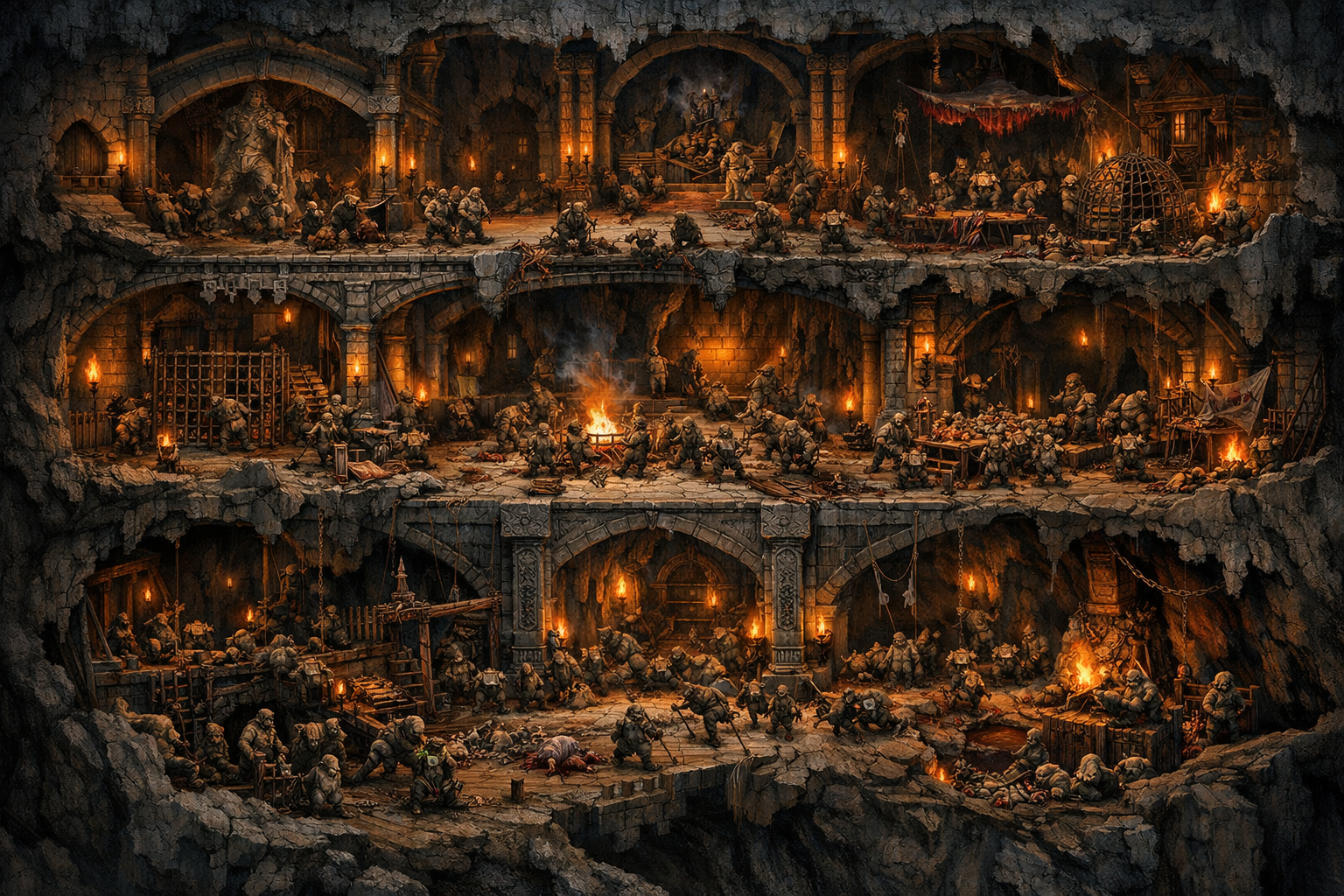
Not all extended dungeon explorations signal failure. By examining a five-session stronghold crawl, we identify when sprawl enhances rather than hinders gameplay.
Dungeon sprawl, the extension of a single dungeon exploration across multiple sessions, typically signals pacing problems and player disengagement. However, not every extended dungeon experience constitutes failure. Some multi-session explorations maintain momentum, deepen player investment, and create memorable campaign moments precisely because they take time to unfold.
Understanding when sprawl works requires examining successful examples. This article analyzes a five-session stronghold exploration that defied conventional wisdom about dungeon pacing, identifying the specific factors that transformed potential sprawl into sustained engagement.
The Blackroot Stronghold: A Case Study
The Blackroot Stronghold presented a dwarven fortress conquered by goblinoid forces, with three distinct levels, approximately forty rooms, and multiple factions operating within its walls. The party spent five three-hour sessions exploring this single location, completing their objectives without experiencing the typical warning signs of dungeon sprawl.
Player attendance remained consistent across all five sessions. Between-session discussion increased rather than decreased. Players voluntarily created maps, tracked NPC relationships, and speculated about unexplored areas. These metrics suggest engagement rather than fatigue.
What made this extended exploration work when similar dungeons stall after two sessions?
Factor One: Multiple Valid Objectives
The stronghold offered three distinct goals, each valuable independently:
Rescue the captive miners (the original quest hook)
Recover the ancestral forge-hammer (discovered in session two)
Eliminate the hobgoblin war-leader (preventing future raids)
Players could pursue these objectives in any order or abandon certain goals entirely. This flexibility prevented the frustration that occurs when parties feel trapped completing a single lengthy objective.
Session three illustrated this principle effectively. After a difficult combat, the party retreated to rest, debating whether to continue toward the forge-hammer or shift focus to the captive miners. They chose the miners, achieved that rescue by session end, and felt genuine accomplishment despite leaving the stronghold incompletely explored.
Multiple objectives create natural checkpoint moments where players assess progress and choose direction. Single-objective dungeons force players forward regardless of momentum, often generating the feeling of being trapped in endless corridors.
Factor Two: Meaningful Retreat and Re-Entry
The party left the stronghold completely three times across five sessions. Each retreat occurred for logical reasons (depleted resources, rescued NPCs needing escort, intelligence gathering in a nearby settlement), and each re-entry changed the dungeon state.
When players returned after rescuing the miners, the goblinoid forces had reorganized. Patrols followed different routes. Previously empty rooms now housed reinforcements. The hobgoblin commander had moved his quarters to a more defensible position.
These changes accomplished several goals. They validated player decisions (rescuing miners had consequences). They prevented rote repetition (the same corridor wasn't identical on the third pass). They created emerging narrative (the hobgoblin commander's increasingly paranoid behavior told a story).
Dungeons that remain static during extended exploration feel artificial. If players leave for three days of game-time, intelligent inhabitants should respond. This responsiveness transforms sprawl from tedious repetition into dynamic interaction.
Factor Three: Faction Complexity
The stronghold housed three distinct groups with conflicting agendas:
Hobgoblin regulars seeking to fortify the stronghold permanently
Goblin scavengers interested primarily in plunder
Enslaved kobolds forced to work the forges under threat
Players could manipulate these factions, creating diplomatic and tactical options beyond simple combat. Session four featured extended negotiation with the kobold overseers, resulting in intelligence about the hobgoblin commander's location and the forge-hammer's hiding place.
Faction play distributes gameplay variety across multiple sessions. Combat-heavy sessions alternate with negotiation-focused sessions. Stealth approaches in one area give way to direct confrontation in another. This variety prevents the monotonous room-after-room grind that characterizes failed dungeon sprawl.
Single-faction dungeons (all undead, all cultists, all constructs) offer fewer interaction modes. Players exhaust their tactical options quickly, leading to repetitive encounters that feel identical by the third session.
Factor Four: Discovery Pacing
The stronghold revealed information gradually across all five sessions. Major discoveries included:
Session one: Basic layout, goblin presence, evidence of captives
Session two: Forge-hammer's existence, hobgoblin leadership structure
Session three: Kobold enslavement, secret passages to lower levels
Session four: Hobgoblin war plans, forge-hammer's specific location
Session five: Commander's personal history, reason for stronghold occupation
Each session answered previous questions while raising new ones. Players never felt they had complete information, maintaining curiosity and forward momentum.
Dungeons that front-load information (placing the key exposition document in the first major room) or withhold it entirely (no clues until the final confrontation) fail to create sustained mystery. Gradual revelation maintains the investigative drive across multiple sessions.
Factor Five: Scalable Encounter Design
Combat encounters adjusted based on party resources and player decisions. Early encounters with goblin patrols involved 4-6 enemies. When players returned fresh after a long rest, patrol sizes increased to 6-8. When players pushed deep without resting, encounters decreased in size but increased in tactical complexity.
This scaling prevented two common sprawl problems. Over-rested parties avoid the trivial encounters that waste time without providing challenge. Resource-depleted parties avoid the overwhelming encounters that force repeated retreats and create frustration.
Rigid encounter design (every patrol is exactly six goblins) fails to respond to the extended timeline of sprawling dungeons. Players who rest frequently steamroll static encounters. Players who conserve resources get punished when fixed encounters exceed their depleted capabilities.
Factor Six: Environmental Storytelling
The stronghold's physical environment told stories through details discovered across multiple sessions:
Dwarven craftsmanship showed evidence of the original builders. Goblinoid modifications revealed current inhabitants' priorities. Recent damage indicated factional conflicts. Personal effects in quarters humanized enemies and potential allies.
Players sketched maps not just for navigation but to document details. They noted which rooms contained dwarven stonework versus crude goblin construction. They tracked which areas showed recent occupancy. They identified safe rooms based on environmental clues.
This environmental narrative created reasons to explore thoroughly rather than rushing to objectives. Rooms became interesting not just for tactical challenges but for what they revealed about the stronghold's history and current state.
Dungeons lacking environmental detail become mere tactical battlegrounds. Players stop investigating and start rushing, seeking only the next combat or treasure. This impatience accelerates sprawl rather than preventing it, as frustrated players drag through rooms that offer nothing beyond empty space.
When Sprawl Signals Success
The Blackroot Stronghold sprawl worked because it met specific criteria:
Player agency remained high. Decisions mattered, and multiple valid paths existed.
Information flow stayed consistent. Each session revealed new details without overwhelming or starving player curiosity.
Variety prevented monotony. Combat, negotiation, exploration, and investigation alternated naturally.
The environment responded dynamically. Player actions changed dungeon states meaningfully.
Objectives scaled appropriately. Goals felt achievable within session blocks while supporting extended engagement.
These factors don't guarantee success with every group or every dungeon. Some tables prefer tight, single-session dungeons regardless of complexity. Some prefer sandbox exploration with minimal structure. Successful sprawl requires matching dungeon design to table preferences.
Distinguishing Successful from Failed Sprawl
Successful extended dungeons show specific markers:
Between-session engagement increases. Players discuss tactics, make plans, and speculate about mysteries.
Attendance remains consistent. Players prioritize sessions rather than finding excuses to miss.
In-session focus stays high. Side conversations decrease, tactical discussion increases.
Players create artifacts. Maps, NPC relationship diagrams, timeline documents, and theory lists appear organically.
Natural stopping points emerge. Sessions end at satisfying moments rather than arbitrary time limits.
Failed sprawl shows opposite patterns. Between-session discussion drops. Attendance becomes erratic. Players check phones frequently during sessions. No one bothers tracking details beyond immediate mechanical necessities. Sessions end with relief rather than anticipation.
Applying These Lessons
Dungeon Masters can incorporate these success factors into extended dungeon designs:
Build multiple objectives that can be completed independently, creating natural milestone moments throughout exploration.
Plan dynamic responses to player retreats and re-entries, ensuring the environment evolves based on time passage and player actions.
Include faction complexity that creates diplomatic, tactical, and narrative options beyond straightforward combat.
Pace revelations across sessions rather than front-loading or withholding critical information.
Design scalable encounters that adjust to party resources and decision patterns without feeling arbitrary.
Layer environmental storytelling throughout the space, rewarding thorough investigation with narrative depth.
Not every dungeon should sprawl. Single-session dungeons serve important campaign functions, providing tight pacing and quick resolution. However, dismissing all multi-session explorations as sprawl failures ignores successful examples that leverage extended time frames to create deeper engagement.
Learning from Player Response
The true test of successful sprawl lies in player response rather than session count. A dungeon spanning five sessions with high engagement succeeds more completely than a two-session dungeon where players disengage halfway through.
Monitor player behavior across extended dungeons. If engagement increases (more note-taking, more between-session discussion, more tactical planning), the sprawl works. If engagement decreases (less attention, more absences, more requests to skip ahead), the sprawl fails regardless of dungeon quality.
Adjust based on these signals. Successful sprawl can be extended further if player interest remains high. Failed sprawl should be accelerated toward resolution through the recovery techniques discussed earlier in this series.
The Role of Campaign Context
The Blackroot Stronghold succeeded partly because it fit campaign context appropriately. The party had established interest in dwarven history through previous adventures. The goblinoid threat connected to ongoing regional conflicts. The rescued miners became recurring NPCs in later sessions.
Isolated dungeons disconnected from campaign threads struggle to maintain engagement across multiple sessions. Players need reasons beyond mechanical challenge to invest in extended exploration. Campaign integration provides those reasons.
Before committing to a potentially sprawling dungeon, ensure it connects meaningfully to established campaign elements. Abandoned dungeons exploring random threats feel disposable. Dungeons exploring character backstories, regional politics, or ongoing mysteries feel essential.
Conclusion
Dungeon sprawl represents a design challenge, not an inevitable failure. Extended explorations can enhance campaigns when they incorporate multiple objectives, dynamic responses, faction complexity, paced revelations, scalable encounters, and environmental storytelling.
The Blackroot Stronghold demonstrates these principles in practice, showing how a five-session dungeon can maintain momentum through intentional design choices that prioritize player agency and emerging narrative over arbitrary pacing constraints.
Recognize when your table responds positively to extended exploration. Some groups thrive in deep, complex environments that reward thorough investigation and careful planning. For these tables, well-designed sprawl creates campaign highlights rather than pacing problems.
The techniques preventing dungeon sprawl (discussed earlier in this series) remain valuable for most situations. However, understanding when sprawl works expands your design options, allowing you to create varied dungeon experiences that match different campaign moments and player preferences.
Looking to refine your dungeon design skills? Explore our complete library of adventure design resources and DM tips at The Dungeon Trainer.
Sources and Further Reading
The Angry GM (www.theangrygm.com) - Extensive articles on dungeon design philosophy, pacing techniques, and managing player agency in complex environments
Sly Flourish by Mike Shea (slyflourish.com) - Practical advice on running dynamic dungeons that respond to player choices, including the "Lazy Dungeon Master" approach
The Alexandrian by Justin Alexander (thealexandrian.net) - Deep analysis of dungeon design theory, including the "Jaquaying the Dungeon" series on creating non-linear environments
Dungeon Master's Guide (Wizards of the Coast, 2014) - Chapter 5 covers adventure environments and dungeon design fundamentals, providing baseline design principles
Return of the Lazy Dungeon Master by Mike Shea (2018) - Streamlined preparation methods that support responsive, player-driven dungeon exploration
Related reading
- Why Megadungeons Succeed or Fail: Lessons from Forty Years of Play
Megadungeons have persisted since the earliest days of tabletop roleplaying, yet many campaigns abandon them within a few sessions. Learn what structural, pacing, and preparation factors separate sustainable megadungeons from those that collapse, and how to apply those lessons at your own table.
- Understanding the Megadungeon: What It Is and When to Use It
A megadungeon is more than a big dungeon. Learn what defines this sprawling adventure structure, why it persists across decades of play, and when it serves your table better than episodic adventures.
- What I Learned Running My First Dungeon Crawl: A Game Master Reflection
A candid reflection on lessons learned from running a first dungeon crawl, including what worked, what failed, and how these insights improved future sessions.