What Is Dungeon Crawling in D&D and Why It Still Matters
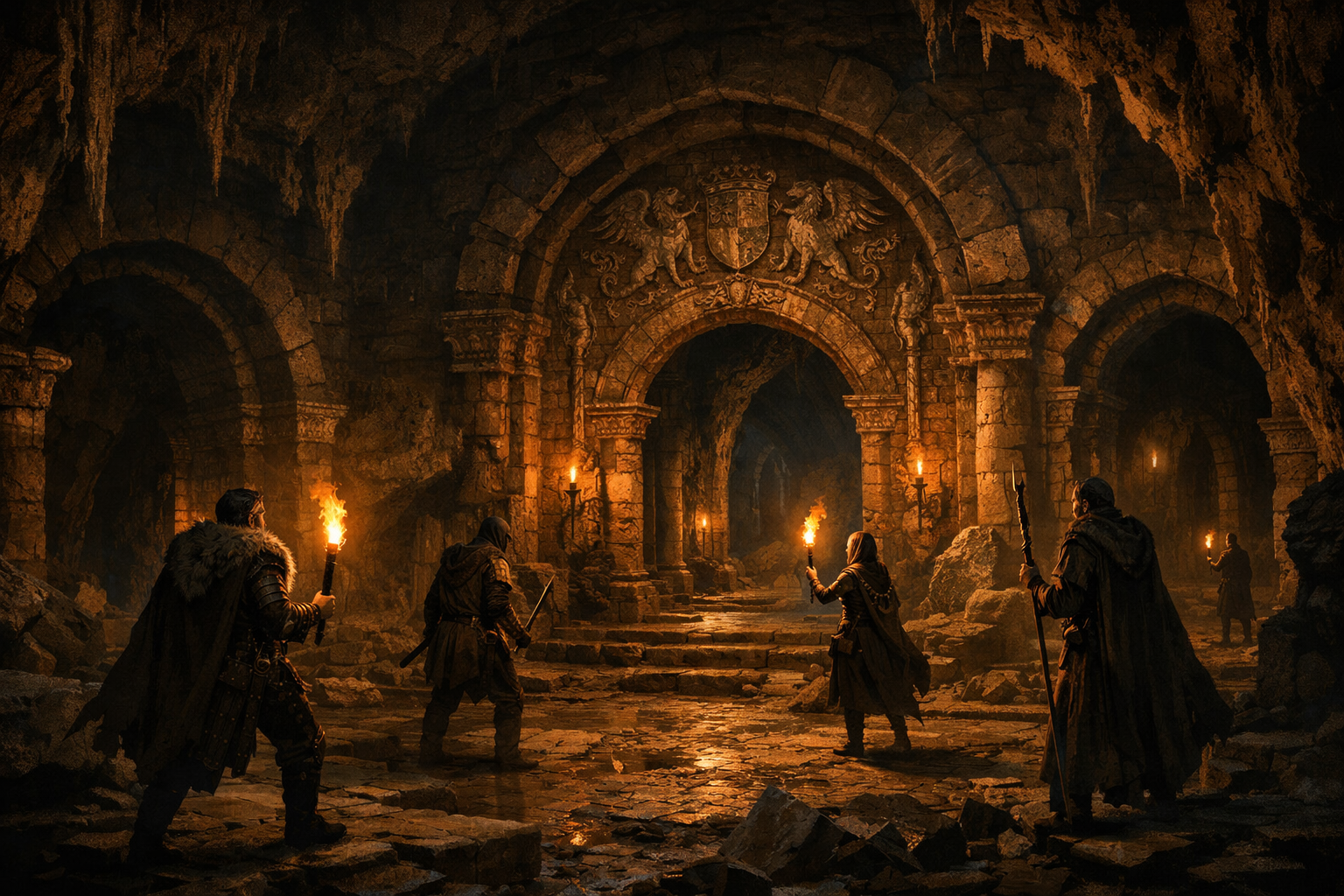
Dungeon crawling combines exploration, problem solving, and combat in underground environments. Learn why this classic playstyle remains essential to great tabletop campaigns.
Dungeon crawling is one of the structures that helped define Dungeons & Dragons.
More than fifty years after the game's original publication, D&D campaigns can now revolve around political intrigue, character drama, wilderness expeditions, mysteries, planar travel, warfare, exploration, or nearly any mixture a group enjoys.
The dungeon crawl has not disappeared.
Nor does it need to survive only as nostalgia.
Location-based exploration still offers something distinctive: a playable environment where geography, information, risk, time, resources, and player decisions interact.
Modern Dungeon Masters do not need to reproduce every procedure used at a 1970s table to benefit from that structure.
The more useful question is:
What did dungeon crawling teach tabletop RPGs that is still valuable today?
This article focuses on that question.
For a detailed explanation of how dungeon crawls themselves work, including navigation, dungeon structures, mapping, encounters, timekeeping, and player advice, see:
What Is a Dungeon Crawl in D&D and How Does It Work?
What Dungeon Crawling Actually Means
A dungeon crawl is a form of location-based exploration.
Characters enter an environment whose structure matters and make decisions about how to move through, understand, exploit, survive, or change it.
Despite the name, the location does not have to be underground.
Dungeon-crawl structures can work in:
- Fortresses
- Haunted mansions
- Caves
- Mines
- Temples
- Ruined cities
- Ships
- Wizard towers
- Sewers
- Laboratories
- Castles
- Derelict spacecraft in other RPG genres
What makes the structure work is not stone walls.
It is that the place itself becomes part of the game.
Players may decide:
- Which route to take
- Which door to open
- Which area to avoid
- Whether to search
- Whether to negotiate
- Whether to press deeper
- Whether to retreat
- Where to rest
- What information to trust
- Which resources are worth spending
- How to use what they have learned about the location
Consider a party entering the abandoned watchtower of Thornkeep.
The intact tower above ground is only the beginning.
Beneath it, old cellars connect to structures far older than the tower itself.
At the first major junction, three routes appear.
Left: Fresh footprints descend a broad stone corridor.
Right: A narrow natural passage contains deep gouges at chest height.
Straight: Cold air moves through a worked-stone hall.
Nothing here tells the players which path is "correct."
Instead, the environment gives them information.
They decide what that information means.
That decision is dungeon crawling.
Dungeon Crawling Was There Near the Beginning
Dungeons & Dragons emerged from a mixture of influences rather than one single predecessor.
Miniature wargaming was important.
Gary Gygax and Jeff Perren developed Chainmail as a medieval miniature-wargame system, eventually adding fantasy rules.
Dave Arneson then developed his Blackmoor campaign using ideas drawn from wargaming, fantasy, and earlier Braunstein-style games in which individual participants assumed particular roles.
Blackmoor moved toward persistent individual characters who gained experience across sessions.
Gygax and Arneson subsequently collaborated on the game that became Dungeons & Dragons, first commercially published in 1974.
Dungeon exploration became one of its central structures.
But it was not the only one.
One of the three original 1974 D&D booklets was titled:
The Underworld & Wilderness Adventures
That title matters.
Early D&D already recognized a rhythm between underground exploration and a larger world outside it.
Characters might:
- Leave safety.
- Travel through wilderness.
- Enter a dangerous location.
- Explore.
- Recover treasure or information.
- Retreat.
- Return to civilization.
- Prepare for another expedition.
The dungeon was central, but it existed inside a campaign rather than replacing one.
Early Published Dungeons Helped Teach the Game
Some early D&D adventures taught players and referees through explorable locations.
Mike Carr's B1 *In Search of the Unknown* presented the underground complex of Quasqueton and famously left portions of its monster and treasure placement for the referee to complete.
Gary Gygax's B2 *The Keep on the Borderlands* provided a broader environment including the Keep, surrounding wilderness, and the Caves of Chaos.
These adventures helped establish several ideas strongly associated with dungeon play:
- Mapped locations
- Keyed areas
- Branching routes
- Monsters occupying particular territories
- Treasure and secrets discovered through exploration
- Parties deciding how far they were willing to push
- Retreat as a legitimate strategic choice
The dungeon was not merely a backdrop for combat.
Its geography created decisions.
What Changed as D&D Evolved
D&D did not remain one game with one dominant style.
Over decades, published adventures and home campaigns increasingly explored:
- Stronger plotted narratives
- Larger wilderness campaigns
- Urban adventures
- Political intrigue
- Character-centered stories
- Mystery structures
- Domain play
- Cinematic encounters
- More elaborate tactical combat
- Different approaches to resource recovery
At the same time, later games and the old-school revival preserved or re-examined procedural dungeon play.
Modern groups therefore have many more choices.
A Dungeon Master running the current 2024 D&D rules does not need to duplicate an early Basic D&D expedition procedure.
But abandoning those procedures does not require abandoning the design lessons behind them.
That is where dungeon crawling remains relevant.
1. Dungeon Crawls Make Geography Matter
Many RPG scenes treat location abstractly.
A political conversation might occur in a palace, but the palace's exact corridors may never matter.
A dungeon changes that relationship.
Players begin learning the environment.
They remember:
"The flooded stairway connects to the crypt."
"There was another locked door behind the chapel."
"The goblins use the western passage."
"That secret staircase bypasses the guard room."
Information about geography becomes strategically useful.
This creates a feedback loop:
Explore → Learn → Decide → Explore differently
The location becomes increasingly meaningful because the players understand it better.
Nonlinear Layouts Strengthen This Effect
Jennell Jaquays became particularly influential in discussions of nonlinear dungeon design.
Her locations frequently used features such as:
- Multiple entrances
- Loops
- Secret routes
- Multiple connections between levels
- Paths that bypass dangerous areas
- Connections players might discover from either side
Justin Alexander later analyzed these techniques extensively in his dungeon-design essays, now presented as Xandering the Dungeon.
Consider two structures.
Linear
Entrance → Guard Room → Crypt → Shrine → Boss Chamber
Players may make interesting decisions inside each area, but navigation itself contributes relatively little.
Interconnected
The entrance connects to:
- Guard Room
- Old Well
- Collapsed Chapel
The Old Well reaches the crypt.
The chapel contains a hidden stair to a lower level.
The crypt reconnects behind the guard room.
A secret tunnel exits outside the dungeon.
Now players can:
- Bypass encounters
- Approach enemies from behind
- Discover shortcuts
- Retreat along safer routes
- Re-enter through another entrance
- Learn the location strategically
The dungeon becomes something they can master rather than merely advance through.
2. Dungeon Crawls Turn Information Into a Resource
A good dungeon communicates.
Players may hear:
- Chanting behind a door
- Running water below
- Heavy footsteps approaching
- Arguments in another language
They may see:
- Tracks
- Blood
- Broken weapons
- Symbols
- Different architectural styles
- Burn marks
- Barricades
- Recently disturbed dust
They may smell:
- Smoke
- Rot
- Sulfur
- Food
- Oil
- Salt water
Those details are not merely decorative.
They can influence decisions.
Return to Thornkeep.
At the three-way junction:
- Fresh footprints suggest recent traffic.
- Deep gouges suggest something large or dangerous.
- Cold airflow may indicate another chamber, a cavern, or even another exit.
Players begin forming hypotheses.
The Dungeon Master does not need to tell them:
"The left path contains humanoids, the right contains a monster, and straight ahead reaches the ice caverns."
The environment provides imperfect information.
Players decide how much risk to accept.
That is a powerful form of gameplay because knowledge is earned through interaction.
3. Dungeon Crawls Can Make Resources Meaningful
Resource management is strongly associated with traditional dungeon crawling.
Classic procedures often placed substantial emphasis on:
- Light
- Food and water
- Ammunition
- Encumbrance
- Spells
- Hit Points
- Healing
- Time
- Equipment
- Safe routes
- Wandering encounters
Different modern systems emphasize those resources differently.
The current 2024 D&D rules still contain meaningful exploration mechanics involving:
- Light and darkness
- Adventuring gear
- Marching order
- Travel pace
- Hazards
- Traps
- Limited-use abilities
- Spell slots
- Hit Points
- Hit Point Dice
- Resting
But modern 5e does not require a Dungeon Master to run exploration using the same strict procedures as early D&D.
That distinction is important.
Resource Pressure Is a Dial
A modern dungeon crawl might emphasize resource pressure heavily.
Another might barely emphasize it at all.
Neither is automatically wrong.
The real design question is:
Do limited resources create interesting decisions at this table?
Suppose a party reaches another unexplored level.
They have:
- Several damaged characters
- A few spell slots remaining
- Limited healing
- An unexplored route behind them
- No immediate knowledge of what lies below
The interesting decision is:
Continue or retreat?
If recovering every resource is effortless and nothing changes while the party rests, that decision may have little weight.
If time matters because:
- Enemies reorganize
- A ritual advances
- Patrols move
- A rival expedition is active
- Supplies are genuinely limited
then resource use becomes more significant.
The point is not deprivation for its own sake.
The point is trade-offs.
Old-School Procedure Is Still Available
Groups that want stronger procedural exploration can borrow from games designed around it.
Old-School Essentials, for example, explicitly maintains procedures for dungeon, wilderness, and waterborne adventuring derived from Basic/Expert D&D traditions.
Torchbearer takes a very different mechanical approach but deliberately centers dungeon crawling, difficult choices, resource management, and turn structure.
These games demonstrate that dungeon crawling is not one exact rules package.
Different systems can make the same broad structure feel dramatically different.
A modern 5e table can borrow individual ideas without converting the entire campaign to another ruleset.
4. Dungeon Crawls Create Bounded Agency
Dungeon crawls do not automatically create more agency than every other form of play.
Nor are open campaigns inherently less meaningful.
What dungeon environments do particularly well is create bounded decision spaces.
The players are not choosing among every imaginable action in the world.
They may instead be deciding:
- Left or right?
- Open the door or listen first?
- Fight or negotiate?
- Explore deeper or retreat?
- Use the spell now or save it?
- Barricade this room or keep moving?
- Follow the obvious corridor or investigate the hidden route?
Those choices are constrained.
But they can still be highly consequential.
This is useful because players can understand enough of the decision to reason about it.
Bounded Does Not Mean Linear
A dungeon can offer substantial freedom inside a contained environment.
A well-connected location can operate almost like a local sandbox.
Players determine:
- Which areas matter
- Which faction to approach
- Which risks to avoid
- What goals to pursue
- When to retreat
- Whether to return later
The boundaries create focus.
The connections create choice.
5. Dungeon Crawls Reward Preparation and Adaptation
A classic image of dungeon play involves someone using a ten-foot pole to test suspicious flooring.
That style highlights an old-school emphasis on player ingenuity.
Modern D&D works somewhat differently because character abilities, skill checks, passive abilities, spells, and explicit mechanical features often play larger roles in resolving uncertain actions.
The useful lesson survives:
Let player ideas matter.
Suppose characters suspect a pressure plate.
They might:
- Inspect it
- Probe it from a distance
- Place weight on it
- Jam the mechanism
- Jump over it
- Find another route
- Trigger it intentionally while standing clear
The Dungeon Master then adjudicates the actual approach using the rules and fictional situation.
A clever plan should not automatically succeed simply because it sounds clever.
Nor should every approach collapse into the same generic die roll regardless of what players attempted.
The environment should respond to what they actually do.
6. Dungeon Crawls Make Retreat Meaningful
Many heroic stories emphasize pushing forward.
Dungeon crawling preserves another important strategic option:
Leave.
The party may decide:
"We aren't ready for this."
That can be a successful decision.
They might return later with:
- Better equipment
- Different spells
- More information
- An ally
- A map
- A way around an obstacle
That creates progression through knowledge as well as character advancement.
The group is not simply stronger.
They understand the dungeon better.
A dangerous area encountered at level 3 may become approachable at level 5 not only because statistics improved, but because the party now knows:
- Where the creature nests
- Which corridor bypasses it
- What it fears
- Which faction hates it
- Where an alternate entrance lies
The dungeon becomes campaign memory.
7. Dungeon Crawls Support Emergent Stories
Dungeon crawling is sometimes contrasted with storytelling as though a group must choose one.
That is a false choice.
Dungeon crawling can produce story through play.
Consider this sequence:
The party encounters something far stronger than expected.
They retreat.
During the escape, they discover a secret passage.
That passage leads to imprisoned members of another faction.
The prisoners offer information in exchange for freedom.
The party uses that information to negotiate with a different group inside the dungeon.
Later they return to confront the original threat from another direction.
Nobody needed to script that arc in advance.
The story emerged from:
- Geography
- Danger
- Player decisions
- Faction relationships
- Information
- Consequences
That is one of the strengths of location-based play.
8. Dungeon Crawls Can Carry Story Through Environment
Story does not need to arrive only through NPC monologues or exposition.
A dungeon itself can communicate history.
Players might discover:
- A statue whose face has been deliberately destroyed
- A shrine built over an older shrine
- Barracks abandoned in a hurry
- Two architectural styles meeting behind a collapsed wall
- Religious symbols scratched out and replaced
- Graves that predate the structure above them
- A sealed chamber nobody currently inhabiting the dungeon understands
These details let players reconstruct what happened.
Thornkeep Example
The party eventually follows the cold air beneath Thornkeep.
The worked stone ends at a collapsed wall.
Beyond it lies natural rock.
Frozen moisture clings to the cavern.
Blue luminescent moss grows where the coldest air enters.
Farther inside, they discover masonry completely unlike the watchtower above.
Now they have new questions:
- Did Thornkeep's builders know this place existed?
- What creates the cold?
- Why is the architecture different?
- Is the moss useful?
- Does the cavern connect elsewhere?
Exploration and story have become the same activity.
9. Dungeon Crawls Give Dungeon Masters a Concrete World to Run
Open-ended scenarios can require substantial improvisation.
A Dungeon Master may need to create:
- Locations
- NPCs
- Faction responses
- Travel
- Consequences
- New scenes
very quickly.
Dungeon environments provide more concrete scaffolding.
The GM knows:
- What locations exist
- How they connect
- Who occupies them
- What creatures want
- What evidence exists
- What changes with time
That does not eliminate improvisation.
It makes improvisation easier because the environment already has structure.
When players surprise you, you can ask:
"Given what exists here, what happens?"
rather than:
"What scene was supposed to happen next?"
What Modern D&D Kept
It would be inaccurate to describe modern D&D as having abandoned exploration.
The 2024 Basic Rules explicitly discuss exploration as delving into dangerous and mysterious places.
They include rules and advice involving:
- Adventuring equipment
- Light and darkness
- Hazards
- Marching order
- Travel pace
- Environmental interaction
The 2024 Dungeon Master's Guide also retains dedicated material on:
- Running exploration
- Dungeons
- Doors
- Hazards
- Traps
- Adventure design
What changed is not that dungeon exploration stopped being part of D&D.
The modern rules simply leave Dungeon Masters considerable freedom over how intensely those elements are emphasized.
What You Do Not Need to Import From Old-School Play
If you want dungeon crawling in a modern 5e campaign, you do not automatically need:
- Exact ten-minute exploration turns
- Mandatory player-drawn maps
- Strict torch accounting
- Random monster checks at fixed intervals
- Highly restrictive encumbrance
- Extremely lethal traps
- Constant attrition
- A megadungeon lasting fifty sessions
Those are tools and traditions, not the definition of dungeon crawling.
Use them when they create the experience you want.
Leave them out when they do not.
Timekeeping
You might track time:
- Precisely
- In exploration turns
- By scenes
- By approximate elapsed time
- Only when a timed event matters
Light
You might make darkness central.
Or several characters may have Darkvision and magical light, making illumination a smaller part of the challenge.
Encounters
You might use random encounter checks.
You might instead use:
- Patrol schedules
- Faction movement
- Event clocks
- Environmental changes
- Prepared developments
Mapping
Players might:
- Draw their own map
- Receive a player-safe map
- Use progressive map revelation
- Use theater of the mind
- Use a VTT
- Mix approaches
The structure should support the table rather than imitate history for its own sake.
Modern Mapping: There Is No Single Best Method
Detailed maps can be extremely useful when:
- Multiple routes matter
- Tactical positioning matters
- Secret connections exist
- Players revisit areas
- The location spans several levels
Theater of the mind can work well when:
- Geography is simple
- Exact distances rarely matter
- The group prefers faster description
- Mapping would create more bookkeeping than gameplay
A hybrid method often works particularly well.
For example:
- Narrate simple corridors and rooms.
- Reveal a schematic exploration map as needed.
- Use a tactical map only when combat or spatial puzzles require precision.
Do not assume maps automatically slow the game.
Do not assume theater of the mind automatically makes it faster.
Choose based on the location and players.
Modern Dungeon Design: Telegraph Meaningful Danger
Older adventures sometimes included extremely dangerous hazards with limited warning.
Modern groups vary widely in how much of that style they enjoy.
One useful principle for contemporary play is to give players information they can reason from.
Instead of:
"You step on an invisible trap and die."
the environment might contain:
- Damaged floor tiles
- Scorch marks
- Broken weapons
- Old corpses
- Suspicious holes
- Disturbed dust
- Unusual architecture
That does not mean every trap must announce exactly how it works.
It means careful play should have opportunities to produce useful information.
Match Expectations
A table explicitly choosing a lethal old-school expedition may want unforgiving hazards.
A heroic 5e campaign may want danger to be more legible.
Neither is universally correct.
Set expectations before the dungeon becomes the place where everyone discovers they wanted different games.
Empty Rooms Are Not Wasted Space
Not every dungeon area needs:
- Combat
- A trap
- Treasure
- A puzzle
Quiet areas can provide:
- Contrast
- Evidence
- Foreshadowing
- Navigation information
- Environmental storytelling
- Temporary shelter
- A place for characters to talk
- Suspicion precisely because nothing attacks
But an empty room should still make sense as part of the location.
"Empty" does not have to mean "meaningless."
And it certainly does not automatically mean "safe to rest."
A room is safe only if the fictional circumstances make it safe.
Do Not Over-Key Every Area
Dungeon crawling depends on geography, so the Dungeon Master usually does need enough map information to understand how the place connects.
That does not mean every ten-foot section of corridor needs half a page of notes.
Detailed preparation is most valuable for:
- Important locations
- Interactive features
- Factions
- Hazards
- Clues
- Treasure
- Connections
- Places likely to change
Simple connecting areas can remain simple.
A compact room key is often easier to use at the table than several paragraphs of prose.
Make the Dungeon Responsive
A dungeon becomes more interesting when its inhabitants do not behave like exhibits waiting in numbered rooms.
Ask:
- Who lives here?
- Who patrols?
- Who avoids whom?
- Who trades?
- Who wants control?
- Who is frightened?
- Who might retreat?
- Who responds to alarms?
- What happens when the party leaves and returns?
A dungeon containing multiple factions can support:
- Negotiation
- Espionage
- Alliances
- Betrayal
- Trade
- Intimidation
- Political manipulation
That is still dungeon crawling.
Geography provides the stage.
The inhabitants make it dynamic.
Dungeon Crawling Is Not Synonymous With Combat
A dungeon might emphasize:
Investigation
Who built this place, and why are people disappearing inside?
Horror
What is moving through the walls?
Social Play
Can the party manipulate three competing underground factions?
Survival
How far can the expedition travel before supplies or exposure force a retreat?
Tactical Combat
How can the party use the environment to defeat organized defenders?
Exploration
What lies beyond the sealed lower level?
Most dungeons mix several.
The term describes an adventure structure, not a required combat ratio.
Dungeon Crawling Beyond D&D
Other tabletop games demonstrate how flexible dungeon crawling can be.
Torchbearer
Torchbearer explicitly describes itself as a dungeon-crawl RPG.
Its design puts heavy emphasis on adversity, resource management, structured turns, and difficult choices.
That creates a much harsher exploration experience than many modern D&D tables use.
Old-School Essentials
Old-School Essentials preserves procedures derived from classic Basic/Expert D&D traditions.
Its rules explicitly include dungeon, wilderness, and waterborne adventure procedures.
For groups curious about procedural old-school exploration, it provides a contemporary presentation of that style.
Dungeon World
Dungeon World demonstrates yet another approach.
It combines dungeon-crawling fantasy with rules built around fiction-driven consequences and forward momentum.
These games do not prove there is one correct dungeon-crawl system.
They prove the opposite.
The structure can survive major changes in mechanics and philosophy.
Why Dungeon Crawling Still Matters
Dungeon crawling remains useful because it combines several forms of decision-making in one environment.
The dungeon repeatedly asks:
- Where do we go?
- What does this information mean?
- What risk are we willing to take?
- What resources should we spend?
- Can we avoid this threat?
- Should we negotiate?
- Should we retreat?
- What changed since we were here last?
Those decisions build on one another.
A map that initially means nothing becomes familiar.
An enemy faction becomes a potential ally.
A locked door becomes a shortcut once opened.
A seemingly useless inscription becomes a clue three rooms later.
The players' knowledge grows.
Their relationship with the location changes.
That accumulation is difficult to reproduce in an adventure built entirely from disconnected scenes.
Using Dungeon Crawling Inside a Story-Driven Campaign
You do not need a dungeon-focused campaign to benefit.
Imagine a broader campaign built around political intrigue.
The party spends several sessions:
- Negotiating
- Gathering evidence
- Building alliances
- Investigating a noble house
Eventually they learn that critical records are hidden in an abandoned fortress.
The campaign temporarily changes structure.
Now the questions are:
- How do we enter?
- Which route reaches the archive?
- Who else is inside?
- What can we avoid?
- How long can we remain undetected?
- Can we escape with the evidence?
The dungeon crawl becomes one chapter inside a much broader style of game.
That mixture is often more useful than asking whether a campaign is "a dungeon crawl" or "story-driven."
It can be both at different times.
Start Small
If your group rarely plays dungeon crawls, do not begin with a 200-room megadungeon unless everyone specifically wants that experience.
Try a compact location.
Examples:
- Barrow tomb
- Abandoned mine
- Smuggler tunnel
- Haunted estate
- Sunken temple
- Fortified hideout
- Ruined watchtower
Give it enough structure to support choices.
For example:
- Several routes
- One shortcut
- One secret
- A handful of distinct areas
- More than one type of challenge
- Something worth discovering
There is no universal ideal room count.
Six rooms can support an excellent session.
Twenty rooms can also work.
The appropriate size depends on:
- Session length
- Complexity
- Combat frequency
- Group pace
- How thoroughly players explore
- Whether the location is meant for repeated visits
Tell Players What Kind of Exploration You Are Running
Before a dungeon-heavy session, explain what will matter.
For example:
"This location is meant to reward careful exploration. Routes matter, time will matter, and there are areas you may want to leave and return to later."
Or:
"I'm not going to track individual torches, but the dungeon is dangerous enough that resting everywhere won't necessarily be safe."
Or:
"You don't need to draw a perfect map. I'll reveal the layout as you explore, but you'll need to remember which routes you haven't checked."
That preparation prevents a procedural surprise.
Dungeon crawling works best when the table understands what information and decisions the game expects them to pay attention to.
Ask for Feedback Afterward
If this style is new to the group, ask what worked.
Useful questions include:
- Did navigation feel interesting?
- Did you have enough information to choose between routes?
- Did resource pressure create decisions or just bookkeeping?
- Were there too many fights?
- Did you enjoy discovering the location's history?
- Did you ever feel lost in a frustrating rather than interesting way?
- Would you want another location like this?
The answer should shape the next dungeon.
Not every player enjoys the same amount of procedure.
Modern dungeon crawling has the advantage of being adaptable.
Use it.
How The Dungeon Trainer Can Support Dungeon-Focused Play
The Dungeon Trainer does not currently replace a dedicated tactical dungeon map or automatically run a classic dungeon-turn procedure.
Its existing tools can support several other parts of dungeon preparation and play.
Campaign Memory and Codex
The platform maintains searchable campaign information involving:
- Characters
- NPCs
- Locations
- Quests
- Events
That can complement a spatial map.
The map tells you:
"Where was the ruined chapel?"
Campaign memory can help preserve:
"What happened when the party reached it?"
Shared Human-Run Table
A human Game Master can run the campaign while the platform tracks:
- Character sheets
- Hit Points
- Conditions
- Initiative
- Combat state
- Dice
- Shared transcript
- Campaign continuity
AI is optional.
That makes the platform usable for a traditional human-run dungeon crawl without handing narration or adjudication to an AI Dungeon Master.
Generators
The Dungeon Trainer can generate:
- Locations
- Monsters
- NPCs
- Items
- Spells
These can provide raw material when building a dungeon.
Generated content still needs to fit:
- The dungeon's purpose
- Existing factions
- Difficulty
- Campaign continuity
- Established tone
A location generator can inspire a chamber or area.
It is not the same thing as automatically generating a coherent tactical dungeon map.
Scry
Scry can help a Dungeon Master examine an upcoming situation for:
- Plausible branches
- Complications
- Pacing risks
- Single points of failure
- Preparation considerations
For dungeon play, that can expose brittle assumptions.
For example:
"My preparation assumes the party uses the main staircase."
Scry can help prompt consideration of what happens if players:
- Search for another entrance
- Climb
- Retreat
- Negotiate with inhabitants
- Use magic
- Approach from below
It does not predict what they will do.
It helps the GM prepare for more than one plausible route.
The Coach
The Coach provides practice situations and rubric-grounded feedback.
Relevant dungeon-crawl skills can include:
- Exploration adjudication
- Information clarity
- Pacing
- Player agency
- Encounter management
- Unexpected approaches
Dungeon crawling often produces precisely those kinds of decisions.
Overworld Exploration Map
The Dungeon Trainer also has a campaign overworld map that fills in as the party explores regions.
That map represents world-scale exploration rather than a tactical dungeon floor plan.
The distinction matters.
Use an appropriate dungeon map, sketch, VTT, or theater-of-the-mind method for the interior location itself.
Why It Still Belongs in Modern D&D
Dungeon crawling does not need to dominate D&D again in order to remain valuable.
It contributes a form of play where:
- Space matters
- Information matters
- Routes matter
- Preparation matters
- Retreat matters
- Resources can matter
- The world responds to player decisions
- Knowledge of a location accumulates over time
Those qualities complement modern character-driven campaigns rather than competing with them.
A group can spend one month navigating court politics and the next exploring an ancient fortress.
A mystery can culminate in a dungeon.
A heist can use dungeon-like spatial design.
A wilderness campaign can discover a ruin whose geography suddenly becomes the central problem.
The structure remains useful because it turns a location into something players can learn and master.
Conclusion
Dungeon crawling is one of D&D's oldest adventure structures, but its value is not confined to D&D's past.
Its lasting contribution is a particular kind of decision-making:
Explore an unknown place.
Gather information.
Choose a route.
Manage risk.
Interact with the environment.
Learn from consequences.
Decide whether to continue.
Modern D&D does not require the same procedures that early players used.
You can track torches precisely or barely at all.
You can use random encounters or dynamic factions.
You can require player cartography or reveal a digital map.
You can run a lethal old-school expedition or a heroic story-focused adventure.
The underlying structure still works.
The characters enter Thornkeep knowing almost nothing.
A few sessions later, the players know:
- Which passages connect
- Which inhabitants can be negotiated with
- Which areas are dangerous
- Where the secret route lies
- What caused the cold
- Which doors remain unopened
- How to get back out
That knowledge was not delivered in exposition.
They earned it by exploring.
That is why dungeon crawling still matters.
More than fifty years after the earliest parties explored Blackmoor, Greyhawk, and the other environments that helped shape D&D, the same basic pleasure remains:
There is a place you do not understand yet.
Go find out what is inside.
Sources and Further Reading
Alexander, J. (2010). Xandering the Dungeon. The Alexandrian. https://thealexandrian.net/wordpress/13085/roleplaying-games/xandering-the-dungeon
Carr, M. (1979). B1: In Search of the Unknown. TSR.
Gygax, G. (1979). B2: The Keep on the Borderlands. TSR.
Gygax, G., & Arneson, D. (1974). Dungeons & Dragons, Volume 3: The Underworld & Wilderness Adventures. Tactical Studies Rules.
Norman, G. (2026). Old-School Essentials. Necrotic Gnome. https://necroticgnome.com/
Olavsrud, T., & Crane, L. (2013). Torchbearer. Burning Wheel Headquarters. https://www.torchbearerrpg.com/
Peterson, J. (2024). The Making of Original Dungeons & Dragons: 1970–1977. Wizards of the Coast.
Wizards of the Coast. (2024). Dungeon Master's Guide. Wizards of the Coast.
Wizards of the Coast. (2024). D&D Beyond Basic Rules: Playing the Game. D&D Beyond. https://www.dndbeyond.com/sources/dnd/br-2024/playing-the-game
Related reading
- Five Weeks in the Sunken Archive: Lessons from a Real Dungeon Crawl Campaign
A five-session dungeon crawl through a flooded library taught valuable lessons about pacing, player agency, and adaptive design. Discover what worked, what failed, and how these insights can improve your own adventures.
- Random Dungeon Generation vs. Hand-Crafted Design: Which Approach Works Best?
Random generation offers speed and surprise while hand-crafted dungeons provide narrative control. Compare both approaches to find the right balance for your table and campaign style.
- Essential Dungeon Master Tools: Your Checklist for Running Better Dungeon Adventures
Running smooth dungeon sessions requires the right preparation and resources. This comprehensive toolkit gives you everything you need to manage exploration, combat, and player engagement.