Looking Back at the Lantern Road: What Quiet Awareness Taught One Illustrative Table
Written with AI. An AI model drafted this article. How we use AI
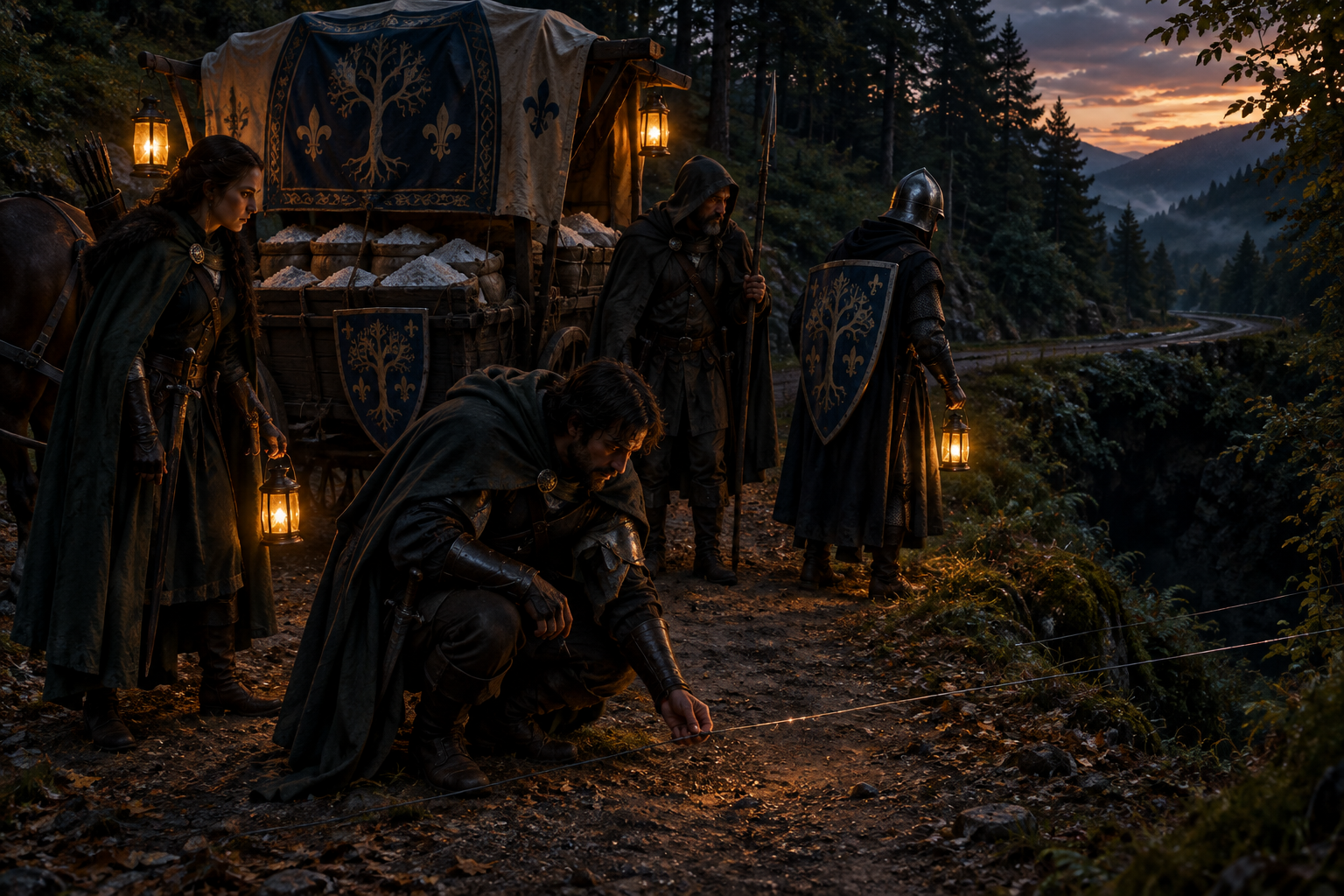
A reflective case study of one illustrative ambush on a forest road, and what it suggests about passive scores, rolled checks, and giving players something to notice.
Most rules explanations stop at the rule. This article does something different: it looks back at a single illustrative scene, the ambush on the Lantern Road, and asks what it suggests about passive awareness in practice. The scene is a composite built to make the ideas concrete, not a record of a real game, and nothing here claims to describe how most tables behave. Where a point is table preference, it says so.
If you arrived here without reading anything else, that is fine. Each section explains the idea it covers, so you can use the lessons without any prior reading.
Why a reflection on a small scene is worth doing
A single ambush on a forest road is a small thing. It lasts a few minutes at the table. But small scenes are where a rule either helps the game or gets in its way, and they are easy to examine because there are so few moving parts.
Looking back at a scene after it ends can be a useful habit for a Game Master. The Angry GM (2016) and Shea (2022) both treat pacing as a Game Master skill that can be worked on. Shea advises keeping tools and ideas on hand to change the pace during play. A scene that went well is as useful to study as one that went badly, because you can ask which choices made it go well and whether those choices can be repeated on purpose.
The questions used here are simple:
- What did the numbers decide, and what did the people at the table decide?
- Who got something to do, and who was left watching?
- Did the scene move, or did it stall?
- What would be worth changing next time?
You can apply the same four questions to any scene you run or play in.
A short refresher on passive Perception
In the 2024 rules, Passive Perception is a score that reflects a creature's general awareness of its surroundings. It equals 10 plus the creature's Wisdom (Perception) check bonus, with 5 added for Advantage or subtracted for Disadvantage. The Rules Glossary in the Basic Rules (Wizards of the Coast, 2024a) defines how Passive Perception is calculated, so check it rather than relying on a summary. The Basic Rules (Wizards of the Coast, 2024a) note that the DM ultimately sets DCs, and they give a table of typical Difficulty Classes.
The practical point is the one that matters for this reflection: a passive score runs quietly in the background. It lets the Game Master decide what characters notice without stopping for dice, and many Game Masters see it as a way to reward characters built for awareness.
The contrast is the active check. When a player says their character is looking, searching, or listening for something specific, the Game Master can call for a rolled check instead. Neither is better in the abstract. They answer different questions, and the useful skill is knowing which question you are asking.
Example: The Lantern Road Company
This reflection looks back at the ambush told in full in the first article of this series, Passive Perception Explained. It is an illustrative scenario, not a record of a real game.
In brief: the Lantern Road Company, four characters escorting a wagon of salt along a forest road, meets a tripwire and two bandits hidden in a ditch at a bend. Their passive Perception scores are 15 for the scout, 13 for the cleric, 11 for the fighter and 10 for the wizard. The Game Master sets the tripwire's threshold at 12, so the scout and the cleric notice it, and only the scout is told about it aloud. The bandits' Stealth result is 15, so only the scout catches their movement. When the wizard's player describes crouching to peer under the branches, the Game Master calls for a Wisdom (Perception) check instead of relying on the wizard's passive 10. The scene never stops for a round of dice, and the ambush becomes a tense standoff rather than an unforeseeable surprise.
The rest of this article treats that scene as a case to study.
Lesson one: the number should serve the scene, not replace it
The most useful observation about the scene is how little the numbers did. They sorted who noticed what, and then they got out of the way. The Game Master did not read out a result table or narrate the mechanics. The scout "spots a thin glint of wire", which is a fact about the world, not a fact about a stat.
That distinction is worth holding onto. Alexander (2017) writes about evocative descriptions as a Game Master skill, and the same instinct applies to reveals: describe what the character perceives, not the process by which the rules decided they perceived it. A player who hears "you notice a glint of wire" is playing in the fiction. A player who hears "your passive Perception beats the DC" is playing in the spreadsheet.
This is a matter of table preference, and some groups enjoy the mechanical transparency. But if the goal is momentum, keeping the rules language behind the screen and the sensory language at the table is a reasonable default.
Lesson two: a threshold is a decision about the fiction
The Game Master set the tripwire at 12 because it is "a modest hazard." That sentence is doing real work. The threshold was not drawn from a table of tripwire values; it was a judgment about how visible a thin wire across a forest road would be.
The Basic Rules give a table of typical Difficulty Classes, from Very easy (5) to Nearly impossible (30), and note that the DM ultimately sets DCs (Wizards of the Coast, 2024a). What the scene suggests is the habit behind the numbers: ask how obvious the thing is in the fiction first, then translate that into a number second.
A useful way to practice this is to ask three questions before you set any threshold:
- Is this thing hidden on purpose, or just unremarkable?
- Would a casually alert person notice it from where the characters stand?
- If the characters miss it, is the result interesting or merely punishing?
The third question matters most. A missed tripwire that leads to a tense, fair ambush is interesting. A missed tripwire that ends a character's story is a design problem, and the fix is usually in the threshold or the consequence, not in telling the player they should have been more careful.
Lesson three: who gets noticed, and who gets to choose
The scene splits attention in a way that is easy to overlook. The scout and cleric noticed the wire. Only the scout caught the movement in the ditch. The fighter and wizard noticed neither. Then the wizard's player acted, and the Game Master shifted from a passive reading to a rolled check.
Three different kinds of participation happened in one short scene:
- The scout was rewarded by a build decision made earlier in the campaign.
- The cleric got partial information, which creates a small and useful puzzle: one character knows about the wire but not the ditch.
- The wizard got agency by choosing to look, which turned a low passive score into a moment of play instead of a limitation.
This is the part of the scene that deserves the most attention, because it is where the fairness question lives. A passive score can feel like a verdict on a character, and a character with a low score can feel like a spectator. The scene avoids that by leaving a door open: anyone can describe a search, and that search is its own event.
The cost of getting this wrong is a table where some players feel the game is being played around them. The remedy is cheap and does not need a rules change: make it normal, even encouraged, for players to say what their characters are looking at. Alexander (2008) makes a related point in his writing on clues, arguing that important information should be reachable by more than one route. That essay is about investigation rather than perception, but the principle carries over: if a scene hinges on being noticed, there should be more than one way to notice it.
Lesson four: avoid the all-or-nothing reveal
One quiet strength of the scene is that the information was graded. The wire could be seen by two characters. The ambushers could be seen by one. Nobody got everything, and nobody got nothing.
Graded information makes a scene better in at least three ways:
- It creates conversation. Characters who noticed different things have to compare notes, which is a natural, in-character moment.
- It protects the surprise without making it unfair. The party knows something is wrong, even if they do not know exactly what.
- It gives the Game Master options. If the party handles the wire and the standoff well, the scene can resolve cleanly. If they do not, the ambush can still spring, but it is no longer a gotcha.
Compare this to a scene where the ambush triggers without any chance of being noticed. That version can be fun for a Game Master who loves a good reveal, but it asks players to accept an outcome that no choice of theirs could have changed. Tables vary in how much they enjoy that, and it is reasonable to ask your own players where they stand during a session zero conversation. Shea (2021) describes session zero as a place to settle exactly these kinds of expectations.
Lesson five: keep the dice for moments that earn them
The scene reserved rolled checks for the wizard's active search. That is a useful pattern: the dice appeared when a player made a deliberate choice and the outcome was genuinely uncertain.
In many Game Masters' experience, calling for dice on everything can slow scenes down, while saving rolls for moments that matter can give each roll more weight. The Basic Rules say ability checks are often called for when an attempt has a chance of meaningful failure, and that the dice decide when the outcome is uncertain and narratively interesting (Wizards of the Coast, 2024a). The Basic Rules are the place to read that guidance in the designers' own words.
Pacing writers make a similar point from the craft side. Alexander (2013) describes pacing as cutting the "empty time" between meaningful choices, and The Angry GM (2016) discusses how a Game Master's delivery sets the pace of a scene. A scene that skips a pointless roll is not rushing; it is spending its tension on the part that counts.
What the scene did not solve
A fair reflection includes the weak points. The Lantern Road scene is tidy, and tidy examples can hide real difficulties. Some of the open questions are worth naming:
- Bookkeeping. The Game Master jotted four scores on a corner of the screen. That works for four characters. Larger parties, or parties whose scores change with conditions and effects, will need a more deliberate tracker, and there is nothing wrong with a small written list or a card.
- The fixed threshold. A threshold of 12 sorts the party cleanly, but it also means the outcome was decided before anyone acted. Some tables prefer that certainty; others prefer the variation of a roll. This is genuine table preference, and neither is wrong.
- The Stealth roll. The Game Master rolled for the bandits and got a 15. A different roll would have changed who caught the movement, including possibly nobody. That swing is part of the appeal for some groups and a source of frustration for others.
- The information gap. The fighter and wizard heard nothing about the wire. Keeping that information from the fighter and wizard is one reasonable way to run it, but the rules leave it to the table. A table might reasonably decide that the party shares what the scout and cleric saw, which would make the information gap smaller. How and when characters share what they noticed is a table decision.
None of these is a flaw in the scene. They are the places where a different table might make a different choice, and noticing them is part of the point of reflecting.
A short reflection routine you can reuse
The four questions from the start of this article work well as a post-scene check. If you want something a little more structured, try this after any scene where awareness mattered:
- Name the thing that was hidden and who could have noticed it.
- Note who actually noticed it and how that was decided (score, roll, or description).
- Note who had no way to engage. If the answer is "someone," ask what a second route to the information would have looked like.
- Rate the pacing in a sentence. Did the scene stall, flow, or rush?
- Pick one change. Not five. One adjustment to try next time.
Shea (2023) presents game prep as a flexible, modular checklist kept small and brief, and the same spirit applies here: the goal is a small, repeatable improvement, not a full audit. Keep the notes short. A line or two in your session notes is enough to make the next ambush a little better than the last one.
Questions players can ask themselves
Reflection is not only for the Game Master. Players can do a quiet version of the same thing:
- Did I describe what my character was looking at, or did I wait for the Game Master to tell me?
- If my passive score was low, did I find another way into the scene?
- Did I share what my character noticed with the party, in character?
- Did I let other characters have their moment when their strengths mattered?
A table where players actively describe their characters' attention gives the Game Master more to work with and makes passive scores less of a verdict and more of a starting point.
Applying the lessons beyond ambushes
The scene is an ambush, but the pattern generalizes. The same approach works for:
- Hidden doors and secret compartments, where a graded reveal keeps exploration moving.
- Social tells, where the Game Master might let a perceptive character notice that an NPC is nervous, and a player who asks can make the Insight check that the Search action lists for reading a creature's state of mind.
- Environmental details, where a passive reading can seed a description (a smell of smoke, a fresh footprint) that players can then choose to investigate.
In each case, the shape is the same: a quiet check sets the baseline, the Game Master describes what is perceived, and players are free to push further with an active choice. The rules give you the baseline; the table supplies the rest.
Where to go for more
If this reflection prompts you to look deeper, the best starting point is the Basic Rules, which explain how Passive Perception and ability checks work (Wizards of the Coast, 2024a). For craft-side thinking about pacing and scene design, the writing of Alexander (2013) and Shea (2022) is a useful complement, and Alexander (2008) is worth reading for the idea of more than one route to a piece of information.
If you want help preparing between sessions, The Dungeon Trainer offers session prep with Scry and skill drills with the Coach alongside its AI Dungeon Master.
The takeaway
The Lantern Road ambush is a small scene, and its value is in how little it needed. A few jotted numbers, a threshold chosen by looking at the fiction, graded reveals, and an open door for active choices were enough to give four players four different experiences without stopping the game.
If you take one thing from the reflection, make it this: let the numbers sort, let the description tell, and let the players choose. Everything else is adjustment.
Sources and Further Reading
- Alexander, J. (2008, May 8). The Three Clue Rule. The Alexandrian. https://thealexandrian.net/wordpress/1118/roleplaying-games/three-clue-rule
- Alexander, J. (2013). The Art of Pacing. The Alexandrian. https://thealexandrian.net/wordpress/31509/roleplaying-games/the-art-of-pacing
- Alexander, J. (2017, September 4). Random GM Tip: Evocative Descriptions. The Alexandrian. https://thealexandrian.net/wordpress/39227/roleplaying-games/random-gm-tips-evocative-descriptions
- Shea, M. E. (2021, April 5). Running session zeros. Sly Flourish. https://slyflourish.com/runningsessionzeros.html
- Shea, M. E. (2022). Improving Pacing. Sly Flourish. https://slyflourish.com/pacing.html
- Shea, M. E. (2023, October 23). The Eight Steps of the Lazy DM: 2023 Review. Sly Flourish.
- The Angry GM. (2016, March 23). Keeping pace. The Angry GM.
- Wizards of the Coast. (2024a). Basic Rules for Dungeons & Dragons. D&D Beyond. https://www.dndbeyond.com/sources/dnd/br-2024/
Play 5E at your own table
Play with friends or solo, run your own campaign, and keep the dice and character math in code. An optional AI Dungeon Master can run the game when you want one. Free to start, no card required.
Related reading
- Linear, Clustered, or Looping: Three Ways to Shape a Session's Rhythm
Three ways to lay out a session's scenes, using working labels, produce three very different rhythms. This comparison weighs linear, clustered, and looping structures and when each one tends to fit.
- The Session Pacing Toolkit: Checklists, Templates, and Table-Side Aids
A practical toolkit of pacing aids for game masters: a scene ledger, a beat map, a timing grid, and table-side prompts for keeping a session's rhythm without overthinking it.
- Designing Rhythm Into a Session: A Design Perspective on Tension, Release, and Spacing
Rhythm is a design decision, not a happy accident. This design-perspective essay looks at intensity, contrast, duration, and placement as materials a game master can shape before play begins.