The Passive Awareness Toolkit: Reference Lists for Hidden Threats at the Table
Written with AI. An AI model drafted this article. How we use AI
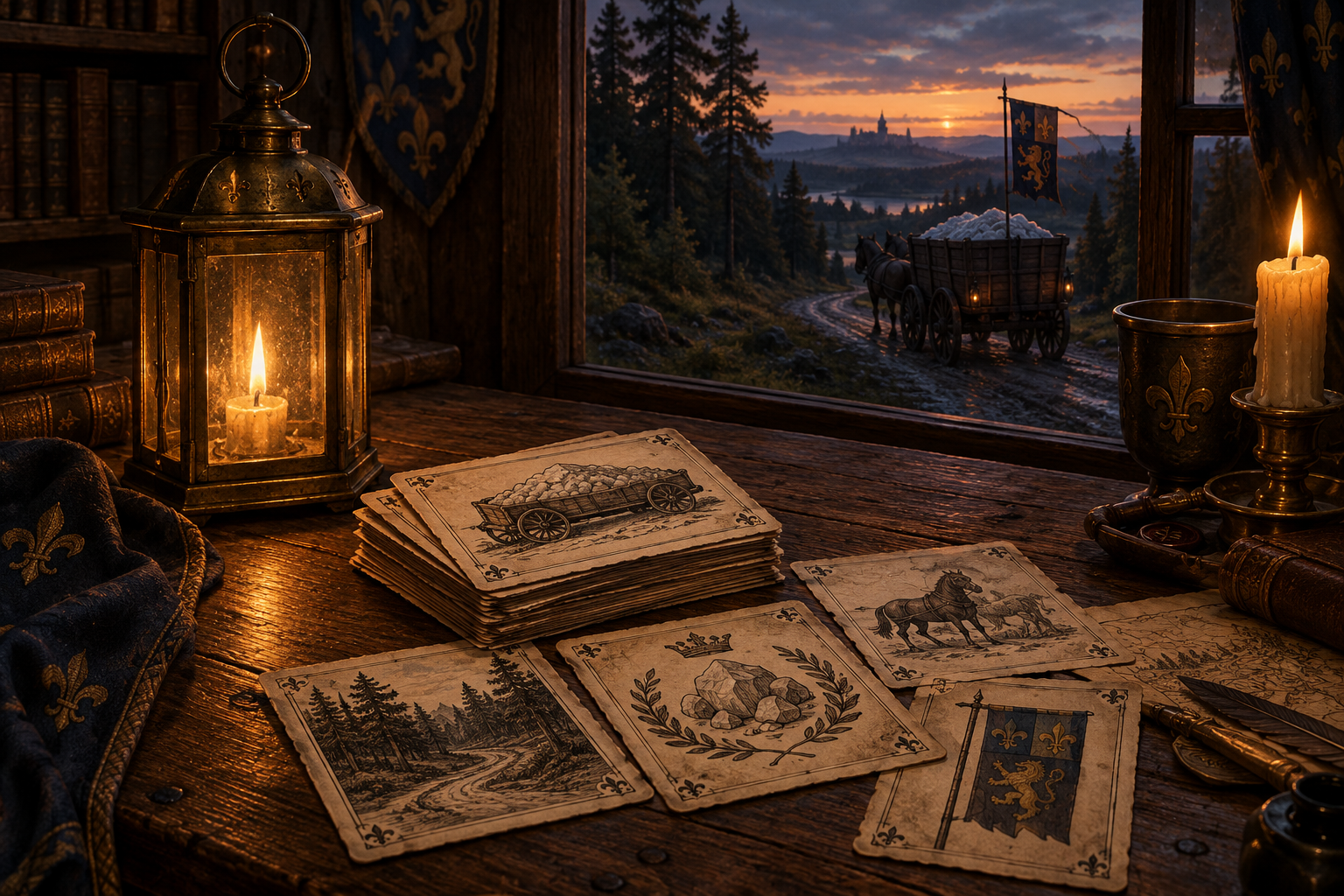
A scannable toolkit of lists and prompts for passive Perception: a score tracker, a threshold ladder, reveal phrasings, and a short checklist for the moment between noticing and searching.
Passive Perception is a quiet stat, and quiet stats are easy to mishandle in the middle of a session. The rule itself is simple. The trouble is that the Game Master has to remember four or five scores, decide a number for a hidden thing, phrase a reveal, and keep the scene moving, all at once.
This article is a toolkit rather than an essay. It collects lists, prompts, and small formats you can copy onto a note card or a corner of the screen. It is built for the person searching for a passive Perception cheat sheet: something fast to scan, easy to adapt, and honest about which parts are rules and which are table preference.
What this toolkit covers
Five pieces, each designed to be used in under a minute:
- A score tracker format for the screen or a note card.
- A threshold ladder for setting the number behind a hidden thing.
- A short list of reveal phrasings that keep a scene moving.
- A passive-or-active decision list for the moment a player says "I look around."
- A pre-session and mid-session checklist.
It does not try to teach passive Perception from scratch. If you want the full explanation, the earlier articles in this series on what the stat is, how it meets Stealth, and how to set thresholds cover that ground. A quick refresher is below so this page stands on its own.
Quick refresher: what the rule says
In the current Dungeons & Dragons rules, Passive Perception is a score that reflects a creature's general awareness of its surroundings, used when the creature is not consciously making a Wisdom (Perception) check. It equals 10 plus the character's Wisdom (Perception) check bonus, increased by 5 with Advantage or decreased by 5 with Disadvantage. The rules text is in the free Basic Rules (Wizards of the Coast, 2024).
One detail matters for everything below:
- Passive Perception is a Wisdom (Perception) score with the same proficiency and modifier math as the active check, just without the die.
Everything else in this toolkit is technique, not rules. Where something is a matter of table preference, it says so.
Tool 1: The score tracker
The single biggest source of friction is not knowing the numbers. If you have to ask "what's everyone's passive Perception?" in the middle of a tense moment, you have already broken the mood. Collect the scores once, at the start of the session or whenever a character's score changes, and keep them where you can see them.
A minimal tracker
A corner of the screen or a sticky note works. Use short labels:
- Scout: 15
- Cleric: 13
- Fighter: 11
- Wizard: 10
That is enough. Sort the list from highest to lowest so you can read it in one glance and spot the threshold cutoffs quickly.
An expanded tracker
If you want to track more, add columns for the things that change a passive score or that you might want to reference mid-scene:
- Passive Perception
- Passive Investigation (a house practice, since the rules define only Passive Perception; useful when a clue is hidden in the structure of a room rather than in the open)
- Passive Insight (also a house practice; useful when an NPC is lying and you want to give a quiet nudge)
- Notes on anything that changes the number (a condition, a situation that grants advantage or disadvantage, a feature that adds a bonus)
The more you track, the more upkeep the sheet demands. Many Game Masters find the minimal version is enough. How much to track is a table preference.
Tracker habits that save time
- Update the number when a character levels up, gains a relevant feature, or changes equipment that affects it. Ask players to tell you when this happens.
- Ask players to hand you their number rather than asking for their sheet each time. A one-line note at the start of a session is enough.
- If a situation imposes advantage or disadvantage on a passive check, adjust the number on the spot and say so aloud once, so players learn why their awareness shifted.
Tool 2: The threshold ladder
A passive score is only useful when it meets a number. That number is the threshold, and you set it. The rules give a table of typical Difficulty Classes for checks in general (Wizards of the Coast, 2024), but there is no single official ladder for passive thresholds, so the version below is a table-craft aid, not a rule. Adjust it freely.
A sample ladder
- Obvious (8 to 10): Something a distracted person would still catch. A lit window across a dark road. A door standing open.
- Modest (11 to 13): Something noticeable to a person paying ordinary attention. A thin wire across a path in daylight. Fresh footprints beside old ones.
- Concealed (14 to 16): Something someone made a real effort to hide. A bandit lying still in a ditch. A seam in a stone wall.
- Well hidden (17 to 19): Something that takes real skill to conceal. A pressure plate disguised by the floor's pattern. A watcher who knows how to stay motionless.
- Nearly invisible (20 and above): Something that passive awareness alone should rarely catch. Treat these as things the party must actively seek out or learn about another way.
How to use the ladder
Work backward from the fiction. Ask: how hard did the person or thing try to hide, and how much light, cover, and distance help them? Then pick the band that matches. You are not looking for a precise number. You are looking for a number that feels fair and that sorts your party in a way that makes the scene interesting.
A caution on thresholds
If your threshold sits above every character's passive score, nobody notices and the hidden thing becomes a pure surprise. If it sits below every score, nobody can fail to notice it and the passive check does no work. Neither is wrong. Both are decisions. The useful habit is to make the decision on purpose rather than by default.
Contested hidden things
When a creature is hiding, a common approach is to use its Stealth result as the number passive scores must meet. Under the rules, a creature that hides must succeed on a DC 15 Dexterity (Stealth) check, and its check total becomes the DC to find it with a Wisdom (Perception) check (Wizards of the Coast, 2024). Using a Stealth roll as the threshold is a practical technique, and some Game Masters instead use a fixed number set in advance, which has the advantage of letting you decide before the session and skip a roll mid-scene. Which you prefer is a table preference.
Tool 3: Reveal phrasings
Knowing that a character noticed something is only half the job. The other half is saying it in a way that keeps the scene moving and does not turn into a quiz. Evocative description is a craft skill in its own right (Alexander, 2017), and the phrasings below are starting points to adapt, not scripts to read.
Phrasing patterns that work
- Sensory first, conclusion second. "A thin glint crosses the road at ankle height." Let the player decide what it is.
- Name the character, not the number. "The scout notices..." is better than "Anyone with a passive of 13 or higher..." The number is yours. The fiction belongs to the table.
- Offer the next choice. End the reveal with a question about action: "What do you do?" This hands momentum back to the players.
- Reveal to the noticing character, not the whole group, when it fits. Passing a quiet note or speaking in a low voice to one player can make awareness feel personal. Whether to reveal privately or aloud is a table preference, and some groups prefer everything said openly.
Phrasings to avoid
- "Does anyone notice anything?" This turns a quiet stat into a prompt for a roll and defeats the purpose of using a passive score.
- "You fail to notice..." Do not narrate the absence of a perception. Say nothing about what characters did not catch.
- Over-explaining. One concrete detail is usually enough. Let the players ask follow-up questions.
When some characters notice and some do not
This is the awkward case, because it creates information asymmetry. A few ways table groups handle it:
- Tell only the characters who noticed, and let them decide whether to share. This tends to produce in-character conversation.
- Announce aloud that one character notices something, then describe it to everyone. This keeps everybody on the same page but gives up some of the tension.
- Pass notes or use a messaging tool for private reveals when you want asymmetry without cluttering the table.
None of these is wrong. A session zero conversation can settle which style the table prefers.
Tool 4: Passive or active? A decision list
The moment a player says "I look around," you have a choice. Here is a short list to help you decide quickly.
Use the passive score when
- The characters are doing something else, such as traveling, talking, or making camp, and awareness is a background condition.
- The thing to notice is meant to be seen or heard by an attentive person without deliberate effort.
- You want the scene to keep moving and the result is not worth a stop.
- Failing to notice would produce an interesting situation rather than a dead end.
Call for an active check when
- A player describes a deliberate action, such as searching a specific spot, listening at a door, or scanning a treeline.
- The result is uncertain and the stakes justify a roll.
- You want the player to feel the weight of a choice and a die.
- A passive score would settle the question too cleanly and remove a moment you want to play out.
Skip the check when
- The player describes an action that plainly finds the thing. If someone says they pull back the rug and look under it, and a trapdoor is there, you can simply tell them.
- Nothing is hidden. Do not roll to look for what does not exist.
This tracks a broader point made in many Game Master advice sources: roll only when failure is interesting and the outcome is uncertain, and otherwise narrate and move on. The idea of making critical information discoverable by more than one route is also discussed in the Three Clue Rule (Alexander, 2008). If something the party needs is hidden behind a single passive check, you may be creating a bottleneck. Consider a second way to learn it.
Tool 5: Checklists
Before the session
- Collect each character's passive Perception, and any other passive scores you want to use.
- List the hidden things in the session: traps, ambushes, secret doors, concealed items.
- Next to each, jot a threshold or a note that you will use a Stealth result.
- For each hidden thing, ask: if nobody notices, what happens? If someone does, what do they gain? If they search actively, what do they find?
- Check that no essential information depends on a single passive check.
During the session
- Glance at the tracker when characters enter a space with something hidden.
- Compare scores against thresholds quietly. Do not announce the comparison.
- Reveal with one concrete detail and return to the question of action.
- If a player describes an active search, switch to an active check or simply narrate the result.
- If a score or situation changes, update the tracker.
After the session
- Note which hidden things landed and which were missed. Missed is not failure. It is information about your numbers.
- If the same character always noticed everything, consider whether your thresholds are too low or whether that character's build deserves a bigger reward through harder challenges.
- If nobody ever noticed anything, consider whether your thresholds are too high or whether you are leaning on passive checks when an active search would be more engaging.
A short list of common problems and fixes
Problem: One character's high score makes everything trivial.
Fix: Raise thresholds on things that should be hard, and design some hidden things that reward active searching or other skills instead. A high passive score is a build reward. It does not need to negate every secret.
Problem: The party always misses the hidden thing and the scene stalls.
Fix: Provide a second clue or route (Alexander, 2008). Let a missed passive check become an interesting consequence rather than a dead end.
Problem: Players feel cheated when something they could not have noticed hurts them.
Fix: Consider telegraphing danger through environment and genre cues, so a missed passive check leaves a fair sense of what went wrong. Session zero can also set expectations about how lethal or surprising the game will be.
Problem: The Game Master forgets the numbers.
Fix: Use the tracker format above and keep it visible. If it is not on the screen, it will not get used.
Problem: Players ask for a roll every time they enter a room.
Fix: Explain that passive awareness is always working, and invite them to describe specific actions when they want to search. This is a conversation to have at the table, in a friendly way.
Example: The Lantern Road Company
This is an illustrative scenario, not a record of a real game.
The Lantern Road Company is a four-character party escorting a wagon of salt along a forest road. The Game Master has prepared an ambush: two bandits are hidden in a ditch beside a bend in the road, and a tripwire is strung across the path a few steps ahead of them.
Using the tracker format from Tool 1, the Game Master has written the passive Perception scores on a corner of the screen, sorted high to low: the scout at 15, the cleric at 13, the fighter at 11, and the wizard at 10.
Using the threshold ladder from Tool 2, the Game Master places the tripwire in the modest band and sets the threshold at 12. The scout and the cleric meet it. Using the reveal patterns from Tool 3, the Game Master says the scout spots a thin glint of wire across the road and asks what the party does. The fighter and wizard, whose scores fall short, do not hear any announcement about it.
The bandits are handled differently. The Game Master rolls Stealth for them and gets a 15, which becomes the number passive scores must meet. Only the scout's 15 meets it, so the scout catches a flash of movement in the ditch. The cleric, at 13, does not.
Then a player says their wizard wants to check the underbrush at the bend, describing how they crouch low and peer under the branches. Following the decision list in Tool 4, the Game Master recognizes a deliberate action and calls for a Wisdom (Perception) check instead of relying on the wizard's passive 10.
The checklist from Tool 5 does its quiet work in the background: the Game Master had already asked what happens if nobody notices the wire, and had a second source of warning ready, so no single missed score could stall the scene. The result is a tense standoff rather than a surprise nobody could have anticipated, and the wizard's player gets a meaningful moment from an active choice.
Adapting the toolkit to other systems
Passive scores are a feature of Dungeons & Dragons and games built on similar foundations. Other systems handle hidden things differently. Some use fixed noticing thresholds, some use a single active roll, and some use no roll at all. The ideas in this toolkit that travel well are the habit of tracking what you need in advance, setting a bar from the fiction, revealing with a concrete detail, and designing so that a single missed perception does not stop the game. The specific numbers and the passive formula do not travel. If you play a different system, check its own rulebook rather than assuming the D&D rules apply (Paizo Inc., 2023).
Building your own version
A toolkit is only useful if it matches how you run. Treat everything above as a starting draft. Cut the pieces you do not need, rename things in your own words, and add what your table asks for. Prep frameworks that fit one Game Master's habits are a recurring theme in the Game Master advice literature, and the point of building your own is that you will actually use it (Shea, 2026). If a tool does not earn its place on the screen, take it off.
Some people keep this kind of material in a notebook, some in a digital document, and some in a campaign tool. Use whatever format helps you spend less time looking things up and more time at the table.
Quick-reference card
Copy this onto a card if you like:
- Scores: list passive Perception, high to low, on the screen.
- Ladder: obvious 8 to 10, modest 11 to 13, concealed 14 to 16, well hidden 17 to 19, nearly invisible 20+. (Table-craft aid, not a rule.)
- Hidden creatures: use a Stealth result or a fixed number. Pick one approach and stay consistent.
- Reveal: one concrete detail, name the character, end with "What do you do?"
- Passive or active: passive for background awareness, active for deliberate searching.
- Never: hide essential information behind a single passive check.
Sources and Further Reading
- Alexander, J. (2008, May 8). The Three Clue Rule. The Alexandrian. https://thealexandrian.net/wordpress/1118/roleplaying-games/three-clue-rule
- Alexander, J. (2017, September 4). Random GM Tip: Evocative Descriptions. The Alexandrian. https://thealexandrian.net/wordpress/39227/roleplaying-games/random-gm-tips-evocative-descriptions
- Paizo Inc. (2023). Pathfinder GM Core.
- Shea, M. E. (2026, January 26). Your Own Prep Framework. Sly Flourish. https://slyflourish.com/yourownprep_framework.html
- Wizards of the Coast. (2024). Basic Rules for Dungeons & Dragons. D&D Beyond. https://www.dndbeyond.com/sources/dnd/br-2024/
Play 5E at your own table
Play with friends or solo, run your own campaign, and keep the dice and character math in code. An optional AI Dungeon Master can run the game when you want one. Free to start, no card required.
Related reading
- Linear, Clustered, or Looping: Three Ways to Shape a Session's Rhythm
Three ways to lay out a session's scenes, using working labels, produce three very different rhythms. This comparison weighs linear, clustered, and looping structures and when each one tends to fit.
- The Session Pacing Toolkit: Checklists, Templates, and Table-Side Aids
A practical toolkit of pacing aids for game masters: a scene ledger, a beat map, a timing grid, and table-side prompts for keeping a session's rhythm without overthinking it.
- Designing Rhythm Into a Session: A Design Perspective on Tension, Release, and Spacing
Rhythm is a design decision, not a happy accident. This design-perspective essay looks at intensity, contrast, duration, and placement as materials a game master can shape before play begins.