What Is a Dungeon Crawl in D&D and How Does It Work?
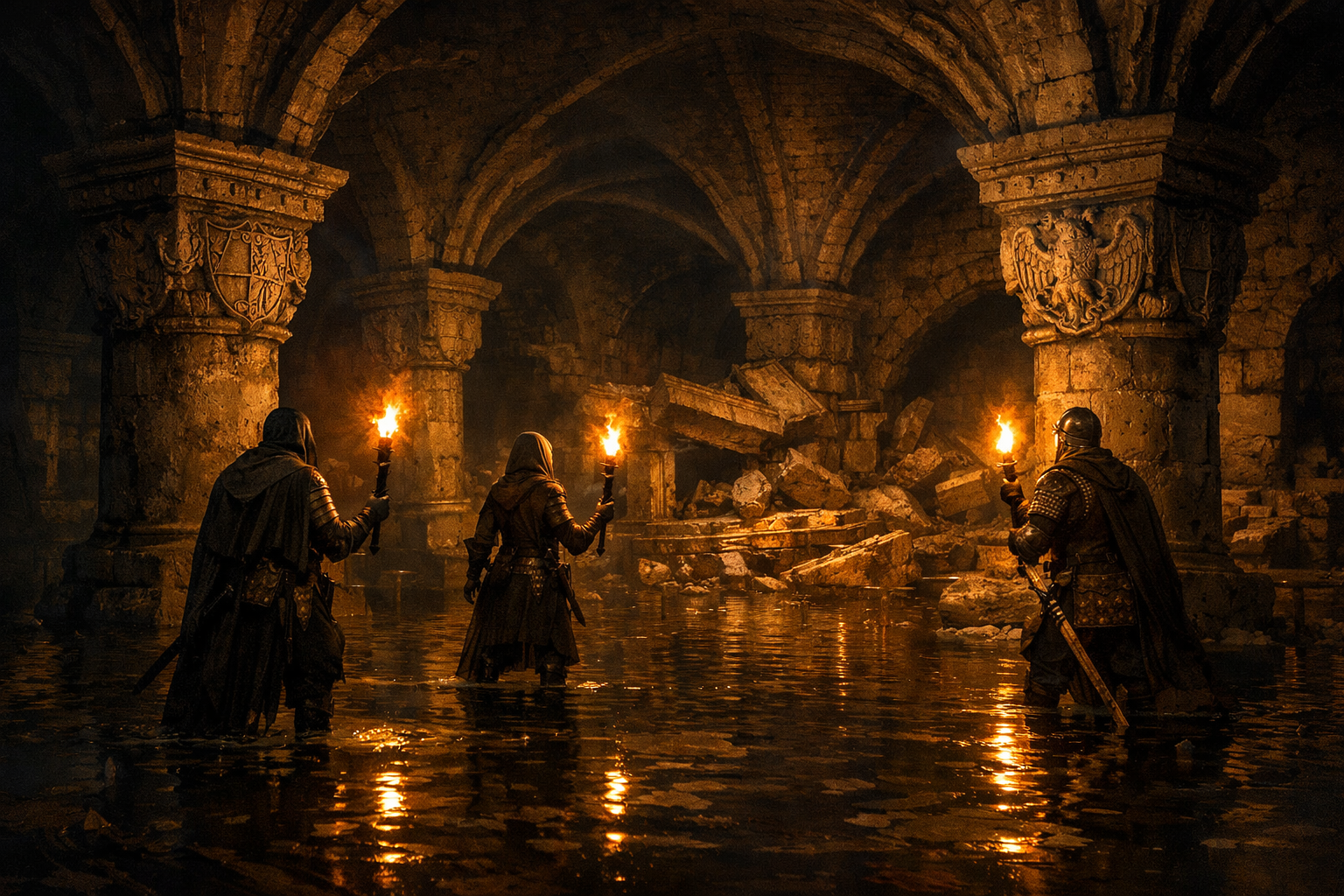
Learn the core elements of dungeon crawls, from exploration and resource management to encounter design, and how to run engaging underground adventures.
A dungeon crawl is one of the foundational adventure structures associated with Dungeons & Dragons.
At its simplest, a dungeon crawl is location-based exploration. The characters enter a bounded environment made up of interconnected areas, gather information, choose routes, overcome obstacles, interact with inhabitants, and decide how far they are willing to push before circumstances force them to change their plans.
Despite the name, a dungeon crawl does not require a literal underground dungeon.
The same structure can work in:
- Ancient ruins
- Sewers
- Haunted mansions
- Fortresses
- Wizard towers
- Temples
- Caves
- Mines
- Abandoned cities
- Ships
- Laboratories
- Other dense, explorable locations
What makes the adventure a crawl is less about stone corridors and more about navigating a place whose geography, inhabitants, hazards, information, and resources interact with player decisions.
Some dungeon crawls emphasize tactical combat and careful resource management.
Others focus more heavily on investigation, atmosphere, factions, puzzles, discovery, or environmental storytelling.
Understanding the structure helps Dungeon Masters design stronger locations and helps players recognize the decisions that make dungeon exploration engaging.
The Core Structure of a Dungeon Crawl
A useful dungeon crawl usually combines several elements:
- A defined location
- Meaningful navigation
- Information gained through exploration
- Obstacles and opportunities
- Consequences that persist
- Some reason to continue exploring
Not every dungeon needs every element in equal measure.
A small haunted crypt might emphasize atmosphere and investigation.
A military fortress might emphasize stealth, patrols, and tactical positioning.
A megadungeon might emphasize navigation, logistics, factions, repeated expeditions, and long-term discovery.
The common thread is that the location itself becomes part of the game.
A Defined, Explorable Location
Dungeon crawls usually take place in an environment with enough spatial structure that movement and route selection matter.
Players might decide:
- Which door to open
- Which corridor to follow
- Whether to descend another level
- Whether to investigate a side chamber
- Whether to return to a previous junction
- Whether to use a secret passage
- Whether to retreat
- Whether to avoid an occupied area
- Whether to barricade a route behind them
This creates a useful default decision.
When nothing remains to do in the current area, the players can choose where to explore next.
That decision may appear simple, but the accumulated choices create the shape of the expedition.
A dungeon with several routes can produce substantially different experiences depending on which direction the party chooses.
Linear and Nonlinear Dungeons
Not every dungeon needs to be a maze.
A dungeon can be:
- Mostly linear
- Branching
- Looping
- Multi-level
- Highly interconnected
- Accessible from several entrances
A linear dungeon may work well for a focused trial, escape sequence, short introductory adventure, or location where the architecture naturally restricts movement.
More interconnected layouts can create additional strategic choices.
Loops and alternate routes allow players to:
- Bypass threats
- Approach locations from another direction
- Create escape routes
- Discover shortcuts
- Revisit earlier areas efficiently
- Choose which dangers to confront
Vertical connections can add even more possibilities.
A stairwell, shaft, balcony, cave opening, collapsed floor, elevator, or hidden passage may connect areas that otherwise appear distant.
The goal is not to make every map complicated.
It is to make geography meaningful when navigation is supposed to be part of the adventure.
Exploration and Information
Dungeon crawling is not simply moving a miniature from room to room.
Exploration gives players information.
That information helps them decide what to do.
Players may discover:
- Tracks
- Sounds
- Architecture
- Damage
- Remains
- Written records
- Symbols
- Patrol patterns
- Environmental changes
- Secret passages
- Evidence of nearby creatures
- Faction territories
Good information creates decisions.
Suppose the party reaches a corridor containing:
- Burn marks across the stone
- Several shattered shields
- A strong smell of sulfur
- A closed iron door
- A narrow side passage with recent footprints
The Dungeon Master has not told the players exactly what lies ahead.
But the players now have information they can use.
They might:
- Investigate the burns
- Follow the footprints
- Listen at the door
- Search for another route
- Prepare fire protection
- Retreat
- Proceed cautiously
That is exploration.
Resource Management
Resource management is strongly associated with traditional dungeon crawling, but the amount of tracking varies by ruleset and table.
Possible resources include:
- Hit Points
- Hit Dice
- Spell slots
- Limited-use class features
- Healing
- Consumables
- Ammunition
- Food
- Water
- Light
- Time
- Safe resting opportunities
- Information
Current D&D still gives mundane light sources real durations.
A torch, for example, burns for one hour under the current rules.
Whether tracking individual torches creates interesting decisions at your table is another question.
Some groups enjoy detailed expedition logistics.
Others prefer to assume the characters maintain routine supplies unless something unusual threatens them.
Neither approach is automatically superior.
Make Resource Tracking Serve Decisions
Track a resource when its scarcity creates meaningful choices.
For example:
Light matters if darkness changes what the characters can perceive and they have limited illumination.
Time matters if enemies are moving, a ritual is progressing, water is rising, or another faction is searching the dungeon.
Food matters during an extended expedition where resupply is difficult.
Spell slots matter because spending a powerful spell now may change what remains available later.
Tracking resources simply because a spreadsheet allows you to do so may add bookkeeping without improving play.
Ask:
What decision does this resource create?
If there is no meaningful answer, detailed tracking may not be necessary.
Time as a Dungeon Resource
Time can make dungeon decisions consequential even when the party has plenty of equipment.
The Dungeon Master might track:
- How long searching takes
- How long light sources last
- When patrols move
- When reinforcements arrive
- When a ritual progresses
- How long until environmental conditions change
- Whether characters can safely rest
Older editions and many old-school games use formal exploration turns to structure this process.
A modern D&D table can adopt a similar procedure if the group enjoys that style, but it is not necessary to impose one universal dungeon-turn system.
You might instead track time approximately.
For example:
Thoroughly searching this chamber takes about ten minutes.
or:
If you barricade the room and take a Short Rest, the inhabitants elsewhere in the dungeon have time to react.
The important part is consistency.
Players should be able to understand that spending time can change the situation.
Marching Order
Current D&D explicitly supports marching order during travel indoors and outdoors.
This can be particularly useful in a dungeon.
A marching order helps determine:
- Who encounters a hazard first
- Who can see around a corner
- Who is closest when combat begins
- Who may notice a hidden creature
- How characters fit through a narrow passage
The party can change its marching order whenever the situation permits.
This does not need to become complicated.
You can:
- Write down character names
- Arrange miniatures
- Use tokens
- Track positions on a VTT
- Ask the players to describe their formation
The purpose is shared spatial understanding.
Tactical Combat
Dungeon environments can make combat tactically different from battles in open terrain.
A dungeon might contain:
- Narrow corridors
- Multiple doors
- Cover
- Difficult terrain
- Platforms
- Bridges
- Water
- Pits
- Furniture
- Stairways
- Hazards
- Choke points
- Alternate entrances
The same enemy can behave differently depending on the location.
Four guards in an empty room create one encounter.
The same guards defending two connected chambers with arrow slits, alarm bells, and a rear escape route create another.
Combat Can Affect Nearby Areas
A dungeon becomes more convincing when encounters are not completely isolated.
Noise might:
- Alert nearby inhabitants
- Cause enemies to investigate
- Encourage creatures to flee
- Change patrol behavior
A surviving enemy might:
- Retreat
- Warn allies
- Barricade a door
- Move valuable objects
- Prepare an ambush
These responses should follow from what the inhabitants can reasonably hear, know, and do.
Do not automatically turn every loud combat into another fight.
The important principle is that events in one area can affect the rest of the location.
Environmental Hazards
Dungeons can contain challenges that are not creatures.
Examples include:
- Collapsing structures
- Flooded chambers
- Unstable floors
- Fire
- Poisonous fumes
- Extreme temperatures
- Magical effects
- Locked doors
- Crumbling bridges
- Moving machinery
Hazards work best when players have something to interact with.
They might:
- Notice warning signs
- Investigate
- Find another route
- Disable a mechanism
- Use equipment
- Accept the risk
- Trigger the hazard deliberately against an enemy
The purpose is not to punish players for failing to guess what the Dungeon Master secretly placed on the map.
The hazard should exist as part of the environment.
Traps
Traps can range from simple alarms to lethal defensive mechanisms.
A trap may protect:
- Treasure
- A restricted area
- A military position
- A tomb
- A secret passage
- A valuable prisoner
Good trap design considers more than the saving throw or damage.
Ask:
- Why is the trap here?
- Who built it?
- Who normally passes through this area?
- How is it avoided by the inhabitants?
- What evidence might it leave?
- What happens after it activates?
The amount of warning appropriate for a trap depends partly on campaign style.
A highly lethal exploration campaign may expect cautious procedures and significant risk.
A heroic campaign may use clearer telegraphing and less severe consequences.
In either case, connecting traps to the environment makes them feel like part of the world rather than arbitrary interruptions.
Puzzles and Environmental Problems
Puzzles are optional.
A dungeon does not need riddles simply because it is a dungeon.
When puzzles are used, they should fit the location.
Possible examples include:
- A ceremonial mechanism
- A sequence of magical seals
- A damaged machine
- A coded archive
- A navigation problem
- A physical obstacle
Avoid making critical campaign progress depend entirely on players guessing one answer in the Dungeon Master's head.
Character knowledge and abilities can provide information.
Investigation, Arcana, History, Religion, tools, spells, equipment, and experimentation may all contribute depending on the situation.
Progressive Discovery
Dungeon crawls naturally support environmental storytelling because information arrives piece by piece.
The party may initially know almost nothing about the location.
As they explore, they begin reconstructing:
- Who built it
- What happened there
- Who occupies it now
- Which factions are present
- What the major threat wants
- Which routes are safe
- Which areas remain unexplored
This information can come through:
- Architecture
- Murals
- Records
- Bodies
- Equipment
- NPCs
- Prisoners
- Symbols
- Environmental damage
- Treasure
- Creature behavior
Discovery feels particularly satisfying when earlier details become useful later.
Example: The Sunken Crypt of Vramore
Imagine a party investigating a crypt beneath the collapsed Cathedral of Vramore.
Local farmers report undead emerging from the ruins after sunset.
The characters descend beneath the cathedral and discover that centuries of flooding have transformed the crypt into a partially submerged network of passages.
The Initial Information
Near the entrance they find:
- Old religious mosaics
- Water marks at several different heights
- Scratches on a sealed door
- Recent footprints mixed with skeletal tracks
- A current of cold air coming from a side passage
Already, they have choices.
Do they follow the footprints?
Investigate the sealed door?
Follow the air current?
Search the mosaics for information?
Light and Exploration
If the group relies on torches, the Dungeon Master can track their duration if that matters to the expedition.
If the party has reliable magical light or Darkvision, ordinary torch scarcity may matter much less.
Instead, time pressure might come from rising water or undead patrols.
The resource pressure should reflect the actual characters and situation.
Combat
In a partially collapsed chapel, the party encounters several undead.
Broken pews provide cover.
Floodwater creates difficult movement in parts of the room.
A cracked balcony offers another route.
During the fight, the cleric uses Turn Undead.
Some creatures flee through an open passage.
What happens next depends on the dungeon.
The fleeing creatures might alert another inhabitant.
They might simply disappear deeper into the crypt.
The DM should follow what makes sense for the location rather than automatically adding reinforcements.
Discovery
Earlier mosaics depicted four symbols associated with the cathedral's original consecration.
Later, the same symbols appear around a sealed chamber.
Characters who recorded or remember the earlier information have an advantage in understanding the mechanism.
Inside, they find the necromantic focus responsible for awakening the dead.
The information discovered through exploration has become part of solving the dungeon's central problem.
That connection is one of the strengths of location-based adventure design.
How Dungeon Crawls Relate to Other Adventure Structures
Dungeon crawls are often compared with sandboxes, linear adventures, and hexcrawls.
These categories are not mutually exclusive.
They describe different structures and scales.
Dungeon Crawls and Sandbox Play
A sandbox campaign gives players broad freedom to decide which objectives, locations, factions, and opportunities to pursue.
A well-designed dungeon can create similar freedom at a smaller scale.
A nonlinear dungeon might contain:
- Several entrances
- Competing factions
- Multiple objectives
- Alternate routes
- Areas far above the party's current capabilities
- Secrets that change how the location can be navigated
Players may decide which areas to explore and in what order.
That is effectively a local exploration sandbox.
A dungeon crawl therefore does not automatically mean a restrictive or predetermined adventure.
Dungeon Crawls and Linear Adventures
A dungeon can be linear.
For example, an ancient trial might deliberately present a sequence of chambers that must be completed in order.
A collapsing mine might force the party along one escape route.
A short introductory dungeon might use a simple branching layout.
The important question is whether the amount of navigational choice supports the intended experience.
If the purpose is exploration, more connections and route choices generally give players more meaningful spatial decisions.
If the purpose is a focused gauntlet, linearity may be intentional.
Dungeon Crawls and Hexcrawls
Hexcrawls operate at a different geographic scale.
A hexcrawl usually involves moving across a larger region and discovering locations distributed throughout that region.
A dungeon crawl zooms into one of those locations.
The structures can nest naturally:
- The party explores a wilderness hex.
- They discover an abandoned fortress.
- Entering the fortress begins a dungeon crawl.
- Leaving the fortress returns to wilderness exploration.
One structure does not replace the other.
They answer different navigational questions.
Dungeon Crawls and Plot-Driven Adventures
A story-focused adventure can include a dungeon crawl.
For example:
The party learns that an antagonist is performing a ritual beneath a city.
The broader campaign may be driven by relationships, political decisions, and character goals.
Once the party enters the underground complex, the immediate structure shifts toward dungeon exploration.
Adventure structures can change within the same campaign.
Running an Effective Dungeon Crawl
Dungeon crawling becomes easier to run when the location is understandable as a place rather than merely a sequence of encounters.
Begin With the Location's Purpose
Ask:
- Why was this place built?
- Who built it?
- What was it originally used for?
- Who occupies it now?
- How has it changed?
- What resources do the inhabitants need?
- How do inhabitants move through it?
A fortress should have architecture that reflects defense.
A tomb may emphasize ceremonial spaces and restricted areas.
A mine follows geology and extraction routes.
A wizard's laboratory may contain systems that make sense only to its creator.
The location does not need perfect architectural realism.
It should have enough internal logic that players can reason about it.
Key the Areas Clearly
For each important area, record the information needed to run it.
A useful room key might include:
Immediate Description
What characters perceive upon entering.
Inhabitants
Who is currently here and why.
Interactive Features
Doors, objects, hazards, mechanisms, furniture, terrain, or other usable elements.
Information
Clues or discoveries available here.
Treasure or Resources
Anything the characters may find or use.
Connections
Where the exits lead.
Keep entries scannable.
Long prose is harder to use while answering player questions.
Quiet and Transitional Spaces
Not every room needs:
- Combat
- A puzzle
- Treasure
- A major clue
A believable environment can contain:
- Empty storage areas
- Corridors
- Abandoned rooms
- Damaged spaces
- Previously looted chambers
- Architectural transitions
These spaces can still contribute.
They might:
- Establish atmosphere
- Provide spatial information
- Offer rest or concealment
- Show evidence of previous inhabitants
- Create distance between threats
- Make other discoveries feel less predictable
The danger is not having an empty room.
The danger is creating long stretches of exploration where repeated areas provide no meaningful information, decision, tension, or atmosphere.
Create Meaningful Connections
If exploration is central to the adventure, look for opportunities to connect areas in interesting ways.
Possible techniques include:
- Loops
- Multiple entrances
- Secret passages
- Vertical connections
- One-way routes
- Shortcuts
- Windows overlooking other rooms
- Locked connections that can be opened later
These features make information about the map strategically useful.
Players can learn the dungeon instead of merely progressing through it.
Populate the Dungeon With Motivated Inhabitants
Creatures should not necessarily wait forever in assigned rooms.
Ask:
- What are they doing?
- What do they want?
- Who are their allies?
- Who are their enemies?
- Where do they go?
- What makes them retreat?
- What alarms them?
A dungeon inhabited by multiple intelligent groups can become a social environment.
The party might:
- Negotiate
- Trade
- Manipulate rivalries
- Recruit allies
- Start a conflict
- Accidentally strengthen one faction
This creates a living dungeon.
Decide How Time Works
Before running the dungeon, decide how precisely you want to track time.
You might use:
Approximate Time
Estimate how long major activities take.
Explicit Exploration Turns
Divide exploration into consistent chunks of time and track activities within them.
Scene-Based Time
Advance the clock after meaningful scenes, searches, rests, or major decisions.
No single method fits every campaign.
Use enough structure that time-dependent consequences remain fair and understandable.
Wandering Encounters and Dungeon Activity
Random or scheduled dungeon events can make time matter.
Possible events include:
- Patrols
- Wandering creatures
- Faction movement
- Environmental changes
- Distant sounds
- Other explorers
- Reinforcements
- Signs of activity
These events do not need to produce combat.
A random encounter table can contain information, atmosphere, and opportunities as well as enemies.
Use random checks when uncertainty about what happens over time improves the dungeon.
Do not use them solely because dungeon crawls traditionally contain wandering monsters.
Resting in a Dungeon
Rest can create an important decision.
The party may ask:
- Is this room defensible?
- Does anyone know we are here?
- Can we barricade the door?
- What happens elsewhere while we wait?
- Do we have time?
Resolve resting based on the rules and the fictional circumstances.
Do not automatically prevent rests because the party has too many resources.
Likewise, do not assume the dungeon freezes while the characters recover.
The inhabitants may respond if they have reason and opportunity to do so.
Telegraph Significant Danger
Players do not need complete knowledge of every threat.
They do need enough information to make meaningful decisions when their characters could perceive warning signs.
Danger might be communicated through:
- Corpses
- Tracks
- Damage
- Sounds
- Smells
- Warnings
- Architecture
- Enemy behavior
- Environmental effects
A powerful creature does not need a sign reading "High Difficulty Encounter."
The environment can communicate that something dangerous lives nearby.
Playing a Dungeon Crawl
Players also influence how satisfying a dungeon crawl becomes.
Maintain Orientation
Know where the party has been and what remains unexplored.
Depending on the table, this might involve:
- Drawing a map
- Annotating a provided map
- Using a VTT
- Taking written notes
- Tracking landmarks
The players do not necessarily need to manually reproduce every corridor.
What matters is being able to make informed navigation decisions.
Use Marching Order Deliberately
Different formations may make sense in different environments.
A narrow tunnel might force single file.
A large chamber may allow the group to spread out.
Characters may rearrange when expecting:
- Traps
- Ambushes
- Negotiations
- Combat
There is no universally correct marching order.
Discuss what the party is doing when position matters.
Manage Resources Deliberately
Do not simply conserve every limited ability forever.
Ask:
- What problem does using this resource solve?
- What might we need later?
- What happens if we do not use it?
- Can we recover before the next major threat?
Sometimes spending a powerful ability early prevents greater resource loss later.
Resource management is about trade-offs, not always saving everything.
Share Information
Dungeon crawls reward groups that communicate.
Tell the other players when your character discovers:
- Tracks
- Symbols
- Secret passages
- Enemy weaknesses
- Strange sounds
- Useful items
Discuss theories.
Compare clues.
Keep track of unresolved questions.
The group's accumulated knowledge is one of its most important dungeon-crawling resources.
Think Beyond Combat
When appropriate, consider:
- Stealth
- Negotiation
- Retreat
- Barricades
- Environmental manipulation
- Alternate routes
- Distractions
- Observation
Not every monster must be fought.
Not every door must be opened.
Not every room must be explored.
Choosing what to leave alone can be as important as choosing what to confront.
Common Dungeon Crawl Variations
Dungeon crawling supports many different scales and styles.
The Compact Dungeon
A small dungeon may contain only a handful of areas.
It works well for:
- One-shots
- Introductory adventures
- Side quests
- Single objectives
Small does not have to mean linear.
Even six rooms can contain loops, alternate routes, secrets, and meaningful choices.
The Megadungeon
A megadungeon is a very large, persistent dungeon capable of supporting repeated expeditions or even an entire campaign.
Common features may include:
- Multiple levels
- Numerous entrances
- Factions
- Areas of different danger
- Shortcuts
- Persistent changes
- Repeated returns
Players often learn the dungeon over time and develop strategies for navigating familiar areas.
The Gauntlet
A gauntlet emphasizes forward progression through a series of challenges.
It may contain:
- Trials
- Hazards
- Battles
- Puzzles
- Time pressure
Because it limits route choice, a gauntlet emphasizes overcoming obstacles more than open-ended navigation.
It is closely related to dungeon design but produces a different exploration experience from a highly interconnected crawl.
The Living Dungeon
A living dungeon emphasizes inhabitants who respond dynamically.
Factions might:
- Fight one another
- Negotiate
- Patrol
- Move
- Trade
- Reinforce positions
- Abandon areas
The party's actions can change those relationships.
The Procedural or Shifting Dungeon
Some dungeons are generated or changed through procedures.
Rooms may:
- Be randomly generated
- Rearrange magically
- Change between visits
- Appear according to tables or cards
Procedural design can create uncertainty and replayability.
Make sure players understand enough of the structure to make meaningful decisions rather than experiencing the dungeon as arbitrary randomness.
Dungeon Crawls Outside Traditional Fantasy
The structure is portable.
A science-fiction dungeon crawl might involve:
- An abandoned research station
- A derelict spacecraft
- An alien complex
A modern game might use:
- A fortified building
- An underground facility
- A quarantined hospital
What matters is dense, location-based exploration rather than medieval stone walls.
Why Dungeon Crawls Work
Dungeon crawling remains useful because the structure gives players a clear method for interacting with an unknown environment.
The location asks recurring questions:
- Where do we go?
- What do we investigate?
- What do we risk?
- What have we learned?
- Should we continue?
- Should we retreat?
The answers accumulate.
Players learn the map.
They learn the inhabitants.
They discover shortcuts.
They identify dangerous areas.
They decide which goals are worth pursuing.
That feedback between exploration and decision-making gives the location increasing meaning over time.
Dungeon Crawls Are Not Only About Combat
A dungeon can support:
- Negotiation
- Mystery
- Horror
- Environmental storytelling
- Survival
- Politics
- Exploration
- Tactical combat
The balance depends on the inhabitants and purpose of the place.
A tomb may be largely abandoned.
A fortress may be full of organized defenders.
An underground city may contain dozens of factions and social opportunities.
Avoid assuming that "dungeon crawl" means "fight whatever is in every room."
Adapting Dungeon Crawls to Your Table
Before running a dungeon-focused adventure, discuss how much detail the group wants.
Possible questions include:
- Do we want precise maps?
- Who tracks discovered areas?
- How closely do we track light?
- Does food matter?
- How precisely do we track time?
- How dangerous should traps be?
- How easy is retreat?
- How available are rests?
- Do we enjoy random encounters?
- Do we prefer tactical maps or theater of the mind?
You do not need a formal meeting devoted solely to these questions.
They can be part of session zero or discussed as the campaign develops.
Adjust the Granularity
A logistics-focused table may enjoy:
- Torch tracking
- Detailed encumbrance
- Expedition supplies
- Exploration turns
- Frequent dungeon events
A story-focused table might track only:
- Major resources
- Important time pressure
- Significant hazards
Both can still experience meaningful dungeon exploration.
The Dungeon Master should choose procedures that reinforce the type of decisions the group wants to make.
Using The Dungeon Trainer for Dungeon Crawls
The Dungeon Trainer can support dungeon exploration whether a human Dungeon Master runs the table or the group chooses AI-led play.
Human-DM Campaigns
A human Dungeon Master can retain narration and adjudication authority while the platform handles shared game state in code.
That can include:
- Character sheets
- Dice
- Damage and healing
- Hit Points
- Conditions
- Initiative
- Combat rounds
- Campaign continuity
- A shared transcript
Human-DM controls do not require AI model calls.
AI can remain completely outside the campaign unless the group chooses to enable it.
Scry
Scry can help a Dungeon Master prepare an upcoming dungeon scene by forecasting plausible branches.
For example, before the party reaches a guarded junction, Scry can help identify:
- Likely approaches
- Possible complications
- Pacing risks
- A single point of failure
- Preparation considerations
The purpose is not to decide which corridor the players will choose.
It helps the DM prepare for several plausible choices.
Campaign Memory
Long dungeon expeditions produce a large amount of continuity:
- NPCs encountered
- Locations visited
- Quests
- Previous events
- Campaign consequences
The platform can maintain searchable campaign records while unrevealed Dungeon Master information remains hidden from players.
Generators
The Dungeon Trainer can generate material such as:
- Monsters
- NPCs
- Locations
- Items
- Spells
Generated content should be reviewed before adding it to the dungeon.
A random room or monster is useful only when it fits the surrounding location and campaign.
The Coach
The Coach can provide practice scenarios involving Dungeon Master decisions such as:
- Adjudicating unusual player approaches
- Handling exploration
- Managing pacing
- Responding to unexpected solutions
- Balancing information and uncertainty
Optional AI Dungeon Master
Groups that want autonomous AI-led play can choose an AI Dungeon Master for separate solo or multiplayer adventures.
That option exists alongside human-run play rather than replacing it.
Conclusion
A dungeon crawl is a location-based adventure structure built around exploring an environment and making decisions about how to interact with it.
The dungeon might be underground.
It might also be a tower, mansion, fortress, ship, ruin, laboratory, or another bounded location.
Its defining strengths come from the relationship between:
- Geography
- Information
- Navigation
- Inhabitants
- Hazards
- Resources
- Consequences
Resource management can strengthen dungeon crawling, but it does not need to dominate every table.
Combat can be important, but dungeon crawling is not simply a sequence of fights.
Maps can help, but exact player-drawn cartography is not mandatory.
Nonlinear routes can create strong exploration, but some dungeons deliberately use more focused structures.
The Dungeon Master's job is to build and present a location that can respond to player decisions.
The players' job is to decide what risks to take, what information to pursue, and where to go next.
That simple cycle can support an enormous variety of adventures:
Explore. Learn. Decide. Act. Discover what changed.
Then choose the next door.
Sources and Further Reading
- Alexander, J. (2010, July 23). Xandering the Dungeon. The Alexandrian.
- Alexander, J. (2010, July 26). Xandering the Dungeon, Part 2: Xandering Techniques. The Alexandrian.
- Alexander, J. (2023, November 1). A Historical Note on Xandering. The Alexandrian.
- Finch, M. (2008). A Quick Primer for Old School Gaming. Lulu.
- Gygax, G. (1979). Dungeon Masters Guide. TSR.
- Shea, M. E. (2018). Return of the Lazy Dungeon Master. Sly Flourish.
- Wizards of the Coast. (2024). D&D Free Rules. D&D Beyond.
- Wizards of the Coast. (2024). Dungeon Master's Guide.
- Wizards of the Coast. (2025). System Reference Document 5.2.1.
- The Dungeon Trainer. (2026). The Dungeon Trainer.
---
Ready to build or explore a dungeon of your own? The Dungeon Trainer supports human Dungeon Masters with code-resolved table mechanics, campaign continuity, Scry preparation, coaching, generators, and optional AI. Run the crawl yourself, use AI only where it helps, or choose a separate AI-led adventure.
This work includes material from the System Reference Document 5.2.1 (“SRD 5.2.1”) by Wizards of the Coast LLC, available at https://www.dndbeyond.com/srd. The SRD 5.2.1 is licensed under the Creative Commons Attribution 4.0 International License, available at https://creativecommons.org/licenses/by/4.0/legalcode.
Related reading
- Why Megadungeons Succeed or Fail: Lessons from Forty Years of Play
Megadungeons have persisted since the earliest days of tabletop roleplaying, yet many campaigns abandon them within a few sessions. Learn what structural, pacing, and preparation factors separate sustainable megadungeons from those that collapse, and how to apply those lessons at your own table.
- Understanding the Megadungeon: What It Is and When to Use It
A megadungeon is more than a big dungeon. Learn what defines this sprawling adventure structure, why it persists across decades of play, and when it serves your table better than episodic adventures.
- Running Sandbox Campaigns: Six Months with The Millbrook Consortium
Sandbox campaigns promise player-driven freedom but demand different preparation and facilitation techniques. This case study examines six months of running The Millbrook Consortium, a merchant-focused sandbox, to identify practical lessons about faction management, player agency, and sustainable open-world play.