What Is Action Economy in D&D and Why It Matters
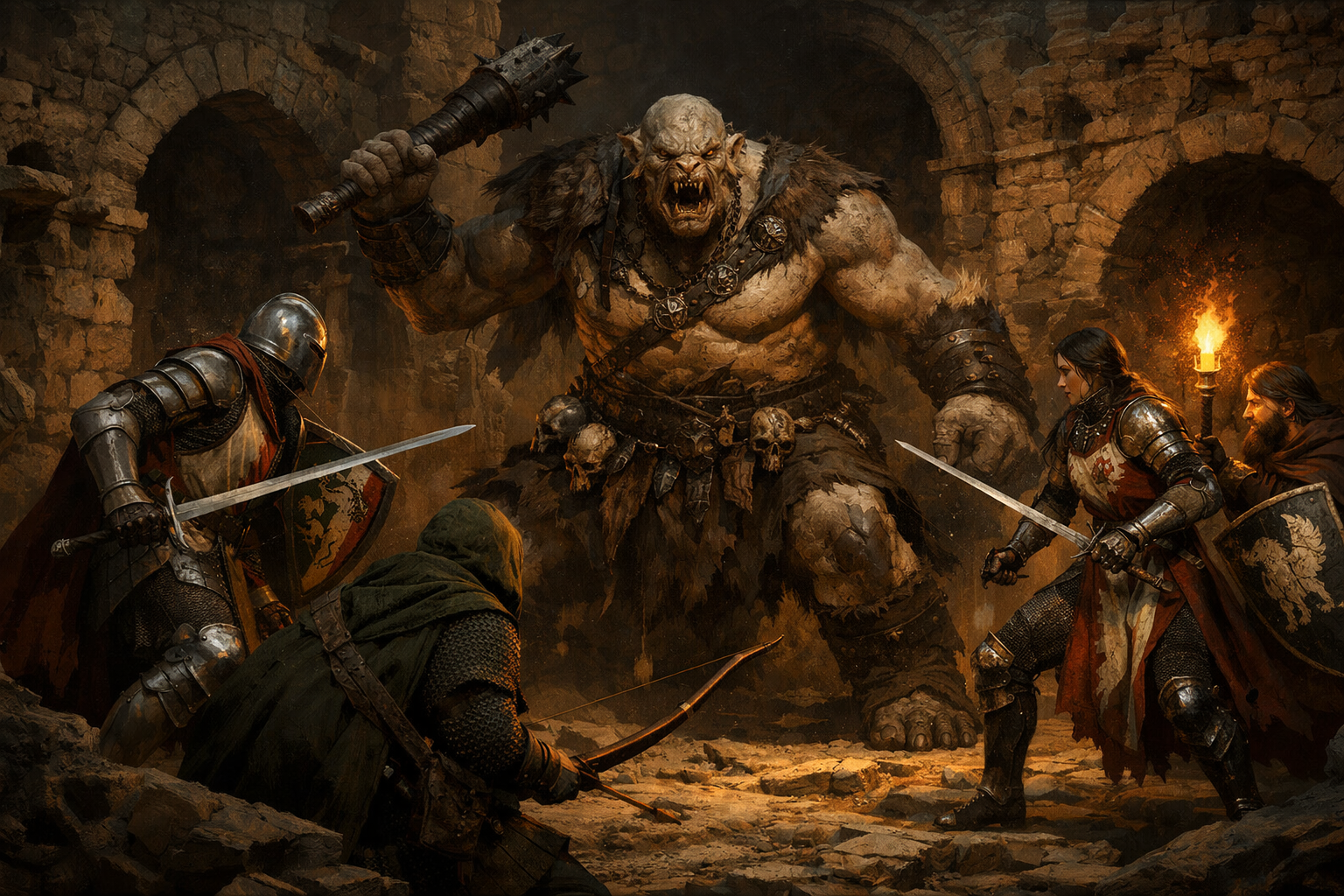
Action economy determines who wins battles in tabletop RPGs. Understanding this core mechanic helps dungeon masters create balanced, engaging encounters.
Action economy describes the total number of meaningful actions available to each side during a combat round. This concept underlies every tactical decision in Dungeons & Dragons and similar tabletop RPGs, yet many dungeon masters struggle to grasp why some encounters feel unfair despite having appropriate challenge ratings.
Understanding action economy transforms how you design encounters, adjudicate combat, and help players make strategic choices.
Defining Action Economy
Action economy refers to the distribution of actions, bonus actions, and reactions across all combatants during a round of combat. The side with more total actions holds a significant tactical advantage, regardless of individual power levels.
In D&D 5th Edition, each creature typically receives:
- One action per turn
- One bonus action (if they have abilities that use it)
- One reaction per round
- Movement up to their speed
A party of four adventurers facing a single enemy means the party gets four actions to the enemy's one. Even if that enemy is a powerful dragon, the sheer volume of attacks, spells, and tactical maneuvers available to the party creates inherent advantages.
Why Action Economy Determines Combat Outcomes
Consider the Brightmarsh Company, a party of four 5th-level adventurers exploring abandoned fortifications. When they encounter a single ogre (Challenge Rating 2), the action economy heavily favors the party. The ogre gets one attack per round, while the party collectively makes four attacks plus whatever bonus actions and reactions they have available.
Even though the ogre hits hard and has substantial hit points, it cannot overcome the mathematical reality that it faces four times as many actions. The party can focus fire, use crowd control, heal each other, and spread damage across multiple targets if reinforcements arrive.
Action economy explains several common DMing observations:
Single powerful enemies die quickly. Without legendary actions or lair actions, even dragons struggle against coordinated parties who can attack, debuff, and control the battlefield multiple times before the creature acts again.
Swarms of weak enemies feel dangerous. Ten goblins might seem trivial, but they generate ten attacks per round, creating significant pressure even against higher-level parties.
Action denial abilities are powerful. Spells and abilities that stun, paralyze, or incapacitate targets effectively remove those targets from the action economy, drastically shifting combat balance.
Initiative order matters tremendously. Going first means acting before opponents can reduce your action economy through damage or conditions.
How Action Economy Affects Encounter Design
The Challenge Rating system attempts to account for action economy, but it provides only rough guidelines. A single CR 8 creature poses a different challenge than two CR 4 creatures, even though the math suggests equivalence.
When the Brightmarsh Company later encounters two gnoll pack lords instead of one ogre, the combat feels dramatically different. The gnolls act on two separate initiative counts, potentially splitting the party's attention. If one gnoll falls, the other continues fighting at full effectiveness. The party cannot eliminate both threats simultaneously, giving the enemies more total rounds to act.
Multiple Weaker Enemies vs. Single Boss
Multiple enemies provide:
- More total actions per round
- Redundancy if some fall in combat
- Ability to flank and gain tactical advantages
- Distributed hit points that resist burst damage
- Multiple saving throw attempts against area effects
Single powerful enemies provide:
- Concentrated damage against individual targets
- Fewer actions for players to track
- Dramatic narrative presence
- Vulnerability to focus fire and action denial
Legendary Actions and Lair Actions
Game designers created legendary actions specifically to address action economy imbalances. These abilities allow powerful solo creatures to act between other creatures' turns, giving them effective parity with parties.
A dragon with three legendary actions per round effectively gains four total actions: its regular turn plus three legendary actions distributed throughout the round. This design keeps the dragon relevant and threatening even when outnumbered.
Lair actions trigger on initiative count 20, adding environmental effects that further enhance a solo creature's action economy without adding another creature to track.
Practical Applications for Dungeon Masters
Balancing Solo Boss Fights
When designing encounters around single powerful enemies:
- Add legendary actions for creatures CR 5 and above
- Include minions that can be defeated quickly but add action economy
- Use lair actions to create environmental challenges
- Give bosses abilities that affect multiple targets
- Consider legendary resistances to prevent single-spell victories
Creating Challenging Mob Encounters
When using multiple weaker enemies:
- Group identical creatures on the same initiative
- Use average damage rather than rolling for each attack
- Create differentiated enemy roles (ranged, melee, support)
- Position enemies to maximize tactical advantages
- Include terrain that limits area-effect spell efficiency
Understanding Player Capabilities
Action economy explains why certain player abilities seem overpowered:
Bonus action attacks (two-weapon fighting, Polearm Master, spiritual weapon) effectively increase a character's action economy. Players with consistent bonus action uses generate more value per round than those who only use their standard action.
Summoning spells dramatically favor the caster's side by adding entirely new actors. A conjure animals spell adding eight wolves doesn't just add damage, it adds eight full turns worth of actions, movement, and battlefield presence.
Haste and similar buffs grant additional actions, directly improving action economy. Even though haste's extra action is limited, it still represents a significant mathematical advantage.
Control spells remove enemy actions entirely. Hypnotic pattern potentially eliminating three enemies from combat is more valuable than dealing damage to those enemies, because it removes three full turns of enemy actions every round.
Action Economy Beyond Combat
While most discussion focuses on combat, action economy principles apply elsewhere:
Exploration: Parties can split up to cover more ground, effectively multiplying their exploration actions. Dungeon masters must balance this against increased danger.
Social Encounters: Multiple party members can attempt different persuasion approaches, pressure different NPCs simultaneously, or create distractions while others act.
Problem Solving: Four players brainstorming solutions generate more creative approaches than one, though DMs should ensure everyone participates.
Common Action Economy Mistakes
Ignoring bonus actions and reactions. New DMs often count only standard actions, underestimating how much parties can actually accomplish. A fighter with four attacks, action surge, and potential opportunity attacks represents far more than "one action."
Forgetting concentration limits. While spellcasters seem powerful, concentration mechanics naturally limit their action economy by preventing them from stacking multiple ongoing effects.
Misunderstanding legendary resistances. These exist specifically to prevent parties from using their action economy advantage to end encounters with a single save-or-suck spell.
Allowing excessive summoning without consideration. Eight summoned creatures create significant table time issues and mathematical imbalances. Consider house rules limiting simultaneous summons or using simplified stat blocks.
Communicating Action Economy to Players
Players benefit from understanding these concepts:
- Explain why focus firing eliminates threats faster than spreading damage
- Discuss how buff spells affect the entire party's effectiveness
- Help them recognize when crowd control prevents more damage than dealing damage would
- Encourage tactical positioning to maximize opportunity attacks
When the Brightmarsh Company's wizard learned these principles, she began using web to restrain enemies rather than always casting fireball. Removing three enemies from the action economy for multiple rounds proved more effective than dealing immediate damage.
Balancing Fun with Mathematics
Action economy is a tool for understanding game balance, not a rigid formula that produces fun automatically. Some players enjoy tactical combat where action economy matters intensely. Others prefer dramatic narrative moments where a solo villain monologues and poses genuine threat despite mathematical disadvantages.
The best approach blends both:
- Use action economy principles to create baseline encounter balance
- Adjust based on your table's preferences and play style
- Employ narrative elements that justify mechanical adjustments
- Stay flexible when strict action economy would reduce fun
Conclusion
Action economy represents the fundamental tactical resource in tabletop RPG combat. The side with more actions per round holds significant advantages, explaining why swarms of weak enemies feel dangerous while single powerful creatures struggle without legendary actions.
Understanding these principles helps dungeon masters create balanced encounters, explains why certain abilities seem overpowered, and improves tactical decision-making. However, remember that action economy is a tool for understanding game balance, not an absolute rule that supersedes fun.
By recognizing how actions distribute across combat and applying this knowledge to encounter design, you create more engaging, balanced battles that challenge players appropriately while maintaining narrative excitement.
Sources and Further Reading
- Dungeon Master's Guide, Wizards of the Coast, 2014 - Official encounter building guidelines
- The Monsters Know What They're Doing by Keith Ammann, 2019 - Tactical combat analysis
- Forge of Foes by Scott Fitzgerald Gray, 2020 - Encounter design theory
- Xanathar's Guide to Everything, Wizards of the Coast, 2017 - Encounter building tools and analysis
Related reading
- One Year as a Dungeon Master: Lessons Learned from Running a Campaign Start to Finish
Running a tabletop campaign from session one to campaign conclusion teaches lessons no amount of preparation can anticipate. Discover what one year behind the screen reveals about pacing, player investment, and sustainable game mastering.
- Solo Dungeon Master vs Co-DMing: Which Approach Works Best for Your Table?
Dungeon Masters can run campaigns alone or share responsibilities with a co-DM. Each approach offers distinct advantages for preparation, storytelling, and table management.
- Essential Dungeon Master Tools and Resources Every Game Master Should Have
The right tools help Dungeon Masters run smoother sessions and focus on storytelling. Discover the essential physical and digital resources that improve preparation, organization, and gameplay.