What Is a Plot Hook? The Foundation of Every Great Adventure
A plot hook draws players into the story and gives them a reason to care. Learn how to recognize, craft, and use plot hooks to launch memorable adventures.
A tabletop roleplaying adventure needs something the characters can meaningfully engage with.
That invitation is often called a plot hook, adventure hook, or simply a hook.
A hook can be information, an event, a problem, an opportunity, a threat, or a strange situation that gives the characters a reason to become involved.
The current Dungeon Master's Guide uses hooks in exactly this practical sense: they help draw characters into adventures.
A good hook does not dictate what the players must do.
It gives them something worth responding to.
That distinction matters.
The goal is not:
"How do I make the players follow my plot?"
The better question is:
"What can I put in front of the characters that gives them a meaningful reason to act?"
What Is a Plot Hook?
A plot hook is a piece of information, event, opportunity, threat, or situation that invites the characters to engage with an adventure.
It often answers one or more questions:
- What is happening?
- Why might the characters care?
- What can they do about it?
- What happens if nobody gets involved?
- What questions remain unanswered?
Consider a simple example we will use throughout this article.
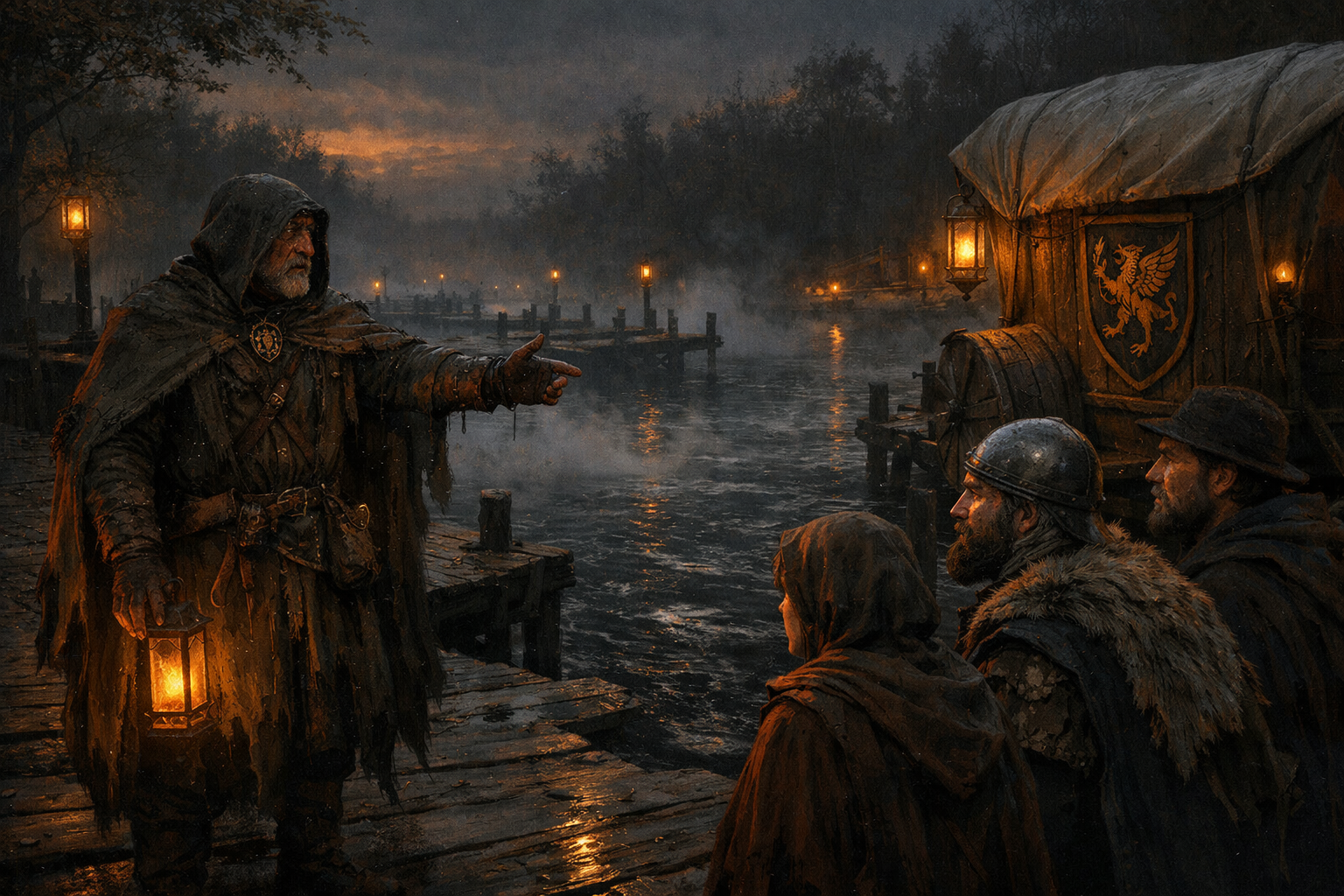
The characters are traveling merchants arriving in the river town of Millhaven for the autumn market.
As they approach the waterfront, they notice something unusual.
The docks should be crowded.
Instead, most are empty.
Several barges remain tied up despite favorable weather.
Shopkeepers close early.
Missing-person notices have been nailed to posts near the river.
Eventually an elderly dockmaster tells them:
"Three people gone this month. All after sunset. All last seen near the river."
That is a hook.
It establishes:
- A situation: People are disappearing.
- A pattern: The disappearances happen near the river after dark.
- Potential stakes: More people may disappear.
- A mystery: Nobody knows what is causing it.
- An opportunity: The characters can investigate.
The players can still decide that their characters are not interested.
That is part of tabletop roleplaying.
The hook creates an opportunity for action.
It does not remove choice.
A Hook Is Not the Same as a Plot
This distinction is important.
A plot describes a predetermined sequence of events.
A hook presents something players might engage with.
Suppose the GM prepares:
- The party investigates the river.
- They discover a hidden tunnel.
- They follow the tunnel.
- They fight a cult.
- They rescue the missing villagers.
That is a planned sequence.
But the players might:
- Question witnesses first
- Search the victims' homes
- Follow the river upstream
- Investigate local smugglers
- Watch the waterfront after dark
- Hire someone else to investigate
- Leave town entirely
A strong hook survives those choices because the underlying situation exists independently of the solution.
People are disappearing near the river.
The GM can prepare that situation without deciding exactly how the players must solve it.
This is closely related to Justin Alexander's scenario-design principle:
Prepare situations rather than predetermined plots.
Core Elements of an Effective Hook
There is no universal formula for a perfect hook.
Different players respond to different things.
However, several qualities consistently make hooks easier to engage with.
1. The Hook Is Actionable
Players should be able to identify something their characters could reasonably do.
Compare:
"Something feels wrong in Millhaven."
with:
"Three people have disappeared from the waterfront this month, all after dark."
The second gives players possible actions.
They could:
- Investigate the river
- Interview witnesses
- Examine disappearance locations
- Watch the docks after sunset
- Search for connections between the victims
Mystery remains.
Confusion does not.
A useful rule of thumb is:
Players do not need to know the answer, but they should have enough information to begin asking useful questions.
2. The Hook Connects to Something the Characters or Players Care About
Hooks become stronger when they intersect with established motivations.
That connection can come from:
- Character goals
- Relationships
- Values
- Backgrounds
- Factions
- Curiosity
- Wealth
- Reputation
- Duty
- Revenge
- Exploration
- Player interests
Suppose one Millhaven character previously worked as a sailor.
Another wants to establish the party as respected merchants.
A third hunts supernatural creatures.
All three can engage with the same situation for different reasons.
The sailor understands how disruptive an abandoned waterfront is.
The merchant knows trade will suffer if the river becomes unusable.
The monster hunter wonders whether something unnatural is responsible.
You do not need a separate adventure for every character.
A strong situation can offer several reasons to become involved.
3. The Hook Gives Enough Information Without Giving Away Everything
Hooks often work by creating questions.
In Millhaven, the players know:
- Three people vanished.
- The disappearances happened recently.
- They occurred near the river.
- They happened after dark.
They do not know:
- Who or what is responsible
- Whether the victims are alive
- Why the river is involved
- Whether the disappearances are connected
- Whether anyone in town knows more than they admit
That information gap creates something to investigate.
Too little information can create aimlessness.
Too much can eliminate discovery.
Compare:
"Strange things are happening."
with:
"Lord Ashton, a vampire, is kidnapping townspeople through a tunnel beneath the docks and taking them to his underwater lair."
The first provides almost nothing to act on.
The second may reveal information the players could have discovered themselves.
The useful middle ground is:
"Three people have disappeared near the river after sunset, and nobody who searched for them found a trace."
4. The Characters Can Meaningfully Affect the Situation
A hook should give the party a plausible role.
That does not mean the problem itself must be small.
A level 1 party could become involved in a conflict between gods.
They probably cannot march into the heavens and resolve the entire divine war.
But they might:
- Investigate strange omens
- Protect a local shrine
- Recover a stolen relic
- Stop cult activity
- Rescue a priest
- Discover that a supposedly divine message was forged
The larger conflict can exist in the background while the characters confront a piece of it appropriate to their capabilities.
Think in terms of actionable scope, not merely narrative scale.
5. Something Changes if Nobody Acts
Many hooks benefit from consequences or evolving circumstances.
In Millhaven:
- Another person may disappear.
- River traffic may decline further.
- Merchants may leave.
- Authorities may impose restrictions.
- Citizens may accuse innocent people.
- Whatever is causing the problem may become bolder.
This creates momentum.
However, every hook does not require a ticking clock.
Curiosity can be enough.
A newly discovered ruin may remain where it is.
A mysterious locked box might sit safely in the party's possession.
An old map may point toward something nobody else knows exists.
Urgency is a tool.
It is not a requirement.
Common Types of Plot Hooks
Hooks can take countless forms, but several recurring structures are useful when brainstorming.
These categories can overlap.
The Call for Help
Someone asks the characters for assistance.
Examples:
- A village asks the party to find missing hunters.
- A merchant hires them to recover stolen cargo.
- A priest asks them to investigate a desecrated shrine.
- A noble needs discreet help exposing blackmail.
This structure is straightforward and particularly useful when the group benefits from clear direction.
The request becomes stronger when the characters understand:
- Who is asking
- What they want
- What they know
- Why they cannot solve it themselves
- Why the party might agree
In Millhaven, the dockmaster could say:
"The watch searched twice and found nothing. If trade stops, this town dies. If you're willing to look into it, the merchants' guild will pay."
The mystery now includes a direct offer.
The Personal Stake
Something affects a person, place, reputation, organization, or goal the characters already care about.
Examples:
- A friend disappears.
- A rival frames the party.
- Someone attacks their home.
- A faction they support is threatened.
- A family member asks for help.
- An enemy from a character's past returns.
In Millhaven, one of the missing people might be the caravan master who traveled there with the party.
The situation immediately becomes personal.
Personal hooks are powerful, but use character backstories collaboratively.
A player's backstory is not automatically permission to destroy everything their character cares about.
The Opportunity
Something desirable becomes available.
That might be:
- Treasure
- Knowledge
- Influence
- Land
- A magical item
- Reputation
- Political advancement
- Access to a restricted location
Millhaven's merchant guild might offer a substantial reward for restoring safe river traffic.
Alternatively, rumors could suggest that a valuable ship disappeared in the same stretch of water decades ago.
Opportunity hooks are especially useful for proactive characters who do not need to be morally obligated before taking action.
The Mystery
Something does not make sense.
Examples:
- People disappear from locked rooms.
- A dead person sends a letter.
- A village celebrates a festival nobody remembers establishing.
- Every clock in a city stops at the same time.
- A road leads somewhere that should not exist.
Millhaven's disappearances are already a mystery hook.
The important part is specificity.
"Something is wrong with the river."
is less actionable than:
"Three people disappeared from the same stretch of waterfront after dark, and none left tracks leading away."
Mysteries thrive on concrete anomalies.
The Threat
Something dangerous is approaching or already causing harm.
Examples:
- Raiders approach the settlement.
- A monster has claimed a trade road.
- A magical storm is spreading.
- Someone is assassinating local officials.
- A disease is appearing in one district.
A threat gives players a reason to respond because ignoring it carries consequences.
Avoid making the threat so overwhelming that the only rational choice is flight unless that is intentionally part of the scenario.
The Discovery
The characters find something that creates opportunity or questions.
Examples:
- An unexplored staircase beneath a familiar building
- A map hidden inside an old book
- A sealed tomb exposed by a landslide
- A strange artifact inside ordinary cargo
- A message written in an unknown language
Discovery hooks are particularly useful for groups that enjoy exploration and curiosity.
They do not necessarily need urgency.
The question itself can motivate action.
The Moral Choice
The characters encounter a situation that challenges their values.
For example, the party arrives in Millhaven as frightened residents accuse a reclusive herbalist of causing the disappearances.
The characters can:
- Defend the accused
- Investigate the accusation
- Support the crowd
- Refuse involvement
- Discover something nobody else knows
A moral hook works best when there is a meaningful decision rather than an obvious test with one approved answer.
Do not punish players merely because their characters make a morally different choice than the GM expected.
Delivering a Hook Effectively
The same underlying hook can feel completely different depending on how players encounter it.
Use the Environment
Not every hook needs to arrive through an NPC quest giver.
Players can notice:
- Empty streets
- Damaged buildings
- Wanted posters
- Abandoned carts
- Strange tracks
- Closed businesses
- Unusual guards
- Missing-person notices
- Changes in weather
- Evidence of a recent conflict
In Millhaven, the GM can establish the problem before anyone explains it.
The riverfront should be crowded this close to the autumn market. Instead, half the docks are empty. Three barges sit tied up with no crews aboard. Every shop facing the water has its shutters closed.
Players may begin asking questions immediately.
The dockmaster then provides additional information.
This makes the hook feel like part of the world rather than a mission marker appearing above an NPC.
Give NPCs a Reason to Know What They Know
NPC information becomes easier to evaluate when players understand where it comes from.
A dockmaster probably knows:
- Who works on the docks
- When people disappeared
- Where they were last seen
- How river traffic has changed
They probably do not automatically know:
- The monster's exact statistics
- A cult's secret leadership
- The complete history of an ancient curse
NPC credibility does not require honesty.
An unreliable witness can make an excellent part of a mystery.
The important thing is that misinformation should arise from the fictional situation rather than because the GM arbitrarily lies to block progress.
An NPC might be:
- Mistaken
- Frightened
- Hiding something
- Protecting someone
- Repeating a rumor
- Deliberately deceptive
Those possibilities create investigation.
Give Concrete Details
Specific information creates better decisions.
Instead of:
"People have vanished."
try:
"Three people disappeared in twenty-two days. All were last seen between the Old Ferry and Tanner's Wharf. All vanished after sunset."
Players now have:
- Locations
- Timing
- A pattern
- Something to investigate
Good details create handles players can grab.
Do Not Confuse a Hook With an Order
A hook works best when players can make an informed choice.
That does not mean every campaign must allow unlimited freedom.
If everyone agreed during Session Zero to play a campaign about members of a royal investigation team, then:
"The queen orders you to investigate an assassination."
is completely reasonable.
The players already chose characters who accept those missions.
Agency does not require pretending the campaign has no premise.
The key is giving players meaningful choices within the game they agreed to play.
What Happens When Players Ignore the Hook?
Sometimes they will.
Before trying to "fix" anything, ask why.
Possibilities include:
- They misunderstood the information.
- They do not realize action is possible.
- Their characters have no reason to care.
- Another goal feels more important.
- The hook sounds too dangerous.
- They suspect it is a trap.
- They are interested in something else.
- They simply made a legitimate choice not to engage.
The answer determines what you should do.
Let the Situation Continue Naturally
If nobody investigates Millhaven's disappearances, the underlying situation does not need to freeze.
Perhaps:
- Another person vanishes.
- The harbor closes at night.
- Traders leave.
- Authorities arrest a suspect.
- The actual culprit continues pursuing its goal.
These developments should follow from the fiction.
They should not exist to punish players for refusing the GM's preferred adventure.
Do Not Keep Repackaging the Same Hook Indefinitely
If the party repeatedly rejects the Millhaven mystery, avoid having:
- The dockmaster ask
- Then the mayor ask
- Then a priest ask
- Then a mysterious stranger ask
- Then the king order them to do it
At some point, the players have communicated something.
Move on or ask directly what interests them.
Multiple Hooks and Player Choice
Some campaigns work well with several simultaneous hooks.
The party might learn:
- People are disappearing near the river.
- A caravan disappeared on the northern road.
- A wealthy merchant wants guards for an expedition.
- Someone stole an item from the party's wagon.
Now the players can decide what matters most.
This style works especially well in open campaigns where choosing what to pursue is part of play.
However, more options are not always better.
Presenting twelve unrelated hooks can create decision paralysis.
Give players enough information to make meaningful choices without drowning them in unfinished possibilities.
Connecting Hooks to a Larger Campaign
An adventure hook can stand alone.
It can also connect to a broader conflict.
Millhaven's disappearances might eventually reveal:
- A water cult expanding into the region
- A noble family's old bargain
- Smugglers using supernatural rumors as cover
- An ancient creature awakening beneath the river
- A political faction intentionally destabilizing trade
Players begin with something understandable:
People are disappearing.
They gradually discover:
This is connected to something much larger.
This allows the campaign to expand without requiring the GM to explain the entire larger conflict in the opening scene.
The 2024 Dungeon Master's Guide distinguishes between episodic adventures and serialized adventures. Hooks can support either structure.
A Millhaven mystery could be a complete standalone adventure.
Or it could become one thread in a continuing campaign.
Neither approach is inherently better.
Hooks for Different Player Interests
Players respond differently to the same situation.
Current D&D guidance encourages Game Masters to understand what their players enjoy rather than assuming everyone engages with the game in the same way.
The Millhaven hook can support several interests at once.
Fighting
Rumors suggest something dangerous is hunting near the river.
Exploring
Old tunnels and forgotten waterways exist beneath Millhaven.
Acting
Fear has divided townspeople into competing factions.
Problem-Solving
The disappearances follow a pattern nobody has recognized.
Storytelling
One victim is connected to an ongoing campaign relationship.
Optimizing
The eventual challenge gives specialized abilities meaningful opportunities.
Instigating
The characters can stake out the docks tonight instead of waiting for permission.
Socializing
The situation still leaves room for the ordinary social experience of playing together without requiring every participant to care about the hook for exactly the same reason.
You do not need to deliberately include every possible preference in every hook.
Look for several natural entry points.
Troubleshooting Hooks That Do Not Land
Even experienced Game Masters create hooks that receive little interest.
That is useful information.
The Players Do Not Know What They Can Do
Symptoms:
- Long silence
- Repeated requests for more information
- Players seem unsure what the GM expects
- Nobody can identify a next step
Solution:
Provide clearer actionable details.
Instead of:
"The river feels strange."
give them:
"Three people disappeared from the same dock after sunset."
Nobody Has a Reason to Care
A missing stranger may not matter to a mercenary party.
That is fine.
Give them a reason appropriate to the characters:
- Reward
- Reputation
- Personal connection
- Threat to something they need
- Access to information
- Opportunity for advancement
Do not assume every character is motivated by altruism.
The Hook Sounds Like a Trap
Players sometimes become cautious because previous adventures taught them that accepting apparently reasonable opportunities results in arbitrary punishment.
The solution is not to promise that hooks are safe.
Adventuring is often dangerous.
Instead, make risk understandable.
An NPC can say:
"Two watch patrols searched the riverbank. One came back injured."
That signals danger.
Players can make an informed choice.
Another Goal Matters More
If the characters are racing to rescue an ally before sunrise, they probably will not stop to investigate Millhaven.
That is rational.
Introduce new hooks when players have enough attention to evaluate them, or connect the hook to the existing objective when that connection makes sense.
Do not make every new idea compete with something the players already care deeply about.
The Players Chose Something Else
Sometimes nothing is wrong.
You prepared three opportunities.
The players chose one.
That is tabletop roleplaying.
Unused hooks can:
- Remain unresolved
- Develop in the background
- Reappear naturally later
- Be recycled into another location
- Be discarded completely
Prep is a resource, not a contract.
Practical Hook Preparation
You do not need to write a complete adventure every time you invent a hook.
For each important hook, consider recording:
1. What the Characters Initially Learn
Example:
Three people disappeared from Millhaven's waterfront after dark.
2. What Is Actually Happening
Example:
A creature has entered Millhaven through an old submerged drainage system and is hunting isolated people along the docks.
This is GM information.
Do not reveal it automatically.
3. Who or What Is Involved
Example:
- Missing residents
- Dockmaster
- Town watch
- Merchant guild
- Creature
- Smugglers who use nearby tunnels
4. What Happens if Nobody Intervenes
Example:
- The creature attacks again.
- River traffic declines.
- The watch closes part of the waterfront.
- Smugglers become nervous that their tunnels will be discovered.
5. What Information Can Lead Players Forward
Think in terms of clues and access points rather than one mandatory sequence.
Players might learn something useful by:
- Interviewing witnesses
- Examining disappearance sites
- Watching the docks
- Following tracks
- Researching local waterways
- Questioning smugglers
- Entering the river tunnels
Several routes can point toward the underlying situation.
This makes the adventure more resilient when players approach it differently than expected.
Five Room Dungeons as a Hook-to-Adventure Framework
The Five Room Dungeon framework popularized by Johnn Four can be useful when a hook needs to become a compact adventure.
The classic structure uses:
- Entrance and Guardian
- Puzzle or Roleplaying Challenge
- Trick or Setback
- Climax or Major Conflict
- Reward, Revelation, or Twist
Despite the name, the framework does not require five literal rooms.
It can structure:
- A dungeon
- A mystery
- A social scenario
- A wilderness expedition
- A heist
- A small quest
For Millhaven:
Hook: People are disappearing near the river.
Entrance/Guardian: The party must access the restricted waterfront after dark.
Puzzle/Interaction: Evidence and witnesses point toward old drainage tunnels.
Setback: The obvious suspect is innocent, or rising water cuts off the easiest route.
Climax: The characters confront the actual threat.
Reward/Revelation: They discover why it came to Millhaven, perhaps revealing a larger campaign thread.
The structure is a tool, not a formula every adventure must follow.
Node-Based Scenario Design
For mysteries or open scenarios with several possible routes, Justin Alexander's node-based design offers another useful framework.
Instead of preparing:
Scene A leads to Scene B, which leads to Scene C.
you prepare important nodes such as:
- Dockmaster
- Missing person's home
- Abandoned warehouse
- Old river tunnels
- Merchant guild office
Clues and relationships connect them.
Players can move through the situation in different orders.
This supports player choice while still giving the GM useful preparation structure.
The underlying lesson applies directly to hooks:
Prepare the situation players are entering, not every decision you expect them to make.
Using The Dungeon Trainer to Develop Hooks
Digital tools can help organize and stress-test adventure ideas without replacing the Game Master's understanding of the table.
The Dungeon Trainer supports human-run campaigns as well as optional AI-assisted features.
Scry
Scry can help a Game Master examine an upcoming scene by surfacing:
- Plausible approaches
- Possible complications
- Pacing risks
- Single points of failure
- Preparation considerations
Suppose you enter the Millhaven waterfront situation.
Scry might help reveal that your preparation assumes the players will question the dockmaster.
That is useful because you can ask:
"What happens if they never talk to him?"
You might then add other access points through:
- Missing-person posters
- A frightened witness
- Physical evidence
- Town-watch records
Scry should not determine what the players will do.
It helps identify where your preparation may be too dependent on one assumption.
Generators
The Dungeon Trainer can generate:
- NPCs
- Locations
- Monsters
- Items
- Spells
These can support hook development.
For example:
- Generate a dockmaster when you need a witness.
- Generate an abandoned riverside location.
- Generate a creature that might fit the mystery.
- Generate an item connected to one of the missing people.
Generated content still requires judgment.
A random NPC does not automatically become a compelling hook.
The GM decides why that NPC matters.
The Coach
The Coach provides practice scenarios and structured feedback on Game Master decisions.
That can help develop skills related to:
- Player agency
- Pacing
- Information clarity
- Encounter management
- Adjudication
Those skills directly affect how well a hook works once it reaches the table.
Campaign Memory and Records
Long campaigns accumulate unresolved hooks.
The Dungeon Trainer maintains searchable campaign information about characters, NPCs, locations, quests, and events.
That can help the GM remember:
- Which hooks players pursued
- Which opportunities remain unresolved
- Which NPCs became important
- What consequences have already occurred
Campaign continuity makes old hooks easier to develop naturally instead of repeatedly inventing unrelated problems.
Building Your Hook Repertoire
Crafting hooks improves through observation.
After a session, ask:
- Which situation grabbed the players immediately?
- Which one did they ignore?
- What questions did they ask?
- Which NPCs interested them?
- What did they voluntarily pursue?
- What surprised me?
Do not assume an ignored hook was badly written.
The players may simply have preferred something else.
Keep notes about what your specific group responds to.
A table fascinated by faction politics may engage strongly with:
"Two guilds both claim ownership of the same mine."
Another group may barely react until you say:
"Something enormous dragged the miners into the darkness."
Neither response is wrong.
Hooks work at tables, not in isolation.
Study Published Adventures
Published adventures provide useful examples of how other designers introduce scenarios.
The short adventures in the current Dungeon Master's Guide, for example, include adventure overviews, hooks that can bring characters into the situation, and encounters that follow.
Study:
- What information players receive first
- Why characters might become involved
- What stakes are established
- How much information remains unknown
- Whether several motivations are offered
- How the adventure supports different approaches
Do not copy hooks mechanically.
Identify why they work and adapt the principle to your group.
Moving Forward
A plot hook is ultimately an invitation to engage with a situation.
It might say:
Someone needs you.
Or:
Something is wrong.
Or:
Something valuable has been discovered.
Or:
Something dangerous is approaching.
Or simply:
You have never seen anything like this before.
The Millhaven merchants now have an invitation.
People are disappearing near the river.
The docks are empty.
Trade is suffering.
Nobody knows what is responsible.
The characters might investigate.
They might pursue another opportunity.
They might leave town.
Whatever they choose, the GM has created something concrete enough to engage with and flexible enough to respond to their decisions.
That is the real purpose of a hook.
Not forcing players onto a story.
Giving them a reason to create one through play.
Sources and Further Reading
Alexander, J. (2010, May 27). Node-based scenario design, part 1: The plotted approach. The Alexandrian. https://thealexandrian.net/wordpress/7949/roleplaying-games/node-based-scenario-design-part-1-the-plotted-approach
Four, J. (2022, August 15). 5 Room Dungeons + Contest. Roleplaying Tips. https://www.roleplayingtips.com/rptn/5-room-dungeons-contest/
Runehammer Games. (2022). Index Card RPG: Master Edition. Runehammer Games.
Wizards of the Coast. (2024). Dungeon Master's Guide. Wizards of the Coast.
Wizards of the Coast. (2024, November 8). Let's prepare an adventure using the 2024 Dungeon Master's Guide!. D&D Beyond. https://www.dndbeyond.com/posts/1851-lets-prepare-an-adventure-using-the-2024-dungeon
Related reading
- Why Megadungeons Succeed or Fail: Lessons from Forty Years of Play
Megadungeons have persisted since the earliest days of tabletop roleplaying, yet many campaigns abandon them within a few sessions. Learn what structural, pacing, and preparation factors separate sustainable megadungeons from those that collapse, and how to apply those lessons at your own table.
- Understanding the Megadungeon: What It Is and When to Use It
A megadungeon is more than a big dungeon. Learn what defines this sprawling adventure structure, why it persists across decades of play, and when it serves your table better than episodic adventures.
- Running Sandbox Campaigns: Six Months with The Millbrook Consortium
Sandbox campaigns promise player-driven freedom but demand different preparation and facilitation techniques. This case study examines six months of running The Millbrook Consortium, a merchant-focused sandbox, to identify practical lessons about faction management, player agency, and sustainable open-world play.