What an AI GM Assistant Should Actually Do
Black water laps at the party’s knees. The rogue asks whether the dock pilings can support a climb. The cleric wants to identify the rune carved into a half-submerged crate. Meanwhile, the players are waiting for an answer, not a search through five old session notes.
Black water laps at the party’s knees. The rogue asks whether the dock pilings can support a climb. The cleric wants to identify the rune carved into a half-submerged crate. Meanwhile, the players are waiting for an answer, not a search through five old session notes.
An AI GM assistant earns its place in that moment by reducing friction without taking authority away from the person running the game. It should surface relevant campaign facts, portray the harbor master with consistency, and help frame consequences. It should not quietly rewrite what happened three sessions ago, decide that a die roll succeeded because the story would be more dramatic, or turn player choices into a predetermined plot.
That distinction matters. Tabletop role-playing games run on imagination, but they also run on trust. Players trust that the world remembers their actions, that risks have real consequences, and that a clever plan can change what happens next. A useful assistant reinforces those conditions.
An AI GM Assistant Is Table Infrastructure
The most common mistake is treating an AI game master tool as a prose generator with a fantasy coat of paint. Vivid narration is valuable. So is a convincing innkeeper, a fast summary of last session, or a few plausible clues when the party searches a crime scene. But none of those functions alone make a campaign reliable.
A campaign has structured state. Characters carry conditions, resources, and unfinished obligations. Factions hold grudges and pursue goals. NPCs know some things and do not know others. Locations change after a fire, a theft, or a bargain with the wrong power. Rules create boundaries around what characters can reasonably attempt and what outcomes mean.
An AI assistant needs to work from that state rather than improvise around it. If the paladin spent their last spell slot in the crypt, the next scene should reflect that. If the group exposed a merchant prince’s smuggling operation, his guards should not greet them as strangers. Memory is not a decorative feature. It is the record that makes choices matter.
This is why a dependable system separates different jobs. Campaign state preserves facts. Rules-aware adjudication evaluates attempts. Narrative generation describes what the table sees and hears. Random resolution happens independently. When those responsibilities blur together, the model can produce a compelling paragraph while undermining the actual game.
What the GM Should Keep
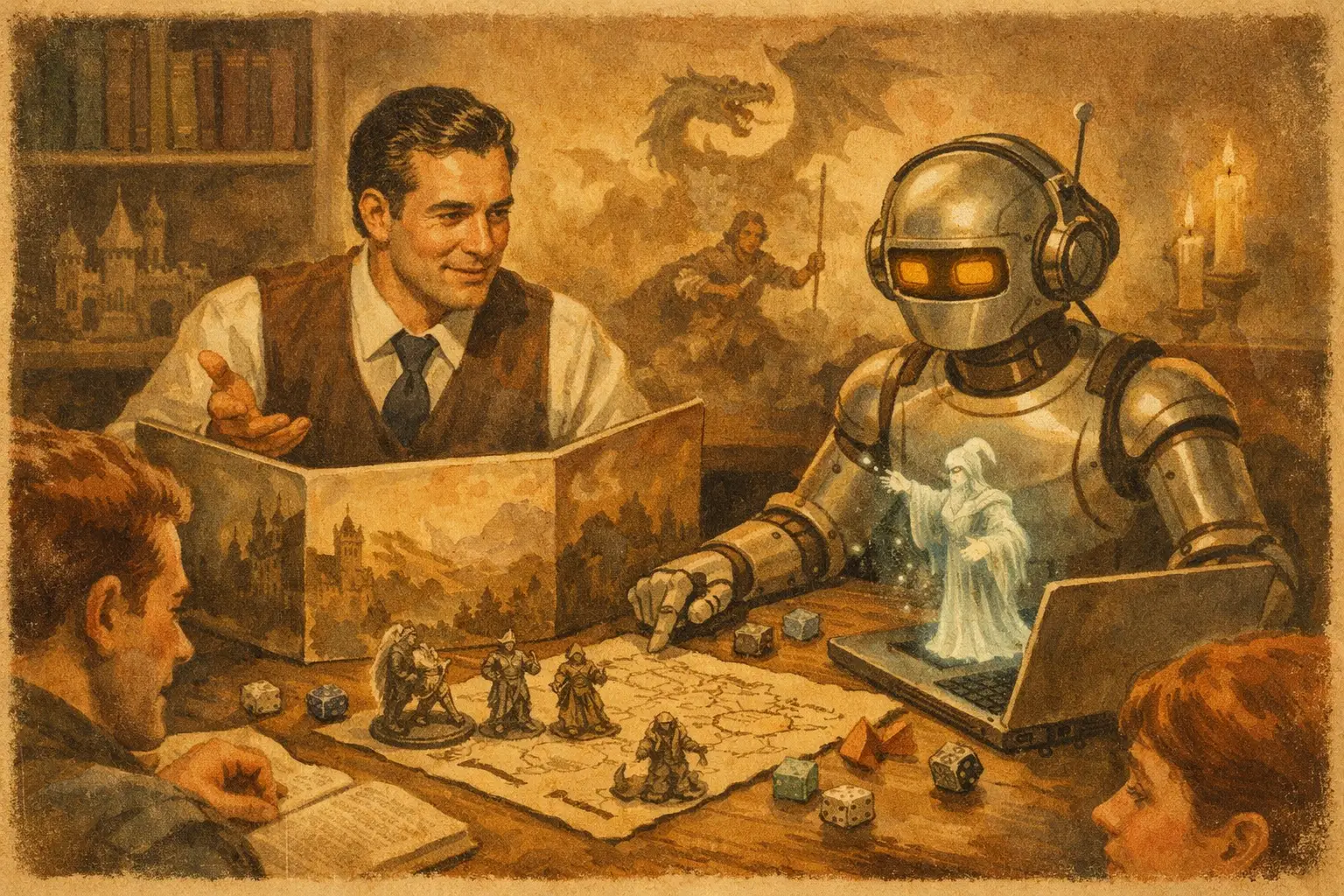
A human GM does not need to surrender control to gain meaningful help. In assisted play, the GM should keep final authority over tone, interpretation, hidden information, and rulings that define the campaign. The assistant can take bounded tasks that consume attention at the table.
For example, a GM might set the scene: the party has entered the flooded archive beneath a ruined monastery. The assistant can portray the anxious ghost librarian, describe the smell of wet vellum, and track which shelves the group has searched. The GM decides whether the ghost is secretly lying, whether the archive connects to an earlier villain, and how a disputed rule applies in context.
That division protects the social role of the GM. Players are not only interacting with a game engine. They are reading a facilitator’s judgment, testing ideas, and building a shared tone. An assistant can make that facilitator faster and more prepared. It should not flatten the table into a command prompt.
There are exceptions. A group without an available GM may want an AI Dungeon Master that can facilitate a complete 5E-compatible campaign. In that case, the system must carry more responsibility: scene framing, NPC intent, encounter handling, rules adjudication, and continuity. The requirement for discipline becomes stronger, not weaker. An autonomous GM needs clear campaign state, persistent memory, and explicit resolution logic because there is no human behind the screen to catch contradictions.
Fair Resolution Cannot Be Decorative
Consider a simple moment. A player says, “I slip past the sentries while the storm covers my footsteps.” A weak system might narrate success because stealth is dramatically appropriate. Another might invent a success probability in polished language, as if that makes the ruling objective.
Neither approach is acceptable. The GM or system should establish the stakes, apply the relevant modifiers and circumstances, and resolve the roll fairly. Dice should resolve in code, never by the model. The model can explain the result in fiction, but it should not choose the result.
That separation preserves uncertainty. It also makes failure useful. A failed stealth check does not have to mean the sentries immediately attack. Perhaps a guard notices movement and begins investigating. Perhaps the party gets through but leaves evidence behind. Those are meaningful branches, but they must follow the actual resolution rather than replace it.
Good adjudication also acknowledges that not every action deserves a roll. If a character has the correct tool, enough time, and no meaningful pressure, success may simply follow. If an attempt is impossible under the established fiction, the answer should be clear before dice hit the table. An AI assistant should help articulate these decisions, not force every sentence into a random check.
Preparation Should Reveal Branches, Not Script Them
Many GMs do not need more ideas. They need to know which idea will break when the players ignore the obvious door, interrogate the wrong witness, or decide the villain’s offer is worth hearing.
A strong preparation workflow looks ahead at a scene and identifies probable branches. If the party infiltrates the duke’s masquerade, what changes if they enter as guests, steal servant uniforms, or trigger a public confrontation? Which NPC is likely to become the source of information? Where does pacing stall if the clue is too obscure? What happens if the group wins the duel but loses the political argument?
This is forecasting, not scripting. The purpose is not to trap players in a planned sequence. It is to ensure that the world has credible responses when they make a surprising choice.
Scry, for example, can help a GM examine a planned scene for failure points and pacing risks before the session begins. That is more valuable than a generic list of plot twists because it is attached to the actual state of the campaign. If the group has already alienated the city watch, a forecast should recognize that the watch is not a neutral rescue option. If the ranger’s backstory points toward the old forest, the scene may need a branch that gives that player a real decision instead of a passing reference.
NPC Portrayal Needs Boundaries
NPC assistance is one of the best uses for AI because it can reduce the mental load of switching voices, motives, and knowledge during play. The key is that an NPC should be constrained by what they want, what they know, and what they are willing to risk.
Take Captain Elian Voss, commander of a river patrol. He wants to prevent panic in the harbor. He knows a barge disappeared near the drowned chapel. He does not know that his first mate is involved. He will offer official payment for information, but he will not authorize a raid on a noble house without proof.
With those boundaries, the assistant can portray Voss consistently across several scenes. He may become impatient, guarded, or grateful depending on player behavior, but he cannot suddenly reveal the traitor’s identity because the model wants to move the plot forward. His limits create playable tension.
The same principle applies to lore. An assistant should distinguish established facts from possible inventions. If the GM asks for a local legend, a new detail can be useful. If the players ask what the campaign’s established cult believes, the system should retrieve the existing record first. Improvisation belongs in open space, not in the foundation beneath the campaign.
Feedback Should Be Specific Enough to Use
After the session, vague praise is easy and nearly worthless. “Great roleplay” does not tell a GM whether the scene gave players meaningful choices. “Be more descriptive” does not explain whether the problem was sensory detail, unclear stakes, or a rushed transition.
Useful coaching evaluates observable table behavior. Did the GM establish what failure would cost before calling for a roll? Did encounters create decisions beyond attack selection? Did the players engage with each other’s ideas? Did a scene linger after its central question had been answered? Were rulings consistent with prior facts and the rules framework?
A rubric-based Coach can turn those questions into actionable feedback. It might identify that a negotiation scene had strong NPC characterization but weak leverage, or that combat moved quickly while the group lost sight of its objective. The goal is not to grade imagination. It is to help the table identify repeatable habits that improve agency, clarity, and pacing.
The Dungeon Trainer is built around that discipline: play from structured state, forecast what a scene may become, then assess what happened with concrete criteria. That approach treats AI as accountable support for the campaign rather than a substitute for judgment.
The best test is simple. After a session, players should feel that their decisions shaped the world, their dice mattered, and the GM had more attention for the table than for administrative overhead. If an AI assistant produces that result, it has done its job. If it merely talks beautifully while forgetting consequences, it is still just noise in the tavern.
Related reading
- When a Plot Hook Fails: Lessons from a Tavern Job Gone Wrong
Not every plot hook lands perfectly. Examining what happens when players reject or ignore a hook reveals essential lessons for designing more resilient adventures.
- Plot Hook vs. Narrative Hook: When Story Meets Gameplay
Plot hooks and narrative hooks both pull audiences into stories, but they serve different purposes at the tabletop. Understanding when and how to use each type creates more engaging sessions.
- 15 Plot Hook Templates Game Masters Can Use at Any Table
Ready-to-use plot hook templates help Game Masters prepare faster and run more engaging sessions. These fifteen proven frameworks work across settings, systems, and experience levels.