Understanding the Megadungeon: What It Is and When to Use It
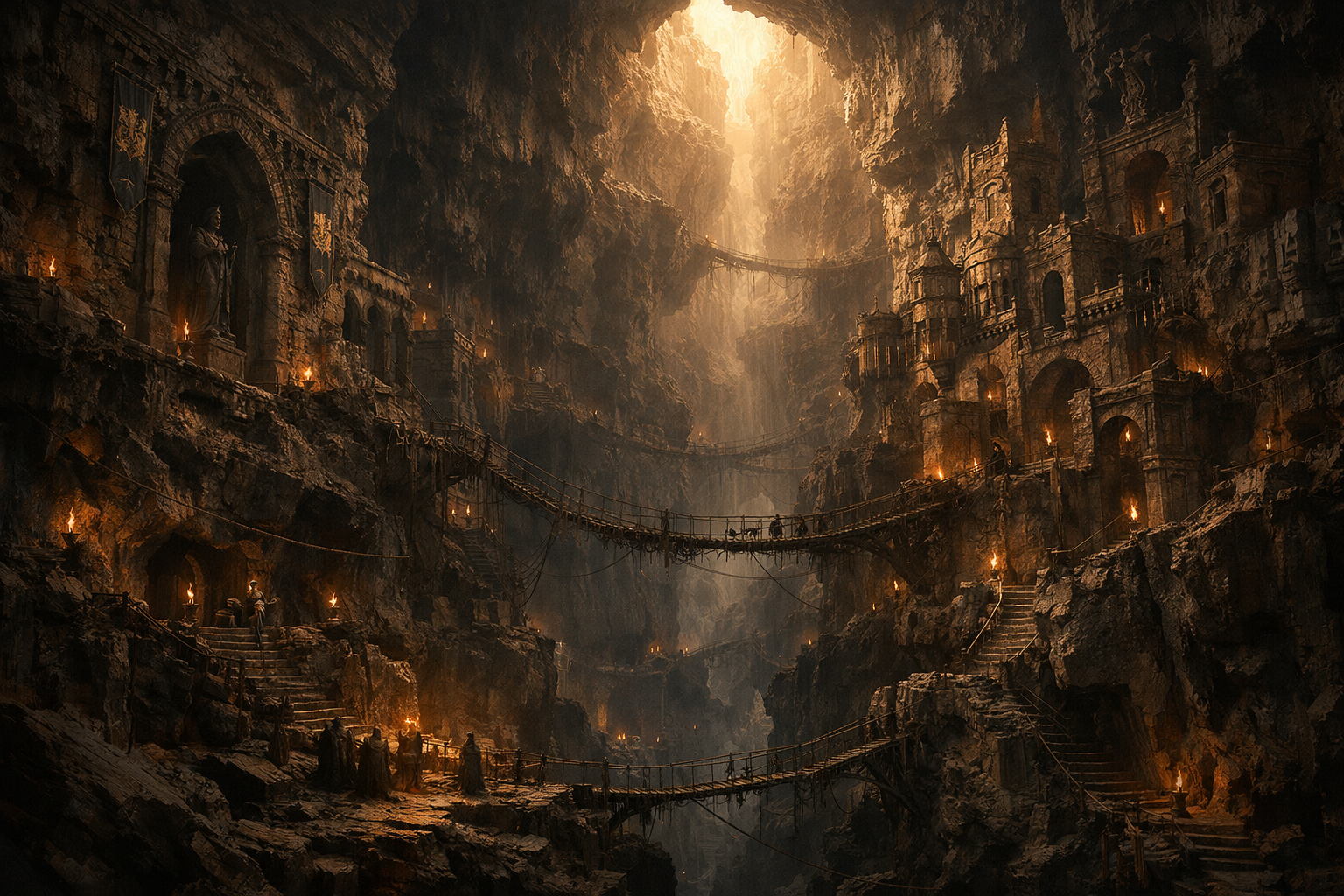
A megadungeon is more than a big dungeon. Learn what defines this sprawling adventure structure, why it persists across decades of play, and when it serves your table better than episodic adventures.
A megadungeon is more than an unusually large dungeon. It is a persistent, expansive adventure environment capable of supporting long-term exploration and potentially an entire campaign.
The term appears frequently in tabletop RPG discussions, but its exact boundaries are not universally agreed upon. Some players use "megadungeon" for any enormous multi-level dungeon. Others reserve the term for sprawling complexes specifically designed to function as campaign-scale environments.
A useful definition focuses less on an exact room count and more on what the dungeon can support.
A megadungeon is large, interconnected, and persistent enough that characters can return repeatedly, explore different routes, interact with changing inhabitants, discover new areas, and continue finding meaningful adventure opportunities over an extended period.
This article defines the megadungeon as a campaign-scale adventure environment, traces its historical roots, compares it with other adventure structures, and offers practical guidance on when and how to use one.
The recurring example follows the Deepfall Chasm, a fictional megadungeon that will appear throughout this series.
What Defines a Megadungeon
A megadungeon is an expansive dungeon environment designed to sustain repeated exploration.
It commonly contains:
- Multiple levels or major zones
- Large numbers of keyed locations
- Branching routes
- Connections between areas
- Places worth revisiting
- Secrets that reward continued exploration
- Enough content to support many separate expeditions
The exact size is not what matters most.
A hundred-room dungeon might function as a megadungeon if it contains enough interconnected situations, alternate routes, factions, secrets, and opportunities for repeated play.
A much larger dungeon could still feel like one long linear adventure if the characters simply move through it once from beginning to end.
D&D Beyond describes megadungeons as dungeons sufficiently large and complex that an entire campaign could potentially take place within them, emphasizing multi-level layouts and numerous connections between levels (Haeck, 2018).
That distinction is useful.
The megadungeon is not defined merely by how many squares appear on its map.
It is defined by how much play the environment can sustain.
Persistence Matters
A typical adventure location may stop being relevant once its central objective is complete.
A megadungeon usually remains relevant.
Players might return because:
- They discovered another unexplored route.
- A new faction moved into an area.
- They learned the location of a hidden entrance.
- They finally possess the equipment needed to cross an obstacle.
- A rumor revealed something they previously overlooked.
- A previously inaccessible level has opened.
- An NPC wants something located inside.
- Their own goals require another expedition.
The dungeon becomes a persistent part of the campaign rather than a location the characters simply complete and abandon.
Interconnection Matters
Megadungeons also tend to benefit from multiple routes through the environment.
A staircase might connect Level 1 directly to Level 3.
A hidden tunnel might bypass a dangerous faction.
A flooded shaft might connect two otherwise distant areas.
An elevator might provide fast access to deeper sections once repaired.
These connections make navigation itself part of the campaign.
Players gradually stop thinking only in terms of rooms and begin thinking strategically about the dungeon as a place.
Historical Roots
The megadungeon tradition reaches back to the earliest tabletop fantasy campaigns.
Dave Arneson's Blackmoor campaign developed before the publication of Dungeons & Dragons and featured sustained adventures involving individual characters, a fantasy setting, and dungeon exploration.
Gary Gygax later developed Greyhawk, including Castle Greyhawk and its extensive dungeon levels.
Original TSR material identifies Blackmoor as an exceptionally early and long-running campaign and credits Arneson as an innovator of the "dungeon adventure" concept. Contemporary TSR material also references Greyhawk Castle as an active campaign environment.
These early campaigns helped establish several ideas that remain recognizable in megadungeon play:
- Persistent characters
- Repeated expeditions
- Expansive underground environments
- Increasing knowledge of a location over time
- Returning to previously explored areas
- Campaign development driven partly through exploration
Jon Peterson's The Making of Original Dungeons & Dragons: 1970–1977 collects and contextualizes primary material from this formative period (Peterson, 2024).
The modern term megadungeon came later, but the underlying campaign structure has deep roots in the development of tabletop roleplaying.
Common Megadungeon Characteristics
No universal checklist determines whether a dungeon qualifies as a megadungeon.
However, many successful examples share several characteristics.
Campaign-Scale Size
The dungeon contains enough material to support extended play.
That does not necessarily mean hundreds of sessions.
The more useful question is whether characters can repeatedly return and continue discovering meaningful new content.
Multiple Levels or Zones
Megadungeons frequently contain distinct regions.
These might be literal underground levels, but they could also be:
- Cavern networks
- Towers
- Buried cities
- Dimensional spaces
- Ruined districts
- Subterranean ecosystems
- Connected fortress complexes
Different areas can have their own themes, hazards, inhabitants, and history.
Multiple Routes
Players can often choose between different paths.
This distinguishes exploration from simply proceeding through a predetermined sequence.
Persistent State
Previously explored areas remain part of the world.
Doors stay unlocked unless someone closes them.
Destroyed bridges remain destroyed until repaired.
Allies remember agreements.
Enemies remember attacks.
Resources may be removed permanently.
Other inhabitants might take advantage of changes the characters created.
Discoverable Information
Players gradually learn how the dungeon works.
Maps improve.
Rumors gain context.
Faction territories become recognizable.
Dangerous routes become known.
Previously mysterious landmarks gain meaning.
Knowledge itself becomes a campaign resource.
Megadungeon vs. Dungeon Crawl
A dungeon crawl is a style or mode of play centered on exploring a dungeon environment.
It does not have to be short.
A dungeon crawl could occupy one session, several sessions, or a substantial portion of a campaign.
A megadungeon describes an environment large and persistent enough to support extensive dungeon-crawling play over time.
The concepts overlap, but they are not interchangeable.
A five-room crypt can support a dungeon crawl without being a megadungeon.
A megadungeon will almost certainly involve dungeon-crawling procedures, but its defining feature is the scale and persistence of the environment.
Megadungeon vs. Sandbox Campaign
Megadungeons and sandboxes have substantial overlap.
A sandbox emphasizes meaningful player choice about goals and direction.
A megadungeon can provide that freedom within a geographically concentrated environment.
Players might choose:
- Which entrance to use
- Which level to explore
- Which rumors to investigate
- Which faction to contact
- Which dangers to avoid
- Whether to seek treasure, information, allies, or specific objectives
- When to retreat
- When to push deeper
This makes many megadungeons function like geographically concentrated sandboxes.
However, the terms are not identical.
A megadungeon can be run in a highly structured way.
A sandbox can contain no megadungeon at all.
Think of the two concepts as compatible rather than synonymous.
A megadungeon describes the adventure environment.
A sandbox describes the distribution of campaign-level choice.
Megadungeon vs. Adventure Path
A published campaign or adventure path often provides a sequence of major situations, locations, or story developments.
The exact amount of linearity varies considerably between products.
A megadungeon shifts more of the organizing structure into the environment itself.
Instead of asking:
"What chapter comes next?"
players often ask:
"Where do we explore next?"
That does not mean megadungeons cannot contain story arcs.
They can include:
- Recurring villains
- Ancient mysteries
- Character-specific objectives
- Faction conflicts
- Prophecies
- Escalating threats
- Major climactic encounters
The difference is that the physical environment and player exploration usually remain central to how those elements are encountered.
Why Megadungeons Remain Useful
The megadungeon has survived decades of changes in tabletop RPG design because it supports several useful campaign properties.
Reusable Preparation
A megadungeon can make preparation highly reusable.
Once the Game Master establishes:
- Geography
- Major factions
- Important locations
- Connections
- Core history
- Recurring hazards
those elements can support many sessions.
Players repeatedly interact with the same environment from different angles.
A staircase discovered during one session may become strategically important five sessions later.
An NPC introduced on an upper level might become the party's guide to deeper territory.
A locked door discovered at low level might become an objective after the characters find its key months later.
Preparation continues generating value because the same environment remains relevant.
Preparation Does Not Need to Be Completely Front-Loaded
A megadungeon does not require designing hundreds of rooms before the campaign begins.
A more sustainable approach is often:
- Create the dungeon's large-scale concept.
- Sketch major levels or zones.
- Establish important connections.
- Detail the starting area.
- Prepare enough nearby content for several likely expeditions.
- Expand deeper areas as players approach them.
This preserves long-term structure without requiring the Game Master to finish an enormous project before session one.
The dungeon can grow with the campaign.
Player-Directed Objectives
Megadungeons naturally support several simultaneous motivations.
Characters might enter seeking:
- Treasure
- Historical knowledge
- Missing people
- Magical resources
- Political leverage
- Monster trophies
- Religious relics
- Lost technology
- Safe routes
- Territory
- Faction alliances
Different players can care about different things while still participating in the same expedition.
The dungeon provides a common environment for their goals.
Environmental Continuity
Repeated visits allow players to develop familiarity.
They remember:
- The trapped western corridor
- The friendly mushroom traders
- The collapsed staircase
- The underground river
- The room where they lost a companion
- The secret door they could not open
- The territory claimed by a hostile faction
That familiarity creates a form of progression separate from character levels.
The players themselves become better at navigating the environment.
Risk Becomes a Player Decision
Many traditional megadungeons use depth, distance, environmental hostility, or restricted access to communicate increasing danger.
Deeper areas may contain stronger threats and more valuable rewards.
However, this is a convention rather than a requirement.
Danger might instead vary by:
- Faction territory
- Region
- Environmental hazard
- Time
- Alert status
- Magical instability
The important principle is telegraphing risk.
Players should have ways to decide whether pushing farther is worth the danger.
When to Use a Megadungeon
A megadungeon works particularly well when the table enjoys the kinds of decisions it naturally produces.
Your Players Enjoy Exploration
Megadungeons reward players who enjoy questions such as:
- Where does this passage go?
- What is behind that sealed door?
- Can we find another way down?
- What did those carvings mean?
- Why is this faction afraid of the eastern tunnels?
- Can we map a safer route?
Curiosity becomes a major engine of play.
Your Players Enjoy Tactical and Resource Decisions
Depending on the rules and campaign style, megadungeon expeditions can emphasize:
- Spell use
- Healing
- Encumbrance
- Light
- Time
- Supplies
- Retreat routes
- Noise
- Rest
- Equipment
Not every megadungeon needs rigorous resource tracking.
But the structure works particularly well when preparation and risk management matter.
You Want a Persistent Adventure Environment
If you like environments that accumulate history, a megadungeon provides a strong foundation.
The characters can change the dungeon and later see the results.
Your Group Likes Expedition-Based Sessions
The party can begin at a safe location, choose an objective, enter the dungeon, explore, and return.
This makes the structure compatible with episodic play.
Rotating Attendance
Megadungeons can also work well with variable attendance if the campaign establishes procedures that return characters to a safe location between sessions.
That makes them compatible with open-table structures.
Ben Robbins' West Marches campaign uses a similar expedition-oriented rhythm, with players organizing expeditions and selecting objectives themselves (Robbins, 2007).
West Marches is not inherently a megadungeon format, but the scheduling and expedition principles can combine effectively with one.
When a Megadungeon May Be a Poor Fit
The format is less likely to satisfy a group that strongly prefers:
- Frequent travel between radically different regions
- Globetrotting adventures
- Campaigns centered primarily on court politics
- Constantly changing settings
- Highly scripted narrative sequences
- Minimal exploration
Even here, the distinction is not absolute.
A megadungeon can contain substantial:
- Politics
- Social interaction
- Horror
- Mystery
- Character drama
- Diplomacy
The relevant question is whether the group enjoys returning to one large environment repeatedly.
Design Principle One: Build Multiple Routes
A megadungeon benefits enormously from route choice.
Avoid designing every level as:
Entrance → Encounter → Encounter → Boss → Stairs
Instead, create loops.
Connect areas in unexpected ways.
Give players choices.
For example:
Level 1 might connect to:
- Level 2 through a guarded staircase
- Level 3 through a dangerous vertical shaft
- A surface cave through an undiscovered tunnel
- Another section of Level 1 through a flooded passage
The dungeon gradually becomes a network rather than a sequence.
Design Principle Two: Combine Vertical and Horizontal Exploration
Descending is exciting, but lateral exploration matters too.
Each level or zone should contain enough meaningful content that players have reasons to investigate instead of immediately searching for the next staircase.
Players might discover:
- Treasure
- Factions
- Safe routes
- Information
- Shortcuts
- Keys
- Resources
- Secondary entrances
A deeper level should represent another option, not necessarily the only meaningful progression.
Design Principle Three: Use Active Inhabitants
A megadungeon does not require factions, but active inhabitants can dramatically increase its longevity.
Possible groups include:
- Miners
- Cults
- Undead enclaves
- Adventuring rivals
- Goblin tribes
- Mercenary companies
- Religious orders
- Refugees
- Scholars
- Intelligent monsters
Give important groups:
- Goals
- Resources
- Territory
- Relationships
- Reasons to negotiate
- Reasons to fight
Players can then influence the dungeon socially instead of solving every problem through combat.
Design Principle Four: Let the Dungeon Change
Previously explored areas do not need to remain frozen forever.
Changes might include:
- A faction occupying an abandoned section
- A collapsed tunnel reopening
- A monster migrating
- New defenses appearing
- A previously neutral group becoming hostile
- A flooded area draining
- A route becoming unsafe
Do not change areas merely to erase player accomplishments.
If the characters cleared and fortified a route, that achievement should matter.
Dynamic change works best when it follows understandable causes.
Design Principle Five: Provide Reliable Ways to Learn
Exploration becomes more meaningful when players can make informed decisions.
Useful information sources include:
- Rumors
- Maps
- Survivors
- Faction members
- Captured enemies
- Historical records
- Environmental clues
- Previous expeditions
- Rival adventurers
A rumor such as:
"The western stairs reach the drowned halls, but something large nests near the bottom."
creates a decision.
Players can investigate another route, prepare for the creature, or deliberately seek it out.
Use False Information Carefully
Not every rumor needs to be perfectly accurate.
People can be mistaken.
Information can be outdated.
Factions can lie.
But if most information is unreliable, players lose the ability to make meaningful strategic choices.
Use uncertainty to create investigation, not to make planning pointless.
Design Principle Six: Give Players Ways Out
Expeditions become more interesting when retreat is possible.
Players should usually be able to consider:
- Returning the way they came
- Reaching another exit
- Negotiating for safe passage
- Hiding
- Establishing a temporary safe point
A nearby settlement can provide:
- Rest
- Resupply
- Rumors
- Buyers for recovered treasure
- Specialists
- New expedition members
Some megadungeons may also contain relatively safe zones inside.
These are useful techniques, not mandatory features.
Example: The Deepfall Chasm
The Deepfall Chasm is a campaign-scale dungeon environment built into a vast canyon near the edge of settled territory.
The canyon walls contain:
- Natural caves
- Ancient ruins
- Artificial tunnels
- Abandoned mines
- Collapsed fortifications
- Forgotten temples
Rope bridges, stairways, tunnels, ancient lifts, and hidden passages connect different elevations.
The farther characters descend, the older and stranger the structures become, although danger does not increase in a perfectly predictable line.
Crestfall
The nearby settlement of Crestfall serves as the most common staging point for expeditions.
Characters can:
- Rest
- Resupply
- Sell recovered goods
- Hire specialists
- Gather information
- Meet other explorers
The town council occasionally posts rewards related to specific problems in the Chasm, but players do not need those jobs to justify exploration.
Factions
Several groups operate inside Deepfall.
Ironclad Guild
A group of dwarven prospectors occupies part of the upper Chasm.
They want:
- Access to valuable mineral deposits
- Safer routes
- Protection from competitors
They can become employers, rivals, trading partners, or enemies.
Hollowborn
Undead remnants of an ancient civilization inhabit deeper ruins.
They are not uniformly mindless.
Some guard tombs.
Others pursue goals connected to the civilization that created the Chasm's oldest structures.
Deeplight Cult
Surface exiles have established hidden enclaves below.
They believe something in the Chasm's depths should be awakened.
Their actions put them into conflict with both surface explorers and other dungeon inhabitants.
Starting Exploration
The most accessible portion of the Chasm is known as the Crumbling Galleries.
It contains:
- Natural caverns
- Collapsed masonry
- Old mining works
- Several unexplored shafts
- Ironclad activity
- Multiple routes downward
Players could spend several expeditions exploring this region without exhausting it.
One passage leads toward the Drowned Passage, a partially flooded zone.
Another descends farther through unstable ruins.
A vertical shaft appears to bypass an entire section, but using it safely requires equipment the party may not initially possess.
Campaign Development
Suppose the players:
- Explore one section of the Crumbling Galleries
- Establish friendly relations with the Ironclad Guild
- Discover signs that Hollowborn activity has increased
- Learn that Deeplight cultists have been traveling through a lower route
They now have several objectives.
They might:
- Investigate the Hollowborn
- Hunt for the cult
- Continue mapping the Galleries
- Explore the flooded route
- Help the Ironclad Guild
- Search for another entrance
- Return to Crestfall and pursue an unrelated goal
Nothing requires a particular next step.
The dungeon provides structure.
The players provide direction.
Common Megadungeon Problems
Repetitive Encounters
A dungeon dominated by one encounter type can become monotonous.
Mix:
- Combat
- Negotiation
- Exploration
- Environmental hazards
- Puzzles
- Discoveries
- Faction interactions
- Resource decisions
- Strange locations
Not every room needs something dramatic.
Empty or quiet areas can provide pacing and information.
The important issue is variety across the larger environment.
Excessive Preparation
Do not assume a megadungeon must be completed before play.
Begin with:
- The overall concept
- A rough structural map
- Several major areas
- Important factions
- The first exploration zone
Then expand.
The structure should provide confidence about what exists beyond the current map without requiring every room to be written immediately.
A Static Environment
If nothing ever reacts to the characters, repeated visits can begin to feel artificial.
Track changes that matter.
Do not simulate every room.
A simple note might be enough:
Characters destroyed the bridge on Day 12. Ironclad scouts discovered this on Day 14 and began using the northern stairway.
That one consequence can affect future navigation.
No Surface Context
A surface settlement is not mandatory, but some form of external support structure can significantly enrich play.
Characters need somewhere to:
- Recover
- Gather information
- Acquire supplies
- Develop relationships
- Decide what to do next
That location also provides contrast with the dungeon.
No Meaningful Navigation
If every corridor ultimately produces the same sequence of encounters, the size of the dungeon becomes cosmetic.
Give route selection consequences.
One route might be:
- Faster
- Safer
- Controlled by a faction
- Flooded
- Difficult to retreat through
- Rich in resources
- Poorly mapped
Navigation should eventually become strategic knowledge.
Tools and Resources for Building a Megadungeon
Several current tools can reduce the mechanical work involved in creating large dungeon environments.
donjon
donjon currently maintains a D&D 5.5 Random Dungeon Generator capable of generating dungeon layouts and exporting maps and dungeon data in several formats.
Random generation is most useful as raw material.
Use it to create:
- Layout inspiration
- Unexpected room arrangements
- Initial geometry
- Sections you can customize
Then modify the results to reflect your dungeon's history, inhabitants, connections, and themes.
Dungeon Scrawl
Dungeon Scrawl is a browser-based dungeon and battle-map editor.
Its current feature set includes:
- Dungeon drawing tools
- Random dungeon generation
- Image exports
- VTT-oriented features
- Connected maps within a project
The ability to organize connected maps can be particularly useful for a large multi-level complex.
Dungeondraft
Dungeondraft is a dedicated mapping application offering:
- Dungeon and cave generation
- Terrain painting
- Lighting
- Object placement
- Print-oriented export
- VTT integration
It is especially useful when you want more visually detailed battlemaps for important portions of the dungeon.
You do not necessarily need to produce detailed battle maps for every megadungeon room.
Use high-detail maps where tactical positioning matters and simpler schematic maps elsewhere.
Design References
Tome of Adventure Design Revised
Matt Finch's Tome of Adventure Design Revised contains extensive random-generation tables and creative prompts for:
- Locations
- Monsters
- Adventure concepts
- Unusual environments
- Dungeon ideas
It is system-neutral and can be useful when a large environment needs more variation (Finch, 2022).
Return of the Lazy Dungeon Master
Mike Shea's Return of the Lazy Dungeon Master is not specifically a megadungeon manual.
Its flexible preparation framework is nevertheless useful when running one.
The core lesson translates well:
Prepare the elements most likely to help you run the next session instead of attempting to anticipate everything the players could possibly do (Shea, 2018).
Node-Based Scenario Design
Justin Alexander's node-based scenario design was developed as a general scenario-design framework rather than specifically for megadungeons.
However, its emphasis on multiple connections translates naturally to large dungeon environments.
Think of important dungeon regions as interconnected nodes.
Whenever practical, avoid making one fragile route the only way to reach everything beyond it.
Multiple connections improve:
- Exploration
- Navigation
- Recovery from blocked paths
- Player choice
When a Megadungeon Works
A megadungeon is a strong choice when your group wants:
- A persistent environment
- Repeated exploration
- Player-directed objectives
- Strong spatial continuity
- Expedition planning
- Environmental problem-solving
- Factions that can be revisited
- Long-term discovery
It can also be particularly useful when the Game Master enjoys developing one environment deeply instead of constantly creating entirely new adventure sites.
When Another Structure May Work Better
Consider another campaign format if the group's strongest priorities are:
- Frequent travel between distant regions
- Constant setting changes
- A tightly defined sequence of dramatic events
- A campaign centered almost entirely on social scenes outside exploration spaces
- Minimal interest in mapping or location-based discovery
A megadungeon can include all of those things in moderation.
The question is whether returning to the same massive environment sounds exciting or restrictive to the players.
Conclusion
A megadungeon is not simply a dungeon with an enormous number of rooms.
It is a persistent adventure environment large and interconnected enough to sustain extended play.
Its strongest qualities come from:
- Multiple routes
- Discoverable information
- Persistent geography
- Meaningful navigation
- Revisitable locations
- Changing circumstances
- Player-selected objectives
It can function as an entire campaign or as one major component of a broader campaign.
It can be mapped completely before play or expanded incrementally.
It can emphasize combat, exploration, diplomacy, mystery, survival, horror, faction politics, or combinations of all of them.
The defining question is not:
"How many rooms does it have?"
It is:
"Can this place keep generating meaningful decisions and discoveries after the players have already spent many sessions exploring it?"
If the answer is yes, you are probably building a megadungeon.
The Dungeon Trainer can complement this style of campaign by giving Game Masters a place to organize persistent campaign information, locations, factions, and session context. In a campaign where players repeatedly revisit the same enormous environment, keeping that history accessible can be just as important as drawing the map itself.
Sources and Further Reading
Alexander, J. (2010, May 27). Node-based scenario design, part 1: The plotted approach. The Alexandrian. https://thealexandrian.net/wordpress/7949/roleplaying-games/node-based-scenario-design-part-1-the-plotted-approach
donjon. (n.d.). 5.5 random dungeon generator. Retrieved September 21, 2026, from https://donjon.bin.sh/5e5/dungeon/
Dungeon Scrawl. (n.d.). Dungeon Scrawl. Retrieved September 21, 2026, from https://www.dungeonscrawl.com/
Dungeondraft. (n.d.). Dungeondraft. Retrieved September 21, 2026, from https://dungeondraft.net/
Finch, M. J. (2022). Tome of adventure design revised. Mythmere Games.
Haeck, J. (2018, November 19). What the heck is a megadungeon? D&D Beyond. https://www.dndbeyond.com/posts/374-what-the-heck-is-a-megadungeon
Peterson, J. (2024). The making of Original Dungeons & Dragons: 1970–1977. Wizards of the Coast.
Robbins, B. (2007, October 17). Grand experiments: West Marches. Ars Ludi. https://arsludi.lamemage.com/index.php/78/grand-experiments-west-marches/
Shea, M. E. (2018). Return of the lazy dungeon master. Sly Flourish.
Related reading
- Why Megadungeons Succeed or Fail: Lessons from Forty Years of Play
Megadungeons have persisted since the earliest days of tabletop roleplaying, yet many campaigns abandon them within a few sessions. Learn what structural, pacing, and preparation factors separate sustainable megadungeons from those that collapse, and how to apply those lessons at your own table.
- Running Sandbox Campaigns: Six Months with The Millbrook Consortium
Sandbox campaigns promise player-driven freedom but demand different preparation and facilitation techniques. This case study examines six months of running The Millbrook Consortium, a merchant-focused sandbox, to identify practical lessons about faction management, player agency, and sustainable open-world play.
- Sandbox vs Railroad: Choosing the Right Campaign Structure for Your Table
Sandbox and railroad campaigns represent fundamentally different approaches to tabletop RPGs. Learn how each structure works, what they offer players and Game Masters, and practical criteria for choosing the approach that fits your table's preferences and play style.