The Cognitive Load Checklist: A Quick-Reference List for Game Masters and Players
Written with AI. An AI model drafted this article. How we use AI
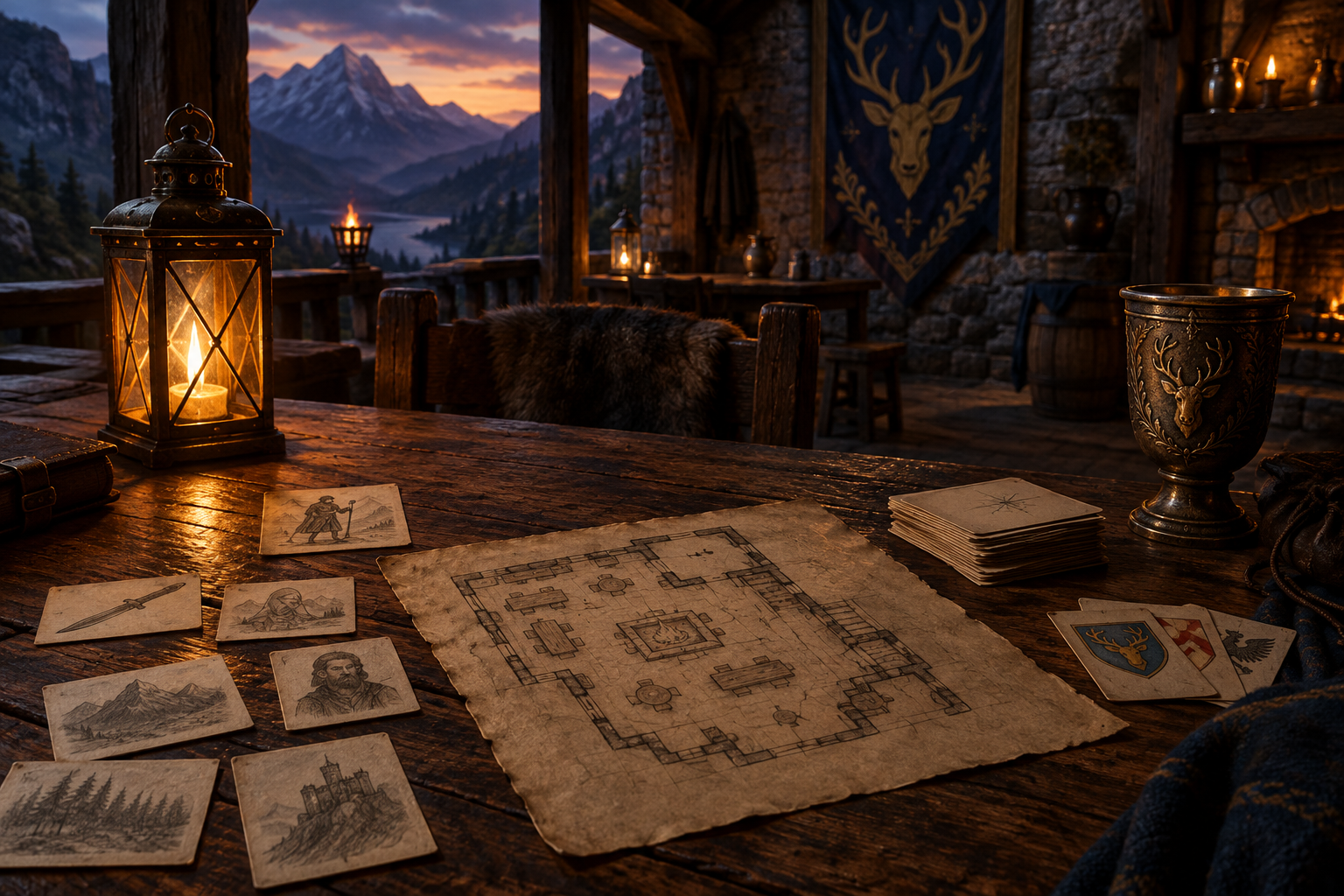
A scannable reference list of table-side checks for game masters and players: what to prepare, what to say, what to put on the table, and what to cut when a session feels heavy.
This article is a reference list, not an essay. It collects the table-side checks that tend to help when a session feels heavy, grouped by when you would use them: before play, during narration, on the table, and in the moment a game stalls. Skim it, pick two or three items, and leave the rest.
The list leans on one idea from learning research: people can hold only so much new information in mind at once. Applied to games, the idea suggests that play may slow when a table is asked to carry too much. That idea comes from educational psychology, not from gaming, and it is a lens rather than a law. Sweller (1988) is the paper this checklist draws on for the idea of cognitive load during problem solving. It studied learners working through problems, not game tables, so every item below is an application of the idea, not a finding about RPGs. Where a checklist item is a matter of table preference, it says so.
How to use this checklist
No table needs every item. Some of these checks overlap, and a few pull in opposite directions (a recap helps one group and bores another). Treat the list as a menu.
A reasonable way to use it:
- Read the section that matches your problem (stalled scenes, confused players, slow prep).
- Try one or two items for a session or two.
- Keep what helps and drop what does not. Ask the table, because the people carrying the load are the best judges of whether it got lighter.
Part 1: Before the session
Many load problems may be easier to prevent than to repair. These checks take a few minutes of preparation.
Prepare fewer named things than you think you need
- Count the named characters you plan to introduce in the opening scene. If the number is more than three or four, ask which ones the party will actually need.
- Give every named character one memorable trait and one want. Two pieces of information are likely to be easier for a table to recall than a paragraph of backstory.
- Keep the rest of the cast unnamed until someone asks. "The man at the back table" costs nothing to say and nothing to forget.
Shea (2018) argues in Return of the Lazy Dungeon Master that game masters can get more out of their games by preparing less, and a short cast list is one small way to do that. Treat it as a style of prep, one among several, not a requirement.
Write the scene on one card
- One card per scene: the purpose, the two or three characters, the place, and the likely choices.
- If a scene will not fit on a card, it may be two scenes.
- Mark the one thing the scene must communicate. If the players leave knowing only that, the scene still worked.
Shea (2024) describes scenes as a catch-all step of the Lazy Dungeon Master process, which fits the idea of keeping each scene small enough to hold in your head.
Decide your recap line
- Write one sentence that states where the party is and what they are trying to do.
- Write a second sentence about the most recent thing that changed.
- Stop there. A recap longer than a few sentences can become its own load.
Pick your shared reference points
- A rough sketch of the main location.
- A short written list of names for anything the table will need to refer to repeatedly.
- A place on the table where those items live, so nobody has to ask where they are.
The Dungeon Trainer's own toolkit articles cover the physical side of this in more depth; see Essential Dungeon Master Tools: What You Actually Need at the Table (The Dungeon Trainer, 2026a) for a broader list of what to bring.
Part 2: While narrating
At many tables, narration is where much of the information enters play, so it is where small habits matter most.
Pace the information, not just the speed
- Introduce characters one at a time, with a beat of play between them.
- Give a name together with a visual or behavioral hook, then repeat the name when the character speaks again.
- Avoid stacking a place description, three names, and a rumor in one breath.
Alexander (2017) offers advice on evocative descriptions, and the general principle that a few well-chosen details can do more than a long inventory is worth testing at your own table.
Know when to stop talking
- End a description on a question or a decision point. If the players have enough to act, they often will.
- Watch for the signs that narration has run long: players looking at their phones, asking you to repeat names, or going quiet.
- When in doubt, stop and ask what the characters do.
The Angry GM (2025) has a piece on when to stop narrating that tackles a related problem: when to summarize long, low-decision actions such as travel, tracking, or gathering rumors instead of playing out every moment.
Repeat names in a natural way
- Use names in dialogue and in the action, not only in introductions.
- If a name has not come up for a while, attach it to the trait: "the smug caravan master, Harrow, steps in front of you."
- Let players ask for a name again without embarrassment. A table culture where asking is normal can remove a lot of friction.
Offer a loose shortlist at decision points
- When the party reaches a choice, name two or three obvious options out loud.
- Say plainly that they can do something else. The list is a handhold, not a fence.
- If the table is energetic and confident, skip the list. It is a tool for quiet moments, not a requirement.
Whether to offer shortlists is a table preference. Some groups find them helpful; others find them constraining, and a few tables will want them only from newer players.
Part 3: On the table
Physical and shared tools take information out of heads and put it where everyone can see it.
The sketch map
- A rough shape with the entrances, hazards, and key features marked.
- Leave it where everyone can see it for the whole scene.
- Redraw rather than overload: a clean second sketch is better than a crowded first one.
For free tools, Dungeon Scrawl (n.d.) is one browser-based option for quick maps, and Dyson Logos (n.d.) publishes a large catalogue of dungeon and location maps on Dyson's Dodecahedron, which show how much a simple style can communicate.
Name cards or a shared list
- One card or line per recurring character, with the name and the single trait.
- Let players write their own if they prefer. Many players find that writing a name down helps them remember it.
- Keep the list short. If it grows long, retire characters who are no longer in play.
The party goal line
- One sentence on a visible card or a corner of the whiteboard: what is the party trying to do right now?
- Update it when the goal changes.
- It gives a returning or distracted player a way back in without interrupting the game.
Character sheets and rules references
- Encourage players to note the two or three actions they reach for most, in plain language, at the top of the sheet.
- Keep a one-page reference for any rule that comes up repeatedly at your table.
- If you rely on a rules text, cite from the current rulebooks rather than from memory; the free Basic Rules (Wizards of the Coast, 2024) are one place to check wording.
Audio and atmosphere
- Background sound can help a scene feel alive, but at some tables it can also compete for attention.
- Test it at a low volume and ask whether the table notices it at all. If conversation gets harder, turn it down.
- Tabletop Audio (2026) hosts ambient tracks. Before using any third-party audio in recorded or streamed play, check the site's licensing information.
Whether music helps is a clear case of table preference. Some groups love it; others find it a distraction.
Part 4: When the game stalls
Sometimes a table goes quiet despite good preparation. These are quick checks to run in the moment.
Diagnostic questions for the game master
- Have I given more information in the last few minutes than the players have had time to use?
- Has anyone asked me to repeat something?
- Is there a clear next action, or a clear question on the table?
- Is one player quiet while the others talk? That may mean they are lost, or it may mean they are thinking.
Quick repairs
- Pause and give a one-sentence recap: where the party is, what they want, what just happened.
- Point at the sketch map or the name list.
- Reduce the options: "The three obvious things are X, Y, and Z. Or tell me something else."
- Ask the quiet player directly and kindly what their character notices.
The Angry GM (2016) has a piece on keeping pace that approaches the same problem from the rhythm side, and Alexander (2013) discusses pacing at greater length. Both are single-author opinions on craft, not rules, so test them against your own table.
What not to do
- Do not respond to a stall by adding more description. More information is unlikely to fix a scene that already has too much.
- Do not single out a player for not remembering. A forgotten name is a table problem, not a player failing.
- Do not assume silence means boredom. Some players think before they speak.
Part 5: Habits for players
The load is not only the game master's to manage. Players can lighten it for themselves and for the table.
- Keep a short notes page with names and one-line descriptions. Many players find that writing a name down helps them remember it.
- Ask for a name again when you need it. Asking is useful, not rude.
- Say what your character is trying to do in a sentence before describing how.
- If you are new, tell the game master which parts feel fast. Many game masters welcome knowing.
- Offer a quick recap at the start of a session if you remember the last one well. It can help everyone settle in.
Part 6: What to cut
A checklist can become a load of its own. These are signs you may be overdoing it.
- More than a few cards, sketches, and handouts per scene.
- A recap that takes longer than the first action of the scene.
- Shortlists at every decision point, including ones where the players clearly know what they want.
- Preparation so detailed that you cannot find the part you need.
If a tool does not make the table's job easier, set it aside. The point of every item here is to lighten the load, and a tool that adds work has missed the point.
Example: The Lantern Road Company
This is an illustrative scenario, not a report of an actual game. It shows how a few items from the checklist might be combined for a fictional group.
The Lantern Road Company is a four-player party escorting a merchant caravan through a mountain pass. The game master is preparing the opening scene at a crowded waystation and picks a handful of items from the list.
Before play. The game master writes one scene card with three characters: a warm, hurried innkeeper who wants help with a broken cart, a smug rival caravan master who wants to leave first, and a nervous tax collector who wants an escort. The recap line is one sentence: the Company must reach the next town before the pass closes.
On the table. A rough rectangle of the common room goes in the middle of the table, with the hearth, the door, and the stable yard marked. The newest player, who is playing a cautious scout, decides to note the three names on a small card.
During play. The game master introduces the characters one at a time, with a short exchange between each. At the first real decision point, the game master says the party could help the innkeeper, question the tax collector, or watch the rival master, and adds that they are free to do something else.
When it stalls. Midway through, one player asks who the tax collector was. Instead of repeating a long introduction, the game master points at the card and says the nervous one who wants an escort. The scene continues.
Nothing about the fiction became simpler. What changed is how much the table had to carry in memory, and how easy it was to recover from a lapse.
A short list to print
If you want a version small enough to keep at the table, here it is.
Before: three characters or fewer per scene, one trait and one want each, one scene card, one recap line, one sketch.
During: one character at a time, names repeated in action, stop on a decision point, offer a loose shortlist if the table is quiet.
On the table: sketch map, name list, party goal line.
If stalled: recap, point at the sketch, shrink the options, invite the quiet player kindly.
Cut: anything that adds more work than it saves.
Where The Dungeon Trainer fits
The Dungeon Trainer (2026b) is a tool that helps people play together and improve their craft. If you want searchable records of the people, places, quests, and events from play kept in one spot, its campaign memory and codex can serve as that. In its human-DM mode, AI is optional; its autonomous AI Dungeon Master runs separate campaigns and is distinct from human-DM mode rather than a replacement for it (The Dungeon Trainer, 2026b). Everything in this checklist works just as well with index cards and a pencil.
Sources and Further Reading
- Alexander, J. (2013). The Art of Pacing. The Alexandrian. https://thealexandrian.net/wordpress/31509/roleplaying-games/the-art-of-pacing
- Alexander, J. (2017, September 4). Random GM Tip: Evocative Descriptions. The Alexandrian. https://thealexandrian.net/wordpress/39227/roleplaying-games/random-gm-tips-evocative-descriptions
- Dungeon Scrawl. (n.d.). Dungeon Scrawl. https://www.dungeonscrawl.com/
- Dyson Logos. (n.d.). Dyson's Dodecahedron: Maps.
- Shea, M. E. (2018). Return of the Lazy Dungeon Master. Sly Flourish.
- Shea, M. E. (2024, September 2). Scenes: The catch-all step of the Lazy Dungeon Master. Sly Flourish. https://slyflourish.com/scenescatchall_step.html
- Sweller, J. (1988). Cognitive load during problem solving: Effects on learning. Cognitive Science, 12(2), 257-285.
- Tabletop Audio. (2026). Tabletop Audio. https://tabletopaudio.com/
- The Angry GM. (2016, March 23). Keeping pace. The Angry GM.
- The Angry GM. (2025, July 31). When to stop narrating. The Angry GM.
- The Dungeon Trainer. (2026a). Essential Dungeon Master Tools: What You Actually Need at the Table. https://thedungeontrainer.com/blog/essential-dungeon-master-tools-what-you-actually-need-at-the-table
- The Dungeon Trainer. (2026b). The Dungeon Trainer.
- Wizards of the Coast. (2024). Basic Rules for Dungeons & Dragons. D&D Beyond. https://www.dndbeyond.com/sources/dnd/br-2024/
Play 5E at your own table
Play with friends or solo, run your own campaign, and keep the dice and character math in code. An optional AI Dungeon Master can run the game when you want one. Free to start, no card required.
Related reading
- Linear, Clustered, or Looping: Three Ways to Shape a Session's Rhythm
Three ways to lay out a session's scenes, using working labels, produce three very different rhythms. This comparison weighs linear, clustered, and looping structures and when each one tends to fit.
- The Session Pacing Toolkit: Checklists, Templates, and Table-Side Aids
A practical toolkit of pacing aids for game masters: a scene ledger, a beat map, a timing grid, and table-side prompts for keeping a session's rhythm without overthinking it.
- Designing Rhythm Into a Session: A Design Perspective on Tension, Release, and Spacing
Rhythm is a design decision, not a happy accident. This design-perspective essay looks at intensity, contrast, duration, and placement as materials a game master can shape before play begins.