Sandbox vs Railroad: Choosing the Right Campaign Structure for Your Table
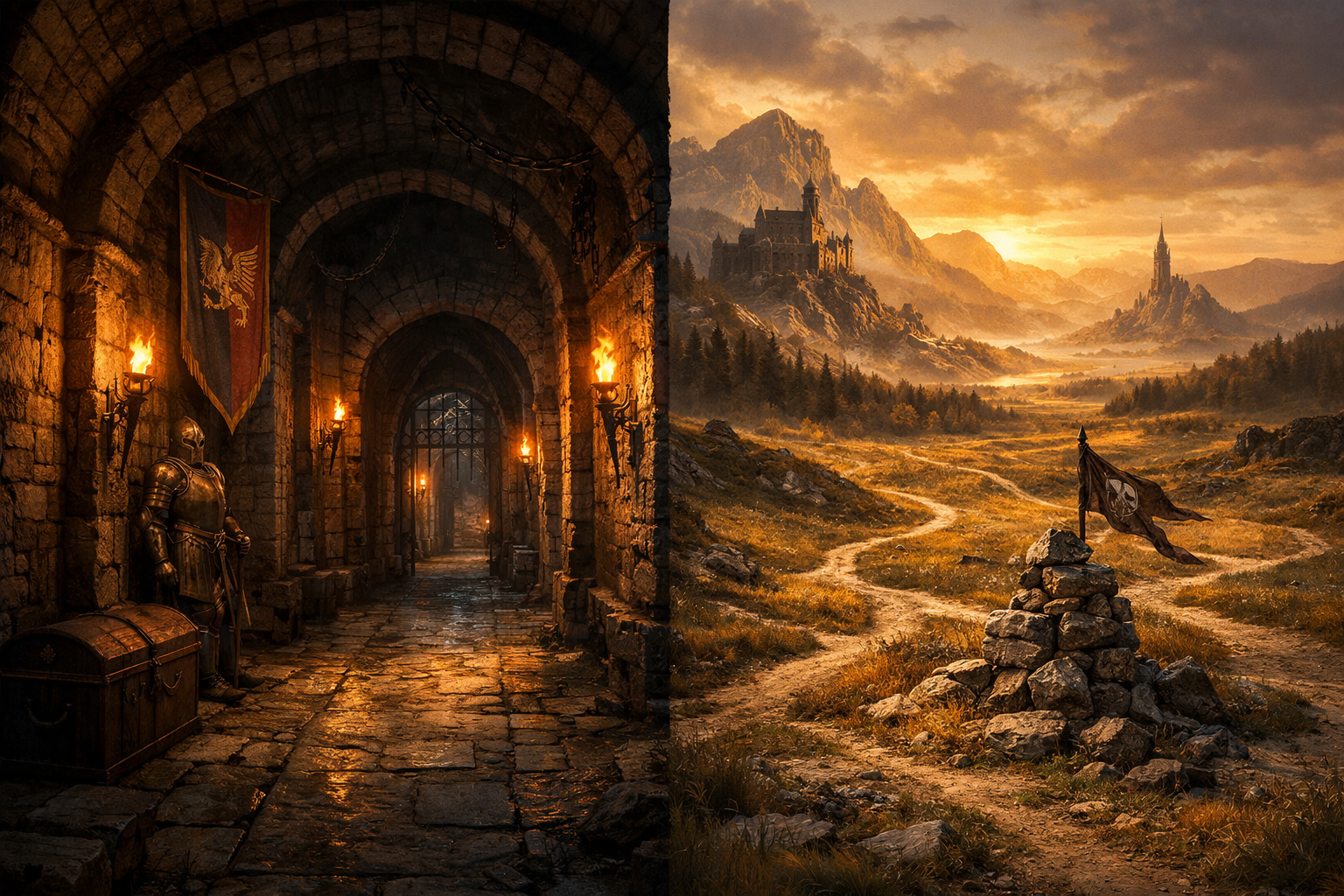
Sandbox and railroad campaigns represent fundamentally different approaches to tabletop RPGs. Learn how each structure works, what they offer players and Game Masters, and practical criteria for choosing the approach that fits your table's preferences and play style.
The choice between an open sandbox and a tightly structured campaign can shape nearly every aspect of how a tabletop RPG feels at the table. Different structures distribute control over campaign direction differently, create different preparation demands, and ask different things from players.
However, one important distinction needs to come first:
A linear campaign is not automatically a railroad.
A campaign can follow a fairly direct sequence of adventures while still allowing players to make meaningful decisions about how problems are solved, which alliances they form, what risks they take, and how events ultimately resolve.
"Railroading" is more accurately used when meaningful player choices are overridden, invalidated, or prevented because the Game Master requires a predetermined outcome.
That distinction matters because sandbox play and railroading are not simply two equally neutral ends of one spectrum.
A more useful comparison is often between player-directed sandbox structure and GM-directed or linear structure, while recognizing that railroading can occur when a structured campaign stops respecting meaningful choices.
This article examines those approaches as practical tools rather than competing philosophies and explores how Game Masters can combine them without sacrificing player agency.
Understanding Campaign Structure Terms
Campaign terminology is not always used consistently across the RPG community, so defining the terms helps prevent misunderstandings.
Sandbox Campaign
A sandbox campaign gives players substantial influence over campaign-level direction.
The Game Master typically prepares:
- Locations
- Factions
- NPCs
- Conflicts
- Threats
- Opportunities
- Resources
- Situations already in motion
Players then decide which elements deserve their attention.
They might choose:
- Where to travel
- Which factions to support
- Which mysteries to investigate
- Which threats to confront
- Which opportunities to ignore
- What personal goals to pursue
- When to abandon one objective for another
The resulting campaign develops through the interaction between player decisions and the prepared environment.
The 2024 Dungeon Master's Guide emphasizes player input when building campaigns, including learning what players want to experience, incorporating character motivations, and allowing character actions to influence future adventures (Wizards of the Coast, 2024).
Those principles can support a sandbox particularly well, although they are also useful in more structured campaigns.
Linear Campaign
A linear campaign follows a comparatively clear progression.
For example:
- The characters investigate attacks near a village.
- Evidence leads them to an abandoned fortress.
- Information discovered there reveals the villain's location.
- The party travels to the villain's stronghold.
- The campaign reaches its climax.
That structure is linear because later stages generally follow earlier ones.
It does not automatically become a railroad.
Players may still have meaningful control over:
- How they investigate
- Whether they negotiate or fight
- Which NPCs they trust
- What resources they use
- How they approach locations
- Whether particular allies survive
- What information becomes public
- What compromises they accept
- How the final conflict resolves
A structured sequence and meaningful agency can coexist.
Railroad
Railroading occurs when preserving the Game Master's intended path takes priority over meaningful player decisions.
For example, suppose the Game Master has planned for the characters to enter a fortress through the front gate.
The players instead discover a forgotten tunnel.
If the tunnel reasonably exists and their plan succeeds, allowing them to use it preserves agency.
If the Game Master suddenly declares the tunnel collapsed solely because the players must use the front gate, that begins to resemble railroading.
Likewise, imagine the players produce convincing evidence that should prevent an NPC's execution.
If the execution occurs anyway because the Game Master needs it for the next planned scene, the players' successful choices have effectively been invalidated.
Justin Alexander's discussion of plotted scenario design identifies this problem as a weakness of rigid sequences: every mandatory transition can become a chokepoint when the players do not follow the expected path (Alexander, 2010).
The issue is therefore not simply that the Game Master prepared a sequence.
The issue is whether the players' meaningful decisions are allowed to change what happens.
Think in Terms of a Spectrum
Campaign structure is rarely binary.
A campaign might be:
- Highly player-directed
- Mostly sandbox with occasional focused arcs
- A regional sandbox with a larger campaign threat
- A branching campaign with several major paths
- A linear campaign with flexible solutions
- A strongly scripted scenario
- A railroad where alternatives are repeatedly invalidated
These distinctions matter.
A campaign can become more structured without becoming a railroad.
Likewise, a sandbox can temporarily narrow its focus because of circumstances created through play.
Imagine that players in an open sandbox anger a powerful enemy who attacks their home city.
For several sessions, the campaign may naturally become focused around defending the city.
The structure has narrowed because previous decisions created a crisis.
That is very different from the Game Master arbitrarily forcing the party into an unrelated storyline.
Core Structural Differences
Sandbox and linear campaigns tend to differ most strongly in preparation, pacing, campaign-level agency, and narrative organization.
Preparation Focus
Sandbox Preparation
Sandbox preparation generally emphasizes situations rather than predetermined event sequences.
The Game Master might prepare:
- Who controls each region
- What major factions want
- Important NPC motivations
- Locations players could visit
- Current conflicts
- Available resources
- What might happen without player intervention
- Information players can discover
Justin Alexander describes this distinction as preparing situations rather than plots.
Instead of preparing:
The characters will confront the smugglers, who will escape to the docks, where the characters will chase them aboard a ship.
Prepare:
The smugglers operate from two warehouses near the docks. They plan to move their contraband tomorrow night. Their leader knows a harbor captain who can provide escape by ship.
The second version gives the Game Master enough information to respond if the players:
- Raid the warehouse
- Follow the smugglers
- Bribe the harbor captain
- Report the operation to authorities
- Steal the shipment
- Join the smugglers
- Ignore the situation
Preparation focuses on understanding the pieces well enough to react.
Linear Preparation
Linear preparation usually emphasizes a likely sequence.
The Game Master might prepare:
- Scene order
- Major encounters
- Clues that lead between locations
- Expected transitions
- Dramatic reveals
- Set pieces
- Pacing beats
- Climactic confrontations
This can provide a strong framework, especially when the group already wants to pursue the campaign premise.
The challenge is making transitions robust enough that one unexpected player decision does not collapse the structure.
Multiple clues, alternate routes, flexible scene ordering, and adaptable NPCs can preserve agency within a largely linear adventure.
Which Requires More Preparation?
There is no universal answer.
A sandbox can become extremely preparation-heavy if the Game Master tries to fully detail every possible location.
A linear campaign can become extremely preparation-heavy if every scene, contingency, dialogue branch, and possible outcome is scripted.
Situation-based preparation can actually reduce work because the Game Master prepares reusable people, locations, motives, and resources instead of trying to predict every player action.
Alexander specifically argues that preparing every possible contingency is unnecessary. The Game Master needs a usable understanding of the situation and can then respond at the table.
The most efficient structure depends on the Game Master's methods and the campaign being run.
Pacing Control
Sandbox Pacing
Sandbox pacing is influenced heavily by player priorities.
Players might:
- Spend three sessions investigating political corruption
- Suddenly abandon that investigation to explore ruins
- Spend a week of game time traveling
- Ignore an urgent rumor
- Focus an entire session on securing a stronghold
- Pursue a minor NPC relationship much further than expected
The Game Master still influences pacing.
They control:
- Scene framing
- Consequence timing
- NPC actions
- Faction developments
- Information delivery
- Travel abstraction
- Encounter transitions
But campaign-level priorities are more difficult to predict because the players have greater freedom to change them.
This unpredictability is not automatically bad pacing.
It is simply pacing that emerges more heavily from play.
Linear Pacing
A linear structure makes planned pacing easier.
The Game Master can arrange:
- Investigation
- Rising danger
- Complication
- Temporary victory
- Revelation
- Escalation
- Climax
in an intentional sequence.
This can be particularly useful for:
- One-shots
- Short convention games
- Focused adventure arcs
- Time-limited campaigns
- Scenarios with clear dramatic escalation
Mike Shea describes pacing as one of the important skills a Game Master develops, regardless of campaign structure (Shea, 2022).
Linear structure gives the GM additional control over the order in which pacing elements appear.
It does not guarantee good pacing.
Narrative Coherence
Sandbox Coherence
Sandbox coherence often emerges retrospectively.
Players may begin by:
- Helping a merchant
- Investigating ruins
- Fighting raiders
- Supporting a political faction
Months later, those decisions may become interconnected through consequences.
A merchant becomes a political ally.
The ruins reveal historical evidence affecting a territorial dispute.
The defeated raiders leave a power vacuum.
A faction uses the party's reputation to gain influence.
What initially appeared to be separate adventures gradually becomes the group's campaign history.
Themes can emerge from repeated player decisions.
Perhaps the characters consistently protect ordinary communities from powerful institutions.
Perhaps they repeatedly pursue forbidden knowledge despite the risks.
Perhaps the campaign becomes a story about building political power.
Those themes developed through play rather than being fully defined beforehand.
Linear Coherence
A structured campaign makes deliberate thematic organization easier.
The Game Master can intentionally establish:
- Foreshadowing
- Symbolic parallels
- Recurring imagery
- Character-specific conflicts
- Reveals
- Narrative callbacks
- Carefully timed payoffs
This can create strong dramatic unity.
However, the structure still benefits from player buy-in.
A beautifully planned theme matters little if the players are interested in something entirely different.
Player Agency
This is where terminology matters most.
Sandbox Agency
Sandbox campaigns frequently emphasize strategic agency.
Players decide:
- What matters
- Where to go
- Which objectives to pursue
- Which factions to engage
- What resources to develop
- What risks are worthwhile
Their choices can reshape the overall campaign.
Agency in Structured Campaigns
A structured campaign may narrow strategic choices while preserving substantial tactical, social, and character agency.
The party may already know that they are going into the haunted castle.
But they might still decide:
- Which entrance to use
- Whether to trust the caretaker
- Whether to destroy or preserve the cursed artifact
- Whether to negotiate with the ghost
- How to allocate resources
- Whether to rescue an enemy
- What happens to the castle afterward
Those decisions can still matter greatly.
Agency Under Railroading
Railroading becomes a problem when apparent decisions repeatedly produce the same result because only the Game Master's chosen outcome is allowed.
At that point, agency is not merely being expressed at a different level.
It is being reduced.
That distinction is why "linear campaign" is usually a better neutral term than "railroad campaign."
Practical Strengths of Sandbox Play
Sandbox campaigns can be particularly effective when players enjoy setting their own direction.
Player-Driven Investment
When players select their own goals, they are often invested in the results because the objective belongs to them.
They chose to investigate the ruins.
They decided to support the rebels.
They wanted to establish a trading company.
The Game Master did not need to convince them that those things mattered.
Emergent Stories
Sandbox play creates opportunities for events nobody predicted.
A minor NPC might become a major ally.
A faction intended as an enemy may become a partner.
A throwaway rumor can become the center of the campaign.
Plans created by the players can transform situations in ways the Game Master never anticipated.
These moments often become memorable precisely because everyone knows they emerged from play.
Long-Term Flexibility
A sandbox does not necessarily depend on one central plot continuing indefinitely.
When one situation concludes, players can move toward another.
New goals can emerge from:
- Previous consequences
- Character ambitions
- Exploration
- Political changes
- New information
This can support long-running campaigns particularly well.
Common Sandbox Challenges
Decision Paralysis
Freedom becomes difficult to use when players have too many options or too little information.
A sandbox still needs:
- Clear information
- Understandable stakes
- Visible opportunities
- Usable geography
- NPC relationships
Agency without context can feel like an empty choice.
Loss of Direction
Players may occasionally stop knowing what they care about.
This can be addressed by:
- Reviewing unresolved situations
- Asking about character goals
- Introducing logical consequences
- Providing new information
- Temporarily narrowing focus around something the players already value
Preparation Scope
The Game Master can overwhelm themselves by trying to prepare the entire world.
Instead, prepare deeply near current player interests and keep distant areas abstract until they become relevant.
Improvisation Pressure
Unexpected decisions sometimes require improvisation.
That burden can be reduced by:
- Asking players about next-session plans
- Using faction notes
- Maintaining reusable NPCs
- Preparing situations rather than outcomes
- Ending sessions after major decisions when practical
A sandbox does not require the Game Master to invent an entire world spontaneously.
Practical Strengths of Linear Structure
Linear adventures also offer real advantages when used transparently and with player buy-in.
Clear Direction
Everyone knows the immediate objective.
This can work particularly well when players want to spend their table time solving problems rather than deciding which campaign problem to pursue.
Focused Preparation
The Game Master can concentrate on the content most likely to appear.
That can support:
- Detailed environments
- Carefully designed encounters
- Strong NPC scenes
- Elaborate set pieces
- Purpose-built handouts
- Detailed tactical maps
Controlled Dramatic Escalation
Because major events occur in a more predictable sequence, the Game Master can more deliberately build toward dramatic moments.
This can be useful for a short, focused arc.
Accessibility
Some players prefer having an obvious goal.
New players may also appreciate clearer direction while they learn:
- Their characters
- The rules
- The setting
- Group dynamics
That does not mean new players require railroading.
It simply means explicit objectives can reduce the number of things they must learn simultaneously.
Common Problems With Linear Structure
Fragile Transitions
If each scene requires one exact player decision to reach the next, the campaign becomes fragile.
For example:
- Players must interrogate NPC A.
- NPC A provides clue B.
- Clue B leads to location C.
- Location C contains NPC D.
What happens if the players never interrogate NPC A?
Robust structured adventures provide alternatives.
Multiple clues, redundant information sources, flexible locations, and branching paths reduce dependency on one required decision.
Passive Play
If every objective is supplied automatically, players may become accustomed to waiting for the next instruction.
This is not inevitable.
Character goals, optional objectives, meaningful decisions, and consequences can preserve proactive engagement inside a structured campaign.
Resistance to Unexpected Solutions
Problems arise when the Game Master becomes attached to the method they expected.
If players discover a sensible way to bypass an encounter, that success should usually matter.
Otherwise, the campaign risks transitioning from linear structure into railroading.
Choosing a Structure for Your Table
The best structure depends less on abstract theory than on what the people at your table enjoy.
Ask Players Directly
Session Zero is the best place to discuss expectations.
Questions might include:
- Do you want a clear central objective?
- Do you enjoy deciding what the party does next?
- How much exploration do you want?
- Do you prefer one large story or many smaller situations?
- Do you enjoy faction politics?
- How much uncertainty about objectives feels enjoyable?
- Do you like long-term personal goals?
- Would you rather choose among several adventures or follow one focused campaign premise?
The 2024 Dungeon Master's Guide strongly encourages gathering player input and using both stated preferences and character choices to shape campaign development (Wizards of the Coast, 2024).
Do Not Diagnose Preferences From One Behavior
A player asking, "What are we supposed to do?" does not automatically mean they want a linear campaign.
They may simply:
- Lack information
- Be unfamiliar with the setting
- Be new to RPGs
- Have forgotten available options
- Be playing a character without clear motivation
Likewise, a player proposing an unexpected plan does not necessarily mean they want a completely open sandbox.
Ask.
Consider the Game Master's Preferences
The Game Master's enjoyment also matters.
You may prefer:
Sandbox-Oriented Preparation
- Faction relationships
- Location design
- World simulation
- Improvisation
- Consequence tracking
- Player-generated goals
Structured Preparation
- Encounter design
- Dramatic pacing
- Scene construction
- Carefully staged reveals
- Thematic development
- Strong narrative framing
Neither preference is inherently superior.
The most sustainable campaign usually uses techniques the Game Master actually enjoys preparing.
Match Structure to the Campaign Concept
Some concepts naturally suggest more player-directed structures.
Examples include:
- Wilderness exploration
- Domain management
- Faction politics
- Merchant campaigns
- Open-ended treasure hunting
- Frontier settlement
- Criminal enterprises
Other concepts often benefit from stronger framing.
Examples include:
- A one-night haunted-house scenario
- A tournament
- A prison escape
- A military mission
- A disaster scenario
- A short convention adventure
Even these examples do not require railroading.
A prison escape can have many escape routes.
A military mission can allow players to determine tactics.
A haunted house can support non-linear investigation.
Structure defines the framework.
Agency determines whether player choices matter inside it.
Mysteries Do Not Require Railroading
Mysteries deserve special attention because they are sometimes treated as naturally linear.
They do not need to be.
Justin Alexander's node-based scenario design specifically demonstrates ways to build investigations that can move through multiple locations and information sources without requiring one exact clue sequence.
A mystery might include:
- Several suspects
- Multiple investigative locations
- Independent clue sources
- Different ways to reach important conclusions
- Consequences for pursuing one lead before another
The final revelation may be fixed because there is an objective truth about what happened.
The path to discovering it does not need to be.
Horror Does Not Require Railroading
Horror often benefits from controlled information, pressure, atmosphere, and escalating danger.
None of those require invalidating player decisions.
In fact, horror can become more effective when players know they made the choices that placed their characters in danger.
The Game Master can control:
- What the characters perceive
- Environmental pressure
- Threat behavior
- Resource scarcity
- Time pressure
while still allowing the party to decide how to respond.
Hybrid Approaches
Many campaigns work best by changing structure according to the current situation.
Structured Sandbox
A structured sandbox narrows the scope without determining the outcome.
For example, the campaign may take place entirely within one valley.
Inside that valley, players decide:
- Which settlements to visit
- Which factions to support
- Which threats to investigate
- Which resources to pursue
- What long-term goals matter
The geographic boundary makes preparation manageable without substantially restricting agency.
West Marches
Ben Robbins' original West Marches campaign is a particularly strong example of sandbox structure.
Its defining features included:
- No regular session schedule
- No permanent party
- No regular plot
- Players selecting where they wanted to explore
- A persistent wilderness environment
- Players organizing expeditions themselves
Robbins explicitly described it as a sandbox in which players decided where to go and what to do (Robbins, 2007).
A bounded map does not make West Marches a sandbox/railroad hybrid.
The boundaries define where the sandbox exists.
They do not determine what the players do inside it.
Flexible Linear Structure
A Game Master can maintain a central story while allowing considerable flexibility.
Suppose three events are likely to define the arc:
- A diplomatic summit occurs.
- An enemy attempts to sabotage it.
- A political decision follows.
Those events might happen because powerful NPCs have scheduled them.
The players can still determine:
- Whom they support
- What information they uncover
- Whether the sabotage succeeds
- Who is blamed
- Who survives
- How the summit concludes
- What consequences follow
The timeline supplies structure.
The players supply outcomes.
That is meaningfully different from railroading.
Scene-Level Variation
Campaign structure can also change temporarily.
A sandbox campaign may contain:
- A tightly mapped dungeon
- A chase
- A siege
- A courtroom hearing
- A ceremonial event
A linear campaign might contain:
- Open investigation
- Freeform urban exploration
- Negotiation among factions
- A large dungeon with multiple routes
- Downtime driven by player goals
Individual scenes do not need to use the same structural philosophy as the entire campaign.
Transparent Expectations
Sometimes the simplest solution is telling the players what kind of game they are about to play.
For example:
"This is a short mystery centered on one manor. You're free to investigate however you want, but the campaign assumes your characters are interested in solving the murder."
That is not railroading.
It is a campaign premise everyone agreed to.
Likewise:
"The next part of the campaign is completely open. Tell me where you want to travel next."
Transparency reduces mismatched expectations.
Recognizing When a Sandbox Needs More Structure
A sandbox may benefit from additional structure when:
- Players repeatedly cannot choose a direction
- Important information has become confusing
- The party has too many unrelated objectives
- Nobody remembers why current situations matter
- Preparation breadth is overwhelming the Game Master
- Players explicitly ask for clearer goals
Useful responses include:
- Summarizing current situations
- Introducing a time-sensitive development
- Asking the party to choose a shared short-term goal
- Bringing back consequences from a previous decision
- Focusing several sessions around one existing conflict
More structure does not mean removing agency.
It means helping players use it.
Recognizing When a Structured Campaign Needs More Flexibility
A structured campaign may need to open up when:
- Players repeatedly propose reasonable alternatives
- Prepared transitions keep breaking
- Players feel their choices do not matter
- The group becomes passive
- Players show greater interest in side situations than the central plot
- The Game Master repeatedly has to invalidate plans to preserve future scenes
Possible responses include:
- Letting player plans succeed when appropriate
- Converting future plot points into situations
- Adding multiple routes toward important information
- Allowing NPC plans to change
- Asking what goals the characters actually want to pursue
If the campaign repeatedly requires preventing reasonable actions, the underlying structure probably needs revision.
Example: The Millbrook Consortium
The Millbrook Consortium campaign begins as a regional sandbox.
Players operate around a trade city where:
- Merchant houses compete for influence
- Smugglers control hidden routes
- Local officials have competing loyalties
- Rural settlements depend on trade
- Several unexplored locations surround the city
For eight sessions, players determine their own priorities.
They decide which contacts to cultivate, which rumors to investigate, and which conflicts matter.
Then their earlier decisions create a crisis.
A rival merchant house plans to frame the Consortium for smuggling during an upcoming trade council.
The council meeting will occur in nine days regardless of what the characters do.
The campaign naturally becomes more focused.
The Game Master knows several things:
- Evidence is being planted.
- The council will convene.
- Rival factions are preparing arguments.
- A decision will eventually be made.
Those are circumstances and scheduled events.
The outcomes remain open.
Players might:
- Discover the planted evidence
- Frame the rival faction instead
- Expose both groups
- Bribe council members
- Negotiate privately
- Convince the Consortium to confess unrelated wrongdoing
- Steal the evidence
- Discredit the entire council
- Fail to stop the scheme
The crisis lasts several sessions and produces a tighter structure than the previous sandbox play.
After the council conflict concludes, the campaign opens again.
The players now have:
- New enemies
- Political allies
- Additional information
- Changes to their reputation
- New opportunities
The temporary structured arc created focus without requiring predetermined outcomes.
This hybrid structure can provide dramatic variation while preserving the campaign's overall player-driven character.
A Practical Decision Framework
When choosing a campaign structure, ask four questions.
1. Who chooses the campaign's immediate goals?
Mostly the players suggests sandbox-oriented play.
Mostly the Game Master suggests more structured play.
2. Can player decisions meaningfully change outcomes?
If yes, either structure can preserve agency.
If no because predetermined outcomes must occur, railroading is becoming a risk.
3. How much uncertainty does the group enjoy?
Some groups enjoy asking:
"What should we do?"
Others would rather ask:
"How should we accomplish what we already know we need to do?"
Neither preference is wrong.
4. What does the Game Master actually want to prepare?
A campaign should be sustainable.
If you dislike maintaining faction states, do not build a campaign requiring twenty active factions.
If you dislike preparing elaborate narrative sequences, do not construct a campaign that depends on dozens of tightly staged scenes.
Choose structures that support both the players' preferences and the Game Master's strengths.
Final Principle
The useful question is not:
"Is sandbox better than railroad?"
It is:
"How much control over direction does this group want, and where should meaningful decisions occur?"
Sandbox campaigns place substantial responsibility for direction in the players' hands.
Linear campaigns provide stronger framing and sequencing.
Both can contain meaningful choices.
Railroading becomes a problem when maintaining a predetermined path requires those choices to stop mattering.
Most long-running campaigns will move between tighter and looser structures over time.
The important thing is preserving the relationship between choice and consequence.
If players understand the campaign's premise, can make meaningful decisions inside it, and see those decisions affect what happens next, the structure is doing its job.
Sources and Further Reading
Alexander, J. (2009, March 23). Don't prep plots. The Alexandrian.
Alexander, J. (2010, May 27). Node-based scenario design, part 1: The plotted approach. The Alexandrian.
Robbins, B. (2007, October 17). Grand experiments: West Marches. Ars Ludi.
Shea, M. E. (2022, April 21). Improving pacing. Sly Flourish.
Wizards of the Coast. (2024). Dungeon master's guide. Wizards of the Coast.
Related reading
- Why Megadungeons Succeed or Fail: Lessons from Forty Years of Play
Megadungeons have persisted since the earliest days of tabletop roleplaying, yet many campaigns abandon them within a few sessions. Learn what structural, pacing, and preparation factors separate sustainable megadungeons from those that collapse, and how to apply those lessons at your own table.
- Understanding the Megadungeon: What It Is and When to Use It
A megadungeon is more than a big dungeon. Learn what defines this sprawling adventure structure, why it persists across decades of play, and when it serves your table better than episodic adventures.
- Running Sandbox Campaigns: Six Months with The Millbrook Consortium
Sandbox campaigns promise player-driven freedom but demand different preparation and facilitation techniques. This case study examines six months of running The Millbrook Consortium, a merchant-focused sandbox, to identify practical lessons about faction management, player agency, and sustainable open-world play.