Room Purpose and Pacing in Dungeon Design
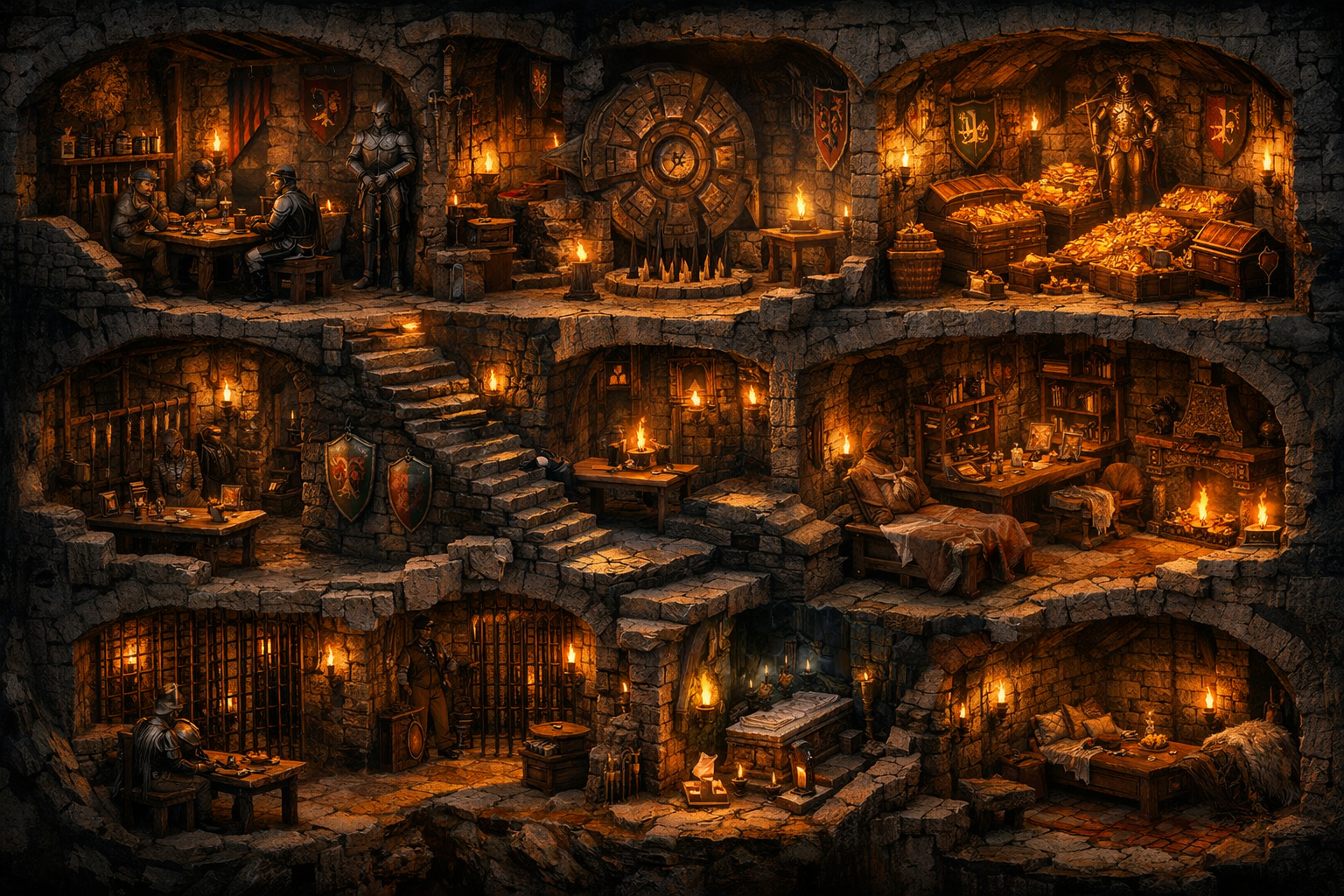
Every room in a dungeon should serve a purpose. Learn how to design chambers with distinct functions and pace your crawls to maintain player engagement from entrance to finale.
Dungeon rooms do more than hold monsters, treasure, and puzzles.
Together, they establish how a location works, what happened there, who inhabits it, what the players can learn, and which decisions they face as they explore.
A guardroom can communicate security.
A library can preserve information.
A collapsed dormitory can show the effects of age or disaster.
An apparently empty corridor can establish distance, provide a route around another threat, or simply make the architecture feel believable.
Good dungeon design therefore involves more than deciding what encounter belongs in each room.
It involves understanding:
- Why spaces exist
- What players can do with them
- What information they communicate
- How they connect
- How pressure changes across the dungeon
- How long different situations deserve at the table
This guide uses room purpose and pacing as practical design lenses.
They are not rigid formulas.
A dungeon does not need a specific ratio of combat, puzzles, treasure, and rest areas. Nor does every room need a discrete mechanical function.
The goal is intentionality: create a location whose spaces work together to produce meaningful exploration.
What Does "Room Purpose" Mean?
A room can have several kinds of purpose at once.
For example, a ruined chapel might simultaneously:
- Reveal the dungeon's history
- Contain an environmental hazard
- Provide cover during combat
- Offer clues to a hidden crypt
- Give characters a defensible place to regroup
- Reinforce the location's religious theme
Room categories are therefore design tools, not labels every chamber must fit neatly.
When examining a room, ask:
- Why does this space exist in the location?
- What does it communicate?
- What can players do here?
- Does anything change because they entered?
- How does it connect to nearby spaces?
- Does it support the tone or theme?
Some rooms will answer all of those questions.
Others may answer only one or two.
That can be enough.
Combat Spaces
Some dungeon areas are likely to become battlefields.
They become more interesting when the location influences how combat works.
Useful features can include:
- Cover
- Elevation
- Doors
- Narrow passages
- Furniture
- Machinery
- Water
- Fire
- Difficult terrain
- Multiple entrances
- Hazards
- Objects characters can interact with
A guardroom with barricades, doors into adjacent areas, and an alarm bell produces different decisions from the same guards standing in an empty square chamber.
Likewise, a dining hall with long tables, a balcony, serving doors, and a large fireplace provides opportunities that a featureless room does not.
Communicate What Characters Can Perceive
Players need enough information to make decisions.
If overturned tables obviously provide cover, describe them.
If the floor slopes toward a visible pit, communicate that.
If a balcony is ten feet above the floor, establish its position.
Hidden traps, concealed enemies, secret doors, and effects the characters have not detected do not need to be disclosed simply because combat may begin.
The principle is clarity, not complete tactical transparency.
Give Opponents Context
Ask why enemies are here.
Guards may be:
- Watching an entrance
- Protecting prisoners
- Resting between patrols
- Waiting for reinforcements
- Defending supplies
That purpose affects their behavior.
A guard protecting an alarm lever may prioritize reaching it rather than fighting to the death.
A mercenary guarding treasure may surrender once continued resistance stops being profitable.
The room's fictional purpose can therefore create the encounter's mechanical objective.
Puzzle and Challenge Spaces
Some areas present problems instead of, or in addition to, combat.
Examples include:
- A sealed ceremonial door
- A damaged elevator
- A flooded passage
- A rotating bridge
- A magical ward
- A collapsed staircase
- A coded archive
- A ritual mechanism
The central question is:
What are the players actually trying to figure out or overcome?
Specific Solutions Can Be Valid
Not every puzzle needs five different solutions.
A particular ceremonial lock may genuinely require a particular sequence.
That can work when:
- Players can obtain the necessary information
- The feedback from interacting with it is understandable
- Failure does not produce endless blind guessing
- The puzzle fits the location
- The consequences are appropriate
Problems arise when critical progress depends on the players guessing an answer that exists only in the Dungeon Master's head.
For essential conclusions or routes, use redundant information or alternate avenues when appropriate.
For example, the sequence for an ancient seal might be discovered through:
- A mural
- An inscription
- A surviving priest
- Religious records elsewhere in the dungeon
The puzzle still has one mechanism.
The information needed to understand it is not restricted to one fragile clue.
Let Character Abilities Matter
A puzzle occurs in the fictional world, so characters may know things the players do not.
Depending on the challenge:
- Investigation might reveal a mechanical connection.
- Arcana might identify magical principles.
- Religion might provide ritual context.
- History might recognize an old symbol.
- Tools might allow physical manipulation.
- Spells may bypass part of the problem.
That does not mean one ability check should automatically solve every puzzle.
Character abilities can provide information and options that help players engage with it.
Rest, Recovery, and Decision Spaces
Some dungeon locations naturally provide opportunities to regroup.
Examples might include:
- A hidden alcove
- An abandoned barracks
- A defensible shrine
- A sealed storeroom
- A room whose occupants were already defeated
- A chamber protected by a heavy door
These spaces can change pacing because the immediate pressure decreases.
But a Dungeon Master does not need to designate rooms as official "rest rooms."
Players may create safety through their own decisions.
They might:
- Barricade a door
- Hide
- Secure an abandoned chamber
- Negotiate sanctuary
- Retreat to a previously cleared location
Whether a Short Rest or Long Rest is practical should follow the rules and circumstances.
Ask:
- Does anyone know the characters are here?
- Can the area be secured?
- Is there time pressure?
- Are enemies searching?
- What happens elsewhere while they wait?
Sometimes the answer is that resting is reasonably safe.
Sometimes it is risky.
Avoid automatically interrupting rests simply because the party is recovering resources.
Decision Points
A room can be valuable because it changes what the party knows about its options.
A junction might reveal:
- Warm air from one route
- Chanting from another
- Stairs descending deeper
- Evidence that one corridor is heavily traveled
- A damaged map showing another wing
The chamber itself may contain no encounter.
Its purpose is to create a navigational decision.
These rooms become particularly valuable in nonlinear dungeons because players can weigh routes based on information rather than choosing randomly.
Lore and Discovery Spaces
Dungeon environments can communicate history without requiring a narrator to explain it.
Possible sources include:
- Murals
- Architecture
- Documents
- Equipment
- Damage
- Burial practices
- Statues
- Maps
- Personal belongings
- Changes made by later inhabitants
A monastery library might reveal what the original order studied.
A burned sanctuary might show that a violent event occurred before the current occupants arrived.
A goblin settlement built inside ancient dwarven machinery communicates two different layers of the location's history at once.
Separate Essential Information From Optional Depth
Some information is necessary for the adventure to function.
Other lore is simply rewarding.
Do not hide essential progress behind unusually exhaustive searching unless the game deliberately uses that exploration procedure.
For example:
Essential information:
The ritual chamber is beneath the chapel.
Provide several reasonable ways to learn this.
Optional depth:
The monastery's third abbot secretly disagreed with the order's doctrine.
That might require someone to study damaged journals.
Players who investigate receive more context without penalizing players who prefer to continue exploring.
Treasure and Resource Spaces
Treasure becomes more believable when it fits the location.
A military outpost might contain:
- Weapons
- Armor
- Supplies
- Pay records
A temple might contain:
- Offerings
- Ceremonial objects
- Religious texts
A wizard's laboratory might contain:
- Components
- Research
- Experimental devices
A thieves' hideout might contain:
- Stolen goods
- Disguises
- Lockpicks
- Forged documents
Treasure does not always need its own vault.
It can be distributed through places where inhabitants would logically keep useful or valuable things.
Treasure Creates Decisions
Rewards can do more than increase character wealth.
A cache might contain:
- Healing resources the party can use now or save
- An item valuable to a faction
- Evidence implicating an NPC
- Equipment useful elsewhere in the dungeon
- Something difficult to transport
The interesting question can become:
What do we do with this?
rather than simply:
How much is it worth?
Quiet and Apparently Empty Rooms
Not every room needs an encounter.
Not every room needs a clue.
Not every room needs treasure.
A location composed entirely of high-value encounters can feel less like architecture and more like a sequence of set pieces.
Quiet spaces can contribute:
- Spatial logic
- Atmosphere
- Contrast
- Distance
- Navigation
- Evidence of ordinary life
- Opportunities to regroup
- Future tactical positions
Some rooms may genuinely contain little of immediate interest.
That is not automatically a design failure.
What Makes an Empty Room Useful?
Suppose the characters enter an abandoned dormitory.
Nothing attacks.
There is no hidden treasure.
The room contains:
- Broken beds
- Rotting blankets
- Dust
- An old washbasin
- Two doors
Its contribution may simply be:
- Showing that people once lived here
- Creating another route
- Providing a defensible chamber
- Establishing the scale of the monastery
That can be enough.
If several consecutive rooms offer no new decision, information, atmosphere, threat, or spatial value, however, exploration may begin to feel repetitive.
The issue is not the existence of quiet rooms.
It is prolonged play without anything meaningful changing.
Room Purpose Can Change During Play
A room's purpose is not permanently fixed.
The party may convert an abandoned barracks into:
- A defensive position
- A temporary headquarters
- A place to hold prisoners
- A fallback point
A ceremonial hall might become a battlefield.
A storage room might become an escape route after players break through a wall.
The inhabitants may also change spaces.
After an alarm:
- Guards occupy a previously empty junction.
- Prisoners are moved.
- Doors are barricaded.
- Supplies disappear.
- A faction abandons one wing.
Treat the dungeon as a location rather than a static list of room functions.
What Is Dungeon Pacing?
Pacing is the relationship between what is happening and how much table time, attention, and pressure it receives.
It is not simply speed.
A long scene can have excellent pacing when:
- Players are making important decisions
- New information is emerging
- The situation keeps changing
- Everyone remains invested
A short scene can drag when nothing meaningful happens.
Dungeon pacing therefore involves more than arranging rooms in a particular sequence.
Useful dimensions include:
- Pressure
- Information
- Decision density
- Uncertainty
- Resource use
- Table time
- Variety
Vary Pressure, Not Just Encounter Type
A common recommendation is to alternate combat, puzzle, combat, social scene, and so forth.
That can create variety, but rigid alternation quickly becomes predictable.
Instead, think about pressure.
A sequence might look like:
- Quiet exploration
- Evidence of danger
- A difficult navigational choice
- Combat
- Discovery
- Temporary safety
- New information that increases urgency
Another section might contain two combats close together because the party has entered an actively defended area.
Another might contain no combat at all.
The dungeon's fiction should help determine the rhythm.
Tension and Release as a Lens
Tension and release can be useful concepts.
Tension may rise through:
- Danger
- Time pressure
- Uncertainty
- Resource depletion
- Difficult choices
- Information suggesting a larger threat
Pressure may decrease through:
- Reaching safety
- Resolving uncertainty
- Defeating a threat
- Finding useful resources
- Discovering a shortcut
- Receiving an answer
Do not treat this as a requirement to alternate high and low tension on a schedule.
Sustained tension may be appropriate in horror.
Long periods of exploratory curiosity may suit a ruined city.
A combat-focused gauntlet may deliberately maintain pressure.
Use the concept to understand the experience, not to impose a waveform on every dungeon.
Do Not Use a Fixed Room Count
There is no general D&D rule stating that three rooms should occur between major decisions, rests, or other pacing beats.
Three can be a useful brainstorming constraint.
Five-room dungeons are another popular design exercise.
Neither is a requirement.
A meaningful decision might occur in two adjacent rooms.
A megadungeon may contain a long stretch of connected spaces before a natural rest opportunity appears.
Design according to:
- Geography
- Inhabitants
- Objectives
- Pressure
- Player choices
not a fixed number of keyed areas.
The Opening Rooms
Early rooms establish expectations.
They might introduce:
- The dungeon's architecture
- A faction
- A hazard
- A theme
- The first clue
- The navigation structure
- The level of danger
They do not always need to be easier than later rooms.
An early encounter can be extremely dangerous if:
- The campaign supports that level of risk
- Players receive appropriate information
- Retreat or avoidance is reasonably possible when appropriate
- The difficulty fits the intended style
What early areas should usually do is teach players something about the location.
For example, the first flooded chamber might reveal that water levels change.
Later, that information becomes strategically important.
Escalation
Escalation does not have to mean bigger monsters.
The stakes can increase because:
- Enemies become alert
- Time becomes scarce
- Navigation becomes harder
- The party discovers what is really happening
- Factions react
- Resources become more valuable
- The environment becomes unstable
- Several problems interact
A goblin scout encountered early may be mechanically weaker than later threats.
But the real escalation may be discovering that allowing the scout to escape changes the defensive state of the dungeon.
Practical Example: The Sunken Monastery
Consider a partially flooded monastery.
The location was once a religious complex but has deteriorated after decades of water damage.
New inhabitants are using parts of the ruins.
We can examine how several areas contribute different functions without treating them as a mandatory sequence.
The Collapsed Nave
The party enters through the remains of the central nave.
The area contains:
- Broken columns
- Fallen roof sections
- Shallow standing water
- Faded religious murals
- Several exits
No enemy needs to be present.
The room establishes:
- The flooded theme
- The monastery's original purpose
- Navigational choices
- Evidence of structural instability
It is primarily an exploration and orientation space.
The Scriptorium
Water has damaged shelves of old manuscripts.
The party can discover:
- References to sealed crypts
- A floor plan missing several later additions
- Notes about religious disputes
- Evidence that someone searched the room recently
This is primarily an information space.
Characters who spend more time investigating may learn additional context.
The essential clue about the crypt should not depend on reading every damaged manuscript if reaching the crypt is necessary for the adventure.
The Refectory
A damaged dining hall is occupied by creatures that entered through flooded tunnels.
The room includes:
- Long tables
- Broken benches
- Deepening water near one wall
- A collapsed serving passage
- Two exits
If combat occurs, those features affect positioning.
The creatures do not need to exist merely because the dungeon requires a combat room.
Their presence should make sense within the flooded environment.
The Bell Tower
The bell tower is largely abandoned.
Reaching the top provides:
- A view of the monastery grounds
- Information about another entrance
- Evidence of activity in the courtyard
- A possible future signal point
The room contains no treasure or required encounter.
Its reward is information and strategic position.
The Abbot's Quarters
This area contains:
- Personal records
- Ceremonial equipment
- Preserved supplies
- Evidence that the abbot attempted to seal part of the monastery
The space combines treasure, lore, and clues.
Its contents arise from what the room originally was rather than from a need to insert a "treasure room."
The Flooded Lower Passage
Water rises above waist height in parts of the lower level.
The challenge may involve:
- Movement
- Visibility
- Equipment
- Alternate routes
- Environmental risk
The passage creates pressure without necessarily containing monsters or a puzzle.
The Defaced Shrine
The party finds a shrine whose original imagery has been damaged by the current occupants.
The change reveals:
- A conflict between old and new inhabitants
- Information about the current faction
- A possible clue to their beliefs
Depending on player choices, it might later become:
- A negotiation site
- A defensive position
- A ritual location
Its function can evolve.
The Sealed Tomb
A sealed tomb may be difficult to enter.
Inside, the party could discover a relatively protected space.
That does not make it a guaranteed rest point.
The players still need to determine whether:
- Anyone knows they entered
- The door can be secured
- Time permits recovery
The room creates an opportunity.
The players determine how to use it.
Pacing Through Choices
Notice that the Sunken Monastery does not require:
Empty room, lore room, combat room, puzzle room, rest room.
Players may explore the areas in another order.
They may never enter some rooms.
The pacing emerges from:
- Which routes they choose
- Which threats they trigger
- How long they investigate
- Whether enemies react
- When they retreat or rest
- What information they discover
This is one reason nonlinear dungeon design can produce varied sessions even from the same map.
Common Pacing Problems
Several patterns can weaken a dungeon.
They are problems when they conflict with the experience your table wants, not universal design violations.
Repetitive Encounter Structure
If several consecutive rooms produce nearly identical:
- Combat
- Searches
- Puzzles
- Conversations
the experience can become predictable.
Before adding another similar encounter, ask whether it introduces:
- A new decision
- A new threat
- New information
- Different terrain
- Different stakes
If not, you may be repeating content rather than developing the dungeon.
Combat Gauntlets
Several combats in succession can be appropriate.
A fortress under alert might logically produce exactly that experience.
A tournament dungeon may deliberately operate as a gauntlet.
The problem appears when repeated combat:
- Has identical objectives
- Uses similar terrain
- Produces little new information
- Exists solely to consume resources
Varying goals can help.
One battle may involve:
- Holding a doorway
- Preventing an alarm
- Escaping
- Protecting an NPC
- Capturing a target
Combat variety is about decisions, not merely changing monster species.
Puzzle Bottlenecks
A mandatory puzzle can stop an adventure when:
- The clues are inadequate
- The feedback is unclear
- No alternate route exists
- Character abilities cannot provide useful information
If the puzzle blocks essential progress, consider:
- Redundant clues
- Alternate routes
- Character knowledge
- Consequences for bypassing it
- Costly methods of forcing progress
A puzzle can still matter without turning one guess into a campaign chokepoint.
Excessive Sprawl
Large dungeons are not automatically bad.
Megadungeons are built around enormous spatial scope.
The question is whether the additional space contributes to the experience.
Rooms may justify their presence through:
- Architecture
- Navigation
- Atmosphere
- Resources
- Information
- Faction territory
- Strategic positioning
- Exploration
A monastery probably needs mundane living spaces to feel like a monastery.
Those rooms do not each require an encounter.
Cutting them solely because they lack obvious mechanical content can make the location less believable.
Instead, compress table time when a space does not deserve extensive play.
Overcompressed Dungeons
The opposite can also occur.
If every door immediately reveals:
- A major fight
- Treasure
- A puzzle
- A revelation
the dungeon can feel artificial and exhausting.
Quiet space gives important content contrast.
Density should match the intended style.
Adjusting Pacing During Play
Preparation cannot perfectly predict how quickly players will move.
But real-time pacing adjustment should preserve the established world.
If Players Are Moving Quickly
Do not automatically add:
- A locked door
- Extra monsters
- A new trap
- Additional Hit Points
simply because the party is progressing faster than expected.
Maybe they made effective decisions.
Let that matter.
Instead, ask whether anything already established would respond.
For example:
- A patrol is due to return.
- The villain's plan progresses with time.
- Escaped guards warn another area.
- The party reaches the next major situation sooner than expected.
If nothing logically changes, fast progress can simply remain fast.
If Players Are Moving Slowly
Determine why.
Are they:
- Enjoying the exploration?
- Confused?
- Afraid of arbitrary traps?
- Searching repeatedly?
- Debating a meaningful decision?
- Missing important information?
Different causes need different responses.
If they are confused, clarify what their characters understand.
If repetitive searching is slowing play, establish a clearer search procedure.
If they are deeply engaged in a difficult strategic choice, the slower pace may be entirely appropriate.
If Resources Are Low
Low resources can create tension.
They do not automatically mean the DM needs to provide recovery.
The players may choose to:
- Retreat
- Find defensible shelter
- Negotiate
- Continue despite the risk
If a plausible recovery opportunity exists, present it honestly.
Do not create healing supplies solely because the encounter difficulty has become inconvenient.
Likewise, do not remove an established safe location simply because the party would benefit from it.
If Players Are Disengaged
Do not assume you need combat.
Consider introducing or emphasizing an element that already exists in the dungeon:
- A meaningful choice
- New information
- A faction response
- An environmental change
- Evidence of the objective
- A consequence from an earlier action
Sometimes the correct response is simply to compress low-value exploration and move to the next meaningful situation.
The Dungeon Should React
Pacing changes naturally when the location responds to the party.
After significant events, ask:
- Who knows they are here?
- Which enemies escaped?
- Which doors were opened?
- Which faction lost resources?
- What objective advanced?
- What would inhabitants logically do?
An empty room may become occupied.
A guardroom may be abandoned.
A previously safe route may become watched.
A faction might request negotiations.
The dungeon's room purposes can change as its state changes.
Room Purpose in Published Adventures
Published dungeons provide useful examples, but do not treat them as perfect templates.
Different adventures were designed for:
- Different editions
- Different assumptions
- Different audiences
- Tournament play
- Introductory play
- Different levels of lethality
Older modules can be valuable historical examples without representing current 2024 D&D guidance.
When studying a published dungeon, ask:
- How are rooms connected?
- Which rooms communicate information?
- Where do inhabitants live?
- Where can players make route choices?
- What happens when alarms are raised?
- How does the location handle treasure?
- Are there quiet spaces?
- Which encounters could be avoided?
- How does the dungeon change after player actions?
Study the decisions the architecture creates rather than merely copying room counts.
Adapting Published Dungeons
You can adjust a dungeon to fit your group.
Possible changes include:
- Clarifying clues
- Revising creature motivations
- Adding environmental features
- Making negotiation possible where appropriate
- Changing treasure
- Creating stronger faction relationships
- Making important routes easier to understand
Avoid changing encounters solely because you want every room to meet a personal room-type quota.
Start with the problems the actual table encounters.
Two Ways to Begin Dungeon Design
"Start with purpose" is useful advice, but it is not the only design method.
Method One: Function First
Begin with experiences or needs.
For example:
- A major confrontation
- A clue about the villain
- A hazardous crossing
- A valuable resource
- A route decision
Then ask what kind of location logically provides that function.
A clue room might become an archive.
A defensible area might become a gatehouse.
A hazardous crossing might become a collapsed aqueduct.
Method Two: Place First
Begin with the location's fiction.
Suppose you are designing a monastery.
It probably needs:
- A chapel
- Living quarters
- Kitchens
- Storage
- Workspaces
- Administrative rooms
- Burial areas
Then ask what each existing space contributes during play.
The kitchen might become:
- A faction meeting place
- A resource cache
- An alternate entrance
The crypt may contain:
- Historical information
- A hostile inhabitant
- A secret route
Both methods work.
Often the best approach combines them.
Connect Purpose to Theme
Rooms become memorable when their functions arise naturally from the location.
In a dragon's lair:
- The hoard reflects possession and status.
- The entrance may show signs of repeated passage by a massive creature.
- Trophy chambers reveal previous victories.
- Servant areas reveal how other creatures survive nearby.
In a flooded monastery:
- Damaged texts reveal the history of flooding.
- Raised walkways show how later inhabitants adapted.
- Waterlogged crypts create environmental complications.
- Defaced shrines reveal ideological conflict.
Theme should influence:
- Architecture
- Hazards
- Treasure
- Inhabitants
- Information
This gives the dungeon coherence.
Meaningful Route Choices
A route choice matters when players can distinguish something about the options.
Imagine a junction.
Flooded Passage
The characters hear moving water.
An old map suggests this route reaches the lower vaults quickly.
Guarded Hall
Voices and torchlight indicate occupation.
It appears to be the most direct path.
Abandoned Quarters
The route is longer, but the rooms may contain information about the monastery.
The players now have information.
They can choose based on:
- Speed
- Risk
- Information
- Resources
The routes may eventually reconnect.
That does not make the choice false.
Different journeys can produce different consequences before reaching the same destination.
Optional Rooms Need Not Contain Rewards
An optional room can exist simply because the dungeon is a place.
Thorough exploration should sometimes produce useful discoveries, otherwise players may learn that investigating side areas never matters.
But not every side chamber requires treasure.
Uncertainty is part of exploration.
A Practical Room Review
After sketching a dungeon, review each area.
For each room, ask:
- Why does this space exist in the fiction?
- What can characters immediately perceive?
- What can they interact with?
- What information might they learn?
- Who uses or inhabits this space?
- How does it connect to nearby areas?
- Could its state change?
- Does it create or support a decision?
You do not need a substantial answer to every question.
The exercise helps identify rooms that may need more thought.
Review the Dungeon as a Whole
Then stop looking at individual rooms.
Ask:
- Are several recent encounters too similar?
- Does navigation produce meaningful choices?
- Are important clues redundant enough?
- Can inhabitants react?
- Are quiet spaces present where they make sense?
- Does resource pressure come from actual circumstances?
- Can players bypass some threats?
- Do optional routes matter?
- Are there places worth returning to?
A collection of individually good rooms can still create a poor dungeon if they do not work together.
Tools That Support Dungeon Design
Dedicated map-making and dungeon-design tools remain useful for spatial planning.
The Dungeon Trainer currently supports adjacent parts of the preparation process rather than replacing a dungeon mapper.
Scry
Scry can help a Dungeon Master examine an upcoming scene and forecast plausible ways it could develop.
For a dungeon room, that might help identify:
- Likely player approaches
- Complications
- Pacing risks
- Single points of failure
- Preparation considerations
For example:
What happens if the players bypass the guards?
Does all progress depend on one clue?
What if they negotiate instead of fight?
Scry helps prepare possibilities rather than dictate outcomes.
The Coach
The Coach provides practice scenarios with rubric-grounded feedback.
A Dungeon Master can use it to practice decisions involving:
- Pacing
- Adjudication
- Player agency
- Information clarity
- Encounter management
Location and Encounter Generators
The Dungeon Trainer can generate:
- Locations
- Monsters
- NPCs
- Items
- Spells
These can provide preparation material.
Generated content should still be reviewed against:
- Dungeon theme
- Existing geography
- Faction logic
- Difficulty
- Campaign continuity
A generated room is not automatically a good room.
It still needs to belong in the location.
Human-Run Campaigns
When the dungeon reaches the table, a human Dungeon Master can retain narration and adjudication authority while The Dungeon Trainer handles shared mechanical state such as:
- Dice
- Character sheets
- Hit Points
- Conditions
- Rests
- Death saves
- XP
- Initiative
- Combat rounds
- Shared transcripts
- Campaign continuity
Human-run controls do not require model calls.
AI roles remain optional.
Campaign Memory
As rooms change through play, campaign records can help preserve what happened.
That can include:
- NPCs encountered
- Locations
- Quests
- Events
A spatial map shows where places are.
Campaign memory helps preserve what happened there.
Those are complementary functions.
Building Your Design Instincts
Dungeon design improves through use.
After a session, ask:
- Which rooms produced interesting decisions?
- Where did players spend more time than expected?
- Which spaces were ignored?
- Which clues were unclear?
- Which encounters felt repetitive?
- Did the environment matter during combat?
- Did players use shortcuts or alternate routes?
- Did the dungeon react convincingly?
Do not judge a room solely by whether players spent a long time there.
A thirty-second corridor may have done its job perfectly.
Likewise, a heavily prepared room may be unsuccessful if players had no meaningful way to interact with it.
Watch Patterns, Not One Session
One group may unexpectedly spend an hour investigating a minor shrine.
That does not mean every future dungeon needs more shrines.
A combat may run long because of unusual dice.
A puzzle may be solved immediately because one player recognizes its inspiration.
Look for patterns across several sessions.
That gives you better information about your table's preferences.
Your Next Dungeon
When designing your next dungeon, you do not need a perfect room-type ratio.
You do not need three rooms between decision points.
You do not need a combat, puzzle, lore room, and treasure room in every section.
Start with the location.
Ask why it exists.
Ask who uses it.
Create routes.
Add inhabitants.
Add hazards and information where they make sense.
Then examine what the resulting rooms allow players to do.
If you prefer function-first design, start with the decisions and situations you want to support, then turn those functions into believable spaces.
Either way, review the dungeon as a whole.
Look for:
- Repetition
- Meaningless routes
- Fragile clues
- Static inhabitants
- Unclear objectives
- Excessive or nonexistent pressure
Then run it.
The players will use rooms in ways you did not predict.
They will turn storage chambers into fortresses.
They will negotiate in rooms you expected to become battlefields.
They will ignore treasures and become fascinated by architecture you considered decorative.
That is not the design failing.
A good dungeon provides enough structure that unexpected decisions can still produce coherent results.
Room purpose gives the location structure.
Pacing determines how that structure feels in play.
Player decisions turn both into an adventure.
Sources and Further Reading
- Adams, J. J. (Ed.). (2023). Kobold Guide to Dungeons. Kobold Press.
- Alexander, J. (2010, July 23). Xandering the Dungeon. The Alexandrian.
- Alexander, J. (2010, July 26). Xandering the Dungeon, Part 2: Xandering Techniques. The Alexandrian.
- Alexander, J. (2023, November 1). A Historical Note on Xandering. The Alexandrian.
- Gygax, G. (1978). Tomb of Horrors. TSR.
- Gygax, G. (1979). The Keep on the Borderlands. TSR.
- Shea, M. E. (2018). Return of the Lazy Dungeon Master. Sly Flourish.
- Wizards of the Coast. (2024). Dungeon Master's Guide.
- Wizards of the Coast. (2024, October 31). Let's Build a Halloween One-Shot With the 2024 Dungeon Master's Guide. D&D Beyond.
- Wizards of the Coast. (2024, November 8). Let's Prepare an Adventure Using the 2024 Dungeon Master's Guide. D&D Beyond.
- The Dungeon Trainer. (2026). The Dungeon Trainer.
---
Ready to turn a map into a dungeon worth exploring? The Dungeon Trainer supports human Dungeon Masters with Scry preparation, coaching, location and encounter generators, campaign continuity, shared transcripts, code-resolved mechanics, and optional AI assistance. Build the location with the tools you prefer, then use the support that helps you run it at the table.
Related reading
- Why Megadungeons Succeed or Fail: Lessons from Forty Years of Play
Megadungeons have persisted since the earliest days of tabletop roleplaying, yet many campaigns abandon them within a few sessions. Learn what structural, pacing, and preparation factors separate sustainable megadungeons from those that collapse, and how to apply those lessons at your own table.
- Understanding the Megadungeon: What It Is and When to Use It
A megadungeon is more than a big dungeon. Learn what defines this sprawling adventure structure, why it persists across decades of play, and when it serves your table better than episodic adventures.
- Running Sandbox Campaigns: Six Months with The Millbrook Consortium
Sandbox campaigns promise player-driven freedom but demand different preparation and facilitation techniques. This case study examines six months of running The Millbrook Consortium, a merchant-focused sandbox, to identify practical lessons about faction management, player agency, and sustainable open-world play.