Reflecting on a Heavy Session: What the Lantern Road Company Taught About Carrying Less
Written with AI. An AI model drafted this article. How we use AI
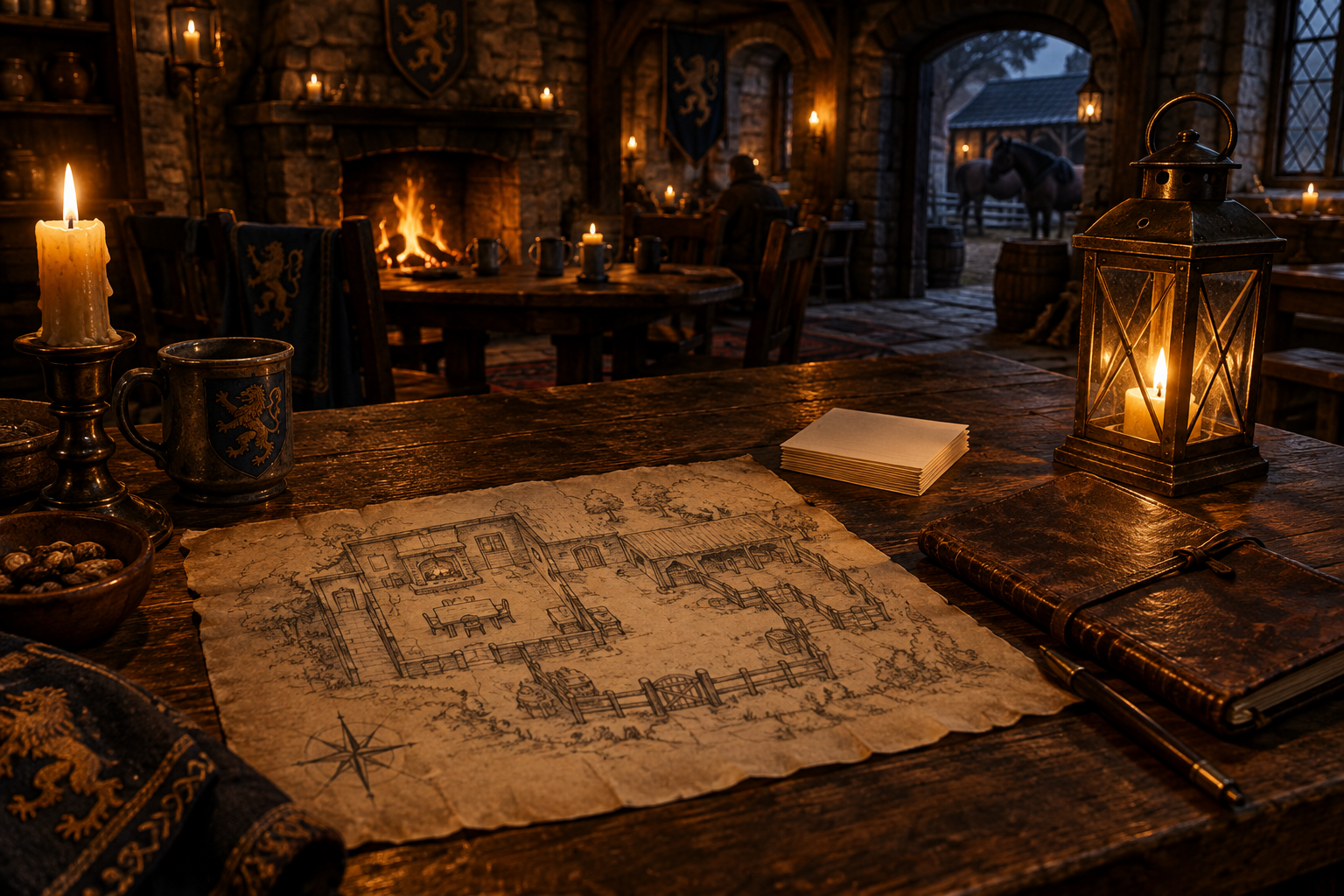
A reflective look at an illustrative scenario in which a crowded waystation scene stalls, then recovers, and what the week's cognitive load ideas look like once they are pulled together into one small practice.
This article steps back to look at cognitive load at the gaming table. It looks at a single illustrative scene from the beginning, asks what a reflective game master might notice after a heavy session, and offers a way to turn those notices into a small, repeatable habit.
It stands alone. You do not need the earlier articles in this series to follow it.
Why reflect on a heavy session at all
A session that stalls can be easy to remember and hard to diagnose. The table goes quiet, someone asks a question that was already answered, the game master repeats a name for the third time, and the energy drains out of the room. Afterward the usual explanations arrive quickly: the players were tired, the scene was boring, the plot was too complicated.
Those explanations may be true. They may also hide a more specific cause, which is that the table was asked to hold too much at once. Cognitive load theory, an idea from learning research, offers one lens on this. Sweller (1988) argued that conventional problem solving uses so much cognitive processing capacity that little is left for acquiring schemas, which interferes with learning. That paper is about problem solving in an educational setting, not about tabletop games, so the connection to play is an analogy rather than a finding. Used carefully, though, the analogy gives a reflective game master a useful question to ask after a rough scene: what exactly was everyone trying to keep in their heads?
Reflection of this kind is a craft habit, not a verdict. It works best when it stays small, specific, and kind to everyone involved, including the person behind the screen.
The shape of a useful reflection
A post-session reflection does not need a long form. A few plain questions can do most of the work.
- Where did the energy dip? Name the moment, not the whole evening.
- What had just happened? Often a stretch of uninterrupted narration, a new batch of names, or a rules question that needed several steps.
- What was the table holding at that moment? Count it loosely: names, places, goals, options, rules.
- What could have lived outside people's heads instead? A card, a sketch, a recap line, a shortlist.
- What is one thing to try next time? Exactly one.
The last question matters most. A reflection that ends with six resolutions may end with none kept; one change is easier to follow through on. Choosing one change keeps the practice light, and it respects the idea the whole exercise is built on: do not overload the person doing the carrying, and that includes you.
A note on honesty and hedging
It is tempting to turn a reflection into a confident theory about why a scene failed. Resist that. A game master reading a table is working from partial evidence: a silence, a repeated question, a glance at a phone. Many things can produce those signals. Table preference varies: some groups may enjoy a dense, name-heavy opening, while others may prefer a lean start. Neither is wrong.
So treat any diagnosis as a working guess. The goal is to find a change worth trying, not to establish a cause. If the change helps, keep it. If it does not, drop it and try another.
Example: The Lantern Road Company
This is an illustrative scenario, not a report of an actual game. It shows how a reflection might look for a fictional group. It continues the waystation scene introduced in the first article of this series.
The Lantern Road Company is a four-player party escorting a merchant caravan through a mountain pass. In the first version of the opening scene, the game master narrates for several minutes at a crowded waystation. The innkeeper, her husband, three rival caravan masters, a tax collector, and two travelers all receive names. The game master also describes the common room, the weather, and a rumor about bandits. Then the game master asks, "What do you do?" The newest player, who is playing a cautious scout, goes quiet. Another player asks who the tax collector was. The scene stalls while names are repeated.
After the session, the game master runs through the five reflection questions.
Where did the energy dip? Right after the question "What do you do?" The silence started there, not during the narration.
What had just happened? A long stretch of narration had introduced many names and a map of the room in spoken form only.
What was the table holding? Eight names, the room layout, a weather detail, a rumor, and the party's larger goal of reaching the next town before the pass closes. None of it was written anywhere the players could see.
What could have lived outside people's heads? The names and wants could sit on a small card. The room could be a rough sketch with the hearth, the door, and the stable yard marked. The party's goal could be a single line of recap.
What is one thing to try next time? Here the reflection narrows. The game master does not resolve to overhaul everything. They choose to prepare a short note card of three characters, each with one memorable trait and one want.
The lightened version of the scene follows from that single choice, plus the sketch and the recap line that cost almost nothing. The innkeeper is warm and hurried and wants help with a broken cart. A rival caravan master is smug and wants to leave first. A tax collector is nervous and wants an escort. The game master presents the three characters one at a time, in short bursts. The scout's player notes the names on a card. When the party reaches a choice, the game master offers a loose shortlist: help the innkeeper, question the tax collector, or watch the rival master. Players remain free to do something else.
Nothing about the fiction became simpler. The same people exist and the same tension is in the room. What changed is how much the table had to carry in working memory.
The reflection also records what it does not know. It cannot say whether the newest player went quiet because of overload, shyness, or simple unfamiliarity with the game. The game master treats the change as an experiment and plans to watch how the next scene feels.
What carries over from a single scene
A reflection on one scene is most useful when it yields a small principle that can travel to other scenes. Here are four that the waystation scenario suggests. Each is framed as a tendency worth testing, not a law.
Name fewer people at once
A crowd of named characters can be a source of load; in the author's view, a bare name gives a listener little to hang onto. Introducing characters one at a time, and attaching a trait and a want to each, gives the table something concrete to remember. If a character will not matter, consider leaving them unnamed. Alexander (2017) advises keeping scene descriptions pithy, using a handful of evocative images instead of lengthy description. By extension, a single vivid detail may serve a minor character better than a long list of facts.
Put the map on the table
Many game masters find spatial information awkward to convey in spoken form alone. A rough sketch lets the table check where the door is instead of remembering it. The sketch does not need to be good. For more on physical aids at the table, see The Dungeon Trainer (2026), Essential Dungeon Crawl Props and Tools: A Game Master's Toolkit.
Recap the goal in one line
A short reminder of the party's goal may help players focus and can help newer or returning players rejoin the thread. The line can be spoken at the start of the scene and left on a card.
Offer a shortlist, not a mandate
When the party reaches a choice, a loose set of options gives people somewhere to start. It should be clear that the list is a prompt and not a boundary. Players can still invent something else. This preserves agency while lowering the effort of deciding what is even possible.
How this relates to pacing
Cognitive load and pacing are close neighbors. A scene that overloads the table may also feel slow, because the energy goes into repeating and re-explaining. Writers on game mastering discuss pacing from several angles. Alexander (2013) describes pacing in roleplaying games as cutting out the 'empty time' between one meaningful choice and the next. The Angry GM (2016) argues that pacing is the rhythm of the scenes in an adventure, which is separate from how fast things move at the table. Shea (2022) offers advice on improving pacing at the table. None of these sources is a statement about cognitive load, so it would be a stretch to say they endorse the idea. They do show that game masters have long paid attention to how a session feels in motion, and a load-aware reflection fits comfortably alongside that attention.
For a related angle, The Angry GM (2025) discusses when narration should stop and hand control back to the players, using what he calls 'tab stop narration.' That is a different framing from working memory, but it points in a compatible direction.
Turning reflection into a repeatable practice
A habit may be easier to keep when it is cheap. Here is a minimal version.
- Within a day of the session, write three lines. One line for a moment that went well, one for a moment that dipped, one for the single change to try.
- Keep the lines somewhere you will see them before prepping. A notebook, a note on your phone, or the first page of your session folder all work.
- Before the next session, check the one change against your prep. Ask whether you have made room for it, such as a blank card for names or a sketch space for the first scene.
- After the next session, glance back. Did the change help, hurt, or do nothing noticeable? Record a short note and choose the next change.
Shea (2024) writes about high value prep, the idea that some preparation pays off more than other preparation. A reflection loop fits that spirit: it points your limited prep time at the thing that actually dipped, instead of at general polish. Treat that connection as a reading of the idea, not a claim about what the source says about reflection.
Including the players in the reflection
A reflection does not have to be solo. If your table is comfortable with it, a brief check-in can surface things a game master cannot see from behind the screen. Keep it light. A few options:
- Ask, "Was there a moment tonight when you felt lost or behind?"
- Ask, "Was there anything you wanted written down or drawn?"
- Invite players to suggest what they would like on a table card for next time.
Some players may prefer not to critique in front of the group, and that is a matter of table culture. A private message or an anonymous form can work for those who prefer it. Offering several channels respects different comfort levels. Some groups may prefer a simple survey form for collecting short responses, and for some small groups an end-of-night conversation may be enough. If the group has a session-zero conversation or a safety practice, a load check-in can slot into the same space.
For players: carrying less is also your craft
Cognitive load is not only a game master concern. Players can lighten their own load, and doing so tends to help the whole table.
- Keep a small name list. A scrap of paper with names and one-word reminders is enough.
- Ask for a recap without apology. A short question like "Remind me, what are we trying to do?" can help others who were wondering the same thing.
- Say what you are tracking. If you are juggling three options, naming them aloud can help the game master offer a shortlist.
- Flag what you would like drawn. If a space is confusing, asking for a quick sketch is a reasonable request.
None of this is about being a better student of the game. It is about making the shared work of play easier to share.
Where the idea stops
It is worth ending on limits. Cognitive load theory comes from education research, and its claims concern learning, not entertainment. A game table is a social space where people want some challenge, some tangle, and some surprise. In the author's view, a table that removed every demand on memory might feel flat to many groups. The point is not to minimize load but to spend it on what the table cares about: the choices, the tension, the characters that matter.
The reflection practice described here is also not a tested method. It is a plain way to look back on a session and choose a small change. It draws on a well-known idea and on common sense about how people remember things, and it hedges accordingly. If a different approach to reviewing a session works better for your group, use that one.
A short closing checklist
Before your next session, you might ask yourself:
- Which single scene is most likely to ask the table to hold a lot at once?
- What is the one thing from that scene I could write, draw, or recap instead of only saying?
- Have I left room for players to ask for a repeat without feeling slow?
- What one change will I try, and how will I notice whether it helped?
That is enough. A small change, noticed honestly, is worth more than a large plan that never reaches the table.
A note on tools
A notebook and a stack of index cards are enough for a reflection habit, so use whatever you will actually open.
Sources and Further Reading
- Alexander, J. (2013). The Art of Pacing. The Alexandrian. https://thealexandrian.net/wordpress/31509/roleplaying-games/the-art-of-pacing
- Alexander, J. (2017, September 4). Random GM Tip: Evocative Descriptions. The Alexandrian. https://thealexandrian.net/wordpress/39227/roleplaying-games/random-gm-tips-evocative-descriptions
- Shea, M. E. (2022). Improving Pacing. Sly Flourish. https://slyflourish.com/pacing.html
- Shea, M. E. (2024, June 3). High Value Prep. Sly Flourish.
- Sweller, J. (1988). Cognitive load during problem solving: Effects on learning. Cognitive Science, 12(2), 257-285.
- The Angry GM. (2016, March 23). Keeping pace. The Angry GM.
- The Angry GM. (2025, July 31). When to stop narrating. The Angry GM.
- The Dungeon Trainer. (2026). Essential Dungeon Crawl Props and Tools: A Game Master's Toolkit. https://thedungeontrainer.com/blog/essential-dungeon-crawl-props-and-tools-a-game-master-s-toolkit
Play 5E at your own table
Play with friends or solo, run your own campaign, and keep the dice and character math in code. An optional AI Dungeon Master can run the game when you want one. Free to start, no card required.
Related reading
- Linear, Clustered, or Looping: Three Ways to Shape a Session's Rhythm
Three ways to lay out a session's scenes, using working labels, produce three very different rhythms. This comparison weighs linear, clustered, and looping structures and when each one tends to fit.
- The Session Pacing Toolkit: Checklists, Templates, and Table-Side Aids
A practical toolkit of pacing aids for game masters: a scene ledger, a beat map, a timing grid, and table-side prompts for keeping a session's rhythm without overthinking it.
- Designing Rhythm Into a Session: A Design Perspective on Tension, Release, and Spacing
Rhythm is a design decision, not a happy accident. This design-perspective essay looks at intensity, contrast, duration, and placement as materials a game master can shape before play begins.