Reading the Two Numbers: Passive Perception Against Stealth in Play
Written with AI. An AI model drafted this article. How we use AI
When a hidden threat meets a watchful character, two numbers collide. This analysis looks at how passive Perception and Stealth interact, and what that means for fairness, tension, and pacing.
Passive Perception is easy to explain on its own. It is a standing awareness score that a character carries into every scene. Stealth is also easy to explain on its own. It is the measure of how well a creature stays unseen and unheard. The interesting questions start when the two meet, because the comparison of one number against another decides whether an ambush lands, whether a sneaking rogue gets caught, and whether a scene feels fair.
This article is an analysis of that meeting point. It is not a primer on passive Perception itself (a separate article in this series covers the basics). Instead, it looks at what happens when a passive score is held up against a Stealth result, which table decisions shape the outcome, and where the comparison helps or hurts play.
The Short Version
- A passive score is a stand-in for a check the character is making all the time without anyone rolling. The rules describe it as a score that reflects a creature's general awareness of its surroundings, used when the creature is not consciously making a Wisdom (Perception) check (Wizards of the Coast, 2024a).
- Stealth is typically rolled once by the hiding creature, and that single result is what the watchers are measured against.
- The comparison is simple, but the judgment around it is not. Who is hiding, who is watching, what the fiction says about cover and light, and whether anyone is actively searching all change which rule applies.
- Tables differ on how visible to make the numbers. That is a matter of preference, not a rule.
What Each Number Actually Represents
Before comparing the two, it helps to be precise about what each one stands for.
Passive Perception
Passive Perception is a score. In the current Basic Rules, Passive Perception equals 10 plus the character's Wisdom (Perception) check bonus, increased by 5 with Advantage or decreased by 5 with Disadvantage (Wizards of the Coast, 2024a). You can read the exact wording and the current handling of the calculation in the free rules (Wizards of the Coast, 2024a), and in the Player's Handbook (Wizards of the Coast, 2024c).
The key idea is that it represents ongoing, low-effort attention. It is the character glancing around, listening, and noticing what a reasonably alert person would notice. It is not the same as a character stopping to scour a room.
Stealth
Stealth is a skill check. The creature trying to stay hidden makes it, and the result describes how well it avoids notice in the moment. In the current rules, hiding interacts with the Hide action, which takes a successful DC 15 Dexterity (Stealth) check and gives the Invisible condition while hidden, and the details are in the rules text rather than something to reconstruct from memory (Wizards of the Coast, 2024b). Where the details matter at your table, read the current text directly.
The important structural point is that Stealth is usually a rolled result while passive Perception is a fixed score. One side brings a number that varies, the other brings a number that does not. That asymmetry shapes everything that follows.
How the Comparison Works in Practice
In the common case, the Game Master compares the hider's Stealth result against the passive Perception of each creature that might notice. A watcher whose passive score meets or beats the result notices. A watcher whose score falls short does not.
This has three useful consequences.
- One roll serves many watchers. The Game Master rolls Stealth once for the hiding group or creature and checks it against every relevant passive score. That saves the table from a dice-rolling procession.
- Different watchers get different outcomes. A sharp-eyed scout may notice something that a distracted wizard misses. That is a feature of the comparison, because it rewards character building and creates uneven information that the players then have to handle together.
- The result is not automatically public. The Game Master can keep the Stealth roll behind the screen and simply narrate what each character perceives.
The exact adjudication of who can attempt to hide, what counts as cover, and what happens when a hidden creature attacks belongs to the rules text. This article does not restate it, and you should check the current rulebooks rather than trust a paraphrase.
Where the Comparison Is the Right Tool
The passive-versus-Stealth comparison earns its place in specific situations.
Ambushes and Lookouts
The moment a creature lies in wait and the party walks past, the party is not searching. They are travelling. A passive comparison models that well. Nobody announced that they were looking for bandits, so a standing score is the honest representation of whether they spot movement in the ditch.
Many Watchers at Once
When four or five characters could plausibly notice the same thing, individual rolls slow the scene and expose the secret by their very existence (a request for a Perception roll from every player tells everyone something is there). A single comparison against known scores avoids that.
Keeping the Fiction Moving
A comparison lets the Game Master narrate through a tense moment without stopping. If a character notices, the narration says so. If nobody notices, the narration proceeds as if nothing is unusual, and the surprise lands naturally.
Where the Comparison Gets Awkward
The same tool has limits, and recognising them is part of using it well.
Active Searching Changes the Rule
If a player says their character is crouching to peer under the branches, they have moved from background attention to a deliberate action. The Game Master can reasonably call for a check rather than rely on the passive score. The core idea is that a stated action deserves a resolved action. Collapsing it into the passive number can feel like ignoring the player's choice.
The Fixed Score Problem
Because passive Perception does not vary, a character with a high score can feel like they are never ambushed, and a character with a low score can feel like they never see anything. That can flatten tension if the Game Master always sets the hider's result low enough or high enough that the outcome is predictable. The fix is not a rule. It is a design habit: vary the difficulty by situation so the comparison is not always won by the same character.
Information Asymmetry and Table Trust
When one character notices a hazard and others do not, the group has to decide how to share that information. Some tables enjoy the friction of imperfect communication. Others find it frustrating if the noticing character is expected to "just know" what to tell everyone. Which approach fits is a table preference. A short conversation in session zero about how information is shared can prevent confusion (Shea, 2021).
The Reverse Case
The comparison also runs the other way. When player characters sneak up on a guard post, the players roll Stealth, and the Game Master compares against the guards' passive scores. The same fairness considerations apply. If the Game Master never lets the players' stealth succeed because the guards' scores are always high, the feature stops being a meaningful choice.
Three Ways Tables Use the Numbers
There is no single right way to handle this. Here are three approaches, with the trade-offs of each.
Approach 1: Fully Hidden Numbers
The Game Master keeps passive scores and the Stealth roll private, and narrates only the outcome.
- Strengths: Preserves mystery. Players are never told that an ambush exists or that they failed to notice it.
- Costs: Players cannot easily see how their character build matters. Some may suspect the Game Master is fudging.
Approach 2: Known Scores, Hidden Rolls
Players know their own passive scores, and the Game Master keeps the Stealth rolls private.
- Strengths: Players understand what their character is good at and can plan around it. The Game Master still protects the surprise.
- Costs: A player may reason backward from "I wasn't told anything" to "nothing is there," which is a different kind of meta-awareness.
Approach 3: Fully Transparent Numbers
Everything is on the table, including the DC or Stealth result.
- Strengths: Maximum clarity about how the mechanic works. Good for teaching new players.
- Costs: Removes the surprise. It can turn an ambush into a procedural check-in.
None of these is correct in an absolute sense. A table that values tension may prefer the first. A table that is learning the game may prefer the third. Mixing approaches is also common.
Designing the Hider's Number
The comparison is only as good as the number the Game Master brings. Here are some design questions that help.
- What does the fiction say? Heavy brush, deep shadow, and a still, patient creature suggest a high result. A poorly hidden figure in an open field suggests a low one. The environment should inform the number, not the other way around. The rules for light and vision are in the current Basic Rules (Wizards of the Coast, 2024b).
- Who is the hider? A trained scout and a panicked commoner should not produce the same result. Use the creature's actual Stealth modifier from its stat block where one exists, and set a reasonable threshold where one does not.
- Is the threat meant to be noticed? If the story wants a tense standoff, set the number so that at least one character is likely to catch something. If the story wants a genuine surprise, accept that the party may miss it, and be prepared for the consequences to play out. Whichever you choose, avoid secretly adjusting the number after the fact, since that undermines the trust that makes the system work.
- Does a miss lead somewhere interesting? An ambush that the party fails to notice is not a failure of the scene. It is a different scene, one that begins with a surprise. Plan for what comes next.
A related design principle is the idea that a scene should have more than one way to learn the key information. Alexander (2008) describes the three clue rule in the context of investigation, and the underlying idea carries over: if a single failed comparison can dead-end the scene, add another way for the characters to learn what they need. For an ambush that might mean tracks on the road, a nervous animal, or a distant sound that does not depend on the same comparison.
Pacing Considerations
The comparison is fast, and that speed is part of its value. Alexander (2013) discusses pacing as a core skill for the Game Master, and the general lesson applies here: spend table time where it creates interesting choices, and move quickly through the places where it does not.
A passive comparison is a good example of a quick resolution. It avoids a round of dice, preserves momentum, and still lets character differences show. The scene moves forward with new information, and the players can respond.
The Angry GM (2016) has also written about keeping pace in play, and the same attention to rhythm can help here. A scene that stops for several rounds of searching and checking every time a threat might be hidden will drag. A scene that uses a quick comparison and then focuses on what the characters do with the result will not.
Common Misreadings
A few misunderstandings tend to come up around this comparison.
- "Passive means the character is not trying." It means the character is not doing anything special. They are still alert in the ordinary way.
- "A high passive score means nothing can surprise the character." It means ordinary hiding will often fail against that character. A skilled and well-prepared hider can still succeed.
- "If a player did not ask, they cannot notice." The point of a passive score is that it works when nobody asks.
- "The Game Master must always roll." Many Game Masters prefer to set a fixed result for the hider, particularly for a minor hazard, to keep things fast. That is a table preference. Check the current rules and your table's expectations.
Example: The Lantern Road Company
This is an illustrative scenario, not a record of a real game.
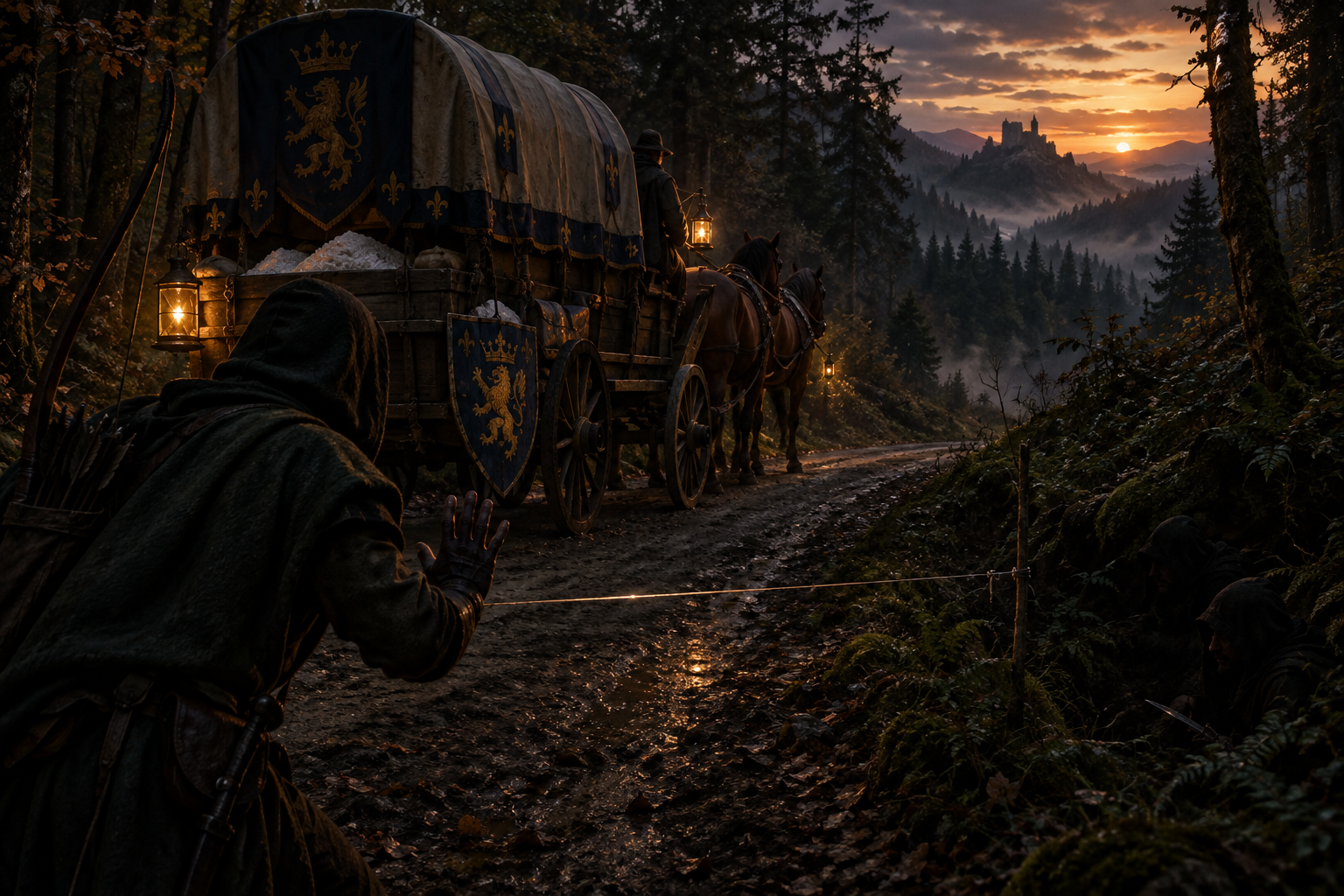
The Lantern Road Company is a four-character party escorting a wagon of salt along a forest road. The Game Master has prepared an ambush: two bandits hidden in a ditch beside a bend in the road, and a tripwire strung across the path a few steps ahead of them.
The Game Master has noted each character's passive Perception on a corner of the screen: the scout is at 15, the cleric at 13, the fighter at 11, and the wizard at 10.
Here is how the comparison plays out, step by step.
The tripwire. The Game Master treats the wire as a modest hazard and sets the threshold at 12. The scout and the cleric meet it. The fighter and wizard do not. The Game Master says only that the scout spots a thin glint of wire across the road, then asks what the party does. Nobody else hears an announcement.
The bandits. The Game Master rolls Stealth for the pair and gets a 15. Only the scout's 15 meets it, so the scout catches a flash of movement in the ditch. The cleric, at 13, does not.
Now consider the analysis. The result is a deliberately uneven spread of information, and the scene is more interesting for it. The scout knows something the others do not. The scout's player has to decide how to communicate it, whether by a whispered warning, a raised hand, or a sudden halt of the wagon. The cleric, at 13, sits just below the bandits' result, which is the kind of near miss that makes the numbers feel meaningful rather than arbitrary.
The active search. A player then says the wizard wants to crouch low and peer under the branches at the bend. The Game Master treats this as an active search and calls for a Wisdom (Perception) check rather than relying on the wizard's passive 10. This is the point at which the comparison gives way to a stated action. The wizard's player made a choice, and the choice gets its own resolution.
Notice what the Game Master did not do. There was no round of dice for every character, no announcement that something was hidden, and no adjustment of the bandits' result after the fact. The scene stayed fast, the information stayed uneven in a way the players could work with, and the active choice mattered. The standoff that follows is tense because the party is not equally informed, and because the bandits still believe they hold the advantage.
Questions to Ask Before You Compare
A short checklist can help a Game Master decide whether a passive comparison is the right tool in the moment.
- Is anyone actively searching or doing something that would justify a check instead?
- Is the threat something the characters could reasonably notice without special effort?
- Would a round of rolls reveal the secret before the scene begins?
- Is the number I am about to use consistent with the fiction I have described?
- If the party misses it, do I know what happens next?
- If the party catches it, do I know what happens next?
If the answers point to a quick comparison, use one. If they point to a stated action, resolve the action. If they point to a scene that could dead-end on a single failed comparison, add another route to the same information.
Teaching the Comparison to New Players
New players often assume that the Game Master is making up an outcome when they are told nothing. A few small habits help.
- Explain at the start that characters notice things without being asked, and that the Game Master will narrate what they perceive.
- Invite players to say when their character is doing something specific, such as watching a rooftop or listening at a door, so that the Game Master can treat it as an active action.
- Share passive scores with the players if the table prefers it, so they know what their characters are good at.
- Revisit the approach if it is not working. A table's preferences can change as the group learns the rules.
A conversation about these expectations fits naturally into session zero (D&D Beyond, 2024; Shea, 2021), and it can prevent the sense that dice results are being hidden unfairly.
Beyond the Numbers
The comparison of passive Perception and Stealth is a small piece of mechanics, but it touches larger questions about how a table shares information, how it values character choices, and how it keeps scenes moving. A Game Master who understands the comparison can use it as a quiet tool: it keeps ambushes tense, rewards characters for what they are good at, and still leaves room for players to take direct action.
Tools that help a group play together can support this kind of craft. The Dungeon Trainer offers resources for Game Masters and players who want to refine how they run scenes like this one.
Sources and Further Reading
- Alexander, J. (2008, May 8). The Three Clue Rule. The Alexandrian. https://thealexandrian.net/wordpress/1118/roleplaying-games/three-clue-rule
- Alexander, J. (2013). The Art of Pacing. The Alexandrian. https://thealexandrian.net/wordpress/31509/roleplaying-games/the-art-of-pacing
- D&D Beyond. (2024, March 11). How to run a session 0 for your D&D game.
- Shea, M. E. (2021, April 5). Running session zeros. Sly Flourish. https://slyflourish.com/runningsessionzeros.html
- The Angry GM. (2016, March 23). Keeping pace. The Angry GM.
- Wizards of the Coast. (2024a). Basic Rules for Dungeons & Dragons. D&D Beyond. https://www.dndbeyond.com/sources/dnd/br-2024/
- Wizards of the Coast. (2024b). D&D Beyond Basic Rules: Playing the Game. D&D Beyond. https://www.dndbeyond.com/sources/dnd/br-2024/playing-the-game
- Wizards of the Coast. (2024c). Player's Handbook. Wizards of the Coast.
Play 5E at your own table
Play with friends or solo, run your own campaign, and keep the dice and character math in code. An optional AI Dungeon Master can run the game when you want one. Free to start, no card required.
Related reading
- Linear, Clustered, or Looping: Three Ways to Shape a Session's Rhythm
Three ways to lay out a session's scenes, using working labels, produce three very different rhythms. This comparison weighs linear, clustered, and looping structures and when each one tends to fit.
- The Session Pacing Toolkit: Checklists, Templates, and Table-Side Aids
A practical toolkit of pacing aids for game masters: a scene ledger, a beat map, a timing grid, and table-side prompts for keeping a session's rhythm without overthinking it.
- Designing Rhythm Into a Session: A Design Perspective on Tension, Release, and Spacing
Rhythm is a design decision, not a happy accident. This design-perspective essay looks at intensity, contrast, duration, and placement as materials a game master can shape before play begins.