Reading the Rhythm: Why Some Sessions Sag in the Middle and Others Build
Written with AI. An AI model drafted this article. How we use AI
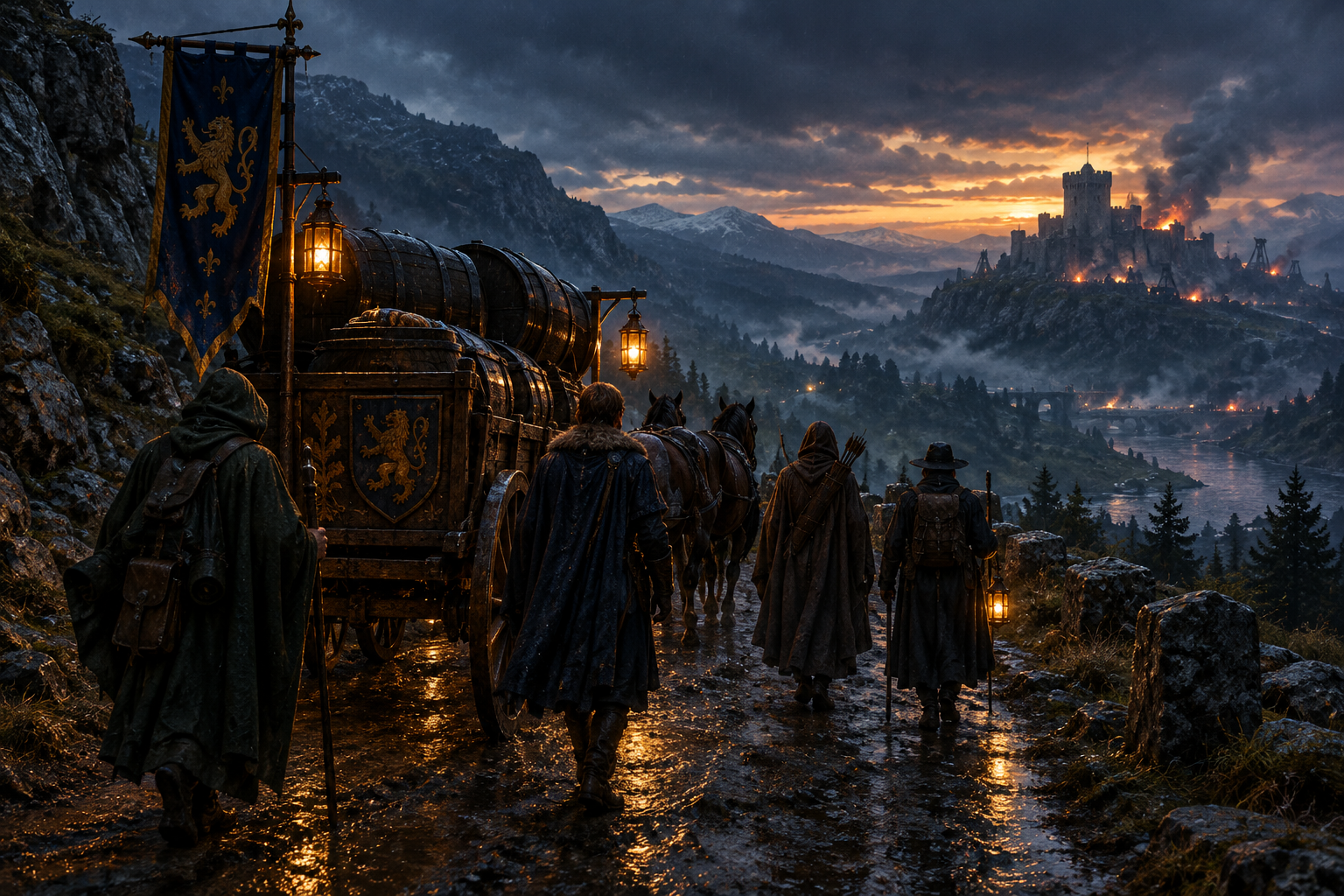
A session can have good scenes and still feel flat. This analysis looks at the structural causes of a sagging middle, and how contrast, duration, and placement shape what a table feels.
Many game masters will recognize the pattern. The opening scene crackles, the finale is decent, and somewhere in between the table goes quiet. Phones come out. Someone asks what time it is. Nothing in the middle was badly designed, yet the session sagged.
This article is an analysis of why that happens. It is not a technique list. The goal is to separate the different forces that shape how a session feels, so that when your own game drags, you can name the cause instead of guessing. An earlier article on this blog this week defines encounter pacing in general terms. This piece goes narrower and deeper, into the specific shape of a session and the middle where things most often go wrong.
The Question Behind the Sag
A sagging middle is a symptom, and several different problems produce it. Before reaching for a fix, it helps to ask what the table is actually experiencing. Broadly, the candidates fall into four groups:
- Sameness. Several scenes in a row feel alike in intensity or in kind of activity.
- Duration mismatch. A scene runs longer than the interest it can sustain.
- Placement. Scenes are individually fine but sit in an order that wastes their effect.
- Stakes drift. The table has lost track of what matters, so nothing feels like it is building.
These overlap, but they are not the same, and they call for different responses. The rest of this article takes each in turn.
What Pacing Means in Practice
Pacing writing for tabletop games is plentiful, and it is worth being clear about what the established sources actually say rather than overstating it. Justin Alexander's essay argues that RPG pacing differs from film pacing and centres on the GM spotting and cutting 'empty time', the gap between one meaningful choice and the next (Alexander, 2013). He also wrote a separate piece aimed at newer game masters (Alexander, 2023). In it, Alexander even suggests beginners may set pacing aside for their first few sessions, which suggests the topic is worth coming back to as experience grows.
Mike Shea's guidance on improving pacing centres on reading how the game feels in the moment and making sure it stays fun (Shea, 2022). Read together, the useful common thread is not a formula but a stance: pacing is something you can observe and adjust, not an innate talent. The Angry GM has likewise written about keeping pace as a deliberate concern (The Angry GM, 2016a), and has written separately about how to structure a session as a whole (The Angry GM, 2016b).
This article reads these sources as offering lenses rather than one correct pacing curve. This piece offers one more lens, aimed specifically at diagnosing the middle.
Force One: Sameness
In this article's view, one frequent cause of a flat middle is also the simplest to describe. When consecutive scenes share the same texture, the table stops registering them as separate events.
"Texture" here covers more than difficulty. A scene has an intensity (how much attention and emotional energy it asks for), a mode (talking, exploring, fighting, deciding, resting), and a tempo (fast exchanges or slow deliberation). Sameness can occur on any of these axes.
Three flavors of sameness
- Mode sameness. Three social scenes in a row, or three fights in a row. Even if each is well run, the mode itself becomes wallpaper.
- Intensity sameness. Every scene sits at a medium level of tension. Nothing is a lull and nothing is a peak, so the whole stretch reads as gray.
- Tempo sameness. Every scene moves at the same speed, so there is no contrast between a quick burst and a slow, deliberate moment.
It is worth stressing that sameness is relative to what came before. A single fight is not a problem. A fight that follows a fight that follows a fight is. The unit of analysis is the sequence, not the scene.
A diagnostic question
When reviewing a session after the fact, ask: if I wrote one word on an index card for each scene describing how it felt, how many cards would carry the same word? A run of identical words points to sameness.
Force Two: Duration Mismatch
The second force is about how long a scene lasts compared with how much it can carry.
Every scene has a natural length, the point at which it has delivered what it was going to deliver. A short, sharp discovery might carry only a few minutes. A tense negotiation with real choices might sustain much longer. Trouble arrives when a scene overstays, because the table keeps sitting in something that has already paid out.
This connects to a distinction worth making clearly: duration is not the same as importance. A scene can matter enormously to the story and still need to be brief. Conversely, a scene of modest importance can be allowed room because it is enjoyable in itself.
Why duration drifts
Duration tends to drift for understandable reasons:
- Resolution mechanics that need many rolls to reach an outcome.
- Players deliberating at length over a low-stakes choice.
- A game master filling space because a prepared scene ended sooner than expected.
- A reluctance to cut a scene that took effort to prepare.
The last of these deserves attention. Preparation effort and table value are different quantities. A scene you spent an hour on is not owed a long running time. Mike Shea's framing of prep as something to concentrate on high-value material (Shea, 2024) is relevant here: the point of focusing prep is to serve play, not to obligate play to use everything prepared.
What a duration problem feels like
The table signal is usually small. Attention flickers. Players start side conversations. The same question gets asked twice. These cues suggest the scene has passed its useful length, though they can also indicate other causes, so treat them as prompts to look, not as proof.
Force Three: Placement
The third force is where scenes sit relative to each other. Two scenes can each be well built and still lose value if they are arranged badly.
Placement matters because experience is comparative. A lull is only restful in contrast to what preceded it. A sudden attack only startles in contrast to calm. If you remove the contrast, you remove much of the effect, even though the content is unchanged.
Contrast as the working mechanism
A useful way to think about placement is that each scene both delivers its own content and sets the baseline for the next scene. A loud scene raises the baseline, so the next scene needs either to match it (continuing the energy) or to drop below it (providing release). A scene that lands at an awkward intermediate level, neither continuing nor contrasting, tends to feel muddy.
This does not mean every session should alternate mechanically between high and low. Rigid alternation becomes its own sameness. It means placement is a choice with consequences, and the choice is worth making consciously.
The finale problem
One placement failure worth watching for involves the session's intended peak. If the finale arrives after a stretch with no release, it competes with accumulated fatigue and lands more softly than it should. The same finale, placed after a deliberate lull, can hit much harder. The content did not improve. The surrounding contrast did.
This is the structural reason that the middle matters so much. The middle is where release either gets built in or gets skipped, and what is skipped there is hard to recover at the end.
Force Four: Stakes Drift
The fourth force is subtler and less about scene order than about meaning. Over a long stretch, the table can lose its sense of what is at risk, and without that, even varied scenes can feel like they are not going anywhere.
Stakes drift typically happens when the connection between the current scene and the larger goal weakens. Players know they are doing something, but not why it matters now. The result is a feeling of treading water.
Signs of drift
- Players ask what they are supposed to be doing.
- Scenes resolve without changing anything that matters.
- Choices feel interchangeable because no option has distinct consequences.
Robin Laws's well-known work on game mastering addresses the idea that different players want different things from a session, which is relevant because stakes that matter to one player may be invisible to another (Laws, 2002). A table whose members care about different things may drift unevenly, with some players engaged and others coasting. This is a reason to check in with the whole table instead of assuming one reaction represents everyone.
Keeping stakes visible
Stakes do not need to be dramatic. They need to be legible. A quiet reminder of what is waiting at the destination, or a small change to the situation that shows time passing, can restore a sense of direction. The goal is that players can feel the session moving toward something.
How the Four Forces Interact
In practice these forces combine. A sagging middle can involve two or three forces at once, and they can mask each other.
For example, a long negotiation (duration) placed directly after another social scene (sameness and placement) with no clear consequence (stakes drift) will feel dead even though negotiation scenes are not inherently dull. Fixing only one factor might help a little. Seeing all of them lets you decide which change gives the most improvement for the least disruption.
A rough ordering of effort, offered as a heuristic and not a rule, might be:
- Check duration first, because cutting or compressing a scene is quick and often effective.
- Check placement next, because reordering or inserting a lull costs little.
- Check sameness, which may require changing the kind of scene, not just its length.
- Check stakes last, because restoring meaning may require a bit more thought.
This ordering reflects ease of intervention, not importance. If stakes have drifted badly, no amount of compression will fix the underlying problem.
Why the Middle, Specifically
It is fair to ask why the middle is the vulnerable part. A few structural reasons are plausible, though the following are reasoned observations about how sessions are built, not findings from a study.
- The opening has momentum from setup. The table arrives fresh, and the first scene benefits from that energy.
- The ending has momentum from resolution. Players can sense the finish and attention sharpens.
- The middle has neither. It is the stretch where setup energy has faded and resolution is still distant, so it relies entirely on the quality of its own contrast and stakes.
The Angry GM's discussion of session structure treats the session as having shape across its length (The Angry GM, 2016b), which is consistent with this view: if a session has a shape, the middle is where that shape is least supported by natural anticipation.
This view also fits Alexander's pacing advice for beginning GMs, which focuses on when to cut scenes, such as cutting a roleplaying scene on its second lull, and on resolving combat faster (Alexander, 2023). Those are the levers that matter most when the middle is the problem.
Tension Tools and Their Limits
Some game masters use explicit tension mechanics to shape a session's rhythm. The Angry GM has published a detailed treatment of one such device, the Tension Pool (The Angry GM, 2021). Mechanics like this can be useful for generating variation, but they address a specific slice of the problem: how the chance of complications builds as time is spent during exploration, investigation, and other slow-paced parts of the game.
A tension device does not by itself solve sameness across scene types, duration drift, or stakes drift. It is one tool among several. If you are considering adopting any such system, read its source directly and test whether it fits your table's preferences, because how much structure players welcome is a matter of table taste.
Cognitive Load as a Hidden Contributor
One more factor sometimes disguises itself as a pacing problem. A scene can drag not because of its rhythm but because the table is holding too much information at once. When players must juggle many names, positions, and open questions, their responses slow and the scene feels heavy.
Cognitive load as a general concept comes from educational psychology, and Sweller's 1988 paper argues that conventional problem solving uses so much cognitive processing capacity that little is left for learning (Sweller, 1988). The relevant point here is diagnostic: if a middle section feels sluggish despite good variety and sensible length, check whether the table is overloaded with information before concluding the rhythm is wrong.
Example: The Lantern Road Company
The following is an illustrative scenario, not a report of a real game. It exists only to show the concepts above in motion.
Return to the Lantern Road Company, the four-character group escorting a wagon of lamp oil along a rain-slick mountain road to a besieged border keep. The game master has four prepared challenges: a rockslide, a negotiation with wary toll-keepers at a ruined bridge, an ambush by hired raiders in a narrow pass, and a tense arrival at the keep where the garrison captain may or may not be trustworthy.
Suppose the session sags in the middle, in the stretch between the rockslide and the ambush. A diagnostic pass using the four forces might look like this.
Sameness. The rockslide and the toll-keeper negotiation are both problem-solving scenes with a lot of discussion. Placed back to back, they share a mode and a tempo. The analysis suggests the table is not feeling two distinct scenes but one long deliberation.
Duration. The rockslide is resolved through a series of skill checks that continue after the outcome is clear. The scene has paid out, but it keeps running. Compressing it to a short, vivid beat would free up time and attention.
Placement. The ambush follows the negotiation with no pause. Because there is no lull, the ambush cannot contrast with calm, so its violence registers as another event in a continuous stream. Inserting a quiet camp scene before the pass would give the ambush a baseline to break.
Stakes drift. By the time the company reaches the bridge, players are no longer sure why the toll-keepers matter. A brief reminder that the garrison's lamps are running low, perhaps a glimpse of the besieged keep's distant fires from the road, would tie the scene back to the larger goal.
Notice that no content has to be added or removed. The same four challenges remain. The adjustments are to length (shorten the rockslide), order and spacing (add a camp scene), and legibility (show what the oil is for). Each is a small change, and together they reshape how the middle feels. The ambush's difficulty is unchanged, which is the point: the felt result comes from rhythm, not from raw challenge.
A game master could also choose a different remedy, such as swapping the order of the negotiation and the rockslide so that a talking scene is followed by a physical problem. That would address sameness through ordering rather than through adding a new scene. Which approach suits the table is a matter of preference and of what the players seem to enjoy.
A Diagnostic Walkthrough for Your Own Sessions
If you want to analyze a session that felt flat, this sequence may help. It works best shortly after play, while details are fresh.
- List the scenes in order. Write one line for each, no more.
- Mark the mode. Note whether each was talking, exploring, fighting, deciding, or resting.
- Estimate the duration. Rough minutes are enough. Exact times do not matter.
- Rate the intensity. Use a simple low, medium, or high.
- Look for runs. Circle any stretch where mode, intensity, or tempo repeats.
- Find where attention dipped. Recall when players seemed to disengage, and see which scene that was.
- Check the stakes. Ask whether, at that point, the table could have said what was at risk.
The point is not to produce a score. It is to make the shape of the session visible so you can see which of the four forces was most active.
What Not to Conclude
A few cautions are worth stating, because pacing analysis is easy to overapply.
- A quiet moment is not a failure. Some of the best table experiences are slow. A lull can be exactly right.
- Variety is not an end in itself. Chasing contrast for its own sake can produce a jerky, unfocused session.
- Players differ. What reads as a drag for one person may be a pleasure for another, so avoid generalizing from one reaction.
- No single curve fits every game. A tense horror one-shot and a leisurely exploration campaign want different rhythms, and the preferences of the table matter more than any model.
These cautions are partly why this article presents forces to examine instead of rules to follow. The aim is better judgment, not a procedure that replaces it.
Building the Habit of Reading Rhythm
The deeper benefit of this kind of analysis is that it trains attention. A game master who regularly asks "what did that stretch feel like, and why?" gradually develops an instinct for it. Over time the diagnostic walkthrough becomes unnecessary because the questions run in the background during play.
Some ways to build the habit:
- Make a brief note after each session about where energy rose and fell.
- Ask the table, lightly and without pressure, which scenes they remember best.
- Notice what you cut or compressed on the fly and whether it helped.
- Compare sessions that felt great with ones that felt flat, looking for structural differences.
If you want a place to practice together with other game masters and players, The Dungeon Trainer is a tool built around playing together and improving your craft, and its community features can help you compare notes on how sessions felt. It also offers an optional AI Dungeon Master for those who want it, though a human game master remains at the center of the craft this article discusses.
Summary
A session that sags in the middle usually suffers from one or more of four forces: sameness, duration mismatch, placement, and stakes drift. Each can be diagnosed by looking at the sequence of scenes instead of any single scene. The middle is especially vulnerable because it has neither the momentum of a fresh opening nor the pull of an approaching ending, so it depends entirely on contrast and legible stakes.
The fixes are often small: shorten a scene that has paid out, reorder or space scenes to restore contrast, vary the mode, and keep the larger goal visible. Pacing is a matter of observation and adjustment, and the sources below offer further lenses on it. Treat them as perspectives to test against your own table, not as final answers.
Sources and Further Reading
- Alexander, J. (2013). The Art of Pacing. The Alexandrian. https://thealexandrian.net/wordpress/31509/roleplaying-games/the-art-of-pacing
- Alexander, J. (2023, May 30). Pacing for the Beginning GM. The Alexandrian. https://thealexandrian.net/wordpress/49547/roleplaying-games/pacing-for-the-beginning-gm
- Laws, R. D. (2002). Robin's Laws of Good Game Mastering. Steve Jackson Games.
- Shea, M. E. (2022). Improving Pacing. Sly Flourish. https://slyflourish.com/pacing.html
- Shea, M. E. (2024, June 3). High Value Prep. Sly Flourish.
- Sweller, J. (1988). Cognitive load during problem solving: Effects on learning. Cognitive Science, 12(2), 257-285.
- The Angry GM. (2016a, March 23). Keeping pace. The Angry GM.
- The Angry GM. (2016b, June 8). When episodes ain't episodes: How to structure a session. The Angry GM.
- The Angry GM. (2021, September 15). The Angry GM's Tension Pool: A Comprehensive, Definitive, Final Guide. The Angry GM.
Play 5E at your own table
Play with friends or solo, run your own campaign, and keep the dice and character math in code. An optional AI Dungeon Master can run the game when you want one. Free to start, no card required.
Related reading
- Linear, Clustered, or Looping: Three Ways to Shape a Session's Rhythm
Three ways to lay out a session's scenes, using working labels, produce three very different rhythms. This comparison weighs linear, clustered, and looping structures and when each one tends to fit.
- The Session Pacing Toolkit: Checklists, Templates, and Table-Side Aids
A practical toolkit of pacing aids for game masters: a scene ledger, a beat map, a timing grid, and table-side prompts for keeping a session's rhythm without overthinking it.
- Designing Rhythm Into a Session: A Design Perspective on Tension, Release, and Spacing
Rhythm is a design decision, not a happy accident. This design-perspective essay looks at intensity, contrast, duration, and placement as materials a game master can shape before play begins.