Plot Hook vs. Quest: Understanding the Critical Difference
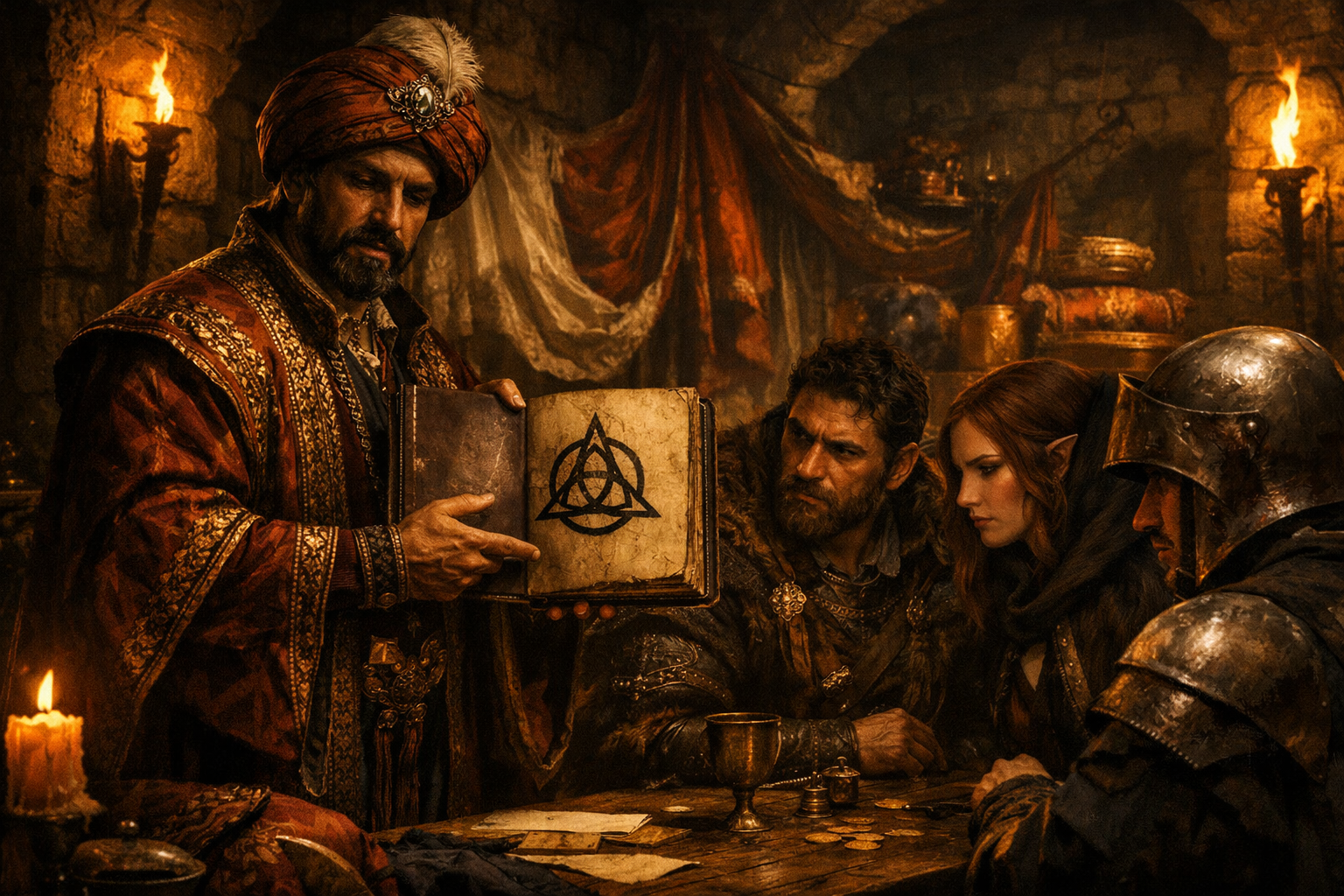
Plot hooks and quests work together but serve distinct purposes. Understanding the difference helps Game Masters design stronger adventures and avoid common pitfalls.
Plot hooks and quests are closely related concepts in tabletop roleplaying games, which is why Game Masters often use the terms interchangeably.
They are not quite the same thing.
A hook gives characters a reason to pay attention to a situation, opportunity, problem, or mystery.
A quest gives them something they can pursue or accomplish.
That distinction can be useful when preparing adventures because it separates two important questions:
Why might the characters become interested?
and
What can they actually try to accomplish?
The relationship is not a rigid sequence, and tabletop RPGs do not universally define these terms in exactly the same way. A quest can itself be presented as an opportunity before the players commit to it, and a hook can appear in the middle of an ongoing adventure.
Think of them as complementary tools rather than mandatory stages.
Defining the Terms
What Is a Plot Hook?
A plot hook, adventure hook, or simply hook is information, an event, a problem, an opportunity, or another situation that gives the characters a reason to become interested.
Examples include:
- A child has disappeared.
- A mysterious map points toward an unknown ruin.
- A merchant offers a reward for recovering stolen cargo.
- Strange lights appear every night above an abandoned tower.
- A former ally sends the party a desperate message.
- Bandits have closed the only safe road through the mountains.
The 2024 Dungeon Master's Guide uses hooks in this practical sense. Its sample adventures include hooks designed to get characters involved in the adventure.
The hook answers questions such as:
- Why should we pay attention to this?
- Why might our characters care?
- What makes this situation interesting?
- Why might we act now?
A hook does not necessarily explain everything that needs to be done.
It creates an entry point.
What Is a Quest?
For adventure preparation, a useful definition of a quest is a goal the characters can choose to pursue.
A quest generally establishes:
- Motivation: Why might the characters pursue it?
- Goal: What are they trying to accomplish?
- Context: Where, against whom, or under what circumstances will they pursue it?
Examples include:
- Find the missing child.
- Recover the stolen Crown of Asterfall.
- Discover who is poisoning the town wells.
- Escort the merchant caravan through the Red Pass.
- Stop the cult from completing its ritual.
- Convince three rival clans to join the alliance.
A quest does not require:
- A monetary reward
- A predetermined sequence of encounters
- One correct solution
- Formal acceptance from an NPC
- A quest-giver
- A specific number of objectives
The characters might invent a quest themselves.
If the party decides:
"We're going to find out who burned down our inn."
that is a perfectly usable quest even if no NPC asked them to do it.
The Simplest Distinction
A useful shorthand is:
Hook: Why might we care?
Quest: What are we trying to accomplish?
Consider this situation:
A merchant tells the party that caravans have been disappearing along the eastern road.
That information can function as a hook.
It raises questions:
- What happened to the caravans?
- Is the road dangerous?
- Who is responsible?
- Is there money to be made fixing the problem?
Now imagine the merchant says:
"I'll pay you 500 gold pieces to find the missing caravan and bring back any survivors."
The party now has a very clear potential quest:
Find the missing caravan and rescue any survivors.
The reward is motivation, not what makes it a quest.
Even without payment, the party might decide to investigate because a friend was traveling with the caravan.
The goal still exists.
Hooks and Quests Do Not Always Happen in a Fixed Order
It is tempting to describe adventure design as:
- Present hook.
- Players become interested.
- Players accept.
- Hook becomes quest.
- Run adventure.
Sometimes play works exactly that way.
Sometimes it does not.
A Quest Can Be Presented Directly
Suppose the characters are members of the royal intelligence service.
Their commander says:
"Travel to Greyhaven and discover who is supplying weapons to the rebellion."
That is both an adventure entry point and a clearly stated quest.
There is no useful reason to wait for the players to formally "accept" it before treating it as a quest.
The campaign premise already established that these characters take assignments from the crown.
Characters Can Create Their Own Quest
Suppose the party discovers an abandoned tower.
Nobody asks them to investigate.
Nobody offers a reward.
Nobody even knows the tower exists.
The players decide:
"We want to find out who built this."
They have created their own goal.
That can become a quest immediately.
Hooks Can Appear During Existing Quests
The party may already be trying to rescue a missing noble when they discover:
The same strange symbol appears at three unrelated crime scenes.
That information may hook their interest in a larger mystery.
They do not need to abandon the current quest.
The new hook may:
- Become another quest later
- Reveal something about the current quest
- Connect several adventures
- Remain unresolved for months
- Be ignored completely
Hooks can exist at any scale.
Practical Scenario: The Missing Merchant's Daughter
Consider a merchant named Marcus whose daughter, Elena, disappeared three nights ago after attending a theater performance.
This single situation can show how hooks, goals, clues, and quests interact.
The Initial Hook
Notices appear throughout the city:
REWARD OFFERED
Information sought concerning Elena Vale, daughter of merchant Marcus Vale, missing since the evening of the 14th after leaving the Lantern Theater.
This creates several points of interest:
- Someone is missing.
- She disappeared recently.
- Her last known location is known.
- Her father is offering a reward.
- Something may have happened after the theater performance.
That is enough to attract attention without explaining the entire adventure.
The Party Investigates
The characters visit Marcus.
They learn:
- Elena attended the theater alone.
- Witnesses saw her speaking with several performers afterward.
- She never returned home.
- Marcus found a strange symbol repeatedly sketched in her journal.
- He does not recognize it.
The players now have several possible leads:
- The theater
- The performers
- Elena's journal
- The symbol
- Her route home
- Anyone who knew her
The hook is developing into an actionable situation.
The Quest
The party decides:
Find Elena and discover what happened to her.
That is the quest.
Notice what the quest does not specify.
It does not say:
- Visit the theater.
- Question the actor.
- Search the warehouse.
- Decode the symbol.
- Find the cult.
- Fight the cult leader.
- Rescue Elena.
Those might be things that happen.
They are not required to define the quest.
The goal is:
Find Elena and discover what happened to her.
How the characters accomplish that goal should remain open to their decisions.
The Situation Develops
During the investigation, the party discovers that the performers belong to a secret cult.
The cult intends to conduct a ritual during the new moon two nights from now.
That revelation changes the situation.
The quest might now become:
Find Elena and prevent the ritual before the new moon.
Or the characters might split those into two related goals:
- Rescue Elena.
- Stop the cult's ritual.
The important point is that quests can evolve as information changes.
What Hooks Actually Do
Hooks are primarily about attention and motivation.
They tell the players:
"Here is something you might want to interact with."
Good hooks often connect to one or more motivations.
Curiosity
Every mirror in the abandoned manor reflects a room that is not there.
Compassion
A frightened child asks the party to find her missing brother.
Wealth
A merchant offers 1,000 gold pieces for a stolen relic.
Duty
The duke orders his knights to investigate attacks along the northern border.
Revenge
The assassin who killed the character's mentor has returned.
Ambition
The winner of the tournament will receive an audience with the queen.
Personal Connection
A character receives a letter written in the handwriting of a friend who died ten years ago.
One situation can appeal to several motivations simultaneously.
That usually makes it more resilient.
What Quests Actually Do
Quests provide a goal for play.
A useful quest is usually clear enough that the players understand what success broadly means.
Compare:
Investigate strange things.
with:
Find out why travelers are disappearing from the eastern road.
The second is easier to act on.
Strong quests often identify:
A Goal
What are the characters trying to accomplish?
Stakes
Why does success or failure matter?
Context
Where or under what circumstances will the characters pursue the goal?
Opposition or Difficulty
What makes accomplishing the goal uncertain?
These elements help the GM prepare.
They do not need to become a rigid mission checklist for the players.
Quests Do Not Need Predetermined Obstacles
The original temptation is to write:
Quest: Rescue the prisoners
- Track the bandits.
- Find their camp.
- Sneak inside.
- Kill the leader.
- Free the prisoners.
That assumes too much.
Players might:
- Question captured bandits
- Bribe a corrupt guard
- Follow supply wagons
- Convince another faction to attack
- Sneak into camp
- Challenge the leader
- Negotiate a ransom
- Create a diversion
- Wait until the bandits move
A more flexible preparation model is:
Goal: Rescue the prisoners.
Situation: The prisoners are held in a fortified bandit camp.
Opposition: Thirty bandits follow a cautious leader.
Complication: The prisoners will be moved in two days.
Relevant NPCs: Bandit leader, prisoners, scout, local smuggler.
Useful information: Camp location, patrol schedule, prisoner location, upcoming transfer.
Now the GM understands the situation without prescribing the solution.
This follows Justin Alexander's useful scenario-design principle:
Prepare situations, not predetermined plots.
Why the Distinction Helps Game Masters
The hook-versus-quest distinction is not merely vocabulary.
It can expose different preparation problems.
Problem: Players Do Not Engage
You may have a hook problem.
Ask:
- Do they know something is available to pursue?
- Does anyone care about it?
- Is the information interesting?
- Does it connect to character motivations?
- Does it sound worth the risk?
- Is another objective currently more important?
Example:
"There is an old mine outside town."
That is information.
It may not be much of a hook.
Compare:
"Miners broke through a sealed wall yesterday. Three went inside. Only one came back, and he refuses to say what he saw."
Now there is something to become curious about.
Problem: Players Are Interested but Do Not Know What to Do
You may have a quest or information problem.
Suppose everyone wants to help with the missing caravans, but nobody understands what action is possible.
Give them something actionable:
- Last known location
- Witness
- Surviving wagon
- Tracks
- Merchant records
- Expected route
- Possible suspect
Interest exists.
Direction does not.
Problem: Players Know the Goal but Feel Railroaded
You may have an adventure-structure problem.
The quest is:
Rescue Elena.
That does not mean:
Follow the six scenes I wrote in this exact order.
Keep the goal stable while allowing the approach to remain flexible.
Player Agency and Hooks
Hooks do not automatically create player agency.
A GM can still railroad players through a hook.
For example:
"The mayor asks you to investigate the mine."
Players decline.
The GM responds:
"You can't leave town until you investigate it."
They still decline.
The GM has guards arrest them and force them into the mine.
The problem is not the hook.
The problem is refusing to accept the players' decision.
However, campaign premise matters too.
If Session Zero established:
"You are troubleshooters employed by the Adventurers' Guild, and each adventure begins with a guild assignment,"
then giving the party an assignment is not inherently railroading.
Players already agreed to that framework.
Agency exists in:
- How they approach the problem
- Which allies they seek
- What risks they take
- How they resolve conflicts
- What consequences they accept
Agency does not require pretending the campaign has no premise.
Multiple Hooks Can Point Toward One Adventure
Different characters may respond to different motivations.
Suppose Elena's disappearance is the central adventure.
You could provide several entry points.
Wealth Hook
Marcus offers a substantial reward.
Personal Hook
One character knew Elena growing up.
Mystery Hook
The strange symbol in her journal also appeared during an earlier investigation.
Duty Hook
A member of the city watch quietly asks the party to investigate because their commander refuses to pursue the case.
Threat Hook
Another person disappears under similar circumstances.
All of these can draw characters toward the same underlying situation.
You do not need to use all of them.
The goal is not to manipulate every player until they surrender.
It is to make sure the situation has understandable reasons for engagement.
One Hook Can Lead to Several Possible Quests
The opposite can happen too.
Suppose the party discovers:
Someone is stealing magical artifacts throughout the city.
That hook might lead to several goals:
- Identify the thief.
- Protect the next likely target.
- Recover a specific stolen artifact.
- Discover why the artifacts are being collected.
- Capture the buyer rather than the thief.
- Steal the collection themselves.
The players' response can help define the quest.
This is especially useful in open campaigns.
Hooks Inside Ongoing Adventures
Hooks do not only belong at the beginning of campaigns or sessions.
During the search for Elena, the party might learn:
The cult's symbol appears on a century-old monument outside the city.
That can function as a hook toward another thread.
Perhaps the party investigates immediately.
Perhaps they write it down and return months later.
Perhaps they never pursue it.
That is fine.
An ongoing campaign can accumulate:
- Rumors
- Leads
- Threats
- Opportunities
- Invitations
- Unanswered questions
Some develop into quests.
Some remain background texture.
Not Every Rumor Is a Hook
A useful distinction is intentionality.
Suppose an NPC casually says:
"There's a war happening across the southern sea."
If there is no practical way or expected reason for the party to engage with that war, it may simply be worldbuilding.
If the NPC says:
"The southern fleet is hiring experienced adventurers, and ships leave tomorrow,"
the information now offers an actionable opportunity.
That can function as a hook.
Worldbuilding becomes a hook when it gives players something they could meaningfully pursue.
Do You Need a New Hook Every Session?
No.
If the party ended last session halfway through infiltrating the cult's headquarters, you probably do not need another adventure hook.
Everyone already knows:
- What they are doing
- Why they are doing it
- What is at stake
What you may need is a strong start.
For example:
"We pick up with the stone door slamming behind you. Boots thunder down the corridor ahead, and the torchlight behind you suddenly goes dark."
That launches the session immediately without introducing a new quest.
Mike Shea's Return of the Lazy Dungeon Master distinguishes useful session-preparation concepts such as strong starts, potential scenes, secrets, locations, NPCs, and other material.
A strong start and a plot hook can overlap.
They are not synonymous.
Quests Can Span Many Sessions
A quest can be tiny:
Deliver this letter before sunset.
Or enormous:
Destroy the lich's phylactery and end its reign.
Length does not define a quest.
A long quest may contain:
- Multiple locations
- Several villains
- Side objectives
- New hooks
- Changing alliances
- Discoveries
- Smaller quests
- Optional opportunities
The original goal may even change as the characters learn more.
What matters is that the players still understand what they are trying to accomplish.
Side Quests
"Side quest" is another useful but informal term.
A side quest is generally a goal that exists alongside a more prominent current objective.
Suppose the party's primary goal is:
Stop the cult before the new moon.
While investigating, they learn that a friendly NPC's brother has been imprisoned by corrupt guards.
The group now has another possible quest:
Free the imprisoned brother.
The players can decide:
- Handle it immediately
- Handle it after the cult
- Ask allies to help
- Ignore it
- Connect it to the main investigation
Side quests create choice when used carefully.
Too many can create cognitive overload.
When Players Ignore a Hook
Not every hook needs to become a quest.
That is normal.
If players repeatedly ignore particular types of hooks, look for patterns.
Maybe they rarely pursue:
- Political disputes
- Rescue missions
- Wilderness expeditions
- Treasure hunts
- Mysteries
Do not immediately conclude that they dislike the entire category.
Ask.
Perhaps your political hooks arrive while the group is already overwhelmed.
Perhaps rescue missions feel repetitive.
Perhaps players do enjoy mysteries but dislike mysteries with unclear starting information.
Direct feedback is better than diagnosis from a single ignored hook.
Do Not Keep Forcing the Same Hook
Suppose players decline Marcus's request to find Elena.
Avoid doing this:
- Marcus asks.
- The city watch asks.
- A priest asks.
- The king orders them.
- Elena appears in everyone's dreams demanding rescue.
At some point the group has communicated a choice.
Let the situation continue naturally or move to another opportunity.
If Elena's disappearance has consequences, those consequences can still occur.
That is different from punishing the players for choosing another adventure.
Quest Rewards Are Optional
Rewards can motivate characters.
Common rewards include:
- Money
- Magic items
- Information
- Reputation
- Favors
- Political influence
- Land
- Access
- Advancement
- Personal satisfaction
But rewards do not define quests.
The quest:
Save your brother.
does not require someone to offer 500 gold pieces afterward.
The goal itself can be the motivation.
Likewise, some quests end with costs rather than rewards.
The characters may succeed at preventing a catastrophe but lose political standing in the process.
That can still be a satisfying outcome.
Formal Quest Logs Are Optional
Video games often present quests as explicit records:
Quest: Find Elena
Objectives:
- Visit the Lantern Theater
- Question the performers
- Decipher the symbol
Tabletop RPGs do not require that structure.
Some groups love visible quest logs.
Others prefer more organic notes.
A useful quest record might be as simple as:
Find Elena Vale
- Missing after leaving the Lantern Theater
- Strange symbol found in journal
- Marcus Vale offering reward
That preserves useful information without pretending the characters already know every step.
A Better Adventure-Preparation Framework
Instead of treating hook and quest as rigid chronological stages, use them as two different preparation questions.
Step 1: Identify the Situation
What is happening?
Elena has disappeared after becoming involved with a secret cult.
Step 2: Identify Possible Hooks
Why might the characters become involved?
- Marcus offers a reward.
- A character knows Elena.
- The cult symbol connects to an earlier mystery.
- Another person disappears.
Step 3: Identify Likely Goals
What might the characters try to accomplish?
- Find Elena.
- Identify her kidnappers.
- Stop the cult.
- Learn what the symbol means.
Do not assume every goal becomes important.
Step 4: Prepare the Situation
What exists regardless of what the characters do?
- Lantern Theater
- Performers
- Cult
- Ritual site
- Marcus
- Elena's journal
- City watch
- Timeline until the ritual
Step 5: Prepare Information, Not a Required Sequence
What clues or interactions could reveal useful information?
Several routes should be possible when the scenario depends on discovering something important.
Step 6: Let Play Determine the Path
The players decide:
- Which hooks matter
- Which goals they adopt
- Which methods they use
- Which risks they accept
- Which opportunities they ignore
That is where prepared adventure material becomes an actual tabletop story.
Preparing Several Potential Quests
For open campaigns, Mike Shea recommends thinking about several quests that might be available when characters finish their current objective.
A simple quest description can often fit into one sentence.
For example:
Merchant Marcus Vale wants the party to find his missing daughter Elena somewhere in the Lantern District.
Or:
Captain Senna wants the party to reopen the eastern trade road by dealing with whatever has been attacking caravans near Blackridge.
Or:
Archivist Vale wants the characters to enter the Sunken Library and recover the Chronicle of Ash before the rival expedition finds it.
Presenting several possibilities lets players choose what interests them.
Once they choose, the GM knows where to focus detailed preparation.
How The Dungeon Trainer Supports Hooks and Quests
Campaign-management tools can help preserve adventure opportunities and active goals without determining how players must respond to them.
The Dungeon Trainer supports human-run campaigns while maintaining campaign continuity and searchable records.
Campaign Memory and the Codex
The campaign record can preserve information about:
- NPCs
- Locations
- Quests
- Events
- Important campaign developments
The Codex makes the quests the party has taken browsable alongside the people and places encountered during play.
This is particularly useful in open campaigns where several opportunities may exist simultaneously.
The GM does not need to rely entirely on memory to remember which objectives are active or which older threads the players may return to.
Scry
Scry can help examine an upcoming scene and identify:
- Plausible player approaches
- Complications
- Pacing risks
- Preparation gaps
Suppose the GM plans to present a quest through Marcus.
Scry may reveal that the preparation assumes the players will trust him immediately.
That gives the GM an opportunity to prepare the underlying situation more robustly.
What if they:
- Investigate Marcus first?
- Visit the theater without speaking to him?
- Suspect Elena left voluntarily?
- Ignore the reward?
Scry does not predict what the players will do.
It helps the GM notice assumptions before those assumptions become points of failure.
Forge and Generators
The platform's campaign creation and generation tools can provide material such as:
- NPCs
- Locations
- Monsters
- Items
- Spells
Those tools can help develop the people, places, and threats surrounding a quest.
Generated material still needs to fit:
- The hook
- The quest goal
- Existing campaign continuity
- Player interests
- The setting
Generation supports preparation.
It does not replace adventure design.
The Coach
The Coach provides structured practice situations for Game Masters and players.
Skills relevant to hooks and quests include:
- Player agency
- Information clarity
- Pacing
- Adjudication
- Encounter management
Those skills matter because even a well-written hook can fail if players cannot understand it, and even a clear quest can become frustrating if every solution except the GM's preferred one is blocked.
Plot Hook vs. Quest: The Practical Difference
The distinction can ultimately be summarized this way:
Plot Hook
Purpose: Create interest or point toward something worth engaging with.
Question: Why might we care?
Examples:
- A person disappears.
- A map is discovered.
- A merchant offers a reward.
- Strange lights appear in the ruins.
Quest
Purpose: Give the characters a goal they can pursue.
Question: What are we trying to accomplish?
Examples:
- Find the missing person.
- Locate the ruin shown on the map.
- Recover the merchant's stolen cargo.
- Discover what is causing the strange lights.
Adventure
Purpose: Provide the situations, locations, characters, conflicts, and consequences that emerge while pursuing the goal.
Question: What happens when we try?
These concepts overlap.
That is expected.
They are tools for thinking about adventure design, not rigid rules the table needs to enforce.
Conclusion
Plot hooks and quests are different, but the difference is more flexible than a simple before-and-after sequence.
A hook says:
"Here is something that might interest you."
A quest says:
"Here is something you can try to accomplish."
Sometimes the hook comes first.
Sometimes a clearly stated quest is itself the hook.
Sometimes players invent their own quest without any hook from the Game Master.
Sometimes a hook sits unresolved for months before anyone pursues it.
Understanding the distinction still matters because it helps diagnose different problems.
If players do not care, examine the hook.
If they care but do not know what they are trying to accomplish, clarify the quest or the available information.
If they understand the goal but cannot approach it creatively, examine the adventure structure.
The Game Master's job is not to move players from Hook A to Quest B according to a predetermined flowchart.
It is to create situations worth caring about, goals worth pursuing, and enough room for the players to decide what happens when they engage.
That is where hooks and quests become adventures.
Sources and Further Reading
Alexander, J. (2009, March 23). Don't prep plots. The Alexandrian. https://thealexandrian.net/wordpress/4147/roleplaying-games/dont-prep-plots
Shea, M. E. (2018). Return of the lazy dungeon master. Sly Flourish.
Shea, M. E. (2024, September 2). Scenes: The catch-all step of the Lazy Dungeon Master. Sly Flourish. https://slyflourish.com/scenescatchall_step.html
Shea, M. E. (2025, July 21). Prep three quests. Sly Flourish. https://slyflourish.com/prepthreequests.html
Wizards of the Coast. (2024). Dungeon master's guide. Wizards of the Coast.
Wizards of the Coast. (2024, November 4). Journey through these 5 short adventures in the 2024 Dungeon Master's Guide. D&D Beyond. https://www.dndbeyond.com/posts/1848-journey-through-these-5-short-adventures-in-the
Wizards of the Coast. (2024, November 8). Let's prepare an adventure using the 2024 Dungeon Master's Guide!. D&D Beyond. https://www.dndbeyond.com/posts/1851-lets-prepare-an-adventure-using-the-2024-dungeon
Related reading
- Why Megadungeons Succeed or Fail: Lessons from Forty Years of Play
Megadungeons have persisted since the earliest days of tabletop roleplaying, yet many campaigns abandon them within a few sessions. Learn what structural, pacing, and preparation factors separate sustainable megadungeons from those that collapse, and how to apply those lessons at your own table.
- Understanding the Megadungeon: What It Is and When to Use It
A megadungeon is more than a big dungeon. Learn what defines this sprawling adventure structure, why it persists across decades of play, and when it serves your table better than episodic adventures.
- Running Sandbox Campaigns: Six Months with The Millbrook Consortium
Sandbox campaigns promise player-driven freedom but demand different preparation and facilitation techniques. This case study examines six months of running The Millbrook Consortium, a merchant-focused sandbox, to identify practical lessons about faction management, player agency, and sustainable open-world play.