Mapping Your Dungeon Crawl: Techniques for Players and Game Masters
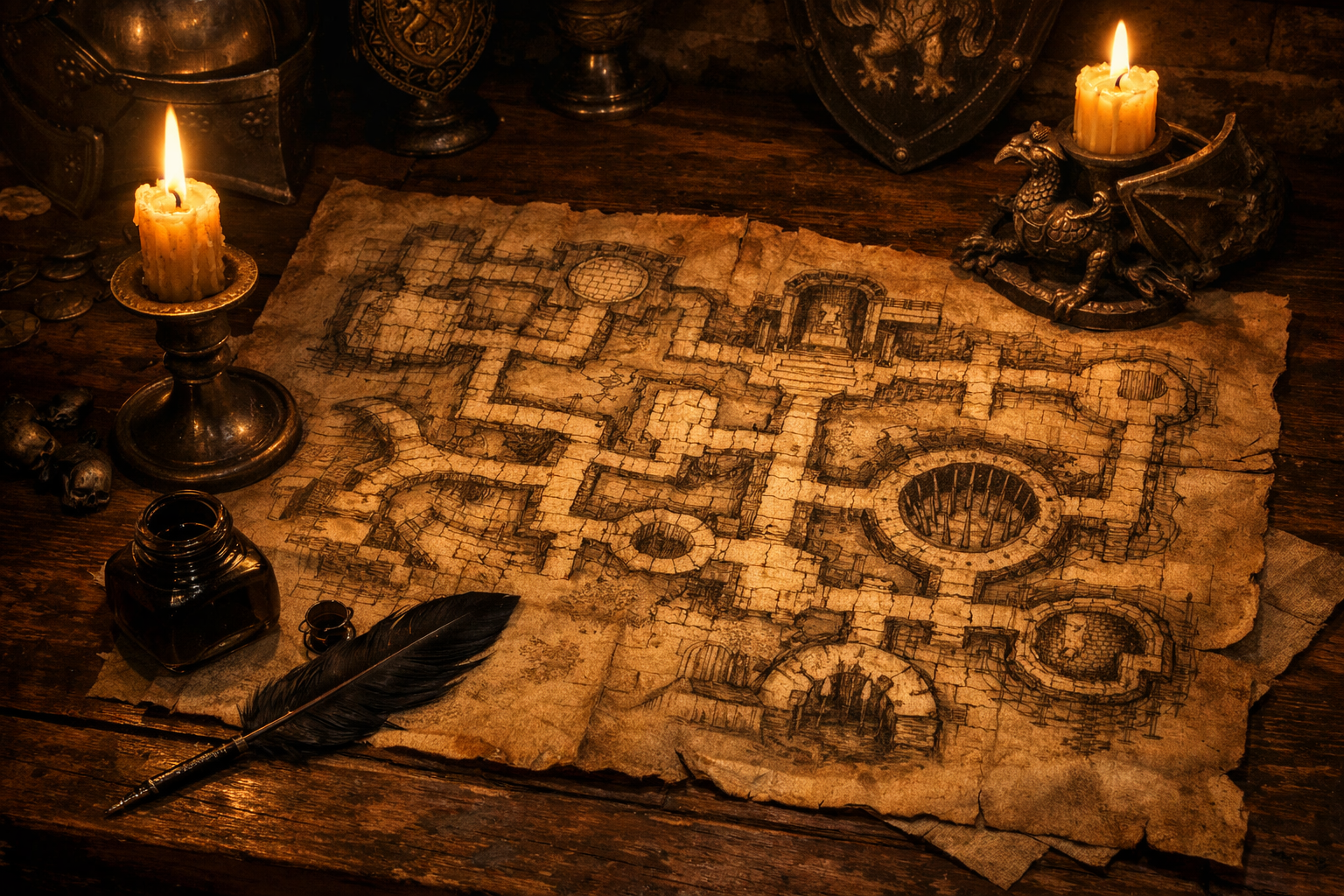
Master the art of dungeon mapping with practical techniques for sketching layouts, tracking progress, and revealing environments at the table.
Mapping can transform dungeon exploration from a sequence of disconnected rooms into a location the players understand, remember, and use strategically.
A map can answer practical questions:
- Where have we been?
- Which routes remain unexplored?
- How do we get back to the entrance?
- Where did we encounter that locked door?
- Does this corridor connect to an earlier area?
- Is there another route around the guards?
- Which parts of the dungeon have changed?
But there is no single correct way to map a dungeon.
Some groups enjoy drawing every corridor themselves.
Others prefer the Dungeon Master to reveal a map as the characters explore.
Some use a virtual tabletop with fog of war.
Others rely almost entirely on verbal descriptions and a few rough sketches.
All of these approaches can support meaningful exploration.
The important question is not whether the players are performing traditional cartography.
It is whether everyone has enough spatial information to make the kinds of navigation and tactical decisions the adventure expects.
This guide examines player-side mapping, Dungeon Master revelation techniques, physical and digital tools, vertical and unusual layouts, mapping-oriented dungeon design, and ways to choose the right level of detail for your table.
Why Mapping Matters in a Dungeon Crawl
Maps can serve several different purposes.
Understanding those purposes helps you decide how much mapping your game actually needs.
Shared Spatial Understanding
A map creates a common reference for the fictional environment.
Instead of four players imagining four different versions of the same intersection, the group can point to a location and say:
We came from here.
We haven't explored this passage.
The guards were in this room.
This staircase went down.
That shared understanding can reduce confusion and make navigation decisions more meaningful.
Remembering Exploration
Dungeon crawls often involve revisiting locations.
The party may:
- Retreat
- Rest
- Return later
- Discover shortcuts
- Open previously locked doors
- Avoid dangerous areas
- Revisit an NPC or faction
- Search an unexplored branch
A map creates a record of what the group has learned about the location.
It can also be annotated with information such as:
- Locked
- Trapped
- Flooded
- Goblins
- Shrine
- Secret passage
- Unexplored
- Safe room
- Collapsed
The annotations can become as useful as the geometry.
Supporting Strategic Decisions
A good dungeon map is not only a record.
It can become a strategic tool.
Players may notice:
- A loop connecting two areas
- A possible shortcut
- A route around a dangerous room
- A suspicious gap between mapped chambers
- A second approach to an enemy position
- An easier retreat path
This is particularly valuable in nonlinear dungeons, where understanding the location creates additional options.
Navigation Map vs. Battle Map
One important distinction is often overlooked:
A dungeon navigation map and a tactical battle map do not need to be the same thing.
Navigation Map
A navigation map primarily communicates:
- Connections
- Relative position
- Levels
- Landmarks
- Explored versus unexplored areas
- Routes
It can be rough.
A room represented by a rectangle may be perfectly adequate even if the actual room is irregular.
Battle Map
A tactical map needs greater precision when movement and range matter.
For current D&D, when using a square combat grid, each square represents 5 feet.
A battle map may therefore need to show:
- Exact creature positions
- Cover
- Difficult terrain
- Hazards
- Elevation
- Distances
- Doors and obstacles
You can use a rough navigation map for exploration and switch to a precise tactical map when combat begins.
That hybrid method often reduces mapping workload while preserving tactical clarity.
Player-Side Mapping
Traditional dungeon crawling often assigns mapping responsibility to the players.
This can be enjoyable when the group likes reconstructing a location from description.
It should not be treated as mandatory.
Graph Paper Mapping
Graph paper remains a simple and effective option.
For a navigation map, choose a scale that is easy to use.
You might decide that:
- One square represents 5 feet
- One square represents 10 feet
- Rooms are drawn approximately without a fixed scale
There is no requirement that a player navigation map exactly reproduce the Dungeon Master's map.
The goal is usability.
Suppose the Dungeon Master says:
The corridor runs north for about thirty feet before entering a roughly circular chamber. Two doors leave the chamber, one east and one northwest.
A player might draw:
- A northward corridor
- A circle
- One east exit
- One northwest exit
That may be all the group needs.
Label Important Features
A useful player map often contains more words than architectural detail.
Labels might include:
- Entrance
- Statue room
- Goblin camp
- Locked
- Trap
- Water
- Strange symbol
- Stairs down
- Unexplored
- Merchant prisoner
These annotations turn the map into an expedition record.
Room numbers from the Dungeon Master's notes are usually less useful to players than descriptions they actually recognize.
"Flooded chapel" means something at the table.
"Room 14B" usually does not.
Do Not Demand Architectural Precision
A player's map is a play aid, not a drafting examination.
Curves can become straight lines.
Irregular caverns can become rough blobs.
Twenty-seven-foot rooms can become thirty-foot rooms.
Minor inaccuracies rarely matter unless exact geometry is itself important to the scenario.
If the party understands that:
- The chapel connects to the crypt
- The crypt connects to the lower stairs
- The lower stairs return to the cistern
then the map may already be doing its job.
Mapping Errors and Fairness
Imperfect maps can create interesting discoveries, but it is important to distinguish in-fiction uncertainty from communication error.
Suppose the characters travel through a twisting natural cavern with poor visibility.
An imperfect player map may reasonably represent the difficulty of understanding the space.
That can be part of exploration.
Now suppose the Dungeon Master clearly intended to describe a rectangular room with two doors, but the player misunderstood where one door was located.
If the characters would obviously see the door's position, clarify it.
Do not preserve the misunderstanding simply because the player drew the map incorrectly.
Player cartography skill should not replace character perception unless the group has deliberately chosen that style of play.
The Mapper Role
Some players genuinely enjoy maintaining the map.
For them, discovering that two passages connect can be one of the pleasures of dungeon crawling.
Others find mapping tedious.
Do not automatically assign the job to one player for an entire campaign.
Options include:
- One volunteer mapper
- Rotating responsibility
- Collaborative mapping
- A shared digital map
- The Dungeon Master revealing the map
- No dedicated mapper at all
Mapping should create useful decisions, not unpaid clerical work for the least resistant person at the table.
Collaborative Mapping
A shared map allows several players to contribute.
One player may sketch the geometry.
Another may record:
- Traps
- Creatures
- Locked doors
- Clues
- Faction territory
This distributes the cognitive load.
A digital shared document or image can also preserve the map when one player misses a session.
Multiple independent maps can be fun for groups that enjoy the uncertainty, but redundancy is not inherently necessary.
Choose the method that fits the table.
Digital Player Mapping
Digital mapping can work particularly well for remote or hybrid games.
Possible tools include:
- General drawing applications
- Shared whiteboards
- VTT drawing tools
- Dungeon-mapping software
- Image annotation
- Tablet note applications
Dungeon Scrawl is one current browser-based option for creating dungeon and battle maps, though a player mapping live during a session may prefer something even simpler.
The important features during play are usually:
- Fast drawing
- Easy correction
- Simple labels
- Sharing
A feature-rich cartography suite is not necessarily a better player notebook.
Dungeon Master Mapping
The Dungeon Master usually needs a more complete version of the dungeon than the players.
The GM map may include:
- Hidden rooms
- Secret doors
- Traps
- Creature starting locations
- Patrol routes
- Faction territory
- Treasure
- Environmental effects
- Room numbers
- Connections the players have not discovered
Because of this, simply handing the GM map to the players can accidentally reveal information.
Consider preparing a player-safe version.
Theater of the Mind
A dungeon can be run entirely through verbal description.
This works best when:
- Geometry is relatively simple
- Exact distances rarely matter
- Navigation is not intended to be a major puzzle
- Players can maintain a mental model comfortably
Be consistent.
Describe information in a predictable order.
For example:
The chamber is roughly thirty feet square. You entered through the south wall. A wooden door stands in the center of the north wall. An open archway leads east. The western wall is lined with damaged shelves.
That gives players:
- Shape
- Scale
- Entry point
- Exits
- Important feature
Then allow questions.
Use Quick Clarifying Sketches
"Theater of the mind" does not mean the Dungeon Master is forbidden from drawing.
If everyone becomes confused, sketch the situation.
A ten-second diagram can resolve a misunderstanding that might otherwise consume several minutes.
You can draw:
- A T-intersection
- Relative door positions
- A staircase
- A bridge
- The shape of a cavern
The sketch can then be discarded.
Tools should serve clarity.
Progressive Map Revelation
Another option is to reveal the actual map as the characters explore.
Physical methods include:
- Drawing rooms on a reusable mat
- Adding dungeon tiles
- Removing pieces of paper covering a printed map
- Drawing on graph paper in front of the group
Digital methods include:
- Manual fog of war
- Token-based visibility
- Dynamic lighting where supported and configured
- Separate revealed and hidden map layers
This approach transfers much of the cartography work from the players to the Dungeon Master or software.
That is not inherently less legitimate.
Players can still make meaningful navigation decisions because they are building knowledge of the space.
How Much Should You Reveal?
Reveal what the characters can reasonably perceive.
Suppose the party opens a door into a long corridor.
How much becomes visible depends on:
- Lighting
- Darkness
- Fog
- Smoke
- Corners
- Obstructions
- Character senses
- Relevant game effects
Do not reveal a corridor in five-foot sections solely to create suspense if the characters can clearly see its entire length.
Likewise, do not automatically reveal everything on the other side of a corner.
The map should represent fictional information, not manipulate pacing independently of the scene.
Player-Safe Maps
If you use prepared maps, consider what information the image itself reveals.
A complete GM map might accidentally show:
- Secret rooms
- Hidden passages
- A suspicious blank space
- Traps
- Creature locations
- Labels
- Undiscovered exits
A player-safe version may remove those features.
For particularly secret-heavy dungeons, progressive drawing may work better than revealing a complete floor plan.
Handout Maps
Finding a map inside the fiction can create an interesting exploration tool.
The characters might obtain:
- An architect's plan
- A damaged adventurer map
- A guard patrol diagram
- A mining survey
- A cultist sketch
- A fragment of an older floor plan
The map does not need to be perfectly accurate.
But inaccuracies should make sense in the fiction.
An old map might omit:
- Recent cave-ins
- New construction
- Later tunnels
- Secret areas unknown to the original cartographer
A guard map might deliberately omit restricted areas.
An adventurer's map may simply end where the previous expedition turned back.
These imperfections give players information without removing exploration.
Example: Mapping the Rustwater Warren
Consider a small dungeon where goblins occupy an abandoned cistern.
The party descends a stone staircase.
The Dungeon Master says:
The stairs descend about twenty feet before reaching a corridor running north. The corridor is ten feet wide, and shallow water covers the floor.
A player navigation map might show:
- Stairs
- North corridor
- "Shallow water"
- Entrance
The exact number of staircase steps does not matter.
The First Junction
Farther north:
The corridor reaches a junction. It continues north, while another passage turns east. You hear steady dripping from the eastern passage. The northern passage smells faintly of smoke.
The players now possess route information.
Their map might record:
- East: dripping
- North: smoke
That annotation is strategically useful.
The Cistern
The eastern passage eventually opens into a broad circular cistern.
The group discovers sleeping goblins there.
The map is updated:
- Cistern
- Goblin sleeping area
- Water
- Western ledge
- Second northern exit
Later, the party discovers that the second exit reconnects with the main northern route.
The loop changes how the players understand the dungeon.
They can now:
- Avoid the original junction
- Approach another area from behind
- Retreat through the cistern
- Split attention between two routes
The map has become more than a record.
It has become part of the party's strategy.
Elevation Changes
Multiple dungeon levels can make maps difficult to read.
Useful symbols include:
- ↑ stairs up
- ↓ stairs down
- Ladder
- Shaft
- Drop
- Ramp
Label where each connection leads when known.
For example:
↓ to Lower Crypt, near flooded chamber
Separate floor maps are usually easier to understand than trying to show several elevations on one crowded page.
Vertical Connections
Verticality can create meaningful dungeon routes.
Examples include:
- Balconies
- Pits connecting levels
- Chimneys
- Wells
- Collapsed floors
- Elevators
- Climbable shafts
- Underground waterfalls
A vertical route can transform the players' understanding of the location.
A shaft discovered on Level 3 might connect directly to a chamber near the entrance.
That creates a powerful shortcut.
Make those connections clear on the map once discovered.
Overlapping Areas
A common mapping mistake occurs when players assume two corridors cannot occupy the same horizontal position.
They can if they are at different elevations.
When designing or describing such areas, make elevation changes explicit enough that the group can reason about them.
For example:
The western passage slopes downward for roughly forty feet before leveling out.
That may be important later when another corridor crosses above it.
Irregular Geometry
Natural caves rarely cooperate with graph paper.
Do not force perfect accuracy.
Use:
- Approximate outlines
- Landmarks
- Relative directions
- Major exits
- Significant elevation
Instead of attempting to reproduce every bend:
This cavern is roughly oval. A stream enters from the northeast and disappears through a narrow opening to the west. Your entrance is on the southern side.
That may be all the party needs.
Non-Euclidean and Magical Spaces
A deliberately impossible dungeon presents a different problem.
If corridors change location or geometry violates ordinary space, mapping may be part of discovering that fact.
Establish ordinary expectations first.
If every early description is imprecise, players may assume the map discrepancy is merely communication error.
For a spatial impossibility to feel meaningful, the table should be able to recognize:
These two spaces genuinely should not connect this way.
Make the weirdness intentional and distinguishable.
Managing Mapping Pace
Mapping can slow the game.
Whether that is a problem depends on what the group enjoys.
Some tables find careful mapping suspenseful.
Others want to reach the next decision quickly.
Do Not Stop for Every Square
For straightforward areas, summarize.
Instead of dictating:
Ten feet north. Then ten more. Then twenty east.
you might say:
The corridor runs north for about forty feet before turning east and entering another chamber.
Let the mapper approximate it.
Reserve precise measurements for situations where they matter.
Pause for Important Geometry
Slow down when the layout itself affects a decision.
Examples include:
- Several exits
- A multi-level chamber
- Tactical obstacles
- A suspicious connection
- A complex intersection
Confirm understanding before continuing.
A useful question is:
Does everyone have the layout?
This is often better than discovering ten minutes later that half the group imagined the room differently.
Do Not Confuse Mapping Difficulty With Dungeon Difficulty
A dungeon should not become harder solely because the Dungeon Master is difficult to understand.
If the intended challenge is:
- Choosing routes
- Managing resources
- Interpreting clues
- Avoiding threats
then poor spatial communication adds noise rather than meaningful difficulty.
Cartographic challenge should be deliberate.
Designing Dungeons That Map Well
The Dungeon Master's map design influences how easy the location is to learn.
A completely uniform dungeon is difficult to remember.
Distinctive areas help players orient themselves.
Use Landmarks
Useful landmarks include:
- A flooded chapel
- A huge statue
- A mushroom cavern
- A collapsed bridge
- A furnace room
- A painted gallery
- A giant underground tree
- A glowing well
Players can reason from landmarks:
Go back to the flooded chapel, then take the western passage.
Justin Alexander's writing on nonlinear dungeon design specifically emphasizes memorable landmarks as an aid to successful navigation.
Use Regions
Large dungeons become easier to understand when areas have identities.
For example:
Upper Monastery
- Living quarters
- Kitchens
- Library
Catacombs
- Burial chambers
- Shrines
- Crypts
Flooded Lower Works
- Cisterns
- Pumps
- Submerged tunnels
Players can build a mental model before memorizing every room.
Loops and Shortcuts
Loops create strategic value for maps.
Suppose two routes reach the same central hall.
One passes through cultist barracks.
The other passes through unstable ruins.
Once the players know both routes, they can decide which risk they prefer.
Shortcuts are especially satisfying when discovered after the party has already traveled the longer route.
Opening a secret door that connects Level 3 to the entrance can dramatically change future expeditions.
Multiple Entrances
Multiple entrances give players additional strategic choices.
One entrance may:
- Be obvious and guarded
- Be concealed and difficult to reach
- Enter on another level
- Require a key
- Become accessible only after exploration
Once the players learn about them, the map helps them plan future expeditions.
Mapping as a Puzzle
Spatial relationships can occasionally become part of a dungeon puzzle.
Examples include:
- A suspicious unmapped gap
- A symmetrical complex missing one chamber
- Two floors whose layouts align
- A route that appears to loop impossibly
Use this sparingly.
Mapping should normally help players understand the dungeon.
If every map contains hidden geometry puzzles, cartography can become another mandatory minigame.
Digital Table Mapping
Virtual tabletops can simplify map revelation but also change the experience.
Players may no longer need to reconstruct geometry themselves because the explored map remains visible.
That reduces cartographic workload.
It does not necessarily remove exploration.
Players can still decide:
- Which path to take
- Where to return
- Which areas to avoid
- How routes connect
- How to approach enemies
The strategic information remains.
Fog of War
Manual or automated fog of war can preserve uncertainty about unexplored areas.
When using it:
- Reveal according to fictional visibility
- Avoid exposing secret geometry
- Check that token permissions work
- Test lighting before the session
- Have a fallback if the software misbehaves
Do not make technical simulation more important than clear play.
If dynamic lighting produces confusion, manual revelation may be better.
Player Notes on Digital Maps
When the platform allows it, player annotations can recreate some benefits of traditional cartography.
Players might mark:
- Locked
- Trap
- NPC
- Unexplored
- Secret?
- Dangerous
- Safe rest?
This preserves ownership over the information even when software supplies the base geometry.
Hybrid Mapping
A useful hybrid approach is:
- VTT or GM map for exact tactical locations
- Player-created sketch for the overall dungeon
The tactical map answers:
Where is the ogre?
The exploration map answers:
How do we get back to the western crypt?
These are different questions.
One map does not need to solve both.
Teaching New Players to Navigate Dungeons
Do not assume new players understand old-school mapping conventions.
Explain what matters.
You might say:
You don't need to reproduce the room perfectly. Just keep track of the major connections, stairs, landmarks, and anything you want to return to.
Start with a manageable dungeon.
Useful early features include:
- A clear entrance
- A few branches
- One loop
- A memorable landmark
- Stairs or a second level
- A shortcut
This introduces spatial decision-making without overwhelming the mapper.
Demonstrate Once
If players want to map but do not know how, demonstrate.
For example:
I would draw this as a rectangle, mark the door we entered through, and add the two exits. You can label the statue if you think you'll want to remember it.
Then give responsibility back to the players.
The map is not an art project.
Mapping Should Be Optional Unless the Game Requires It
A table that dislikes cartography does not need to perform it simply because dungeon crawling historically used player maps.
The Dungeon Master can provide:
- A revealed map
- A simplified route diagram
- A VTT
- A shared sketch
- Clear verbal navigation
The trade-off is not simply:
Mapping equals agency, provided maps equal less agency.
The actual trade-off is about where the group's attention goes.
Player mapping can create satisfaction from charting unknown territory.
A revealed map can reduce cognitive overhead and allow more attention for:
- Route strategy
- Character decisions
- Clues
- Combat
- Roleplay
Choose deliberately.
When Not to Use a Map
Maps may add little when:
- The location is extremely simple
- Navigation has no meaningful decisions
- The scene is brief
- Exact positioning does not matter
- The group already understands the environment
A three-room roadside cave probably does not require a detailed player map unless the group enjoys making one.
Use the amount of spatial support the situation deserves.
Tools for Dungeon Mapping
You do not need specialized equipment.
Physical Tools
Useful options include:
- Graph paper
- Pencil
- Eraser
- Index cards
- Reusable battlemat
- Dungeon tiles
- Printed maps
- Tokens
Incompetech currently provides customizable graph-paper generators in several formats and styles.
Digital Tools
Dungeon Scrawl provides browser-based dungeon and battle-map creation and can export maps for print or virtual tabletop use.
Other options include:
- VTT map editors
- General illustration programs
- Shared whiteboards
- Note applications
Use the simplest tool that supports your workflow.
Map Inspiration
Studying existing maps can help Dungeon Masters understand:
- Loops
- Vertical connections
- Room clusters
- Multiple entrances
- Secret routes
- Landmark placement
Dyson Logos maintains a large collection of fantasy RPG maps and cartography examples.
Justin Alexander's Xandering the Dungeon series focuses specifically on techniques for creating nonlinear dungeon layouts where navigation choices become strategically meaningful.
Using The Dungeon Trainer Alongside Dungeon Maps
The Dungeon Trainer is not a replacement for dedicated dungeon-mapping software.
Its current tools support other parts of preparing and running a dungeon crawl.
Human-DM Campaigns
A human Dungeon Master can run the dungeon while the platform maintains shared mechanical state in code, including:
- Character sheets
- Dice
- Initiative
- Hit Points
- Damage and healing
- Conditions
- Combat rounds
- Campaign continuity
- Shared transcript
Human-DM turns can operate without AI model calls.
Scry
Scry can help prepare a mapped location by forecasting plausible ways an upcoming scene might develop.
At a three-way dungeon junction, for example, it can help the Dungeon Master consider:
- Likely approaches
- Complications
- Pacing risks
- Single points of failure
- Preparation needs
It does not determine which route the players will choose.
Campaign Memory and Codex
A long dungeon crawl can accumulate information about:
- Locations
- NPCs
- Quests
- Previous events
The platform maintains searchable campaign records while unrevealed Dungeon Master information remains hidden.
This can complement a spatial map by tracking what happened in the places shown on it.
The Coach
The Coach can provide practice situations involving:
- Exploration adjudication
- Information clarity
- Pacing
- Player agency
- Unexpected routes
Generators
The Dungeon Trainer can generate:
- Locations
- Monsters
- NPCs
- Items
- Spells
Generated material should still be adapted to the existing dungeon.
A generated room or creature should make sense within the location rather than being inserted simply because it exists.
Choosing Your Mapping Style
Before a dungeon-heavy adventure, decide what the table actually wants from mapping.
Ask:
- Do players enjoy drawing maps?
- Is navigation intended to be a major part of the challenge?
- Does precise positioning matter?
- Are there many secret connections?
- Does the dungeon have several levels?
- Are you using a VTT?
- Would mapping slow the game in a way the group dislikes?
Then choose a method.
Player Cartography
Best when the group enjoys reconstructing and learning the location themselves.
Progressive GM Revelation
Best when spatial clarity matters but players do not want the bookkeeping of drawing.
Full Player-Safe Map
Best when route strategy matters more than discovering basic geometry.
Theater of the Mind
Best when geometry is simple and exact mapping contributes little.
Hybrid
Best when exploration and tactical combat require different levels of precision.
There is no universally superior option.
Bringing It All Together
A successful dungeon map helps the group understand enough of the location to make meaningful decisions.
It might be:
- A carefully drawn graph-paper record
- A rough network of labeled boxes
- A progressively revealed VTT
- A printed handout
- A few quick sketches
- A combination of several methods
The quality of the artwork matters far less than the quality of the information.
A useful map helps players answer:
- Where are we?
- Where have we been?
- Where can we go?
- What have we learned about those places?
- How might the routes connect?
- How do we get out?
When players use that knowledge to avoid a threat, find a shortcut, approach an enemy from another direction, return to an unexplored branch, or recognize a hidden connection, the dungeon has become more than a series of rooms.
It has become a place they understand.
That is the real value of mapping.
Not perfect cartography.
Not drawing every five-foot square.
Not reproducing the Dungeon Master's map.
The goal is giving the table a shared spatial model that supports exploration.
Choose the level of detail that helps your group make better decisions, then let the map disappear into the play.
Sources and Further Reading
- Alexander, J. (2010, July 23). Xandering the Dungeon. The Alexandrian.
- Alexander, J. (2010, July 26). Xandering the Dungeon, Part 2: Xandering Techniques. The Alexandrian.
- Alexander, J. (2010). Xandering the Dungeon, Part 3: The Philosophy of Xandering. The Alexandrian.
- Alexander, J. (2023, November 1). A Historical Note on Xandering. The Alexandrian.
- Dungeon Scrawl. (n.d.). Dungeon Scrawl: Free Dungeon and Battle Map Maker.
- Dyson Logos. (n.d.). Dyson's Dodecahedron: Maps.
- Incompetech. (n.d.). Graph Paper Generators.
- Wizards of the Coast. (2024). D&D Free Rules. D&D Beyond.
- Wizards of the Coast. (2024). Dungeon Master's Guide.
- The Dungeon Trainer. (2026). The Dungeon Trainer.
---
Ready to put your dungeon map to use? The Dungeon Trainer supports human Dungeon Masters with code-resolved table mechanics, campaign continuity, shared transcripts, Scry preparation, coaching, generators, and optional AI assistance. Use a dedicated mapping tool for the floor plan, then let The Dungeon Trainer help you manage what happens inside it.
Related reading
- Why Megadungeons Succeed or Fail: Lessons from Forty Years of Play
Megadungeons have persisted since the earliest days of tabletop roleplaying, yet many campaigns abandon them within a few sessions. Learn what structural, pacing, and preparation factors separate sustainable megadungeons from those that collapse, and how to apply those lessons at your own table.
- Understanding the Megadungeon: What It Is and When to Use It
A megadungeon is more than a big dungeon. Learn what defines this sprawling adventure structure, why it persists across decades of play, and when it serves your table better than episodic adventures.
- Running Sandbox Campaigns: Six Months with The Millbrook Consortium
Sandbox campaigns promise player-driven freedom but demand different preparation and facilitation techniques. This case study examines six months of running The Millbrook Consortium, a merchant-focused sandbox, to identify practical lessons about faction management, player agency, and sustainable open-world play.