Five Warning Signs Your Dungeon Has Lost Momentum
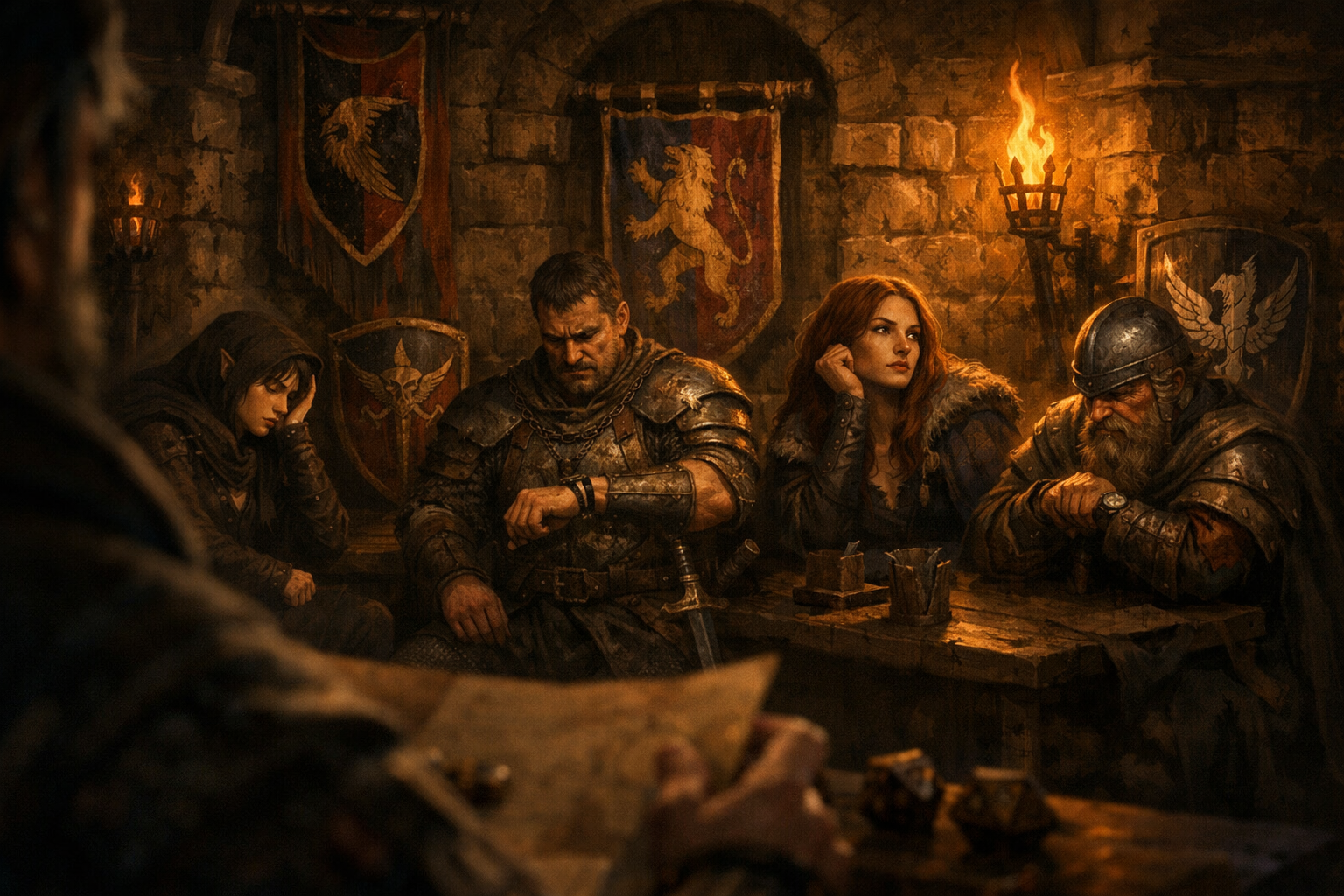
Recognize the telltale signs that your dungeon exploration has stalled. Learn to identify player disengagement, pacing problems, and session fatigue before they derail your campaign.
Dungeon masters invest considerable time designing underground complexes, plotting encounters, and imagining atmospheric details. Yet even well-crafted dungeons can lose their dramatic tension and player engagement. Recognizing when momentum has stalled allows you to course-correct before frustration sets in.
This analysis examines five concrete warning signs that indicate your dungeon has lost momentum, helping you identify problems early and maintain engaging play.
Warning Sign 1: Players Stop Taking Notes
Active players typically jot down room details, NPC names, trap locations, and tactical observations. When note-taking ceases, it signals declining investment in the exploration.
What This Indicates
Players stop recording information when they no longer believe it matters. This happens when:
- Room descriptions blur into indistinguishable repetition
- Clues and discoveries lead nowhere
- Decisions feel inconsequential
- The dungeon becomes a mechanical exercise rather than exploration
Consider a scenario where players explore the Tombs of Ashmar, a sprawling necropolis beneath a desert city. During the first session, they sketch maps, note which passages contain undead, and track the strange crystalline deposits in certain chambers. By the third session, notebooks remain closed. Rooms have become functionally identical, the crystals never proved relevant, and exploration feels like checking boxes rather than solving mysteries.
How to Address It
Reintroduce meaningful choices and consequences. Plant immediate payoffs for observation (the crystals might actually be condensed magical energy that powers certain doorways). Create urgency (a rival expedition is one day behind them). Ensure player decisions matter by acknowledging previous choices and observations.
Warning Sign 2: Combat Encounters Become Tedious Rather Than Tense
Combat naturally takes longer than other activities at the table. When players visibly disengage during fights, checking phones or having sidebar conversations, tactical excitement has given way to mechanical drudgery.
What This Indicates
Combat loses appeal when:
- Encounters feel identical with only monster stat blocks changing
- Environmental features offer no tactical options
- Victory seems guaranteed but slow
- Resource depletion becomes the only real consequence
- Stakes remain unclear or constantly deferred
In the Tombs of Ashmar, imagine the party faces their fifth group of skeleton warriors in identical stone corridors. The tactics never change: front-line fighters advance, spellcasters target clusters, the cleric turns undead. Players know they will win. They are simply waiting for hit points to reach zero.
How to Address It
Vary encounter design beyond stat blocks. Introduce environmental hazards (collapsing floors, magical darkness that spreads each round). Create clear stakes beyond attrition (enemies attempting to flee with a critical artifact, time limits before reinforcements arrive). Use terrain that rewards creativity (chandeliers to swing from, explosive barrels, narrow bridges).
If encounters truly serve no purpose beyond resource drain, consider narrative resolution. Let skill checks or creative solutions bypass unnecessary fights entirely.
Warning Sign 3: Players Ask 'How Much Longer Is This Dungeon?'
This question reveals fundamental pacing problems. Players experiencing good momentum ask about immediate choices, not when the experience ends.
What This Indicates
When players want to know the endpoint, they are:
- No longer enjoying moment-to-moment gameplay
- Feeling obligated to continue rather than invested
- Unable to see progress toward meaningful goals
- Experiencing the dungeon as obstacle rather than adventure
This differs from reasonable session-ending questions. Asking 'how much longer' at minute 200 of a session is practical time management. Asking it 45 minutes after starting dungeon exploration indicates deeper problems.
How to Address It
Provide visible progress markers. These might include:
- Physical depth indicators (descending stairways, elevation changes)
- Narrative breadcrumbs (journals describing deeper chambers)
- Mechanical unlocks (finding keys, disabling barriers)
- Environmental shifts (architectural changes, temperature variations)
In the Tombs of Ashmar, ensure players recognize they have moved from outer burial chambers (simple stone) to royal crypts (elaborate murals) to the forbidden vault (obsidian walls with warning glyphs). Each tier feels distinct and represents advancement.
Also consider whether the dungeon actually is too long. Some complexes work better compressed into single sessions with intermissions rather than stretched across weeks.
Warning Sign 4: Detailed Descriptions Receive Minimal Response
Dungeon masters often prepare evocative descriptions: flickering torchlight on ancient frescoes, the smell of centuries-old dust, the echo of dripping water in vast chambers. When these details prompt only silence or perfunctory acknowledgment, immersion has broken.
What This Indicates
Players tune out descriptions when:
- Flavor text contains no actionable information
- Descriptions have become interchangeable across rooms
- The ratio of description to meaningful interaction has skewed too heavily toward narration
- Previous descriptive details never mattered mechanically or narratively
If you described elaborate tomb paintings in six previous chambers and none proved relevant, players reasonably assume the seventh painting also carries no significance.
How to Address It
Make descriptions interactive and consequential. When you describe frescoes showing ancient burial rites, let players roll History or Religion to gain tactical advantages. Perhaps the paintings reveal that these undead are vulnerable to salt (commonly used in mummification). Maybe the depicted burial positions indicate which sarcophagi contain treasure versus traps.
Trim pure flavor to essential elements that establish atmosphere without delaying action. A 30-second description works better than a 3-minute monologue if it includes actionable details.
In the Tombs of Ashmar, describe the crystalline deposits mentioned earlier, but make them interactive. Characters touching them might receive brief visions of the tomb's history, feel magical energy they can harness for a single spell boost, or trigger guardian constructs. Descriptions become invitations to engage rather than passive narration.
Warning Sign 5: Players Choose Obvious Safe Routes Exclusively
Healthy dungeon exploration involves calculated risk-taking. Players weigh options, debate approaches, and sometimes choose dangerous paths for potential rewards. When they exclusively select the safest, most conservative option every single time, something has shifted.
What This Indicates
Risk-averse behavior throughout an entire dungeon suggests:
- Previous bold choices were punished disproportionately
- Rewards for risk-taking proved negligible or absent
- Resource depletion has created fear of any additional expenditure
- Players no longer trust the dungeon master to provide fair challenges
This differs from appropriate caution in genuinely deadly dungeons. This warning sign appears when players who normally enjoy bold tactics suddenly become extremely conservative without clear in-game justification.
In the Tombs of Ashmar scenario, imagine players consistently refuse to investigate side passages, avoid examining suspicious treasures, and retreat from any difficult-looking door. If earlier they triggered a trap that killed a character with no save, looted a cursed item with no warning signs, and found a hidden room containing only more skeletons after a difficult puzzle, their caution makes perfect sense.
How to Address It
Rebuild trust through proportional consequences and visible rewards. Ensure:
- Traps provide warning signs that observant characters can detect
- Risk-taking sometimes yields significant advantages (powerful items, shortcuts, valuable information)
- Difficult encounters offer retreat options before becoming lethal
- Effort correlates with reward (hard puzzles unlock genuinely useful treasures)
Consider explicitly acknowledging player caution in-game. An NPC might note that the party seems hesitant, creating an opening to discuss whether the dungeon feels unfair. This metagame check-in can reveal whether conservative play reflects character caution or player frustration.
Recognizing Patterns Versus Isolated Incidents
Single instances of these warning signs might reflect temporary factors: players distracted by real-world concerns, one particularly draining encounter, simple bad luck with engagement. Patterns matter more than isolated moments.
If three or more warning signs appear consistently across two full sessions, momentum has genuinely stalled. This requires active intervention rather than hoping the problem resolves naturally.
Combining Warning Signs into Diagnosis
Different combinations suggest different root causes:
Players stop taking notes + minimal response to descriptions typically indicates repetitive content without meaningful variation or consequence.
Tedious combat + players asking how much longer suggests pacing problems, likely too many encounters relative to story advancement.
Players choosing safe routes + tedious combat often means resource depletion has created a death spiral where players cannot afford interesting choices.
All five signs together indicate fundamental problems requiring substantial changes, possibly including abandoning the current dungeon approach entirely.
Making Mid-Dungeon Corrections
Recognizing warning signs means nothing without willingness to adjust. Mid-dungeon corrections might include:
- Introducing dramatic new element (rival explorers, environmental catastrophe, discovery that recontextualizes everything)
- Compressing remaining content (narrating through less important rooms, allowing skill checks to bypass entire sections)
- Adding immediate high-stakes scenario (a time limit, an NPC in danger, a rapidly developing threat)
- Taking a session break to run something completely different, returning to the dungeon later with fresh perspective
In the Tombs of Ashmar example, if warning signs appear, consider having the rival expedition arrive immediately, creating competitive exploration. Or reveal that the crystalline deposits are actually a slow-acting poison requiring players to find the cure in the deepest vault within a certain timeframe. Or simply skip to the final vault, narrating the journey through intermediate chambers.
Prevention Through Design
Recognizing warning signs helps with existing dungeons. Prevention requires thoughtful initial design:
- Build in obvious progress markers from the start
- Vary encounter types and environments across the complex
- Create meaningful choices with visible consequences
- Design interactive elements throughout, not just in boss rooms
- Plan reasonable endpoints (most dungeons work better at 8-12 rooms than 30-40)
- Include obvious shortcuts and alternate routes players can discover
When designing the Tombs of Ashmar initially, establish three distinct tiers (burial chambers, royal crypts, forbidden vault), plan specific discoveries that unlock new areas, create environmental variation (water-filled chambers, collapsed sections, magically preserved gardens), and ensure treasure and information appear regularly.
Conclusion
Momentum loss rarely happens suddenly. These five warning signs provide early detection, allowing course correction before players disengage completely. Watch for patterns across sessions, diagnose root causes through combinations of symptoms, and maintain willingness to adapt even mid-dungeon.
The difference between a memorable dungeon and a slog often comes down to recognizing these warning signs early and responding decisively.
Ready to maintain momentum in your dungeon sessions? The Dungeon Trainer provides practical game master techniques for every aspect of campaign management. Subscribe for weekly insights that keep your table engaged.
Sources and Further Reading
- Gygax, Gary. Dungeon Master's Guide (1st Edition). TSR, 1979. (Classic dungeon design principles)
- Angry GM. "The Angry Guide to Pacing." The Angry GM blog. (Contemporary analysis of game pacing)
- Sly Flourish. Return of the Lazy Dungeon Master. Self-published, 2018. (Practical session preparation and pacing guidance)
- The Alexandrian. "Don't Prep Plots" and dungeon design articles. The Alexandrian blog. (Node-based design theory)
- Dungeon Master's Guide (5th Edition). Wizards of the Coast, 2014. (Modern dungeon creation guidelines)
Related reading
- Why Megadungeons Succeed or Fail: Lessons from Forty Years of Play
Megadungeons have persisted since the earliest days of tabletop roleplaying, yet many campaigns abandon them within a few sessions. Learn what structural, pacing, and preparation factors separate sustainable megadungeons from those that collapse, and how to apply those lessons at your own table.
- Understanding the Megadungeon: What It Is and When to Use It
A megadungeon is more than a big dungeon. Learn what defines this sprawling adventure structure, why it persists across decades of play, and when it serves your table better than episodic adventures.
- What I Learned Running My First Dungeon Crawl: A Game Master Reflection
A candid reflection on lessons learned from running a first dungeon crawl, including what worked, what failed, and how these insights improved future sessions.