Essential Dungeon Session Toolkit: 12 Items Every DM Needs
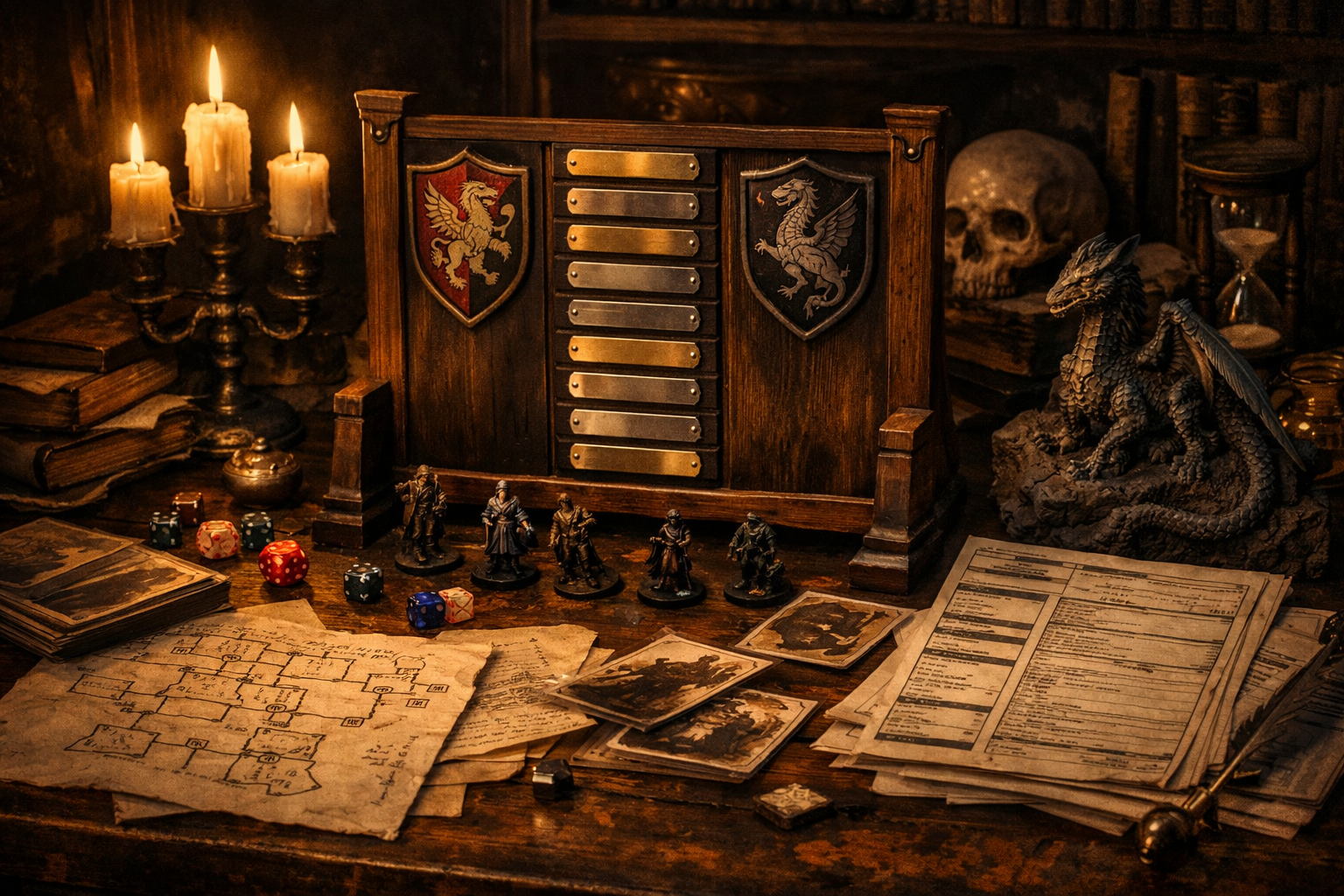
Running smooth dungeon sessions requires the right tools at your fingertips. This comprehensive toolkit covers everything from tracking aids to quick-reference materials that prevent session slowdowns and keep players engaged.
Running a smooth dungeon session requires managing several moving parts at once. Combat encounters, player navigation, resource use, environmental changes, and improvised interactions can all demand attention while you maintain the momentum of the adventure.
The right tools can reduce unnecessary cognitive load and allow you to focus more attention on the players, the fictional environment, and the consequences of their decisions.
This toolkit includes physical items, digital resources, and organizational systems that address common dungeon-session challenges. Each item serves a particular purpose, but no game master needs every tool for every session. Select the tools that address your table’s actual problems and leave the rest aside.
Tracking and Reference Tools
- Initiative and Combat Tracker
When dungeon combat involves several characters and opponents, a clear initiative tracker can reduce repeated questions and make damage and condition tracking easier.
Physical options include magnetic boards with movable nameplates, folded index cards placed over a game master screen, dry-erase cards, or a simple written list visible to the table.
Digital alternatives include spreadsheets, virtual tabletop trackers, text documents, and applications that organize initiative, damage, and conditions.
Useful features include:
- A clearly visible turn order
- Fast damage or hit point tracking
- Condition and duration reminders
- Distinct labels for similar enemies
- Minimal setup and maintenance during play
Showing initiative to the players lets them know when their turns are approaching and may encourage them to prepare their actions earlier. It does not guarantee faster decisions, but it removes uncertainty about the turn order.
For example, when a party encounters four corrupted guardians in the Undermarch temple, the game master must track the guardians, the player characters, damage, and ongoing effects. A consolidated tracker keeps that information in one place and reduces the need to reconstruct it during every round.
Use the simplest system that provides the information your group needs. A pencil and sheet of paper may work better for one table than a specialized combat application.
- Dungeon State Checklist
A dungeon state checklist records changes that may remain important after the scene or session ends.
Possible categories include:
- Doors opened, locked, destroyed, or barricaded
- Traps triggered, disabled, bypassed, or undiscovered
- Alarms raised or silenced
- Lights extinguished or created
- Shortcuts opened
- Areas flooded, collapsed, burned, or otherwise altered
- Factions alerted
- Creatures that escaped
- Items removed from important locations
- Safe areas established or compromised
Record only changes likely to affect future play. Tracking every moved chair or broken bottle creates more work than value.
This tool becomes especially useful when exploration extends across multiple sessions. The party may remember barricading the northern entrance or alerting the vault guards even when the game master’s attention has shifted to other parts of the dungeon.
A brief state record preserves continuity and helps the dungeon respond consistently to player actions.
- Consolidated Monster Reference
Searching through several rulebooks or digital sources during combat can interrupt the flow of an encounter.
Before the session, identify the creatures the party is reasonably likely to encounter and place bookmarks, page references, digital links, or brief authorized notes where you can reach them quickly.
Your reference may include:
- Armor Class or equivalent defense
- Hit points or damage thresholds
- Movement options
- Important saving throw or ability difficulties
- Signature actions and reactions
- Conditions the creature can impose
- Immunities, resistances, or vulnerabilities
- Brief tactical or motivational notes
Tactical notes should describe behavior rather than prescribe a rigid script.
Examples include:
- Protects the sealed doorway
- Retreats when seriously wounded
- Calls for reinforcements if an alarm remains active
- Avoids open flame
- Attempts to capture intruders rather than kill them
- Prioritizes anyone carrying the relic
Include likely wandering creatures or occupants of nearby areas when the party could reasonably reach them.
Do not spend excessive preparation time recreating entire stat blocks when bookmarks, page numbers, or existing digital tools provide faster access. Respect the licensing and usage restrictions that apply to any published game material you copy or redistribute.
- Quick NPC Reference
Players frequently interact with characters the game master did not expect to become important.
A captured guard, frightened survivor, wandering scavenger, rival explorer, or neutral dungeon inhabitant may suddenly become the focus of the session.
Prepare compact lists containing:
- Names appropriate to the setting
- Motivations
- Mannerisms
- Physical details
- Attitudes toward the party
- Useful information
- Immediate needs or fears
When an unplanned NPC appears, select or combine several details that fit the situation.
For example:
Name: Mara Venn
Role: Injured treasure hunter
Mannerism: Speaks quietly and watches every doorway
Motivation: Wants help escaping
Information: Heard chanting beneath the eastern stairwell
Complication: Secretly took an object belonging to a dungeon faction
This produces enough structure to run the interaction while leaving room for improvisation.
Names and traits should reflect the cultures and regions already established in the campaign rather than functioning as disconnected random details.
Planning and Preparation Materials
- Modular Encounter Notes
Prepare brief encounter notes on index cards, digital cards, or individual sections of your session document.
Each note can contain:
- Encounter purpose
- Likely participants
- Relevant location features
- Potential developments
- Treasure or information
- Special rules
- Tokens, maps, or references required
Modular preparation makes it easier to omit unused material or adapt when the players take an unexpected direction.
However, not every encounter should be freely relocated.
A guardian bound to a specific vault, a trap integrated into an ancient mechanism, or an NPC waiting at an established location should remain connected to that fiction unless circumstances justify a change.
More mobile elements can be repositioned when appropriate:
- Patrols
- Wandering creatures
- Rival explorers
- Reinforcements
- Portable clues
- Environmental complications
- Faction representatives
Treat modular notes as flexible components, not as permission to make every route lead to the same encounter.
If the party avoids the western corridor, its choices should remain meaningful. A patrol may later move south because it heard the party, but the western corridor’s fixed shrine should not silently appear elsewhere merely because it was prepared.
- Dungeon Map and Structural Overview
A keyed dungeon map shows geography, distances, entrances, rooms, and physical connections.
A supplemental flowchart or node diagram shows structural relationships at a higher level, including:
- Major zones
- Critical routes
- Optional areas
- Loops and shortcuts
- Faction territories
- Locations containing major objectives
- Routes through which enemies can move
- Areas affected by changing conditions
The flowchart does not replace the keyed map. It provides a simplified overview that may make the dungeon’s broader structure easier to assess during preparation and play.
Use boxes for major areas and lines for meaningful connections. Mark which connections are visible, hidden, locked, one-way, dangerous, or dependent on earlier actions.
Avoid placing essential information behind a single location or route.
If the players must learn something for the adventure to continue, provide multiple reasonable opportunities to discover it. A flowchart can help identify information bottlenecks before they stop the session.
During play, use the map to answer spatial questions and the structural overview to understand how choices may affect later areas.
- Flexible Pacing Outline
A pacing outline provides reference points for the expected shape of the session without dictating what the players must accomplish.
Before play, identify:
- The opening situation
- Several likely scenes or locations
- Potential moments of escalation
- Optional material
- A satisfying stopping point
- Developments that may occur if the party delays
You may divide the session into broad sections, but avoid assigning required events to exact clock times.
Players may spend an hour negotiating with an NPC you expected them to ignore. They may bypass a combat encounter, retreat early, or become deeply interested in a minor discovery.
Use pacing checks to ask:
- Is the current scene still producing meaningful choices?
- Does the group understand its objective?
- Has one encounter type dominated the session?
- Is there enough time to begin the next major scene?
- Would a natural stopping point be better than rushing the climax?
- Can optional or repetitive material be summarized?
Do not remove meaningful choices solely to meet a predetermined schedule.
The outline should help you respond to the session’s actual pace, not force the session to conform to your preparation.
Momentum Maintenance Tools
- In-Game Clock or Countdown Tracker
Some dungeons contain conditions that change over time:
- Rising water
- Approaching reinforcements
- A spreading fire
- A ritual nearing completion
- A fleeing enemy
- Deteriorating magical protection
- A limited supply of air
- A rival expedition moving toward the objective
A visible clock can make those developments understandable.
Possible formats include:
- A numbered track
- Segmented circles
- Tokens removed from a pool
- Dice added to a container
- A written timeline
- A digital counter
Advance the tracker according to established fictional triggers, such as:
- Completing a dungeon turn
- Spending significant in-game time searching
- Taking a rest
- Making excessive noise
- Triggering an alarm
- Failing to contain a spreading threat
- Choosing a slower but safer route
Do not automatically treat ten minutes of real-world discussion as ten minutes of fictional time.
Characters may be able to exchange a few words quickly even when the players need more time to understand the situation. Conversely, a character spending twenty minutes searching a chamber should advance an in-game clock even if the action is resolved at the table in seconds.
Real-time timers can be effective for specific scenes such as timed puzzles or rapidly unfolding crises, but they should be used deliberately and with consideration for the group. Some players may find strict timers stressful, inaccessible, or incompatible with the thoughtful tactical experience they enjoy.
Before using real-time pressure, explain how it works and confirm that it fits the table.
In the Undermarch temple, corrupted energy might spread after every exploration turn or major disturbance. The tracker shows the players when previously secure areas will become hazardous and allows them to make informed decisions about searching, resting, and advancing.
- Dungeon Event and Complication Table
A dungeon event table helps determine how the environment or its inhabitants respond when time passes, alarms are raised, or characters take risky actions.
Possible entries include:
- A patrol changes routes
- A distant gate closes
- Smoke begins entering the corridor
- A faction sends a messenger
- A wounded creature attempts to escape
- A ceiling section becomes unstable
- Evidence of another expedition appears
- A hidden route becomes accessible
- A harmless sound creates uncertainty
- An environmental hazard worsens
- A neutral inhabitant approaches
- Reinforcements arrive in a nearby area
Complications should emerge from the dungeon’s logic.
Do not roll merely because the players appear bored or because you want to punish prolonged discussion. Establish the trigger before using the table.
Examples include:
- One roll per dungeon turn
- A roll after loud or reckless actions
- A roll when the party rests in an unsafe area
- A roll after an alarm is activated
- A roll when a visible tension track reaches a threshold
Not every random event needs to become a combat encounter. Many should create information, decisions, movement, or changing conditions.
A wandering patrol might force the party to hide, negotiate, retreat, create a diversion, or prepare an ambush. The value lies in the decision, not automatically in the fight.
Beneficial discoveries such as treasure and shortcuts may be placed on a separate discovery table or included as neutral developments rather than labeled as complications.
- Sensory Description Prompts
Prepare short sensory prompts for common dungeon features:
- Corridors
- Empty chambers
- Guard posts
- Shrines
- Storage rooms
- Underground water
- Recent battle sites
- Traps
- Treasure chambers
- Areas affected by magic
Each prompt should include one or two details that establish atmosphere or provide usable information.
Instead of:
"You enter a 30-foot-square room with doors on the north and south walls."
Try:
"Moisture beads on the limestone walls. A trail of recent boot prints crosses the dust toward the southern door, while the northern door is swollen shut with damp."
The revised description still communicates the room’s structure, but it also suggests recent activity and gives the players something to investigate.
Prompts should support the actual location rather than being selected randomly without regard for context.
A sulfurous odor may fit a volcanic shrine but create confusion in an ordinary wine cellar unless it signals something important.
Use prepared language as a starting point. Paraphrase it naturally and adjust it to reflect:
- Player actions
- Light conditions
- Character senses
- Previous environmental changes
- Current threats
- What the characters can reasonably observe
The goal is clear, evocative communication, not lengthy boxed text.
Session Management Aids
- Resource and Expedition Tracker
Resource tracking can create meaningful decisions when scarcity is part of the game being played.
Relevant resources may include:
- Hit points
- Spell slots or similar abilities
- Healing supplies
- Ammunition
- Light sources
- Food and water
- Encumbrance
- Air supply
- Time
- Charges on important items
- Faction favors
- Limited-use exploration tools
Not every campaign needs detailed tracking of every resource.
Choose the resources that matter to the dungeon and the group’s preferred style of play. Tracking every ration and arrow adds little when the campaign does not treat them as meaningful constraints.
Assign responsibility clearly.
Players should normally track their own character resources. A shared expedition sheet can record party-level supplies such as torches, communal healing items, food, climbing equipment, or time remaining.
The game master may track hidden or environmental resources, including:
- Enemy readiness
- Ritual progress
- Structural stability
- Wandering encounter pressure
- Spreading corruption
A visible shared tracker helps players evaluate whether to rest, retreat, continue, or change tactics.
Resource pressure should follow the rules and fiction rather than existing only to prevent the party from exploring at its preferred pace.
- Session Recap and Continuity Template
At the end of a dungeon session, record the information needed to resume play efficiently.
Useful categories include:
- Current location
- Party condition
- Areas explored
- Important environmental changes
- Enemies defeated, escaped, or alerted
- NPCs encountered
- Treasure and important items acquired
- Clues and revelations discovered
- Unresolved puzzles or threats
- Current objectives
- Intended next action
The recap does not need to document every attack roll or conversation.
Focus on information that may affect decisions in the next session.
You can complete the record yourself, ask a player to maintain it, or build it collaboratively. Player-written recaps can reveal what the group considered important, although the game master should correct consequential misunderstandings before they distort future choices.
For a multi-session dungeon, the recap provides a stable point of return. It reduces the time spent reconstructing where the party stopped and what conditions remain active.
The time required and saved will vary by group. The benefit is not a guaranteed number of minutes but a more reliable transfer of information between sessions.
Implementing Your Toolkit
Not every session requires every tool.
Select tools based on the specific friction you observe.
If combat becomes difficult to manage, begin with:
- An initiative and combat tracker
- Accessible monster references
If players lose direction during exploration, try:
- A clear dungeon map
- A structural overview
- A visible objective list
If continuity suffers between sessions, prioritize:
- A dungeon state checklist
- A recap template
If the dungeon lacks urgency, consider:
- An in-game clock
- A complication table tied to time and player actions
Add one or two tools at a time. Use them for several sessions and evaluate whether they improve play enough to justify the effort required.
A modest toolkit used consistently is more useful than a comprehensive system that creates additional work.
Prepare the tools before the session when possible. Bookmark references, print or load trackers, organize tokens, and review the procedures you intend to use.
Physical tools provide visibility and tactile interaction but require table space.
Digital tools provide searchability, automation, and backups but may require setup, reliable devices, and additional screen use.
A hybrid approach often works well:
- Physical initiative cards with digital monster references
- A printed map with digital session notes
- Physical tokens with a shared online campaign journal
- A digital combat tracker with handwritten dungeon-state notes
Choose the combination that creates the least friction for your table.
Adapting Tools to Your Style
Every game master has different strengths, preferences, and recurring difficulties.
Someone comfortable improvising NPCs may not need extensive personality tables but may benefit from organized stat references.
Someone who remembers geography easily may still need a written record of triggered traps, escaped enemies, and faction responses.
Someone running online may prefer integrated virtual tabletop tools, while an in-person game master may work faster with index cards and pencils.
Your toolkit should reduce stress and improve consistency.
When a tool feels burdensome:
- Identify what problem it was meant to solve.
- Determine whether that problem still exists.
- Remove unnecessary fields or procedures.
- Replace the tool with a simpler method when possible.
- Stop using it if the maintenance cost exceeds the benefit.
Test new tools in actual sessions before making them permanent.
A method that looks efficient during preparation may prove awkward while simultaneously narrating, answering questions, and resolving actions.
Building the Habit
Tools become useful through consistent, low-friction use.
Create a brief pre-session checklist that includes only the setup your game requires.
For example:
- Load or print the dungeon map
- Prepare initiative cards
- Bookmark likely creature references
- Review the dungeon state
- Set out condition markers
- Update the event clock
- Open the recap template
- Confirm required tokens or handouts
After the session, review the toolkit.
Ask:
- Which tools did I actually use?
- Which tool prevented confusion or delay?
- Which one required too much attention?
- What information did I still struggle to find?
- Did players understand the visible trackers?
- Did any timer create useful pressure or unnecessary stress?
- What can be simplified before the next session?
Share relevant tools and responsibilities with the players.
Players can track initiative, party supplies, mapping, conditions, or session notes when the group agrees. Delegation reduces the game master’s workload and gives players a clearer role in maintaining the shared game state.
Avoiding Tool Overload
The primary risk is creating so many systems that managing them competes with running the game.
There is no universal ideal number of tools per session.
One game master may comfortably use several integrated digital trackers. Another may find that a map, initiative list, and notebook are sufficient.
Evaluate each tool by asking:
- What specific problem does this solve?
- How often does that problem occur?
- How much setup does the tool require?
- How much attention does it demand during play?
- Can it be combined with another tool?
- Could a player manage it?
- Would a simpler method work?
Remove or consolidate tools that duplicate information.
For example, an initiative tracker that already records damage and conditions may eliminate the need for separate combat sheets.
The ideal toolkit is not necessarily invisible. Initiative displays, countdown clocks, maps, and resource trackers may be intentionally visible to players.
The better goal is for the toolkit to feel understandable and unobtrusive. It should communicate useful information without becoming a separate management game.
Conclusion
Dungeon-session management challenges many game masters, but the appropriate toolkit can turn difficult tracking and preparation tasks into manageable routines.
Start with the two or three tools that address your most persistent problems.
Use them consistently, evaluate their effect, and simplify them when needed.
The goal is not perfect organization. It is to spend less time searching for information, reconstructing previous events, and maintaining unnecessary systems, leaving more attention available for meaningful decisions, responsive environments, and player engagement.
Your toolkit should evolve with your game-mastering style, campaign structure, play format, and group preferences.
These 12 tools provide a practical menu, but the most effective toolkit is the one that solves your table’s actual problems without creating new ones.
Ready to run smoother dungeon sessions? Visit The Dungeon Trainer for more practical guides on session management, encounter design, and campaign pacing techniques that keep players engaged from the first door to the final treasure.
Sources and Further Reading
- Alexander, J. (2010, May 27). Node-Based Scenario Design, Part 1: The Plotted Approach. The Alexandrian.
- Shea, M. E. (2022, March 7). Tracking Combat in D&D. Sly Flourish.
- Shea, M. E. (2023, November 27). Prepping a Dungeon. Sly Flourish.
- Shea, M. E. (2024). The Lazy GM's Resource Document. Sly Flourish.
- The Angry GM. (2016, March 23). Keeping Pace. The Angry GM.
- The Angry GM. (2021, September 15). The Angry GM's Tension Pool: A Comprehensive, Definitive, Final Guide. The Angry GM.
- Wizards of the Coast. (2014). Dungeon Master's Guide (5th ed.), Chapters 3, 5, 6, and 8.
This work includes material from the System Reference Document 5.2.1 (“SRD 5.2.1”) by Wizards of the Coast LLC, available at https://www.dndbeyond.com/srd. The SRD 5.2.1 is licensed under the Creative Commons Attribution 4.0 International License, available at https://creativecommons.org/licenses/by/4.0/legalcode.
Related reading
- Why Megadungeons Succeed or Fail: Lessons from Forty Years of Play
Megadungeons have persisted since the earliest days of tabletop roleplaying, yet many campaigns abandon them within a few sessions. Learn what structural, pacing, and preparation factors separate sustainable megadungeons from those that collapse, and how to apply those lessons at your own table.
- Understanding the Megadungeon: What It Is and When to Use It
A megadungeon is more than a big dungeon. Learn what defines this sprawling adventure structure, why it persists across decades of play, and when it serves your table better than episodic adventures.
- What I Learned Running My First Dungeon Crawl: A Game Master Reflection
A candid reflection on lessons learned from running a first dungeon crawl, including what worked, what failed, and how these insights improved future sessions.