Essential Dungeon Crawl Props and Tools: A Game Master's Toolkit
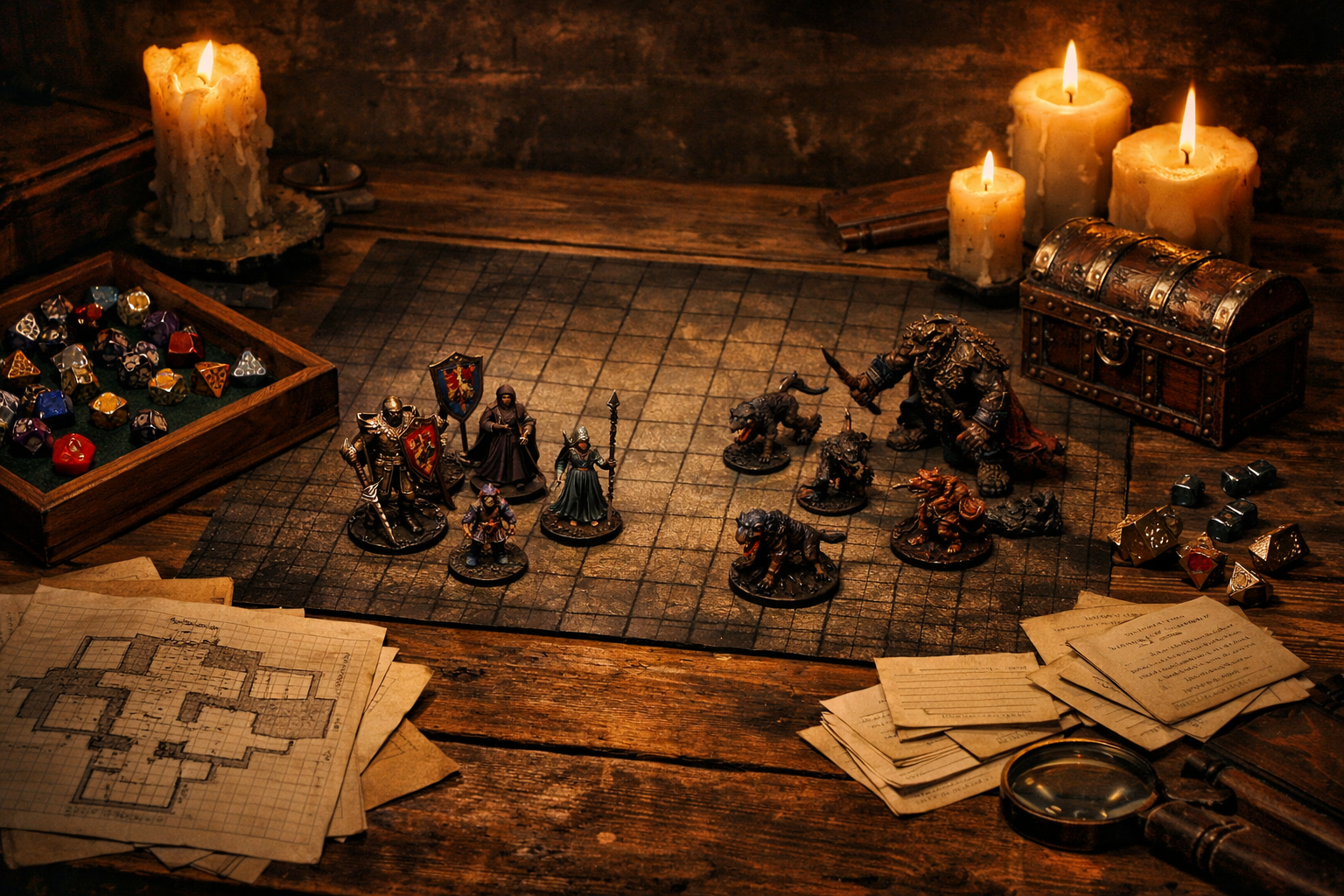
Equip your table with the right props, maps, tools, and accessories to bring dungeon crawls to life and keep players immersed in underground exploration.
Dungeon crawls do not require a table covered in miniatures, terrain, props, timers, and specialty accessories.
At their core, they require the same things as other Dungeons & Dragons sessions:
- Access to the rules you are using
- Character information
- A way to resolve dice rolls
- Adventure or location notes
- A way to track changing information during play
Everything else should solve a problem.
A map can clarify complicated space.
Tokens can make tactical positioning easier to understand.
Condition markers can prevent forgotten effects.
A handout can communicate information better than a long verbal description.
Lighting and music can reinforce atmosphere when the group enjoys them.
The useful question is not:
What should every Dungeon Master buy?
It is:
What would make this dungeon easier to understand, run, or enjoy at my table?
This guide separates practical dungeon-crawl tools from optional immersion props so you can build a toolkit around the way your group actually plays.
Start With the Minimum Toolkit
Before buying specialized dungeon accessories, make sure the basic game is covered.
A minimal in-person toolkit might include:
- Rules access
- Character sheets
- Dice or a digital roller
- Pencils or another note-taking method
- Current-session notes
- Creature statistics
- A way to track combat when necessary
That may be enough.
For online play, the equivalent might be:
- Voice or video communication
- Digital character sheets
- A dice roller
- Shared notes
- A virtual tabletop or simple image-sharing tool if spatial information matters
You do not need a battle mat, miniatures, timer, dice tower, DM screen, soundtrack, or handmade props to run a dungeon crawl.
Add those tools when you know what problem they are solving.
Mapping and Spatial Tools
Dungeon crawling often makes location and navigation important.
That makes maps one of the most commonly useful tools, but there are several ways to handle them.
Graph Paper
Graph paper is inexpensive and flexible.
Dungeon Masters can use it to:
- Sketch layouts
- Track room connections
- Design simple battle areas
- Record changes to the dungeon
Players can use it to:
- Maintain a navigation map
- Mark unexplored routes
- Record traps or hazards
- Note landmarks
- Track shortcuts
A player exploration map does not need architectural precision.
Boxes, lines, arrows, and labels may be enough.
If you are using a tactical square grid under current D&D rules, each square represents 5 feet.
That does not mean every player-created exploration map needs to reproduce the dungeon at 5-foot scale.
Navigation maps and battle maps solve different problems.
Pencils, Erasers, and Scratch Paper
Simple writing tools remain some of the most useful items at the table.
Scratch paper can track:
- Initiative
- Temporary Hit Points
- Monster damage
- Clues
- Names
- Room numbers
- Improvised details
Do not underestimate disposable notes.
Not every piece of campaign information needs to enter a permanent database during the session.
Record the important information afterward.
Reusable Battlemats
A reusable battlemat can be useful when exact positioning matters.
It can show:
- Walls
- Doors
- Cover
- Hazards
- Elevation
- Creature positions
- Difficult terrain
Before using markers, check the manufacturer's instructions for the specific mat.
Some surfaces are intended for wet-erase markers.
Others may support different marker types.
Using an incompatible marker can permanently damage the surface.
You do not need several marker colors.
If you use color, combine it with labels, shapes, or symbols so important information does not depend on color vision alone.
Dungeon Tiles
Modular tiles can provide a middle ground between drawing everything and building elaborate terrain.
They can be useful for:
- Chambers
- Corridors
- Intersections
- Stairs
- Doors
- Modular encounter areas
Tiles work particularly well when the dungeon is:
- Procedurally generated
- Improvised
- Revealed room by room
Their disadvantage is setup and storage.
If assembling the dungeon takes longer than drawing it, the tool may not be helping.
Virtual Tabletops
A VTT can provide some combination of:
- Maps
- Tokens
- Initiative
- Dice
- Character information
- Measurement
- Fog of war
- Lighting
- Handouts
- Notes
Capabilities vary by platform and configuration.
Do not assume every VTT automatically handles dynamic lighting, visibility, conditions, or automation.
Test the features you intend to use before the session.
For in-person groups, a VTT can also be displayed on:
- A television
- A monitor
- A tablet
- A projected surface
Use the technology when it improves clarity.
Do not build the session around complicated software you have not tested.
Miniatures, Tokens, and Position Markers
Miniatures can make tactical situations easy to understand.
They are not required.
Miniatures
Miniatures can represent:
- Player characters
- Enemies
- NPCs
- Summoned creatures
- Important objects
Painted miniatures provide visual atmosphere.
Unpainted miniatures work mechanically just as well.
You also do not need the exact miniature for every creature.
A generic figure can represent a guard.
A larger figure can stand in for an ogre.
A distinctive token can represent a boss.
The purpose is shared spatial understanding.
Tokens
Tokens are often cheaper and easier to store than miniatures.
Possible substitutes include:
- Numbered discs
- Coins
- Wooden pieces
- Cardboard tokens
- Paper circles
- Spare dice
- Printed creature tokens
Numbered tokens are particularly useful when several identical enemies are present.
Instead of:
Which goblin did I hit?
the table can say:
Goblin 3.
That small distinction can reduce combat confusion.
Paper Standees
Paper standees provide more visual presence than flat tokens while remaining inexpensive.
They can be:
- Printed
- Cut from cardstock
- Placed in reusable plastic bases
They are useful when you want a large variety of creatures without maintaining a large miniature collection.
Initiative and Combat Tracking
Combat often creates several simultaneous pieces of information.
Good tracking reduces the amount the DM must remember.
Initiative Trackers
Possible initiative systems include:
- Paper lists
- Index cards
- Folded name tents
- Clothespins
- Magnetic boards
- VTT trackers
- Campaign applications
A visible tracker can help players know when their turn is approaching.
That may make it easier to prepare decisions.
Visibility is optional.
A DM can also track initiative privately if that works better for the table.
The important part is consistency and clarity.
Index Cards
Index cards are one of the most versatile low-cost tools available.
They can hold:
- Initiative
- NPC information
- Creature reminders
- Clues
- Magic items
- Conditions
- Temporary rules notes
- Player handouts
You can also use them for dungeon areas.
For example:
Flooded Chapel
- Deep water near east wall
- Two exits
- Bell rope
- Cult symbol
- Footprints north
That is enough information to run the space without searching through paragraphs of notes.
Condition Markers
Conditions become easy to forget during a busy combat.
Markers can represent:
- Poisoned
- Frightened
- Restrained
- Stunned
- Invisible
- Concentration
- Other ongoing effects
Possible tools include:
- Rings
- Tokens
- Cards
- Clips
- Miniature-base markers
- Digital indicators
Avoid relying solely on color.
A red ring and green ring may be difficult to distinguish for some players.
Use:
- Text
- Symbols
- Shapes
- Labels
alongside color where practical.
Resource Tracking
Some dungeon crawls emphasize limited resources.
Others barely track them.
Do not add resource counters merely because the adventure takes place underground.
Track resources when scarcity produces meaningful decisions.
Light
Current D&D rules give several light sources specific durations.
For example, a torch burns for one hour of game time.
If that matters to your dungeon, track fictional elapsed time, not real-world table time.
A one-hour torch should not burn out because the players spent an hour discussing rules, ordering food, or role-playing a conversation that represented five fictional minutes.
Possible light trackers include:
- Written time records
- Tokens
- A clock diagram
- Check boxes
- VTT effects
If the party has reliable magical illumination, mundane torch scarcity may not matter at all.
Do not manufacture scarcity around a resource the characters have already solved.
Consumable Tokens
Physical tokens can represent:
- Torches
- Rations
- Ammunition
- Potions
- Special expedition supplies
This can make quantities easy to see.
It is optional.
A number written on a character sheet communicates the same mechanical information.
Use physical counters if the tactile representation helps your group remember or reason about the resource.
Spell Slot Trackers
Some players enjoy using:
- Tokens
- Beads
- Cards
- Dice
- Digital trackers
to represent spell slots or other limited-use abilities.
Others prefer the character sheet.
Resource tracking is primarily a player responsibility unless the system or table arrangement assigns it differently.
The DM does not need to maintain duplicate records of every player's remaining spell slots.
Hit Point Tracking
Players normally track their own Hit Points.
The Dungeon Master tracks creatures they control.
Some groups voluntarily make party Hit Points publicly visible.
Others prefer exact values to remain on individual character sheets.
Either can work.
Do not expose exact party Hit Points merely so the Dungeon Master can secretly tune encounter difficulty around them.
Encounter consequences should arise from the rules and situation rather than constant behind-the-scenes correction toward a desired difficulty.
Time Tracking
Dungeon time can matter.
But a real-world countdown timer and an in-game clock are different tools.
Tracking Fictional Time
Track fictional time when it affects:
- Light duration
- Patrol movement
- Rituals
- Environmental changes
- Spell durations
- Rest opportunities
- Faction activity
Methods include:
- Written timestamps
- Check boxes
- Exploration turns if your table uses them
- Clock diagrams
- Tokens
The method matters less than consistency.
Players should understand when spending time changes the dungeon.
Real-World Timers
A kitchen timer, phone timer, or sand timer can be useful when the table has intentionally agreed to a real-world deadline.
Examples might include:
- A timed puzzle
- A special convention scenario
- A deliberate speed challenge
Use these sparingly.
Do not automatically impose a five-minute timer on a combat turn.
Players differ in experience, processing speed, accessibility needs, and character complexity.
If combat decisions are taking too long, first identify why.
The problem may be:
- Rules confusion
- Too many options
- Unclear battlefield information
- Distraction
- Character-sheet organization
A timer is one possible solution, not the default.
Dungeon Master Screens and References
A DM screen is optional but can be useful.
It provides:
- Privacy for unrevealed information
- A place for references
- A place to attach notes
- Protection for hidden maps
Useful Screen Information
Instead of filling the screen with every available table, include information you actually use.
Possible references include:
- Conditions
- Common actions
- Light information
- Current NPC names
- Faction reminders
- Dungeon-specific procedures
- House rules
The 2024 Dungeon Master's Guide also includes tracking sheets and practical tools for maintaining information during play.
Use references to reduce lookup time.
Do not turn the screen into another wall of information you never read.
Binders, Folders, and Digital Notes
Organization is often more valuable than expensive props.
Session Binder
Keep current-session material together.
Possible sections include:
- Dungeon overview
- Current level
- NPCs
- Creature statistics
- Maps
- Clues
- Handouts
- Treasure
- Rules references
Archive older material elsewhere.
The goal is to avoid searching through an entire campaign while running one room.
Sheet Protectors
Sheet protectors can allow temporary annotation without writing directly on printed material.
Before using markers, test them on the protector.
Different plastics and marker types behave differently.
Digital Session Dashboard
A digital equivalent might contain links or sections for:
- Current map
- NPCs
- Encounters
- Rules
- Clues
- Initiative
- Campaign notes
Keep the number of applications manageable.
Six excellent apps can still produce a terrible workflow when you constantly switch between them.
Atmospheric Props
Immersion tools can be effective when the group actually enjoys them.
They are enhancements, not prerequisites.
Lighting
Dimmable lighting can help establish mood.
Flameless LED candles are usually more practical than open flames around:
- Paper
- Books
- Maps
- Miniatures
- Drinks
- Fabric
Make sure everyone can still:
- Read character sheets
- See dice
- Navigate the room safely
Darkness that makes the real game difficult to use is not useful atmosphere.
Also consider visual accessibility.
Some players may need brighter lighting.
Music and Ambient Sound
Background audio can reinforce:
- Exploration
- Combat
- Horror
- Mystery
- Environmental atmosphere
Keep it below conversation level.
Ask the group whether audio helps.
Some players find continuous background sound:
- Distracting
- Overstimulating
- Difficult when processing speech
Accessibility is more important than maintaining a soundtrack.
If the game is recorded, streamed, or published, make sure your music and sound sources permit that use.
"Free to listen" does not automatically mean unrestricted reuse.
Scent
Scented candles, incense, or similar immersion props deserve particular caution.
People may have:
- Allergies
- Migraines
- Asthma
- Sensory sensitivities
Avoid scented effects unless the whole group has explicitly agreed to them.
Immersion should not create a physical barrier to participating.
Physical Handouts
Handouts can transform information into something players can inspect and retain.
Useful examples include:
- Letters
- Journals
- Partial maps
- Wanted posters
- Religious texts
- Diagrams
- Codes
- Contracts
- Drawings
- Prophecies
Make Handouts Functional
A good handout gives the players information they may want to revisit.
For example, a partially damaged map might show:
- Two known entrances
- An old chapel
- A blocked corridor
- An unexplored lower level
Players can annotate it.
That makes the prop part of decision-making rather than only decoration.
Keep Important Text Readable
Atmospheric fonts and distressed paper can become difficult to read.
Prioritize legibility.
You can create an aged appearance with:
- Printing on textured paper
- Carefully crumpling and flattening paper
- Safe staining techniques
- Digital aging effects
You do not need to burn the edges of paper.
The prop should look dangerous.
It does not need to become a fire hazard.
Do Not Hide Accessibility Behind Authenticity
If a handwritten note is difficult to read, provide a plain-text version.
If a cipher is part of the challenge, distinguish between:
- Deciphering the code
- Deciphering the Dungeon Master's handwriting
Only one of those is supposed to be the puzzle.
Treasure Props
Physical treasure can make discoveries memorable.
Possible stand-ins include:
- Decorative coins
- Plastic gems
- Keys
- Small boxes
- Sealed envelopes
- Stones
- Tokens
Use inexpensive objects.
The goal is symbolic representation.
A $1 metal key can make a future locked door memorable if the players have carried the key around for several sessions.
Item Cards
Cards are often more practical than physical replicas.
An item card can include:
- Name
- Appearance
- Known properties
- Attunement information when appropriate
- Space for discovered information
Cards also help prevent magic items from disappearing into forgotten character-sheet notes.
Puzzle Props
Physical puzzle components can work especially well in dungeon crawls.
Examples include:
- Tiles
- Rotating discs
- Symbol cards
- Fragments that assemble
- Maps
- Cipher wheels
Remember that a physical puzzle tests the players, not necessarily their characters.
Consider how character abilities can contribute.
A character with relevant knowledge might receive:
- Additional context
- A hint
- Recognition of a symbol
- Information about the mechanism
Do not make the character's expertise irrelevant simply because you brought a physical prop.
Tools for Improvisation
Not all dungeon tools are physical scenery.
Some of the most useful tools help the DM respond when players go somewhere unexpected.
Name Lists
Keep several appropriate names nearby.
Random Tables
Useful categories include:
- Dungeon dressing
- Minor discoveries
- Sounds
- NPC traits
- Treasure
- Environmental complications
Random output is input, not an instruction.
Review it before making it true.
Blank Cards
A blank card can become:
- An improvised NPC
- A newly discovered room
- An item
- A faction
- A clue
Write down what you establish.
Improvisation becomes campaign continuity once the players encounter it.
Storage and Transportation
A useful toolkit is one you can actually set up.
Possible storage solutions include:
- Small parts organizers
- Card boxes
- Miniature cases
- Binders
- Game bags
- Craft containers
Separate:
- Frequently used tools
- Current-session tools
- Long-term collection
You should not have to unload your entire hobby collection for every session.
The Dungeon Crawl Go-Bag
If you run games in several locations, a compact kit might contain:
- Dice
- Pencils
- Index cards
- Current notes
- Rules access
- Tokens
- A small reusable map if you use one
- Appropriate markers
That is enough for many games.
Everything else can remain optional.
Building Your Toolkit Gradually
Do not purchase tools because another Dungeon Master calls them essential.
Run the game first.
Then notice friction.
If Players Lose Track of the Dungeon
Try:
- A player map
- A revealed map
- Better landmarks
- A VTT
If Combat Positioning Is Confusing
Try:
- Tokens
- A grid
- Miniatures
- A simple tactical sketch
If Conditions Are Forgotten
Try:
- Cards
- Rings
- Tokens
- Digital markers
If Dungeon Resources Feel Abstract
Try:
- Physical counters
- Check boxes
- An expedition tracker
Only if those resources actually matter.
If Information Is Getting Lost
Try:
- Index cards
- A session dashboard
- Better notes
- Player handouts
If Atmosphere Feels Flat
Before buying props, improve:
- Description
- Environmental information
- NPC behavior
- Dungeon reactions
Then consider:
- Music
- Lighting
- Handouts
- Terrain
Props can reinforce atmosphere.
They cannot create meaningful dungeon design by themselves.
Integrating Tools Without Distracting From Play
Every tool has a cost.
That cost may be:
- Money
- Setup time
- Storage
- Screen space
- Maintenance
- Learning
- Attention
Ask:
Does this tool return more value than it consumes?
A detailed 3D room may look incredible.
If assembling it requires fifteen minutes while everyone waits, a quick sketch might have produced a better session.
A digital tracker may automate several rules.
If the DM spends the session troubleshooting it, paper may have been better.
A playlist may create atmosphere.
If someone must constantly search for the next track, silence may be better.
The best tools disappear into the experience.
Using The Dungeon Trainer Alongside Physical Tools
The Dungeon Trainer can handle several digital-table functions while a human Dungeon Master retains control of narration and adjudication.
Human-Run Campaigns
When the human chooses to DM, the platform can handle game state in code, including:
- Dice
- Character sheets
- Hit Points
- Conditions
- Rests
- Death saves
- XP
- Combat rounds
- Shared transcript
These controls do not require a model call.
AI can remain entirely outside the campaign unless the group chooses to add it.
Scry
Scry supports preparation by examining a scene and identifying plausible:
- Branches
- Complications
- Pacing risks
- Preparation considerations
For a dungeon encounter, this can help a DM think through possibilities such as:
- What if the party avoids the guards?
- What if they retreat?
- What if they bypass the trap?
- What happens if an alarm is raised?
It supports preparation without determining what the players must do.
The Coach
The Coach provides practice situations for Dungeon Masters and players with rubric-grounded feedback.
It can help practice:
- Adjudication
- Pacing
- Exploration decisions
- Encounter management
- Player agency
Campaign Memory
Dungeon crawls can create large amounts of campaign state.
The platform maintains searchable records related to:
- Characters
- Locations
- Quests
- Events
This complements physical maps and notes.
The map tells you where the flooded chapel is.
Campaign memory helps preserve what happened there.
Generators
The Dungeon Trainer can generate material such as:
- Monsters
- NPCs
- Locations
- Items
- Spells
Review generated material before using it.
A generated monster or room should fit the dungeon's established environment, factions, difficulty, and continuity.
Optional AI
The AI Dungeon Master is optional.
Human-run campaigns can operate without it.
AI roles can also be added intentionally for limited purposes rather than automatically controlling the table.
Use AI when it solves a problem you actually want solved.
A Practical Dungeon Crawl Toolkit by Tier
Instead of calling everything essential, it is useful to think in tiers.
Minimum Toolkit
- Rules access
- Character sheets
- Dice or digital roller
- Current session notes
- Creature statistics
- Basic note-taking supplies
Add When Spatial Complexity Requires It
- Graph paper
- Player map
- Reusable battlemat
- Tokens
- Miniatures
- VTT
Add When Tracking Becomes Difficult
- Initiative tracker
- Condition markers
- Resource counters
- Index cards
- Digital tracker
Add When Information Deserves a Physical Form
- Letters
- Maps
- Item cards
- Puzzle pieces
- Diagrams
Add When the Group Enjoys More Atmosphere
- Music
- Ambient sound
- Adjustable lighting
- Decorative props
- Terrain
This approach keeps accessories connected to actual needs.
Final Recommendations
If you are starting from nothing, do not begin by purchasing a full dungeon-master workstation.
Begin with:
- Rules
- Dice
- Notes
- Characters
- An adventure
Run the session.
Then ask:
- What was hard to communicate?
- What was difficult to track?
- What information kept disappearing?
- Where did setup slow us down?
- What would have improved clarity?
Solve those problems.
If a rough sketch worked, you do not need expensive terrain.
If coins worked as monsters, you do not need fifty miniatures.
If everyone understood conditions, you do not need status rings.
If theater of the mind worked, you do not need a battlemat.
And if your group loves painted miniatures, handmade letters, dungeon tiles, lighting, and atmospheric sound?
Use them.
The point is not minimalism for its own sake.
The point is intentionality.
A Dungeon Master's toolkit should support:
- Clear communication
- Reliable rules resolution
- Useful information
- Meaningful decisions
- Smooth table management
- The type of atmosphere your group enjoys
The best prop is not the most expensive one.
It is the one that improves the game enough that everyone notices the adventure rather than the tool.
Sources and Further Reading
- Alexander, J. (2010). Xandering the Dungeon. The Alexandrian.
- Dyson Logos. (n.d.). Dyson's Dodecahedron: Maps.
- Shea, M. E. (2018). Return of the Lazy Dungeon Master. Sly Flourish.
- Wizards of the Coast. (2024). D&D Free Rules. D&D Beyond.
- Wizards of the Coast. (2024). Dungeon Master's Guide.
- Wizards of the Coast. (2025). System Reference Document 5.2.1.
- The Dungeon Trainer. (2026). The Dungeon Trainer.
---
Build a dungeon toolkit around the way your table actually plays. The Dungeon Trainer supports human Dungeon Masters with code-resolved mechanics, campaign continuity, shared transcripts, Scry preparation, coaching, generators, and optional AI. Pair those digital tools with maps, tokens, handouts, terrain, or nothing more than a notebook, depending on what helps your group play.
This work includes material from the System Reference Document 5.2.1 (“SRD 5.2.1”) by Wizards of the Coast LLC, available at https://www.dndbeyond.com/srd. The SRD 5.2.1 is licensed under the Creative Commons Attribution 4.0 International License, available at https://creativecommons.org/licenses/by/4.0/legalcode.
Related reading
- Why Megadungeons Succeed or Fail: Lessons from Forty Years of Play
Megadungeons have persisted since the earliest days of tabletop roleplaying, yet many campaigns abandon them within a few sessions. Learn what structural, pacing, and preparation factors separate sustainable megadungeons from those that collapse, and how to apply those lessons at your own table.
- Understanding the Megadungeon: What It Is and When to Use It
A megadungeon is more than a big dungeon. Learn what defines this sprawling adventure structure, why it persists across decades of play, and when it serves your table better than episodic adventures.
- Running Sandbox Campaigns: Six Months with The Millbrook Consortium
Sandbox campaigns promise player-driven freedom but demand different preparation and facilitation techniques. This case study examines six months of running The Millbrook Consortium, a merchant-focused sandbox, to identify practical lessons about faction management, player agency, and sustainable open-world play.