Encounter Pacing Explained: The Rhythm of Tension and Release at the Table
Written with AI. An AI model drafted this article. How we use AI
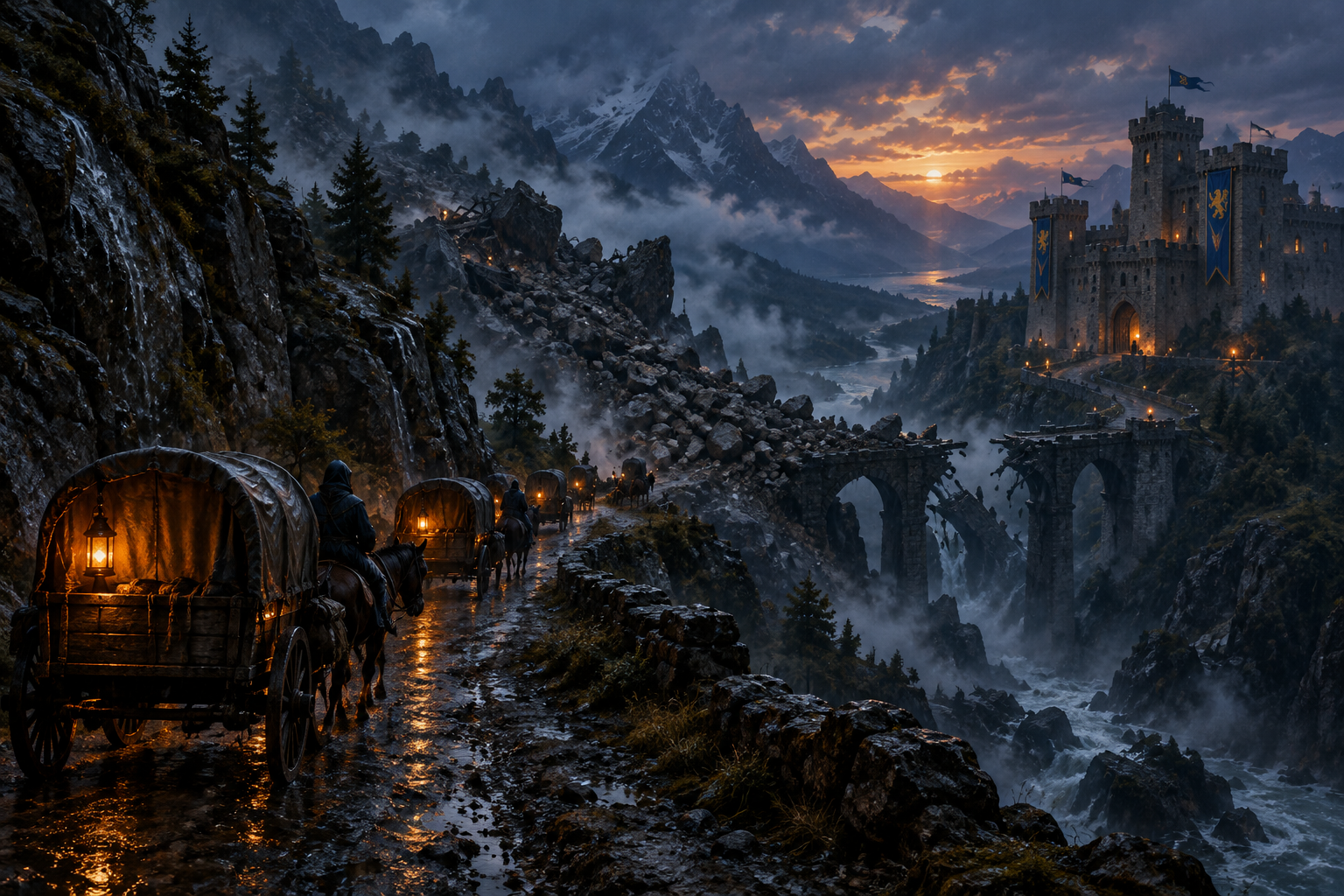
In this article, 'encounter pacing' means the rhythm of tension, release, and rest across a session. Learn what it is, how it differs from combat speed, and how to see it at your own table.
Many tabletop groups eventually run into the same quiet problem. Nothing is technically wrong. The rules were followed, the monsters were interesting, and everyone showed up. Yet the session felt flat in the middle, or exhausting from start to finish, or strangely over before it started. Often the culprit is not any single scene. It is the order, spacing, and weight of the scenes taken together. That arrangement is what this article calls encounter pacing.
This is a concept explainer. It defines the term, separates it from look-alike ideas, walks through the parts that make up a session's rhythm, and gives you ways to notice pacing at your own table. It does not try to hand you a formula, because pacing is largely a matter of table preference and group temperament.
What Encounter Pacing Means
In this article, 'encounter pacing' means the rhythm of tension, release, and rest across a session. More concretely, it is the deliberate or accidental shaping of how intense, how long, and how frequent the challenging moments of a session are, and what happens in the spaces between them. An "encounter" here is any bounded moment of challenge: a fight, a negotiation, a trap, a chase, a tense conversation with a suspicious gatekeeper. "Pacing" is the tempo and spacing of those moments.
A useful way to picture it is as a line drawn across the evening. High points are moments of danger, decision, or high stakes. Low points are rest, exploration, banter, or planning. Pacing is the shape of that line.
Justin Alexander argues that a game master controls pacing through how they respond to players' choices, mainly by skipping the 'empty time' between one meaningful choice and the next (Alexander, 2013). The Angry GM separates the pace a scene should move at from 'flow', the speed at which play actually lets it happen, which includes not stopping to check the rulebook unless necessary (The Angry GM, 2016a). Both offer practical techniques, which suggests pacing is something a game master can work on.
What Encounter Pacing Is Not
Because the word "pace" is used loosely, it helps to separate a few neighboring ideas. Mixing them up may be one reason advice about pacing can feel contradictory.
It is not the same as combat speed
Combat speed is how quickly a single fight resolves in real time: how long turns take, how fast people look up their abilities, how smoothly initiative flows. A fight can be fast and still badly placed in the session. Encounter pacing asks a wider question: given that fight, what came before it, what comes after it, and how did it feel in the context of the evening?
Michael Shea has written about practical ways to track initiative, damage, conditions, and monster positions during combat (Shea, 2022). That is a combat-speed concern. Pacing sits one level above it.
It is not the same as encounter difficulty
Difficulty is how dangerous a challenge is. Pacing is when and how often danger arrives. A deadly encounter at the climax of an evening and the same deadly encounter as the third surprise of an already exhausting night are identical in difficulty and very different in pacing.
For design guidance on difficulty and balance specifically, official materials exist. D&D Beyond's guidance on building combat encounters with the 2024 Dungeon Master's Guide and Monster Manual addresses how to assemble fights (Barker, 2025). That topic is adjacent to pacing but is a separate subject from how a session's rhythm is shaped.
It is not the same as session length
A short session can be well paced and a long one badly paced. Length is how much time you have. Pacing is how you spend it.
It is not the same as story structure
Story structure concerns plot: setup, rising action, resolution. Pacing concerns the felt tempo of play. The two interact, but a table playing a sandbox with no planned plot still has pacing, because the moments of challenge and rest still fall in some order.
The Building Blocks of a Session's Rhythm
It is easier to talk about pacing once you can name its parts. Here these are descriptive labels, not rules terms. They name things most tables experience.
Intensity
Intensity is how much attention, risk, and emotional investment a moment demands. A tense standoff is high intensity. Browsing a market is low. Many tables find that variety in intensity helps a session, though how much variety is a matter of taste.
Duration
How long does a moment last? A scene that overstays its welcome lowers its own impact. A scene that ends too early can feel unearned. Duration is partly about the clock and partly about whether the scene has delivered what it promised.
Spacing
Spacing is the gap between high-intensity moments. Too little spacing and players have no time to breathe, plan, or care about consequences. Too much and momentum drains away. Alexander describes pacing as handling the 'empty time' between meaningful choices, which is closely related to spacing (Alexander, 2013).
Escalation
Escalation is the tendency for stakes to rise across a session or an arc. Escalation can be steady, stepped, or sudden. Not every session needs it, but some players enjoy a sense that the evening is building toward something.
Release
Release is the relief after tension: a won fight, a solved puzzle, a safe camp. Release is what makes the next tension feel meaningful. A session that is all tension and no release can feel numbing, while one that is all release can feel weightless.
Resource attrition
In games where characters have limited resources that recover only with rest, the order and number of encounters affect how those resources are spent. Rest rules vary between games, and tables handle resting differently. For discussion of how a group might manage rest in practice, see Shea (2021a), who treats resting as a table-management decision. Whether to treat rest strictly or loosely is table preference.
Why Pacing Is Hard to See
Pacing can be hard to judge from inside a session; Alexander calls it 'ephemeral, subjective, and devilishly difficult to get a grip on' (Alexander, 2023). Several things get in the way.
First, game masters are busy. Tracking rules, voicing characters, and watching the clock leaves little attention for noticing the overall shape of the evening.
Second, players experience pacing differently. One player may crave long tactical fights while another is waiting for dialogue. A pace that feels brisk to one person can feel rushed to another.
Third, pacing problems are often described as moods rather than causes. Players say "that dragged" or "that felt rushed" without being able to point to a specific scene. Reading pacing means translating moods back into structural observations about intensity, duration, and spacing.
Common Pacing Patterns
The following patterns are descriptive, not prescriptive. They are shapes a session might take, and none is universally correct. Which feels best is a matter of table preference.
The steady climb
Each challenge is a little harder or higher-stakes than the last, ending in a peak. This shape gives a clear sense of progress and suits tables that enjoy a building story.
The wave
Tension rises and falls repeatedly, with several small peaks and quiet valleys. This shape gives players frequent breathing room and can suit longer sessions.
The front-loaded session
The biggest challenge arrives early and the rest of the evening is aftermath, exploration, or planning. This can work well when the early scene is the point of the night, but it can leave the end of the session feeling quiet.
The slow burn
Long stretches of low intensity lead to a late, sharp spike. This shape rewards patience and works for investigation and atmosphere, but it depends on the quiet stretches being engaging in their own right.
The grind
Encounter follows encounter with little release between them. This is sometimes intentional, as in a siege or a forced march, but when it happens by accident it can read as fatigue.
Pacing and the Three Modes of Play
The 2024 D&D rules call social interaction, exploration, and combat the three main pillars of play (Wizards of the Coast, 2024a). Some tables find that moving between these modes helps pacing, though a table that loves one mode may prefer to stay there.
The point is not that every session needs a third of each. The point is that switching modes is itself a pacing tool. A tense negotiation after a fight, or a quiet exploration beat after a social scene, changes the kind of attention players are using, and that change can feel like release even when the stakes remain high.
Pacing in Different Kinds of Games
Pacing looks different depending on the structure of the game.
In a dungeon-focused game, pacing tends to be tied to the layout and contents of the space. How rooms are sequenced and what each one asks of players shapes the rhythm.
In an investigation-style game, pacing often depends on the delivery of information. Alexander's Three Clue Rule is a technique for making sure an investigation does not stall for lack of leads, which is a pacing safeguard as much as a design one (Alexander, 2008).
In a sandbox or open-world game, the game master has less control over order, so pacing is partly shaped by what the players choose to do and partly by how the world responds. Alexander argues against over-preparing plots and in favor of preparing situations (Alexander, 2009), which affects how much a game master can plan the rhythm in advance. Some tables will find that liberating, others will find it unmoored. That is preference.
In one-shot or convention-style games, the whole arc is compressed, so pacing can be more visible and less forgiving. Wizards of the Coast has published short adventures for the 2024 Dungeon Master's Guide that illustrate compact structures (Wizards of the Coast, 2024b).
How Pacing Differs From Cognitive Load and Information Delivery
It is easy to confuse a session that drags with a session that overwhelms. They can feel similar from the outside, since in both cases players disengage, but the causes differ.
In this article, 'cognitive load' means how much information and decision-making players must keep track of at once. A session can be perfectly paced in terms of intensity and spacing and still overload players with names, numbers, and options. The reverse is also possible.
When diagnosing a session that felt off, it helps to ask separately: was it the rhythm of challenge and rest, or was it the amount of information people had to track? The fixes differ.
Reading Pacing at Your Own Table
You do not need a special system to start noticing pacing. The following questions are observational prompts. They are not rules, and they will not give you a score.
- Where did energy rise? Think of the moments people leaned in, spoke over each other, or went quiet with focus.
- Where did energy dip? Note moments of checking phones, side conversations, or long silences that were not thoughtful ones.
- What came before each peak? Was there enough lead-up for the moment to land?
- What came after? Was there time to react, or did the next challenge start immediately?
- How did the end feel? Did the session close on a peak, a valley, or a plateau, and was that deliberate?
Keeping a short note after each session, even a few lines, can reveal patterns across weeks. A game master who notices that sessions repeatedly end on a dip may choose to move a strong scene later. One who notices repeated grind may add a deliberate breather. Whether any change is warranted depends on what the table wants.
Pacing Is a Shared Responsibility
It is tempting to treat pacing as solely the game master's job. In practice, players shape it too. A group that debates at length before every door changes the rhythm of the evening. So does a player who keeps the group moving with clear decisions.
Session zero, the conversation before a campaign begins, is a natural place to talk about preferred tempo, such as whether the group likes long tactical fights or quick resolutions. D&D Beyond and Sly Flourish have both published guides on running one (Haeck, 2024; Shea, 2021b). The takeaway here is simply that tempo preferences are legitimate things to discuss out loud.
Rest, Downtime, and the Space Between Scenes
A great deal of pacing happens in the unglamorous gaps. How a game master handles travel, shopping, resting, and transitions often determines whether the high points feel earned.
There is a real tension here. Skipping transitions keeps momentum but can make the world feel thin. Lingering on them builds texture but can sap energy. Shea discusses how a game master might handle rests in a way that supports the session's flow (Shea, 2021a), and Alexander offers a related discussion aimed at newer game masters (Alexander, 2023). Neither is a universal rule. They are options for tables to weigh.
A practical way to think about transitions: each one should either deliver something (information, character moment, mood) or be skipped. A transition that does neither is a candidate for compression.
Example: The Lantern Road Company
The following is an illustrative scenario, not a report of a real game. It exists only to show the concepts above in motion.
Imagine a four-character group, the Lantern Road Company, escorting a wagon of lamp oil along a rain-slick mountain road to a besieged border keep. The game master has prepared four challenges: a rockslide that blocks the road, a negotiation with wary toll-keepers at a ruined bridge, an ambush by hired raiders in a narrow pass, and a tense arrival at the keep where the garrison captain may or may not be trustworthy.
Consider two ways the evening could unfold.
Version one: the grind. The rockslide is resolved with a series of skill checks that take half an hour. The toll-keeper negotiation follows immediately, and then the ambush begins before anyone has had a moment to react to the negotiation's outcome. By the time the company reaches the keep, the group is tired, and the captain's reveal, which was meant to be the emotional peak, lands softly. Each encounter was individually fine. The spacing was the problem: no release, no breathing room, and the final scene had to compete with accumulated fatigue.
Version two: the wave. The game master compresses the rockslide into a short, vivid scene, then lets the company camp for a moment of quiet conversation, which gives players a chance to voice their characters' worries about the keep. The toll-keeper negotiation becomes a slow, atmospheric scene with real choices. The ambush is placed after a deliberate lull, so its sudden violence has contrast. The arrival at the keep opens a fresh kind of tension. Same four encounters, different spacing and duration, and a very different felt rhythm.
Notice what changed and what did not. The difficulty of the ambush is identical in both versions. The content is identical. What changed was intensity variety, duration of the early scenes, and the presence of release before the finale. That is encounter pacing in miniature.
A different table might prefer the first version, perhaps because they relish relentless pressure. The example is not an argument that one shape is right. It is a demonstration that the shape is a variable you can see and adjust.
Pacing Tools Worth Knowing About
Several established techniques give a game master levers over rhythm. They are described here as ideas, not endorsed procedures.
- Scene framing. Deciding where a scene starts and ends is a major pacing tool; some game masters prefer to start scenes late and end them early, while other tables prefer fuller scenes. The Angry GM has written about knowing when to stop narrating (The Angry GM, 2025).
- Timing devices. Some game masters use visible timers, countdowns, or pools of tension to modulate urgency. The Angry GM has published a detailed guide to one such device (The Angry GM, 2021). Whether such devices suit your table is a matter of preference.
- Prepared flexibility. Preparing modular material that can be moved around lets a game master adjust rhythm on the fly.
- Episode structure. Thinking of a session as a self-contained episode with its own beginning, middle, and end can help. The Angry GM has written about structuring sessions this way (The Angry GM, 2016b).
- Evocative description. Alexander argues that a handful of evocative images works better than lengthy description for immersing players (Alexander, 2017).
Common Misunderstandings
"Good pacing means fast pacing." Not necessarily. Pacing is about fit. A slow, atmospheric scene can be perfectly paced, and a rushed one can be badly paced.
"Every session needs a big climax." Many do, but some tables enjoy sessions that end quietly or on an open question. That is preference.
"Pacing is something you fix with encounter math." Balancing difficulty is a separate concern. Pacing is about arrangement across the session.
"If players are bored, the game master failed." Players can be disengaged for reasons unrelated to pacing, such as fatigue, tangled information, or mismatched expectations. Treat disengagement as a prompt to investigate, not a verdict.
"There is one correct rhythm." There is not. Much published GM advice reflects the experience and preferences of individual authors. Treat it as a menu.
A Note on Tools
If you like to review sessions after the fact, a simple log helps. Some groups keep notes in a shared document, and some use campaign-management software. Nothing in this article depends on any particular tool. A pen and a few lines of notes work just as well.
Putting the Concept to Work
If you take only a few ideas from this explainer, make them these.
- Pacing is the shape of intensity, duration, spacing, escalation, and release across a session.
- It is distinct from combat speed, difficulty, session length, story structure, and cognitive load, though it interacts with all of them.
- Players and game masters both shape it.
- Pacing problems are often described as moods rather than causes, so translating "that dragged" into "which scene, and why" is the real skill.
- No single rhythm is correct. Table preference decides.
The next time a session feels off, resist the urge to blame a single scene. Sketch the line of the evening, mark the peaks and valleys, and ask whether the shape matched what your table wanted. That small habit is the foundation of every more advanced pacing technique.
Sources and Further Reading
- Alexander, J. (2008, May 8). The Three Clue Rule. The Alexandrian. https://thealexandrian.net/wordpress/1118/roleplaying-games/three-clue-rule
- Alexander, J. (2009, March 23). Don't Prep Plots. The Alexandrian. https://thealexandrian.net/wordpress/4147/roleplaying-games/dont-prep-plots
- Alexander, J. (2013). The Art of Pacing. The Alexandrian. https://thealexandrian.net/wordpress/31509/roleplaying-games/the-art-of-pacing
- Alexander, J. (2017, September 4). Random GM Tip: Evocative Descriptions. The Alexandrian. https://thealexandrian.net/wordpress/39227/roleplaying-games/random-gm-tips-evocative-descriptions
- Alexander, J. (2023, May 30). Pacing for the Beginning GM. The Alexandrian. https://thealexandrian.net/wordpress/49547/roleplaying-games/pacing-for-the-beginning-gm
- Barker, D. (2025, February 4). Creating Combat Encounters Using the New Dungeon Master's Guide and Monster Manual. D&D Beyond.
- Haeck, J. (2024, March 11). How to run a Session 0 for your D&D game. D&D Beyond. Original work published January 8, 2021.
- Shea, M. E. (2021a, February 15). Manage Rests. Sly Flourish. https://slyflourish.com/handling_rests.html
- Shea, M. E. (2021b, April 5). Running session zeros. Sly Flourish. https://slyflourish.com/runningsessionzeros.html
- Shea, M. E. (2022, March 7). Tracking Combat in D&D. Sly Flourish.
- The Angry GM. (2016a, March 23). Keeping pace. The Angry GM.
- The Angry GM. (2016b, June 8). When episodes ain't episodes: How to structure a session. The Angry GM.
- The Angry GM. (2021, September 15). The Angry GM's Tension Pool: A Comprehensive, Definitive, Final Guide. The Angry GM.
- The Angry GM. (2025, July 31). When to stop narrating. The Angry GM.
- Wizards of the Coast. (2024a). D&D Beyond Basic Rules: Playing the Game. D&D Beyond. https://www.dndbeyond.com/sources/dnd/br-2024/playing-the-game
- Wizards of the Coast. (2024b, November 4). Journey through these 5 short adventures in the 2024 Dungeon Master's Guide. D&D Beyond. https://www.dndbeyond.com/posts/1848-journey-through-these-5-short-adventures-in-the
Play 5E at your own table
Play with friends or solo, run your own campaign, and keep the dice and character math in code. An optional AI Dungeon Master can run the game when you want one. Free to start, no card required.
Related reading
- Linear, Clustered, or Looping: Three Ways to Shape a Session's Rhythm
Three ways to lay out a session's scenes, using working labels, produce three very different rhythms. This comparison weighs linear, clustered, and looping structures and when each one tends to fit.
- The Session Pacing Toolkit: Checklists, Templates, and Table-Side Aids
A practical toolkit of pacing aids for game masters: a scene ledger, a beat map, a timing grid, and table-side prompts for keeping a session's rhythm without overthinking it.
- Designing Rhythm Into a Session: A Design Perspective on Tension, Release, and Spacing
Rhythm is a design decision, not a happy accident. This design-perspective essay looks at intensity, contrast, duration, and placement as materials a game master can shape before play begins.