Dungeon Crawl vs. Exploration Adventure: Which Structure Works Best?
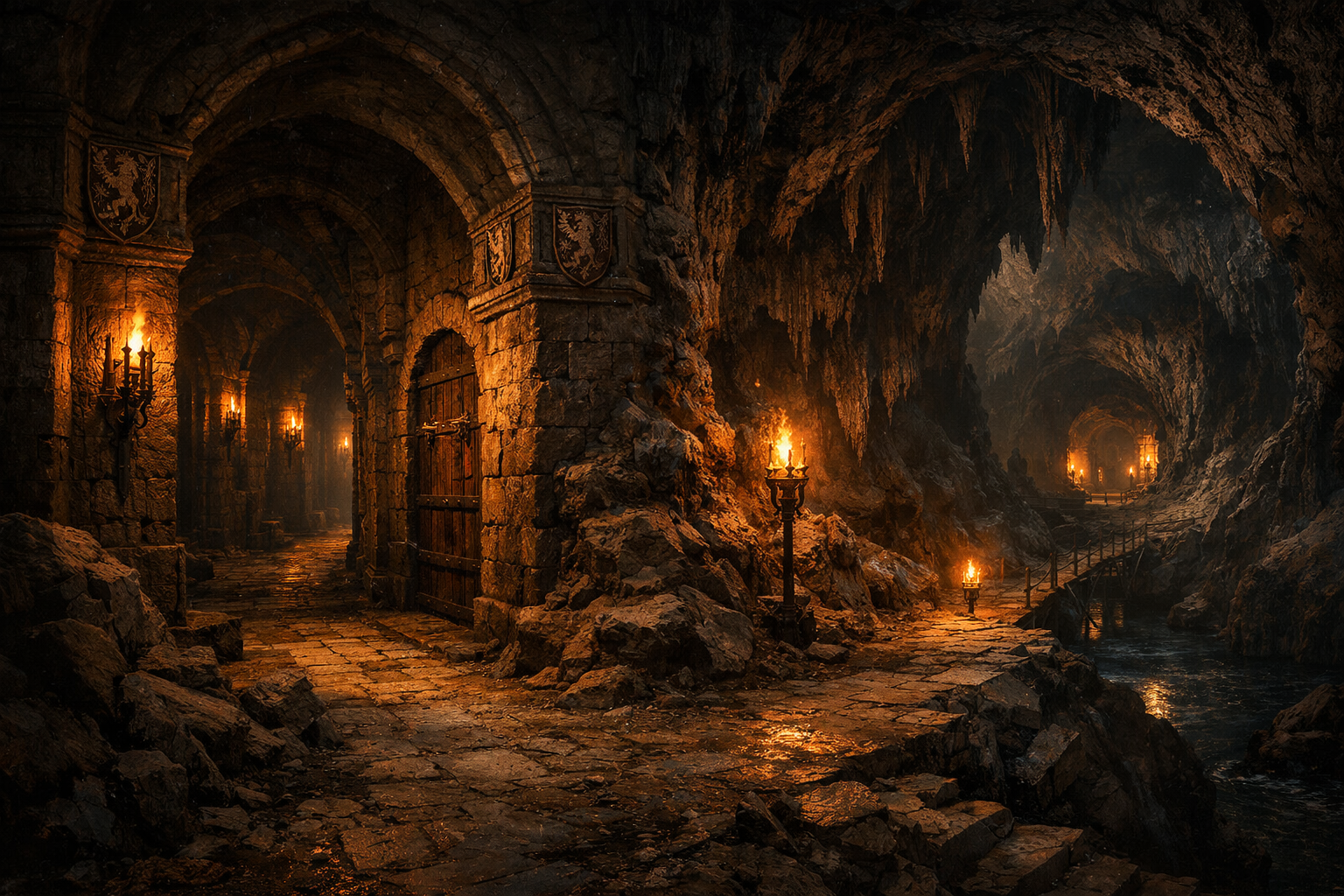
Dungeon crawls and exploration adventures both emphasize discovery, but they use different pacing, constraints, and rewards. Understand the strengths of each structure to choose the right approach for your table.
Exploration is not one single style of tabletop play.
A party opening doors inside a ruined fortress is exploring.
So is a group crossing an unmapped swamp, sailing between strange islands, navigating a lost city, or choosing which ancient sites to investigate across a frontier.
The difference lies in how that exploration is structured.
A dungeon crawl usually organizes exploration around a dense, bounded location whose rooms, routes, inhabitants, hazards, and discoveries are closely connected.
Broader exploration structures operate at a larger scale. Characters may travel between settlements, landmarks, wilderness regions, islands, ruins, factions, or other points of interest while choosing where to go and what to pursue.
Neither structure is inherently more open, more tactical, more narrative, or more player-driven.
Both can support substantial agency.
Both can become railroaded.
Both can use detailed resource management.
Both can be run lightly.
The useful question is not:
Which one is better?
It is:
What kind of decisions do you want exploration to produce right now?
This guide compares dungeon crawls with broader exploration adventures, explains where each structure excels, and shows how they can work together within the same campaign.
First, Define the Comparison
"Exploration adventure" is not a single standardized tabletop RPG structure.
For this article, the term refers broadly to adventures in which exploration occurs across a larger geographic or conceptual area rather than primarily room by room inside one dense location.
That may include:
- Hexcrawls
- Wilderness expeditions
- Point-to-point exploration
- Island or archipelago exploration
- Large underground wilderness areas
- Regional sandboxes
- Planar journeys
- Exploration between known and unknown landmarks
Some investigations can also feel exploratory, but they often use a different underlying structure.
For example, an urban investigation may connect:
- A witness
- A warehouse
- A noble family
- A criminal organization
- A tavern
- A murder scene
Those nodes may be connected primarily by clues, not geography.
That is closer to node-based investigation design than a traditional geographic crawl.
The terminology matters because different structures create different default decisions for players.
What Is a Dungeon Crawl?
A dungeon crawl is a location-based exploration structure.
The characters explore a relatively dense environment made up of connected areas.
Those areas might be:
- Rooms
- Corridors
- Caverns
- Platforms
- Streets inside a ruined district
- Ship compartments
- Temple chambers
- Sewers
- Fortifications
Despite the name, the dungeon does not need to be underground.
A haunted mansion can be a dungeon crawl.
So can a derelict starship.
A sprawling fortress can be one.
The defining characteristic is that players interact with the environment at a relatively detailed spatial scale.
A common default decision is:
Where do we go next?
The answer might be:
- Open the western door
- Descend the stairs
- Investigate the side chamber
- Take the secret passage
- Retreat to the entrance
- Bypass the occupied hall
- Return to an earlier junction
The geography itself becomes part of play.
What Is a Broader Exploration Adventure?
Broader exploration operates at a larger scale.
Instead of deciding which room to enter, the characters might decide:
- Which valley to cross
- Which island to visit
- Which road to follow
- Which ruin to investigate
- Whether to follow a river
- Whether to visit a settlement
- Whether to bypass dangerous terrain
- Which rumor to pursue
The game may still zoom into detailed locations.
The difference is that the default exploration decision operates across a wider area.
For example:
Do we travel north toward the abandoned keep, follow the merchant road east, or investigate the smoke we saw near the mountains?
That is a different decision from:
Do we take the north corridor or open the iron door?
Both are exploration.
They operate at different scales.
Scale Is the Most Useful Distinction
The cleanest way to compare these structures is not "confined versus open."
It is fine-grained versus broad-grained geographic exploration.
Dungeon Crawl Scale
The party may care about:
- Individual rooms
- Doors
- Corridors
- Nearby sounds
- Exact entrances
- Shortcuts
- Patrols
- Hazards
- Tactical terrain
Broader Exploration Scale
The party may care about:
- Miles traveled
- Terrain
- Routes
- Weather
- Navigation
- Settlements
- Landmarks
- Regional factions
- Supplies
- Travel time
The scale can change during the adventure.
A single campaign may move between both repeatedly.
Spatial Constraints
Dungeon geography usually creates tighter spatial constraints.
Walls, doors, cliffs, locked gates, water, vertical shafts, and corridors define available routes.
That does not necessarily mean the dungeon is restrictive.
A nonlinear dungeon may contain:
- Multiple entrances
- Loops
- Secret routes
- Vertical connections
- Faction territory
- Alternate objectives
- Shortcuts
A large dungeon can function like a small geographic sandbox.
Players learn the environment and use that knowledge to make increasingly sophisticated decisions.
Broader Exploration
At regional scale, players may have more freedom to change direction.
They might:
- Leave the road
- Travel around a mountain
- Return to town
- Follow another river
- Ignore a discovered ruin
- Abandon one region entirely
The increased geographic freedom can create more possibilities.
It can also create uncertainty if players have no information about those possibilities.
A choice between twelve destinations is not meaningful simply because twelve destinations exist.
Players need information that helps distinguish them.
Meaningful Navigation in Both Structures
The same principle applies at either scale.
Good exploration provides information before decisions.
Dungeon Example
At a junction:
- Chanting comes from the east.
- Cold air flows from the north.
- The western corridor contains recent tracks.
Wilderness Example
At a regional crossroads:
- Travelers report bandits on the western road.
- Smoke rises from the northern hills.
- An old map marks ruins east of the river.
The party lacks complete information.
But it has enough to form preferences.
That is what turns movement into exploration.
Time Scale
Dungeon exploration and regional exploration often use different time scales, but there is no universal rule requiring either one.
Dungeon Time
A Dungeon Master might track:
- Minutes spent searching
- Light duration
- Spell durations
- Patrol movement
- Environmental changes
- Resting
- Ritual progress
Some tables deliberately use formal exploration turns, such as 10-minute increments.
That style has strong historical roots and remains common in old-school and OSR play.
However, a 10-minute exploration turn is not a universal current D&D rule.
A modern D&D table can use:
- Approximate time
- Scene-based advancement
- Explicit exploration turns
- Another consistent procedure
Use whichever supports the decisions the dungeon is intended to create.
Regional Time
Broader travel often operates in:
- Hours
- Days
- Watches
- Journey stages
Current D&D supports Fast, Normal, and Slow travel paces and provides additional terrain guidance when more detail matters.
The Dungeon Master can also summarize travel when exact distance and time are not important.
That distinction is useful.
Not every journey deserves full procedural resolution.
Resource Pressure
Resource management can matter in both structures.
The types of pressure may differ.
Dungeon Resources
Possible concerns include:
- Hit Points
- Hit Dice
- Spell slots
- Limited-use abilities
- Light
- Healing
- Consumables
- Time
- Safe resting locations
The pressure often comes from deciding how deeply to continue exploring.
Do we open another door, or do we leave while we still have resources?
That is a classic dungeon-crawl decision.
But not every dungeon needs heavy attrition.
A mystery-focused haunted house may involve little concern about torches or rations.
Regional Resources
Broader exploration might emphasize:
- Food
- Water
- Mounts
- Navigation
- Weather
- Travel time
- Equipment
- Exhaustion
- Safe shelter
- Distance from resupply
These resources operate across longer intervals.
Again, not every exploration campaign needs detailed survival accounting.
A game about traveling between major fantasy cities may abstract routine supplies almost entirely.
Do Not Track Resources Without a Reason
The same rule applies to both structures:
Track a resource when scarcity creates an interesting decision.
If the entire party has reliable magical light, tracking individual torches may add little.
If food is readily available everywhere, counting individual meals may create bookkeeping instead of tension.
If a desert crossing makes water survival-critical, water becomes meaningful.
Structure the resource game around the actual scenario.
Encounter Density
Dungeon crawls often contain a higher density of keyed content because the areas are physically close together.
That content might include:
- Creatures
- Hazards
- Clues
- NPCs
- Faction activity
- Treasure
- Environmental discoveries
- Quiet spaces
Not every room needs something dramatic.
The location simply has a high concentration of potential interaction.
Broader Exploration
Regional exploration spreads locations across a larger area.
Characters may travel significant distances between points of interest.
This does not mean the travel must be filled with random encounters.
Sometimes the interesting choice is:
Which destination do we choose?
not:
What happens during every mile along the way?
Use travel encounters when they:
- Reveal the region
- Introduce a faction
- Complicate the journey
- Create a decision
- Change available information
Do not add them solely because a travel segment feels empty on your notes.
Player Agency
It is misleading to say exploration adventures provide more agency while dungeon crawls provide less.
Agency depends on the design.
High-Agency Dungeon Crawl
A dungeon might have:
- Four entrances
- Several factions
- Multiple objectives
- Loops
- Secrets
- Areas of different danger
- Negotiable inhabitants
- Optional sections
Players may have enormous control over what they attempt.
Low-Agency Wilderness Adventure
A wilderness adventure might technically cover hundreds of miles but still require:
Follow the road to the next scripted encounter.
Physical scale does not determine agency.
Meaningful choices do.
Tactical Play
Dungeon crawls often create natural opportunities for tactical interaction because spatial detail is already important.
Players may use:
- Choke points
- Doors
- Cover
- Elevation
- Narrow passages
- Multiple entrances
- Hazardous terrain
But broader exploration can also produce strong tactical situations.
A wilderness encounter might involve:
- A ravine
- A river crossing
- Forest cover
- Cliffs
- Mounted opponents
- Weather
The difference is that dungeons tend to make those spatial relationships relevant more frequently.
Preparation
A bounded dungeon can make preparation easier because the Dungeon Master can define a relatively clear geographic scope.
If the party is exploring a twelve-room crypt, you know where the likely play area is.
But that does not mean dungeon preparation is always easier.
A large megadungeon with:
- Several levels
- Factions
- Hundreds of rooms
- Multiple entrances
- Persistent changes
can require substantial design.
Preparing Broader Exploration
Regional exploration can look intimidating because the players can choose many directions.
You do not need to fully detail the entire world.
Instead, prepare:
- Key locations
- Useful rumors
- Major factions
- Regional threats
- Travel procedures
- A few likely destinations
- Information connecting locations
Hexcrawls, point-based structures, and modular preparation techniques provide ways to manage this scope.
The goal is not to predict where players will go.
It is to have enough structure to respond when they choose.
Hexcrawls
A hexcrawl divides a region into hexagonal geographic units.
The Dungeon Master typically keys locations or other relevant material to the map and uses travel procedures to determine movement and discovery.
A useful default action is:
Choose a direction and travel.
Hexes are primarily an organizational tool.
Players do not necessarily need to see the hex grid itself.
Hexcrawls work particularly well when:
- Geography matters
- Discovery is central
- Navigation matters
- Players choose destinations
- The region contains many explorable locations
Pointcrawls
A pointcrawl simplifies geographic exploration into important locations connected by routes.
Instead of tracking every mile, the game focuses on meaningful points.
For example:
Millhaven
↓ forest road
Ruined Bridge
↓ mountain trail
Monastery
↓ hidden pass
Old Mine
This can work well when the meaningful decisions concern:
- Which route
- Which destination
- Which danger
- Which connection
rather than exact wilderness positioning.
Node-Based Adventures
Node-based design solves a somewhat different problem.
Nodes may be:
- Locations
- People
- Organizations
- Events
- Activities
They are often connected by clues rather than geography.
This structure is particularly useful for investigations.
A city murder mystery may therefore involve exploration in an ordinary-language sense while using node-based scenario design rather than a wilderness crawl.
Do not assume every open-ended adventure needs a geographic map.
Choose the structure that matches the actions players are expected to take.
Pacing
Dungeon pacing often moves quickly between points of interaction because the content is dense.
A group might encounter:
- A junction
- A trap
- An NPC
- A combat
- A clue
within a relatively short period of fictional time.
Regional exploration may contain larger gaps.
The game might move from:
You leave Millhaven at sunrise.
to:
By late afternoon, you reach the flooded ford.
That compression is useful.
Do not role-play every uneventful hour simply because the characters traveled through it.
Pacing Is About Decisions, Not Distance
A four-mile corridor is not automatically boring.
A three-day journey is not automatically slow.
The question is how much meaningful table activity exists.
Compress uneventful material.
Expand situations where:
- Players have choices
- Stakes matter
- Information changes
- Characters interact meaningfully
This principle applies to both structures.
Strengths of Dungeon Crawls
Dungeon crawls are particularly effective when you want dense location-based decision-making.
Strong Spatial Identity
Players can gradually learn the location.
They discover:
- Routes
- Shortcuts
- Threats
- Safe areas
- Faction territory
- Unexplored sections
The dungeon becomes increasingly understandable over time.
Frequent Decisions
Rooms and junctions provide natural decision points.
Players usually have an answer to:
What do we do next?
even when the answer is simply:
Try another route.
Tactical Geography
Walls, corridors, elevation, doors, and terrain naturally influence encounters.
Persistent Consequences
A dungeon can remember player actions.
- Doors remain open.
- Guards disappear.
- Factions react.
- Routes become blocked.
- Areas become safer or more dangerous.
Bounded Scope
A compact dungeon can provide a self-contained adventure that is relatively easy to understand and prepare.
Repeated Expeditions
Larger dungeons can support:
- Retreat
- Resupply
- Return visits
- New routes
- Different parties
The location persists between expeditions.
Challenges of Dungeon Crawls
Repetition
If every area produces:
- Fight
- Search
- Loot
- Repeat
the crawl can become mechanical.
Vary:
- Information
- Objectives
- Inhabitants
- Terrain
- Pressure
- Decisions
not simply monster types.
Meaningless Navigation
A maze of corridors does not automatically produce interesting choices.
Give routes:
- Identity
- Clues
- Risks
- Advantages
Overly Static Inhabitants
If every enemy waits permanently in its assigned room, the dungeon can feel artificial.
Let inhabitants respond when they reasonably can.
Excessive Procedural Detail
Some groups enjoy:
- Exact torch counting
- Detailed mapping
- Frequent wandering checks
Others do not.
Use the amount of procedure your table actually enjoys.
Strengths of Broader Exploration
Broader exploration is effective when regional movement and discovery themselves are important.
Large-Scale Choice
Players can decide:
- Which destination matters
- Which route to take
- Which rumor to pursue
- When to abandon one area
Setting Discovery
Travel can expose characters to:
- Cultures
- Settlements
- Ecosystems
- Factions
- Political boundaries
- Geography
The world itself becomes the object of exploration.
Strong Sense of Journey
Crossing a desert, sailing an archipelago, or traveling between planes can communicate scale in ways a single bounded dungeon may not.
Modular Discovery
The DM can prepare locations that remain useful regardless of exact route order.
Flexible Scope
Exploration can zoom between:
- Travel
- Settlements
- Dungeons
- Investigations
- Social scenes
A regional structure can act as a framework containing several other structures.
Challenges of Broader Exploration
Too Many Undifferentiated Options
Freedom is not useful when players know nothing about the choices.
Give:
- Rumors
- Landmarks
- Maps
- Faction information
- Visible threats
- NPC recommendations
Players need information to set priorities.
Aimless Travel
If travel is repeatedly:
Roll for encounter. Nothing happens. Continue.
the structure may lose energy.
Focus on meaningful travel decisions and discoveries.
Prep Anxiety
The DM may believe every possible destination needs complete preparation.
It does not.
Prepare enough material to support the most plausible choices and use modular tools for the rest.
Scale Confusion
Decide when to zoom in and when to summarize.
Not every road deserves minute-by-minute resolution.
Not every discovered ruin deserves one sentence.
The amount of detail should follow the importance of the current situation.
Neither Structure Requires a Specific Story Style
Dungeon crawls can support:
- Political conflict
- Horror
- Character drama
- Mystery
- Faction negotiation
Regional exploration can support:
- Tactical combat
- Survival
- Resource management
- Focused missions
Structure describes how players navigate content.
It does not determine the genre or quality of the story.
When a Dungeon Crawl Works Well
Consider a dungeon crawl when the interesting questions concern one dense location.
Examples:
- Infiltrate the fortress
- Explore the ruined temple
- Search the abandoned research complex
- Find the missing expedition
- Recover an artifact
- Discover what lives beneath the city
It may be especially suitable when:
- Spatial relationships matter
- Players enjoy learning a location
- Shortcuts and route choices are important
- Tactical terrain matters
- The location itself is central to the adventure
Resource attrition can be part of that experience.
It does not need to be.
When Broader Exploration Works Well
Consider broader exploration when the interesting questions concern movement between locations.
Examples:
- Map an unknown frontier
- Find a route through dangerous mountains
- Investigate several ancient sites
- Explore an archipelago
- Search for a lost city
- Travel between planar landmarks
It may work particularly well when:
- Geography matters
- Discovering locations matters
- Players choose among multiple destinations
- Journey decisions matter
- The region itself is central to play
When Node-Based Design Works Better
If the real question is:
Which clue do we follow?
rather than:
Which direction do we travel?
consider node-based design.
Examples:
- Murder investigation
- Conspiracy
- Political intrigue
- Criminal network
- Cult investigation
A node may still be a physical place.
The important structure is the web of information connecting it to other nodes.
Combining Structures
Many campaigns work best because they do not choose one structure permanently.
A hexcrawl can contain dungeons.
A dungeon can contain a faction negotiation.
A city investigation can lead to a wilderness expedition.
A wilderness expedition can discover a megadungeon.
These are not failures of structural consistency.
They are useful transitions.
Example: The Sunken Barrows
Imagine a party exploring the Thornmarch.
Rumors describe several ancient burial sites disappearing beneath expanding wetlands.
Regional Exploration
The party has learned about:
- A drowned road to the north
- Marshfolk settlements to the east
- Several barrow mounds
- A ruined watchtower
- Strange lights at night
They choose where to investigate.
Travel decisions may involve:
- Route
- Pace
- Weather
- Navigation
- Local information
This is broad exploration.
Discovery
The party locates one particularly large barrow.
They discover a stone entrance descending beneath the marsh.
At that moment, the useful game structure changes.
Dungeon Crawl
Inside the barrow, decisions become:
- Which corridor?
- Which door?
- Which flooded chamber?
- Do we retreat?
- What do these carvings mean?
- Can we bypass the guardians?
The scale has changed.
The adventure has not become a different story.
It is simply using a structure better suited to the characters' current actions.
Returning to the Region
The party eventually emerges with:
- An artifact
- A partial map
- Evidence of another site
- Information about the region's history
Now they choose where to go next.
The game shifts naturally back to broader exploration.
This type of structural layering can make a campaign feel varied without becoming incoherent.
Practical Dungeon Crawl Recommendations
Give Routes Information
Avoid constant blind choices between indistinguishable doors.
Use:
- Sounds
- Tracks
- Architecture
- Maps
- Environmental clues
Let Geography Matter
Use:
- Loops
- Alternate routes
- Multiple entrances
- Shortcuts
- Vertical connections
when they strengthen exploration.
Track Time When It Matters
You may use:
- Approximate time
- Formal exploration turns
- Another procedure
Do not present one method as mandatory.
Track Meaningful Resources
If light, time, healing, or supplies create decisions, track them.
If they do not, detailed bookkeeping may be unnecessary.
Let Inhabitants React
Escaped enemies may warn others.
Factions may move.
Defenses may change.
The dungeon should not necessarily freeze between rooms.
Practical Broader Exploration Recommendations
Give Players Useful Leads
Provide information about several possibilities.
For example:
- Rumors
- Maps
- Visible landmarks
- Faction requests
- Known dangers
Choose a Geographic Structure
Depending on your needs:
- Hexcrawl
- Pointcrawl
- Route map
- Region map
Summarize Uneventful Travel
Current D&D explicitly allows the Dungeon Master to summarize long-distance travel when exact movement is not important.
Use detailed procedures when those procedures create decisions.
Connect Locations
A region becomes more interesting when discoveries point toward one another.
A ruined keep might contain information about:
- A nearby village
- A necromancer's tower
- Another dungeon
This turns random discovery into informed exploration.
Let Players Leave
One of the strengths of regional exploration is that players can decide:
We are no longer interested in this area.
Let that decision matter.
Recommendations for Both Structures
Establish Expectations
Discuss:
- Exploration detail
- Mapping
- Survival
- Lethality
- Travel
- Resource tracking
The group does not need to use every procedure.
Give Information Before Decisions
Meaningful choice requires something to reason from.
Preserve Consequences
If the players discover a shortcut, let it remain useful.
If they avoid an area, do not secretly move its encounter onto their chosen route.
If they spend time, let appropriate events progress.
Do Not Force Variety Mechanically
You do not need to alternate:
Dungeon, wilderness, town, dungeon, wilderness.
Use the structure that matches what the characters are currently trying to accomplish.
Choosing the Right Structure
Ask one question first:
What is the default action the players should be able to take when they are unsure what to do next?
If the answer is:
Choose another room, passage, or route through this location.
you probably want a dungeon-crawl structure.
If the answer is:
Choose another geographic destination or direction.
you probably want a broader exploration structure such as a hexcrawl or pointcrawl.
If the answer is:
Follow another clue.
you may want node-based scenario design.
If the answer is:
Talk to another participant in the social event.
you may need a different structure again.
Scenario structures are tools.
Use the one that gives players a clear way to interact with the current situation.
Using The Dungeon Trainer Across Both Structures
The Dungeon Trainer can support both dense dungeon exploration and broader campaign travel without requiring an AI Dungeon Master.
Human-Run Campaigns
A human Dungeon Master can retain narration and adjudication authority while the platform maintains shared game state in code.
That includes:
- Character sheets
- Dice
- Hit Points
- Damage and healing
- Conditions
- Initiative
- Rests
- Death saves
- XP
- Combat rounds
- Shared transcript
- Campaign continuity
Human-DM turns make no model call.
AI stays out unless the group chooses to add it.
Scry
Scry can help prepare the next scene regardless of scale.
For a dungeon junction, it might help identify:
- Likely approaches
- Complications
- Pacing risks
- Single points of failure
For a regional expedition, it might help the Dungeon Master think through:
- Likely routes
- Possible complications
- Preparation gaps
- Consequences of delay
The goal is not to determine what players will choose.
It is to prepare for several plausible directions.
Campaign Memory and Codex
Exploration creates continuity.
Players discover:
- Locations
- NPCs
- Quests
- Events
The Dungeon Trainer maintains searchable campaign records while unrevealed Dungeon Master information remains hidden.
This becomes particularly useful when a campaign moves repeatedly between:
- Towns
- Wilderness
- Dungeons
- Factions
- Long-running objectives
The Coach
The Coach can provide practice situations involving:
- Exploration adjudication
- Pacing
- Player agency
- Encounter management
- Information clarity
Generators
The platform can generate:
- Locations
- Monsters
- NPCs
- Items
- Spells
Generated content should still fit the structure.
A random location is not automatically useful in a hexcrawl.
A random monster is not automatically appropriate in a dungeon.
The Dungeon Master decides how generated material belongs in the campaign.
Optional AI Dungeon Master
Groups that want autonomous AI-led play can choose the AI Dungeon Master for solo or multiplayer campaigns.
Human-run play remains separate and can operate without AI.
Making Your Choice
Dungeon crawls and broader exploration adventures are not competitors.
They are different tools for organizing discovery.
A dungeon crawl is strongest when the location itself deserves detailed attention.
Broader exploration is strongest when movement between locations and discovering the region are central.
Node-based design may be more useful when information and investigation connect the scenario.
And a single campaign can move between all three.
You do not need to choose one structure forever.
Use the scale that matches the current decision.
When the party crosses the wilderness, think regionally.
When they enter the ruined fortress, zoom in.
When they uncover a conspiracy, follow the clues.
When they return to the road, zoom back out.
The structure should follow what the players are doing.
That is the real advantage of understanding these formats.
You are not choosing between freedom and focus.
You are choosing the tool that makes the next meaningful decision clear.
Sources and Further Reading
- Alexander, J. (2010). Node-Based Scenario Design. The Alexandrian.
- Alexander, J. (2012). Game Structures, Part 6: Hexcrawls. The Alexandrian.
- Alexander, J. (2024). Hexcrawl Addendum: The Layered Hexcrawl. The Alexandrian.
- Milton, B., Lumpkin, S., & Perry, D. Principia Apocrypha: A New Expression of Old School RPG Playstyle Principles.
- Shea, M. E. (2018). Return of the Lazy Dungeon Master. Sly Flourish.
- Wizards of the Coast. (2024). D&D Free Rules. D&D Beyond.
- Wizards of the Coast. (2024). Dungeon Master's Guide.
- The Dungeon Trainer. (2026). The Dungeon Trainer.
---
Whether your party is choosing the next dungeon door or the next destination on the horizon, The Dungeon Trainer supports human Dungeon Masters with code-resolved table mechanics, campaign continuity, Scry preparation, coaching, generators, and optional AI. Use the structure that fits the adventure, then let the players decide where it goes.
Related reading
- Why Megadungeons Succeed or Fail: Lessons from Forty Years of Play
Megadungeons have persisted since the earliest days of tabletop roleplaying, yet many campaigns abandon them within a few sessions. Learn what structural, pacing, and preparation factors separate sustainable megadungeons from those that collapse, and how to apply those lessons at your own table.
- Understanding the Megadungeon: What It Is and When to Use It
A megadungeon is more than a big dungeon. Learn what defines this sprawling adventure structure, why it persists across decades of play, and when it serves your table better than episodic adventures.
- Running Sandbox Campaigns: Six Months with The Millbrook Consortium
Sandbox campaigns promise player-driven freedom but demand different preparation and facilitation techniques. This case study examines six months of running The Millbrook Consortium, a merchant-focused sandbox, to identify practical lessons about faction management, player agency, and sustainable open-world play.