Dungeon Crawl vs. Dungeon Delve: Choosing the Right Format
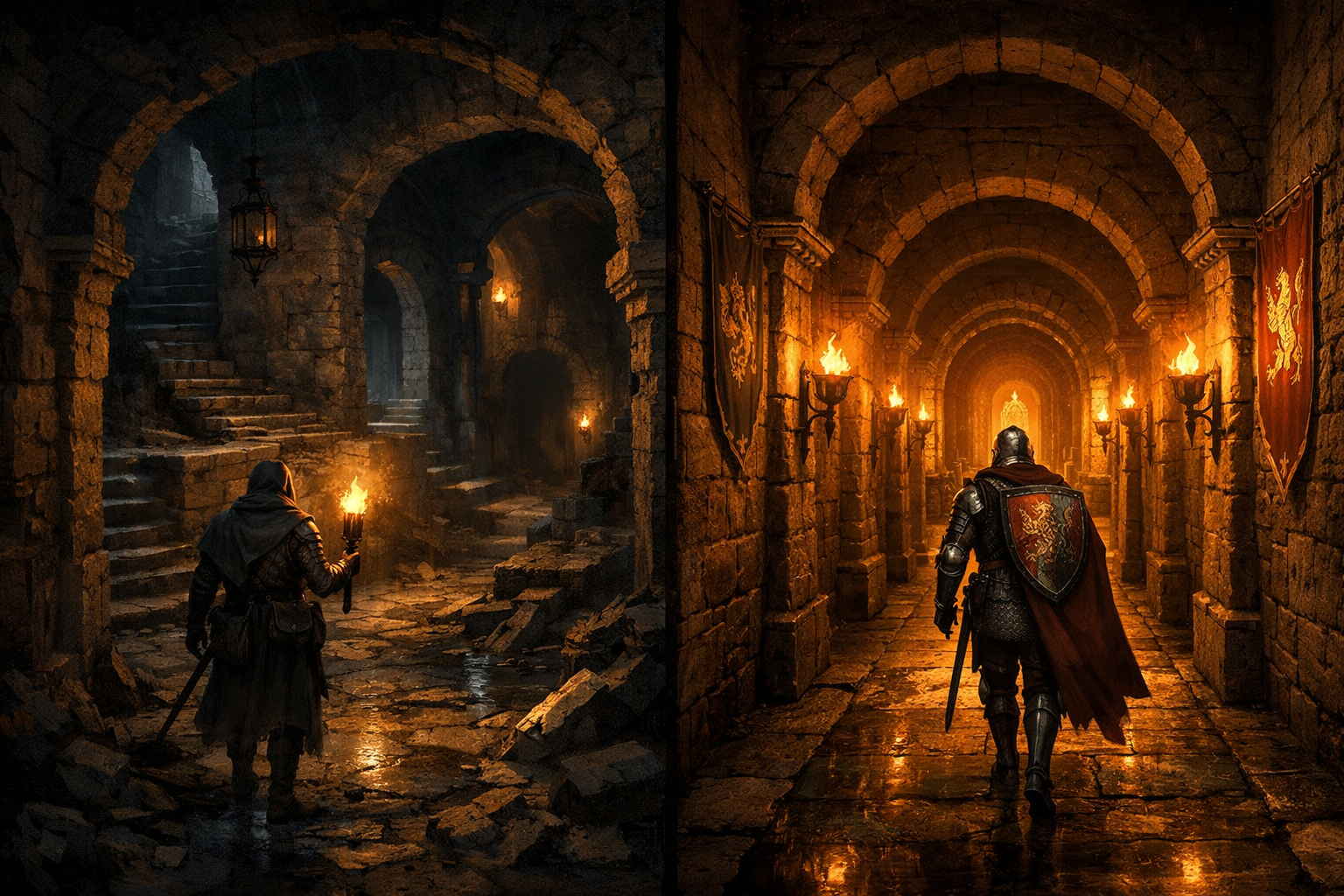
Understanding the fundamental differences between dungeon crawls and dungeon delves helps you choose the right exploration format for your campaign's needs and player preferences.
Understanding the differences between extended dungeon exploration and focused dungeon missions can help you choose a format that supports your campaign’s goals, player preferences, schedule, and game system.
The terms dungeon crawl and dungeon delve are sometimes used interchangeably, and there is no universal definition that separates them in every tabletop roleplaying game. For this guide, a dungeon crawl refers to an extended, exploration-driven location structure, while a dungeon delve refers to a compact mission designed around a limited objective and scope.
These are practical design categories rather than rigid classifications. A single adventure may combine elements of both.
Defining the Dungeon Crawl
A dungeon crawl is an exploration-focused adventure in which characters navigate a substantial, relatively unknown location room by room or area by area.
The dungeon itself is a major part of the game. Its geography, inhabitants, hazards, secrets, and changing conditions create the structure through which play develops.
Key characteristics often include:
Extended Scope: Crawls commonly continue across multiple sessions or expeditions, although a compact crawl can fit within a shorter period. The defining feature is sustained exploration rather than a specific number of sessions.
Resource Management: Depending on the game system, light, time, hit points, spell slots, ammunition, food, equipment, and consumable items may create meaningful constraints.
Interconnected Geography: Multiple paths, levels, loops, shortcuts, secret routes, and alternate entrances allow navigation decisions to affect the experience.
Risk Accumulation: Deeper exploration may increase the distance from safety, expose characters to additional threats, and make retreat more complicated.
Exploration Procedures: Mapping, searching, listening, monitoring time, opening routes, and deciding when to withdraw may be as important as combat.
Environmental and Faction Complexity: Traps, puzzles, hazards, inhabitants, rival groups, and changing conditions make the dungeon more than a sequence of isolated fights.
A dungeon crawl does not require the characters to clear the entire complex in one continuous attempt.
Repeated expeditions may be central to the format. Characters can enter, explore, withdraw, recover, resupply, and return. Their absence may allow factions to relocate, defenses to change, cleared areas to be reoccupied, or time-sensitive objectives to advance.
Consider the abandoned dwarven fortress of Karak-Undol.
In a crawl format, the fortress functions as a persistent location with multiple routes, factions, discoveries, and objectives. The players might explore the upper halls during one expedition, return to their base, and later descend into the fungus-choked lower levels.
Retreat preserves the characters but may carry costs. Enemies could strengthen their defenses, rivals could advance toward the objective, and previously secured routes could become dangerous again.
Defining the Dungeon Delve
For this guide, a dungeon delve is a focused dungeon mission built around a specific objective, limited area, and relatively compact play experience.
The term has historically been used in different ways. Wizards of the Coast’s 2009 Dungeon Delve presented short adventures built around three encounters, reflecting the term’s association with concentrated, easily deployed dungeon scenarios.
Key characteristics often include:
Limited Scope: The adventure concentrates on a small area, a short sequence of locations, or one section of a larger dungeon.
Clear Objective: Retrieve the artifact, rescue the captive, destroy the ritual focus, locate the missing scout, or eliminate a specific threat.
Focused Structure: Encounters, discoveries, and obstacles directly support the mission or provide meaningful choices about how to complete it.
Shorter Resource Horizon: Players can estimate the likely scope of the mission more easily than they can in a large, unknown complex.
Immediate Stakes: The mission often begins with a clear problem and builds toward a confrontation, discovery, escape, or decision.
Contained Resolution: The game master generally intends for the main objective to be resolved within one session or a small number of sessions, although actual play may take longer than expected.
A delve does not need to be completely linear.
Players might choose between stealth, negotiation, environmental manipulation, alternate entrances, or direct confrontation. The scope is constrained, but the methods can remain open.
Returning to Karak-Undol, a delve might focus on one mission:
Descend through the western wing, recover the Crown of Ironpeak from the throne room, and escape before the stone guardian fully awakens.
The larger fortress still exists, but the adventure focuses on the rooms, routes, and threats directly connected to that objective.
Comparing Pacing and Momentum
One important difference between crawls and delves is how they maintain momentum.
Crawl Pacing: Momentum develops through continued exploration, accumulated knowledge, opened routes, changing faction relationships, and decisions about when to advance or withdraw.
Because the adventure may continue across sessions, the game master should preserve:
Current location
Explored routes
Remaining resources
Active threats
Dungeon-state changes
Current objectives
Intended next actions
Strong recaps, maps, expedition notes, and persistent dungeon records reduce the amount of information players must reconstruct.
Delve Pacing: A delve usually follows a tighter dramatic arc.
The group receives or establishes an objective, enters the location, encounters complications, reaches the central challenge, and resolves or abandons the mission.
The game master can focus preparation on a smaller number of meaningful scenes. However, the group should not be forced through every planned encounter simply to complete the arc before the session ends.
When play takes longer than expected, use a natural stopping point, summarize low-value transitions, or continue the mission during the next session.
Resource Management Philosophy
Resource pressure depends on the game system, dungeon conditions, and consequences of resting or retreating. It does not result from the label applied to the adventure.
Resources in Crawls
In a crawl, resource conservation can become a major strategic consideration because the full scope of the dungeon is uncertain.
Players may need to decide:
Whether to use a powerful ability now
How much time to spend searching
Whether another room is worth the risk
When to rest
Whether a resting location is defensible
When to withdraw
Which supplies to carry
Whether treasure is worth additional encumbrance
How delay might affect dungeon factions or objectives
Resource pressure works best when the costs and procedures are understandable.
If resting is always safe and carries no consequences, scarcity may lose much of its effect. If recovery is nearly impossible or resource expenditure is punished too severely, players may become excessively cautious.
Resources in Delves
A delve gives players a clearer sense of the mission’s expected length, but that does not mean resources should be spent without consideration.
The characters still operate within the game world. Ending the real-world session does not automatically restore hit points, spell slots, equipment, or other limited abilities.
A shorter mission may encourage players to use their strongest abilities more readily because fewer unknown areas remain. The game master can account for that when selecting threats and obstacles.
Resource pressure can still define a delve:
A rescue must be completed before air runs out.
The party has only three doses of an antidote.
A magical seal can be opened only twice.
The escape route will collapse after the final confrontation.
Reinforcements arrive after a limited amount of in-game time.
The distinction is not that delves eliminate resource management. Their resource horizon is usually easier to estimate.
Player Experience and Preference
Avoid assuming that every player belongs permanently to one format.
Many players enjoy careful exploration during one campaign and focused missions during another.
Players may prefer crawl-style play when they enjoy:
Mapping and navigation
Strategic withdrawal
Long-term planning
Resource management
Persistent locations
Environmental problem-solving
Faction interaction
Discovering optional areas
Building knowledge across several expeditions
Players may prefer delve-style play when they enjoy:
Immediate objectives
Concentrated action
Shorter commitments
Clear mission boundaries
Tactical encounters
Frequent changes in setting
Self-contained adventures
Easier accommodation of irregular schedules
Discuss these preferences directly.
A group that enjoys tactical combat may still dislike a delve composed entirely of battles. A group that enjoys exploration may still become frustrated by confusing maps or repetitive empty rooms.
The format should support the experience the players want rather than serve as a substitute for varied encounter design.
Campaign Integration
Each format can serve different functions within an ongoing campaign.
Crawls as Campaign Pillars
A large dungeon can serve as a recurring campaign location or major story arc.
Players may return repeatedly as they:
Open new routes
Discover deeper levels
Form alliances
Defeat faction leaders
Recover specific treasures
Learn the dungeon’s history
Establish safe areas
Change the balance of power
The location becomes persistent and recognizable. Player knowledge becomes a resource alongside character abilities.
A crawl does not need to occupy the entire campaign. It may function as one major region connected to settlements, wilderness routes, political conflicts, or other adventures.
Delves as Focused Episodes
Delves work well as:
Side missions
Emergency responses
Bounty assignments
Rescue operations
Artifact recoveries
Monster hunts
Faction tests
Convention sessions
One-shots
Palate cleansers between longer arcs
A focused delve can introduce a new threat, reveal campaign information, provide tactical variety, or resolve a problem without committing the group to a lengthy location-based arc.
Preparation Requirements
Neither format has a fixed preparation burden.
Preparation depends on the complexity of the dungeon, the game master’s method, available published material, system procedures, and how much content is created during play.
Preparing a Crawl
A crawl benefits from understanding the location as a functioning environment.
Useful preparation may include:
A keyed map
Multiple routes and entrances
Major dungeon zones
Factions and motivations
Encounter or reaction tables
Wandering creatures
Rest and resupply procedures
Time-sensitive developments
Important treasures
Essential clues
Changes that occur between expeditions
The game master does not need to write every detail before play begins.
A large dungeon can be developed in sections. Tables, short room keys, modular inhabitants, and procedural tools can generate significant play from relatively concise preparation.
Published dungeons can also reduce the initial design burden, although the game master should still understand their structure before running them.
Preparing a Delve
A delve usually requires less geographical scope but may demand careful editing.
Because time is limited, preparation should identify:
The mission objective
The opening situation
Relevant routes
Essential information
Meaningful decisions
Major encounters
Optional material
A likely climax
A stopping point if the mission runs long
A short adventure is not automatically easy to prepare.
Fitting a satisfying mission into one session may require removing unnecessary material, estimating encounter duration, and ensuring that missed information does not stop progress.
One-page dungeons and short published adventures can provide useful foundations, but they may still need adjustment for the group and system.
Hybrid Approaches
Many dungeon adventures combine crawl and delve structures.
The Segmented Crawl
Divide a large dungeon into wings, districts, levels, or objectives that can be addressed separately.
Each segment offers a contained accomplishment, while the larger dungeon remains persistent.
Players might clear the outer fortifications, return to town, and later undertake a separate mission into the lower vaults. Character resources may recover between expeditions, but faction changes, lost opportunities, opened routes, and other consequences continue.
The Mission-Based Crawl
Place several focused missions inside a persistent dungeon.
The group might enter the same megadungeon to:
Rescue a missing expedition
Negotiate with a faction
Recover a specific key
Destroy a spawning chamber
Map a route to the lower level
Each expedition resembles a delve, but collective knowledge and dungeon state create a continuing crawl.
The Extended Delve
A mission intended for one session may continue into a second or third session because players investigate more deeply, pursue an optional objective, or spend more time on major encounters.
Preserve the focused objective rather than adding unrelated content merely to justify the longer duration.
The Compact Crawl
A smaller location can still support crawl-style play through interconnected geography, uncertain scope, resource pressure, and meaningful navigation.
The number of sessions is less important than whether exploration procedures and location-based decisions drive the adventure.
Choosing the Right Format
Consider the following factors before choosing a structure.
Available Play Time
Use a focused delve when the group has limited remaining sessions, is approaching a campaign transition, or needs an adventure that can reach a clear stopping point quickly.
Use a crawl when the group wants to invest in a persistent location and has enough campaign space for repeated exploration.
Current Campaign Pace
A tightly scoped mission can add urgency to a campaign that has become diffuse.
A recurring dungeon can provide depth and continuity when a campaign has moved rapidly between unrelated locations.
Do not assume that crawls are automatically slow or delves are automatically fast. Encounter length, player decision-making, rules familiarity, and session management affect both.
System Support
Some systems provide detailed procedures for dungeon turns, light, encumbrance, wandering encounters, rest, and extraction.
Others emphasize cinematic scenes, tactical combat, or narrative objectives.
Either format can be adapted, but the game master should understand what the system supports directly and what procedures must be added or simplified.
Familiarity with Resource Management
Players unfamiliar with a game’s abilities and recovery rules may benefit from a clearly bounded mission while they learn.
However, new players are not inherently unsuited to crawls. Clear procedures, visible resources, manageable initial areas, and straightforward objectives can make crawl play accessible.
Experienced players may enjoy strategic scarcity, but experience alone does not determine preference.
Story and Scenario Requirements
Use a crawl when the location itself should be studied, navigated, revisited, and changed.
Use a delve when the central question is whether the party can complete a specific mission within a constrained area.
A conspiracy hidden throughout a ruined city beneath the earth may support extended exploration.
A time-sensitive rescue from one section of that city may work better as a focused delve.
Scheduling and Attendance
Consistent attendance helps preserve continuity in any multi-session adventure.
However, crawls can also accommodate rotating players when they are structured as separate expeditions that begin and end at a shared base.
A continuous crawl that stops mid-room is harder to manage with changing attendance than an expedition model in which each session returns the characters to safety.
Delves generally accommodate irregular scheduling more easily because their objectives and casts can be contained within individual sessions.
Making Either Format Successful
For Crawls
Establish clear reasons to explore.
Use maps or support player mapping.
Include multiple routes and meaningful navigation choices.
Track time and dungeon-state changes.
Create understandable rest, retreat, and resupply procedures.
Let factions respond to player actions.
Include discoveries and positive developments alongside danger.
Vary encounter types.
Provide intermediate accomplishments.
Begin each session with a focused recap.
Preserve enough information to resume play accurately.
For Delves
Establish the objective quickly.
Communicate the likely scope.
Begin near a meaningful decision or problem.
Include more than one possible approach.
Remove encounters that do not support the mission.
Place essential information along multiple paths.
Allow optional material to remain optional.
Build toward a consequential decision, discovery, or confrontation.
Prepare a natural stopping point if the session runs long.
Do not force a predetermined ending solely to finish on schedule.
Converting Between Formats
Existing material can often be adapted.
Converting a Crawl into a Delve
Select one objective, section, or conflict from the larger dungeon.
Then:
Define the mission clearly.
Limit the relevant geographical scope.
Preserve several meaningful approaches.
Remove repetitive or unrelated areas.
Relocate essential clues only when doing so remains logically consistent.
Add urgency when it follows from the situation.
Adjust rests and resources to match the mission.
Provide rewards appropriate to the objective and game system.
Create a clear exit or resolution point.
Do not automatically eliminate resource pressure or increase treasure merely because the adventure is shorter.
Converting a Delve into a Crawl
Expand the location’s geography, inhabitants, objectives, and consequences.
Consider adding:
Multiple levels
Loops and shortcuts
Alternate entrances
Optional areas
Factions
Recurring NPCs
Persistent environmental conditions
Several objectives
Rest and extraction decisions
Wandering encounters
Changes between expeditions
Secrets that recontextualize earlier areas
Avoid expanding the adventure by simply adding more rooms and combat encounters.
The new material should create navigation choices, strategic decisions, discoveries, and relationships that reward continued exploration.
Common Pitfalls
Crawl Pitfalls
Losing continuity between sessions
Creating large areas without meaningful content
Making navigation confusing rather than challenging
Allowing every rest to occur without consequence
Punishing resource expenditure so harshly that players avoid action
Providing no intermediate victories
Failing to update the dungeon after player actions
Requiring the party to clear every room
Ignoring player fatigue
Delve Pitfalls
Treating “focused” as completely linear
Padding the mission to fill session time
Using only combat encounters
Providing only one route to essential information
Underestimating encounter duration
Making every optional room necessary
Rushing the ending because the session is almost over
Assuming the real-world session boundary restores resources
Failing to prepare a stopping point when the mission runs long
The Format Decision Matrix
Choose a crawl when:
The location itself is a major campaign feature.
Players want sustained exploration.
Navigation and discovery should drive play.
Resource and extraction decisions matter.
Factions or environmental conditions will evolve.
The group enjoys returning to familiar locations.
The game supports or can accommodate exploration procedures.
You want player knowledge to accumulate across expeditions.
Choose a delve when:
The group needs a focused, self-contained mission.
Scheduling or attendance is irregular.
The objective should be addressed within a short timeframe.
The dungeon is a backdrop for a specific operation.
The campaign needs episodic variety.
You are running a one-shot or convention game.
The group wants immediate stakes and a limited scope.
You need an adventure with a clear stopping point.
Both structures can provide rewarding dungeon exploration.
The better choice depends on the location’s role, the game system, available time, group preferences, and the decisions you want players to make.
Many campaigns benefit from alternating between them. A persistent dungeon can contain focused missions, and a short delve can reveal a larger complex worth returning to later.
The distinction is valuable when it helps you design intentionally. It should not prevent you from combining the strongest elements of both.
Sources and Further Reading
Alexander, J. (2010, July 26). Xandering the dungeon, Part 2: Xandering techniques. The Alexandrian.
Alexander, J. (2011, October 19). Advanced node-based design, Part 6: Node-based dungeons. The Alexandrian.
Alexander, J. (2012, April 6). Game structures, Part 3: Dungeoncrawl. The Alexandrian.
Noonan, D., & Slavicsek, B. (2009). Dungeon Delve. Wizards of the Coast.
Shea, M. E. (2022, August 22). Running a dungeon crawl. Sly Flourish.
Shea, M. E. (2022, December 26). A simpler checklist for engaging dungeon maps. Sly Flourish.
Shea, M. E. (2023, November 27). Prepping a dungeon. Sly Flourish.
Shea, M. E. (2024, February 26). Running dungeon crawls. Sly Flourish.
Wizards of the Coast. (2014). Dungeon Master’s Guide (5th ed.), Chapter 5: Adventure Environments.
Ready to design your next dungeon experience? Whether you choose the extended depth of a crawl or the focused intensity of a delve, The Dungeon Trainer offers detailed guides for creating memorable underground adventures. Browse our dungeon design articles for room-by-room advice, encounter-building techniques, and tools that keep your players engaged from entrance to treasure vault.
This work includes material from the System Reference Document 5.2.1 (“SRD 5.2.1”) by Wizards of the Coast LLC, available at https://www.dndbeyond.com/srd. The SRD 5.2.1 is licensed under the Creative Commons Attribution 4.0 International License, available at https://creativecommons.org/licenses/by/4.0/legalcode.
Related reading
- Why Megadungeons Succeed or Fail: Lessons from Forty Years of Play
Megadungeons have persisted since the earliest days of tabletop roleplaying, yet many campaigns abandon them within a few sessions. Learn what structural, pacing, and preparation factors separate sustainable megadungeons from those that collapse, and how to apply those lessons at your own table.
- Understanding the Megadungeon: What It Is and When to Use It
A megadungeon is more than a big dungeon. Learn what defines this sprawling adventure structure, why it persists across decades of play, and when it serves your table better than episodic adventures.
- What I Learned Running My First Dungeon Crawl: A Game Master Reflection
A candid reflection on lessons learned from running a first dungeon crawl, including what worked, what failed, and how these insights improved future sessions.