Designing Sandbox Spaces: Layer, Populate, and Connect Your World
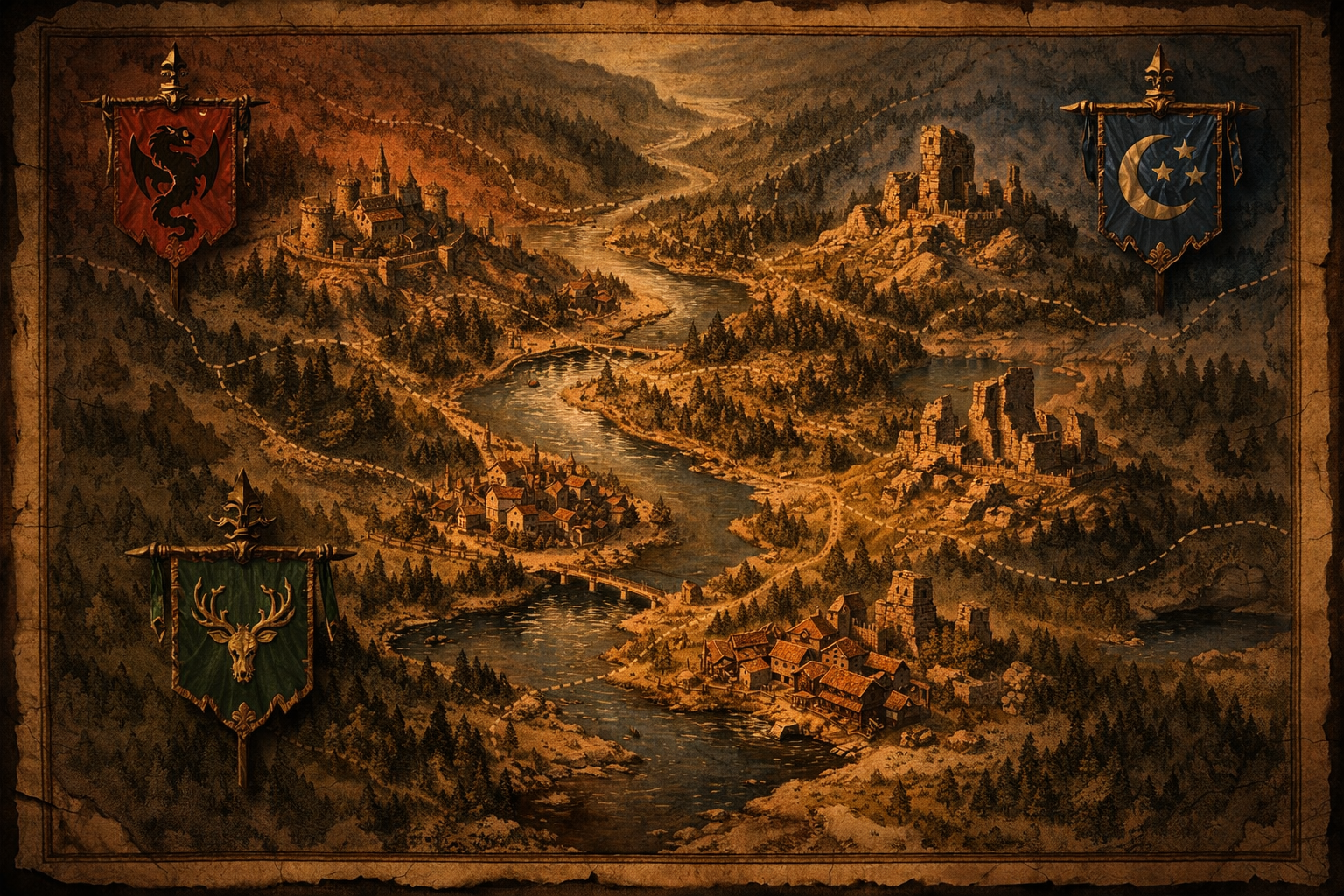
Strong sandbox design requires intentional layering of locations, factions, and hooks. Learn how to build interconnected spaces that support exploration and player agency without prescribing outcomes.
Sandbox campaigns promise player agency and emergent storytelling, but an open map alone does not create meaningful freedom. A useful sandbox gives players understandable places to explore, enough information to make decisions, forces that can react to those decisions, and connections that allow one choice to affect what becomes possible later.
The goal is not to simulate an entire world in exhaustive detail.
The goal is to build enough structure that players can decide where to go, what to investigate, whom to support, and which goals matter to them without requiring the Game Master to predetermine what happens.
This article examines practical principles for designing sandbox spaces. It draws on techniques from node-based scenario design, hexcrawls, location-based adventures, faction play, and information design to create worlds that can respond to player choices while remaining manageable to run.
What Sandbox Space Design Requires
Sandbox space design involves building locations, relationships, information, and active situations that support player-directed exploration and decision-making.
Unlike a tightly linear adventure, where the campaign may expect characters to move through a particular sequence of scenes, a sandbox usually provides multiple places to go and multiple situations that can be approached in different orders or ignored entirely.
This does not mean a sandbox lacks structure.
Justin Alexander's node-based scenario design illustrates an important distinction. Structure and player choice are not opposites. A scenario can have meaningful organization without requiring players to move through that organization in one predetermined sequence (Alexander, 2010).
The 2024 Dungeon Master's Guide similarly provides broader campaign-building guidance on developing campaign premises, conflicts, settings, character goals, starting locations, and connected adventures (Wizards of the Coast, 2024). Those tools can support many campaign structures, including player-directed ones.
Effective sandbox design generally needs to address three practical challenges.
First, players need enough information to make intentional decisions.
Second, the Game Master needs enough structure to respond consistently when players choose unexpected directions.
Third, the setting needs enough continuity that player choices can produce meaningful consequences.
These goals can be supported without preparing every possible outcome in advance.
Layer Your Space for Different Engagement Depths
Sandbox spaces benefit from multiple levels of detail.
Players might pass through a location, investigate it briefly, or become deeply involved with the people and problems there. Preparation can reflect those different levels of engagement.
One useful model is to think in terms of geographic, landmark, activity, and detail layers.
Geography Layer
The geography layer establishes how the space fits together.
It answers questions such as:
- What terrain exists?
- How far apart are important places?
- Which routes connect them?
- What areas are difficult to cross?
- What can characters see from a given location?
- Where are natural barriers?
- Which routes are commonly traveled?
In a hexcrawl, this might include terrain types, hexes, roads, rivers, and movement procedures.
In a city sandbox, geography might instead consist of districts, major streets, walls, bridges, gates, restricted areas, and transportation networks.
In a nautical campaign, geography could consist of islands, ports, currents, reefs, weather patterns, and sailing distances.
The geography layer does not determine what players must do. It gives their movement context.
Landmark Layer
Landmarks give players identifiable destinations.
Examples include:
- Settlements
- Ruins
- Towers
- Shrines
- Bridges
- Mines
- Caves
- Fortresses
- Crossroads
- Unusual natural features
- Known monster lairs
- Historical sites
A landmark does not always need an adventure attached to it.
Some locations exist primarily to provide orientation, history, atmosphere, resources, or information.
Others contain deeper situations.
The important principle is that players have places they can intentionally investigate instead of choosing directions with no information about what might exist there.
Activity Layer
Some parts of the sandbox contain people or groups actively pursuing goals.
These might include:
- Political factions
- Merchant organizations
- Religious groups
- Criminal networks
- Military forces
- Adventuring companies
- Settlements
- Monster groups
- Noble families
- Rebel movements
- Nomadic communities
Not every sandbox requires many factions, and not every location needs an active group attached to it.
However, active groups are particularly useful because they can create change.
A ruined tower may remain unchanged for decades.
A mercenary company occupying that tower may patrol nearby roads, recruit local fighters, negotiate with merchants, and react when the players interfere.
Both are valid sandbox elements, but they behave differently.
Detail Layer
The detail layer contains information players need when they engage closely.
This might include:
- Specific NPCs
- Sensory descriptions
- Individual rooms
- Local secrets
- Specific resources
- Clues
- Immediate conflicts
- Treasure
- Social relationships
Not every landmark requires the same level of detail before play begins.
A distant monastery may initially need only:
- A name
- Its approximate location
- Who controls it
- One notable feature
- One reason characters might care about it
If players decide to travel there, deeper preparation can follow.
This allows preparation effort to scale with player interest.
Populate With Active Elements, Including Factions
Locations create space.
Active forces create change.
A useful sandbox often combines both.
A faction can be any organized group capable of pursuing an objective. It might be a large political organization or something much smaller, such as a monster tribe defending territory.
A simple faction description can include four elements:
Goal: What does the group want?
Method: How is it attempting to achieve that goal?
Resources: What people, money, information, influence, equipment, territory, or magic can it actually use?
Next likely action: What might it do if circumstances remain unchanged?
For example:
Faction: Red Bridge Company
Goal: Control merchant traffic through the northern valley.
Method: Extort merchants at a strategically important bridge.
Resources: Twenty fighters, several scouts, local informants, and a defensible camp.
Next likely action: Establish a second checkpoint if current operations continue successfully.
The purpose is not to write a predetermined faction plot.
It is to understand the group well enough to determine what it is likely to do.
Use Timelines When Time Matters
A faction does not necessarily need a detailed calendar.
For significant or time-sensitive situations, however, a rough timeline can be useful.
For example:
Week one: The company extorts merchants at the bridge.
Week two: Successful profits allow it to recruit additional fighters.
Week three: The company attempts to establish another checkpoint.
Week four: Regional authorities begin organizing a response.
These developments are possibilities based on current conditions.
Player actions can disrupt them.
Other factions can disrupt them.
Unexpected events can change them.
The timeline is a prediction, not a script.
Let Faction Goals Intersect
Faction play becomes particularly useful when different groups care about the same resources, locations, or people.
A merchant guild wants a trade route kept open.
A bandit company profits by controlling that route.
A local noble wants tax revenue from the merchants.
A village depends on those merchants for imported tools.
Now a single road matters to several groups for different reasons.
The players can:
- Support the guild
- Fight the bandits
- Negotiate a toll agreement
- Work for the noble
- Help the village create another route
- Investigate why the bandits became bandits
- Ignore the entire situation
The situation supports many possible approaches because the participants have understandable interests rather than predetermined narrative roles.
Connect Locations With Meaningful Travel When Travel Matters
Travel can be an important part of sandbox play, but it does not always need detailed procedures.
If the interesting decision is what happens at the destination, routine travel can be summarized.
If route selection, time, resource use, navigation, weather, danger, or discovery matter to the campaign, then travel itself can become part of the sandbox.
Hexcrawl Procedures
Justin Alexander's discussion of traditional hexcrawls describes a recognizable structure:
- Create a hex map.
- Key hexes with locations or encounters.
- Use movement procedures to determine overland travel.
- Reveal terrain and keyed content as the characters explore.
Mapping and discovery then become part of play rather than simply a transition between adventures (Alexander, 2012).
A hexcrawl is one method, not a requirement for sandbox campaigns.
Other options include:
- Point-crawl maps
- Road networks
- Region maps
- City districts
- Nautical routes
- Abstract travel turns
The appropriate structure depends on what decisions the campaign wants players to make.
Give Routes Meaningful Differences
When travel matters, routes can offer tradeoffs.
For example:
Mountain pass: Fast, but exposed and occasionally patrolled.
Forest trail: Slower, but concealed.
River route: Efficient with a boat, but dependent on water conditions.
Old imperial road: Easy travel, but well known to enemies.
These distinctions create decisions before the characters even reach their destination.
Let Travel Communicate Information
Travel encounters do not need to exist only as random combat.
Characters might encounter:
- Refugees
- Patrols
- Traders
- Damaged wagons
- Recently abandoned camps
- Animal migrations
- Construction crews
- Funeral processions
- Changed road conditions
- Faction symbols
These details communicate what is happening elsewhere.
A burned caravan tells players something about road security.
Refugees tell them something about another region.
A new checkpoint reveals changing political control.
Travel becomes another way the world provides information.
Let Players Change the Network
Players may eventually improve how they move through the sandbox.
They might:
- Discover a shortcut
- Secure a bridge
- Establish a safe camp
- Hire guides
- Buy a boat
- Restore a road
- Form alliances with local communities
- Gain permission to use restricted routes
These improvements turn exploration into persistent progress.
The sandbox becomes easier to navigate because the players changed it.
Build Discovery Through Information Layers
Information is one of the most important resources in a player-directed campaign.
Players need information to decide:
- Where to go
- What is dangerous
- Who can be trusted
- What factions want
- Which opportunities exist
- What has changed
- Which problems deserve attention
A sandbox can therefore reveal information in layers.
Distant Information
Players first receive broad signals.
Examples:
- A fortress stands on the eastern ridge.
- Smoke rises from the northern forest.
- Travelers speak of a haunted burial mound.
- Merchants are avoiding the western road.
- Church bells have rung every night for a week.
This information creates possible directions.
Closer Observation
Approaching or investigating provides more detail.
The fortress flies the banner of a mercenary company.
The smoke comes from a refugee camp.
The burial mound has recently been opened.
The western road contains fresh barricades.
The nightly bells are being rung by different people each time.
Now players can begin preparing more intelligently.
Direct Investigation
Deeper involvement reveals specifics.
The mercenaries are recruiting for a campaign.
The refugees fled a conflict between two neighboring settlements.
Another adventuring party opened the tomb.
The barricades were built by a faction demanding tolls.
The bell ringing is part of an internal dispute among the clergy.
Each new layer changes the available decisions.
Adapt the Three Clue Rule for Important Sandbox Information
Justin Alexander's Three Clue Rule was developed primarily for mystery scenario design.
Its central principle is:
For any conclusion you want the PCs to make, include at least three clues.
The purpose is redundancy. A scenario should not collapse because players missed one required clue (Alexander, 2008).
That principle can be adapted carefully to sandbox information design.
Suppose it is particularly important that players have a reasonable chance to learn that the northern forest has become dangerous.
Do not rely entirely on one tavern NPC mentioning it.
Players might instead encounter:
- Refugees arriving from the north
- A merchant whose wagon was attacked
- A posted warning from local authorities
- Physical signs of increased patrols
- Hunters discussing unusual activity
Players do not need to encounter all of them.
Multiple channels make important information more robust.
Do Not Turn Every Fact Into a Three-Clue Exercise
The Three Clue Rule should not become a bookkeeping requirement for every detail in the setting.
Use redundancy when information matters to meaningful decision-making.
If players miss an obscure local legend, the campaign probably continues normally.
If they have no reasonable way to discover that an apparently safe route crosses an active battlefield, the information failure matters much more.
Redundancy should protect meaningful choices, not create unnecessary preparation.
Give Information Sources Motives
NPC information becomes more interesting when the source has a perspective.
A merchant warns about bandits because she wants the road reopened.
A city guard minimizes the danger because his commander wants to avoid panic.
A rival merchant exaggerates the danger because reduced traffic benefits him.
A displaced farmer knows what happened but misunderstands why.
The information does not need to be false.
Perspective makes it contextual.
Players can compare sources and decide how much confidence to place in each account.
Create Connected Hooks Without Making Everything One Plot
Connections help a sandbox feel coherent.
However, not every hook needs to connect to every other hook.
Too much hidden connectivity can make an apparently open sandbox collapse into one master storyline.
A healthier model mixes connected and independent situations.
Connected Hooks
Suppose a merchant's stolen ledger was taken by a bandit captain.
The bandit captain is negotiating with a magistrate.
The magistrate is being pressured by a criminal organization.
Now investigating the ledger can expose several additional situations.
Players might:
- Recover the ledger
- Negotiate with the bandits
- Investigate the magistrate
- Approach the criminals
- Sell the information
- Ignore the deeper connections
The original hook opens possibilities instead of determining a sequence.
Independent Hooks
Elsewhere, an abandoned observatory contains unusual astronomical records.
It has nothing to do with the merchant, bandits, magistrate, or criminal network.
That independence is valuable.
It reminds players that the world contains more than the conflict they are currently investigating.
A sandbox benefits from both webs and loose ends.
Think in Situations Instead of Quest Logs
Instead of preparing:
Quest: Recover the merchant's ledger.
Prepare:
Situation: The merchant lost a valuable ledger during a raid. The bandits possess it. The merchant wants it returned. The bandit captain realizes it contains sensitive financial information.
Now players can decide what the ledger is worth and what they want to do about it.
The goal is to create something they can interact with, not a task they are expected to complete.
Design for Emergent Consequences
Emergent play occurs when player decisions combine with the setting in ways no one fully predicted before the session.
The Game Master supports this by preparing causes and participants rather than predetermined outcomes.
Prepare Reactions, Not Scripts
If the characters ally with a merchant guild, ask:
- Who benefits?
- Who loses influence?
- Who notices?
- Who cares?
- What resources can affected groups use?
- How quickly can they respond?
Suppose the characters expose a corrupt magistrate.
Possible consequences might include:
- The magistrate resigns.
- Political allies defend the magistrate.
- Rivals attempt to seize the position.
- Criminal contacts destroy evidence.
- A replacement proves worse.
- The magistrate flees.
- The magistrate offers the party information in exchange for protection.
Which response occurs depends on the situation at that moment.
The Game Master does not need to prepare every branch in advance.
Advance Important Situations When Appropriate
If a faction is working toward a goal and the players choose not to intervene, the faction may continue.
This is not punishment.
The players chose to spend time somewhere else, and something else happened during that time.
However, not every ignored hook needs to escalate.
Some situations remain stable.
Some solve themselves.
Some fail because another faction intervenes.
Some disappear.
A dynamic world should not become a machine designed to punish players for failing to complete every available task.
Track Relationships at the Level You Need
A political sandbox may benefit from detailed faction relationships.
A wilderness exploration campaign might only need broad notes such as:
- Friendly
- Neutral
- Suspicious
- Hostile
Use enough tracking to preserve consistency.
Do not track numbers merely because a system can be tracked numerically.
Balance Scope With Sustainable Preparation
Sandbox campaigns can create an obvious preparation trap.
If players can travel anywhere, the Game Master may feel required to fully prepare everywhere.
That is rarely necessary.
Start With a Manageable Region
A starting sandbox might consist of:
- One city and its surroundings
- A river valley
- Several wilderness hexes
- A group of islands
- A frontier district
- A cluster of settlements
Give players enough room to choose without creating an entire continent in advance.
Use Increasing Levels of Abstraction
Nearby locations need more detail.
Distant areas need less.
For example:
Current town: Named NPCs, streets, active conflicts, local resources.
Nearby village: Name, population, notable feature, current issue.
Distant city: Name, general reputation, major faction, reason someone might travel there.
If the players decide to visit the distant city, expand it.
This keeps preparation aligned with actual play.
Reuse Material Carefully
Unused preparation can often be repurposed.
An unused NPC personality, tavern description, puzzle, monster group, or building layout can be adapted elsewhere.
However, avoid secretly moving established geographic content merely to force the players to encounter it.
If players learned that the ruined fortress is east of the river and deliberately traveled west to avoid it, placing that same fortress in their path anyway undermines the meaning of their choice.
A useful distinction is:
Unobserved, non-location-dependent content can often be reused freely.
Established setting facts should remain consistent unless something in the fiction changes them.
Let Player Goals Guide Detail
Player attention is useful preparation data.
If the players decide to ally with a religious order, develop:
- Its leaders
- Internal divisions
- Rivals
- Important locations
- Current problems
If they begin exploring an ancient road, develop:
- Its route
- Nearby ruins
- Historical context
- Travel complications
The players are telling you where deeper detail is most likely to matter.
Accept Unused Possibilities
Some locations will never be visited.
Some faction plans will never matter.
Some mysteries will remain unsolved.
That is normal.
The existence of alternatives is part of what makes choices meaningful.
A sandbox does not require completion.
Example: The Millbrook Consortium
Consider a river valley containing three towns, several farmsteads, forested hills, ruins, and contested resource sites.
The Game Master designs the area in layers.
Geography
The Millbrook River forms the primary transportation route.
Farms occupy the floodplain.
Forested hills rise to the east.
River travel is relatively efficient.
Travel through the hills takes longer but provides access to ruins, mines, and less-traveled routes.
Landmarks
Important known locations include:
- Millbrook
- Thornfeld
- Eastmarch
- Two major river crossings
- An eastern mining camp
- Several ruins in the hills
- A religious site farther east
Not every landmark is fully prepared before the campaign starts.
Players know enough to make decisions about where they might travel.
Active Groups
Several factions operate in the region.
Millbrook Trade Consortium
Goal: Expand profitable trade into the eastern hills.
Method: Secure transportation routes and access to mineral resources.
Hillfolk Communities
Goal: Preserve control over traditional territory.
Method: Monitor outsiders, resist expansion, and negotiate from a position of local knowledge.
Northern Bandit Company
Goal: Profit from regional traffic and instability.
Method: Ambush vulnerable travelers and exploit contested routes.
Eastmarch Religious Order
Goal: Regain access to a sacred site in the hills.
Method: Recruit guides, petition local authorities, and send expeditions.
These groups have competing interests, but none is automatically the campaign's villain.
Initial Connections
The Trade Consortium wants explorers to survey a route toward the mines.
Hillfolk representatives object to further commercial expansion.
The bandits attack supply traffic.
The religious order needs safe passage toward its sacred site.
Players can approach any of these situations from multiple directions.
Emergent Outcome
Suppose the party decides to negotiate between the Consortium and the hillfolk rather than simply choosing a side.
The Game Master did not prepare a required peace treaty.
However, the faction goals make negotiation plausible.
The Consortium primarily wants profitable access.
The hillfolk primarily want territorial security.
The players propose restricted mining rights, limits on settlement, trade compensation, and formal recognition of hillfolk territory.
Both sides have reasons to consider the arrangement.
The bandit company, however, benefits from instability and attempts to disrupt negotiations.
The players intervene and preserve the agreement.
The result emerges from:
- Player initiative
- Established faction goals
- Available resources
- Existing relationships
- Logical consequences
No one needed to script the treaty in advance.
That is one form emergent sandbox play can take.
Practical Advice for Implementation
A sandbox can begin with relatively compact preparation.
Sketch the Geography
Create enough of a map to answer:
- What is nearby?
- How are places connected?
- How long does travel take?
- Which areas are difficult or dangerous?
- What major landmarks are known?
The map can be simple.
Consistency is more important than visual polish.
Create a Small Number of Important Active Groups
Three to five major factions can be a manageable starting heuristic for many regional sandboxes, but it is not a rule.
You may need:
- Two major factions
- Seven small groups
- One central authority and many independent settlements
- No formal political factions at all
Use the amount your campaign needs.
For each important group, record:
- Goal
- Method
- Resources
- Relationships
- Current activity
Seed Information Through Multiple Channels
Players can learn about the world through:
- Rumors
- Direct observation
- NPC requests
- Maps
- Travelers
- Letters
- Public notices
- Environmental evidence
- Faction activity
- Previous consequences
Important information should generally have more than one reasonable route of discovery.
Choose a Travel Structure Appropriate to the Campaign
If wilderness navigation is central, use a procedure that supports it.
If travel is mostly connective tissue, summarize routine journeys and focus on decisions that matter.
Do not add hexcrawl procedures merely because the campaign is a sandbox.
Sandbox describes player freedom and campaign responsiveness.
Hexcrawl describes one possible exploration structure.
Track Discoveries and Decisions
Useful campaign notes include:
- Locations discovered
- People contacted
- Faction relationships
- Important information learned
- Promises made
- Significant resources gained or lost
- Unresolved situations
- Consequences likely to appear later
This record helps maintain continuity.
Let Sessions End With Open Questions
A sandbox session does not always need to resolve everything.
Players may finish while planning:
- Which ruin to investigate next
- Which faction to approach
- Whether to take a dangerous route
- What to do with sensitive information
- How to respond to a political development
Open questions can provide strong momentum for the next session.
When possible, ask what the party intends to pursue next. Their answer can focus your preparation.
When the Sandbox Feels Aimless
An aimless session does not necessarily mean players need a plot imposed on them.
First identify the actual problem.
Do Players Lack Information?
Refresh their understanding of the world.
Remind them:
- What situations are active
- What they recently learned
- Which places are accessible
- Which deadlines exist
- Who has contacted them
Do Players Lack Concrete Options?
Translate broad problems into actionable opportunities.
Instead of:
"The merchants are having trouble."
Provide:
"A caravan leaves tomorrow."
Instead of:
"The monastery is behaving strangely."
Provide:
"One monk secretly asks to meet you tonight."
Do Players Lack Investment?
Ask what their characters care about.
Player goals may need stronger connections to:
- People
- Places
- Factions
- Resources
- Personal ambitions
Has the World Stopped Responding?
Bring forward an appropriate consequence.
An ally sends news.
A faction changes tactics.
A previous rival asks for help.
A route the players secured becomes commercially important.
The response should follow from established circumstances, not simply exist to force movement.
Measuring Whether the Space Is Working
There is no universal metric for sandbox success.
Several behaviors can indicate that players understand and are engaging with the space.
Players Form Plans
They discuss where to go and why.
They compare options.
They prepare for future expeditions.
They decide which relationships matter.
Geography Influences Decisions
Players recognize that:
- One route is faster.
- Another is safer.
- A settlement offers resources.
- A river provides access.
- A border creates complications.
The map has become part of decision-making rather than decoration.
Information Changes Behavior
Players alter their plans because of something they learned.
A rumor leads to reconnaissance.
Evidence causes them to distrust an ally.
A newly discovered route changes their next destination.
Consequences Remain Understandable
Players can often see why circumstances changed.
They may not know everything happening behind the scenes, but developments generally follow from established actors and events.
Players Generate Goals
Eventually, players begin proposing objectives that were never presented as quests.
They might decide to:
- Control a trade route
- Restore a fortress
- Map the hills
- Unite two communities
- Expose a political alliance
- Establish a business
- Hunt a specific enemy
- Investigate ancient history
- Become influential within a faction
At that point, the sandbox is no longer being driven primarily by prepared hooks.
The players are using the setting to create their own campaign.
The Core Principle
Good sandbox design is not about maximizing the number of choices.
It is about making choices understandable and consequential.
Build geography players can reason about.
Place landmarks worth investigating.
Introduce active forces where change is useful.
Provide information through multiple channels.
Connect some situations while allowing others to remain independent.
Track important consequences without trying to simulate everything.
Expand detail in response to player interest.
Most importantly, preserve the connection between player decisions and what happens next.
The world does not need to be infinitely detailed.
It needs to be coherent enough that players can explore it, understand it, change it, and eventually pursue goals that belong to them.
Sources and Further Reading
Alexander, J. (2008, May 8). Three clue rule. The Alexandrian. https://thealexandrian.net/wordpress/1118/roleplaying-games/three-clue-rule
Alexander, J. (2010, May 27). Node-based scenario design, part 1: The plotted approach. The Alexandrian. https://thealexandrian.net/wordpress/7961/roleplaying-games/node-based-scenario-design-part-1-the-plotted-approach
Alexander, J. (2012, April 13). Game structures, part 6: Hexcrawls. The Alexandrian. https://thealexandrian.net/wordpress/15156/roleplaying-games/game-structures-part-6-hexcrawls
Wizards of the Coast. (2024). Dungeon master's guide. Wizards of the Coast.
Related reading
- Why Megadungeons Succeed or Fail: Lessons from Forty Years of Play
Megadungeons have persisted since the earliest days of tabletop roleplaying, yet many campaigns abandon them within a few sessions. Learn what structural, pacing, and preparation factors separate sustainable megadungeons from those that collapse, and how to apply those lessons at your own table.
- Understanding the Megadungeon: What It Is and When to Use It
A megadungeon is more than a big dungeon. Learn what defines this sprawling adventure structure, why it persists across decades of play, and when it serves your table better than episodic adventures.
- Running Sandbox Campaigns: Six Months with The Millbrook Consortium
Sandbox campaigns promise player-driven freedom but demand different preparation and facilitation techniques. This case study examines six months of running The Millbrook Consortium, a merchant-focused sandbox, to identify practical lessons about faction management, player agency, and sustainable open-world play.