Designing Around the Quiet Stat: A Design Perspective on Hidden Threats and Passive Awareness
Written with AI. An AI model drafted this article. How we use AI
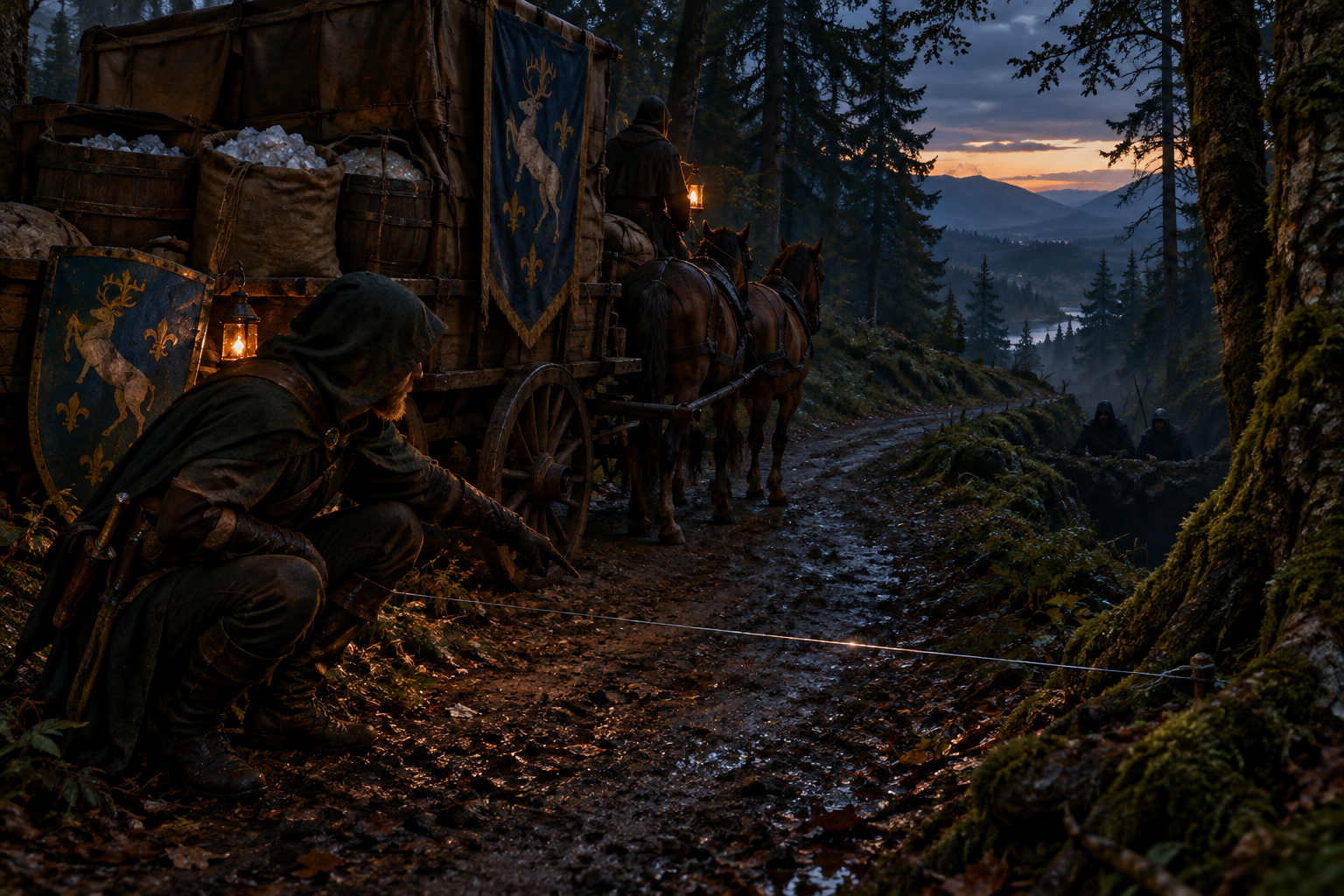
Passive awareness is a design input as much as a rule. This design perspective looks at how to build traps, ambushes, and secrets that pay off both noticing and searching.
Much of the advice about passive Perception seems to be about the middle of a scene: the party walks up to a bend in the road, and the Game Master has to decide, in the moment, who notices what. This article moves the question earlier. It asks what changes when you treat passive awareness as a design input, something you build around while preparing an encounter, rather than a quick ruling you make while running it.
The goal is not to optimize players out of surprises. It is to build hidden threats that feel fair, that reward both the character who is always watchful and the player who stops to say "I look under the branches," and that do not leave the table staring at a stalled scene. Everything below is a matter of design craft and table preference, not a rule you must follow.
Start From What the Rules Actually Say
Before designing around passive awareness, it helps to be clear about what the rules do and do not say. The free Basic Rules describe how ability checks work in general, including Difficulty Classes, which the rules provide for certain checks but which the DM ultimately sets (Wizards of the Coast, 2024).
Two details matter for design. First, outside of changing circumstances, a character's passive score tends to change rarely, so many Game Masters find it convenient to write it down and plan against it. Second, the rules leave a great deal of judgment to the Game Master: they provide DCs for certain checks, but the DM ultimately sets them, and the DM has the final say on whether a skill is relevant to a situation. That judgment is where design lives.
Other systems may handle hidden information differently, and not every game uses a passive score. Everything in this article about designing around a fixed, known awareness number applies most directly to games that have one. In games without that mechanic, the underlying design questions (who gets to notice what, and how is it revealed) still apply, but the tools change.
The Core Design Question: What Is This Secret For?
Every hidden thing in an adventure exists for a reason, and the reason should shape how you hide it. A useful way to sort hidden elements is by what happens if the party misses them.
Consider three categories:
- Required information. If the party never learns this, the adventure stalls. A hidden door that is the only way forward is the classic example. Justin Alexander's Three Clue Rule exists for precisely this reason: for any conclusion you want the players to reach, include at least three clues, so that missing one does not end the scenario (Alexander, 2008). Applied to awareness, the lesson is that a single secret behind a single threshold is a fragile design.
- Optional reward. Missing it costs the party something pleasant but not essential: a cache of coins, a shortcut, a tactical edge. Here a threshold can be demanding, because nothing breaks if no one meets it.
- Consequence trigger. Missing it springs a trap, an ambush, or a complication. The party is meant to be able to avoid this, but it is also acceptable, even interesting, if they do not.
The design mistake worth avoiding is putting required information behind a number that some parties will not meet. That is a design problem, not a dice problem, and it has a design solution: more routes to the same fact.
Know Your Party's Numbers Before You Hide Anything
Because passive scores change rarely, they are one of the few parts of an encounter you can usually know in advance. Some Game Masters like to keep a short list of the party's passive Perception scores somewhere visible and update it when characters change.
This changes how you prepare. Instead of guessing, you can ask concrete questions:
- Who at the table is the likely noticer, and who is not?
- If I set this threshold at X, how many characters meet it?
- Is that the outcome I want?
There are really three design stances here, and they are all legitimate depending on the table:
- Hide against the best. Set the threshold so that only the most perceptive character notices. This makes the dedicated scout feel valuable and keeps tension high for everyone else.
- Hide against the average. Set it so that roughly half the party notices. This produces mixed information and interesting disagreements about what each character saw.
- Hide against the worst. Set it low enough that anyone paying attention notices. This works for things you want to be visible and are using mainly as scene dressing or fair warning.
None of these is correct in the abstract. A group that enjoys scouting specialists may like the first. A group that likes shared uncertainty may prefer the second. This is table preference, and a conversation at session zero or between sessions can settle it (Shea, 2021).
Two Layers: Passive Noticing and Active Searching
The most useful structural idea in this whole topic is that a well-designed hidden element has two layers, one for each way a party can engage with it.
The passive layer is what a character sees by simply being there. It should be modest, it should be cheap to reveal, and it should hint rather than explain. A glint of wire. Footprints that stop too neatly. A smell of oil near a door.
The active layer is what a character finds by deliberately looking. It should be richer than the passive layer, because the player has spent a real decision on it. If someone describes crouching and checking the ditch, they should learn more than a character who merely walked past.
This two-layer approach protects against two opposite failures. Without a passive layer, awareness stats feel meaningless and the party is ambushed by things no character could have sensed. Without an active layer, players learn that describing what they do is pointless because the numbers decide everything. Designing both layers into the same hidden element makes both kinds of play worth doing.
A practical way to prepare this is to write each hidden element as a short pair of lines:
- Passive: what a watchful character notices without trying.
- Active: what a deliberate search reveals.
The dungeon-keying tradition supports this kind of terse, usable notation. Alexander's history of location keys criticizes 'wall of text' entries and highlights formats whose organization makes an adventure easier for the Game Master to run, including keys that separate what is apparent on entering a room from what investigating it reveals (Alexander, 2014). A two-line passive and active entry is easy to scan mid-session.
Setting Thresholds as a Design Choice
A threshold is just the number a score must meet. The rules include a Typical Difficulty Classes table that runs from Very easy (DC 5) through Easy (10), Medium (15), Hard (20), and Very hard (25) to Nearly impossible (30) (Wizards of the Coast, 2024). The design question is how to use that scale for hidden things.
A few guiding ideas, offered as craft rather than rule:
Tie the threshold to how well something is concealed, not to how much you want it found. A tripwire strung quickly across a dirt road is not well hidden. A trap built by a patient craftsman is. Let the fiction set the number, and the number will feel fair.
Separate concealment from danger. A deadly trap is not automatically hard to notice, and a harmless secret is not automatically easy. Keeping these independent gives you more variety. A lethal but crude snare invites a party to be careful. A subtle but harmless detail rewards close attention.
Vary the thresholds within a scene. If every hidden thing in a room has the same number, the scene becomes binary: either the party notices everything or nothing. Spreading thresholds produces graded information, where a sharp-eyed character catches the obvious sign and only the best catches the subtle one.
Let circumstances move the number. Poor light, noise, distraction, and weather can all plausibly raise or lower how hard something is to notice. Treat these as fictional inputs to your threshold rather than separate rules to remember. How far you let them move it is a table preference.
Designing Ambushes: Opposed Numbers
Ambushes add a second variable. Instead of a fixed threshold you set in advance, many Game Masters take the number from the hiding creatures' Stealth, which means it can vary from encounter to encounter.
From a design standpoint, the interesting choice is whether to roll the hiders' Stealth once for the whole group, once per creature, or to fix a number in advance. These produce different textures:
- One shared result is fast and gives a clean split: the party either spots the ambush or does not.
- Per-creature results are slower but produce partial detection, where one hidden creature is spotted and another is not.
- A fixed number gives you full control and lets you prepare in advance, at the cost of removing the dice's uncertainty.
There is no single right answer. A Game Master who values speed may prefer a single shared result. One who values texture may prefer per-creature results. This is exactly the kind of choice to make deliberately during preparation rather than improvising under pressure.
It also helps to design the ambush so that being noticed is still an interesting scene. An ambush that is spotted should become a tense standoff or a tactical advantage for the party, not a deflation. Creatures with a plan and some intelligence can plausibly use terrain, cover, and timing, so a spotted ambush can still be a meaningful fight rather than a foregone conclusion.
Pacing: Do Not Let Awareness Stall the Scene
A design that depends on constant checking will slow the game. The reason to rely on passive scores in the first place is that they let information flow without stopping for dice. Good design preserves that.
Some principles for keeping pace:
Decide in advance, reveal in a sentence. If you have prepared the passive and active layers, the reveal in play is a single sentence of description plus a question: "The scout spots a thin glint of wire across the road. What do you do?" The scene continues.
Avoid announcing the mechanics. Telling the table "your passive Perception was not high enough" breaks immersion and invites arguments. Describe what characters sense, and say nothing about what they missed.
Reserve rolls for decisions. Pacing advice from several Game Master writers points toward a similar idea: cut the empty time between meaningful choices and get quickly to what the players want to do (Alexander, 2013; Shea, 2022). An active search is a decision, so it earns a check. A passive notice is background, so it does not.
Know when to stop narrating. Not every observation needs elaboration. Over-describing what a character notices can bury the one useful detail. A useful habit is to give players the information, then stop narrating and hand control back to them.
Redundancy and Fairness
Fairness in hidden-information design is largely about whether players feel they had a real chance. A few design habits support that feeling.
Build multiple clues. Alexander frames the Three Clue Rule for mysteries but extends the same thinking to any chokepoint the adventure depends on, making sure there are at least three solutions (Alexander, 2008). If a secret door is essential, signal it several ways: a draft, scuff marks, an NPC's offhand remark, a discrepancy on a map. Different characters and different approaches can then find different clues.
Make the hidden thing visible somewhere. A secret that nothing in the world hints at is not a secret, it is a gate. Even a faint hint turns it into a puzzle the players can engage with.
Reward description. When a player describes a specific, sensible action, such as checking where the wall meets the floor, lean toward giving them something. This is the heart of the active layer, and it keeps awareness from being purely a numbers game.
Let consequences be proportionate. If failing to notice a threat costs a character their life with no recourse, players will feel cheated. If it costs them resources, position, or initiative, they will feel the sting without feeling the injustice. Where the line sits is a matter of table preference and is worth discussing with the group rather than assuming.
A Short Design Workflow
Here is one way to put all of this into a preparation routine. Adapt it freely.
- List the hidden elements in the scene: traps, ambushers, secret doors, concealed items.
- Label each by purpose: required, optional reward, or consequence trigger.
- Note the party's passive scores for the relevant skills.
- Set a threshold for each, based on how well it is concealed, not how much you want it found.
- Write a passive line and an active line for each element.
- Add redundancy for anything required, using multiple clues.
- Decide the ambush method: shared result, per-creature, or fixed number.
- Plan the reveal, one sentence, then a question.
This fits comfortably into the kind of lightweight preparation that favors what you will actually use at the table. Preparation is arguably best spent where it pays off in play, and a short passive and active note for each hidden element is small, usable, and directly useful mid-session.
Common Design Pitfalls
The single-point secret. One hidden thing, one threshold, and the adventure depends on it. Fix this with redundancy.
The invisible ambush. An attack that no character could plausibly have sensed. Fix this by giving it a passive layer, a faint sign that hints without explaining.
The meaningless stat. Awareness numbers that never affect anything, because every hidden thing is either trivially obvious or impossible. Fix this by varying thresholds and tying some to the party's actual scores.
The gotcha. A trap designed so that no reasonable action avoids it. This is a fairness problem, not a difficulty problem. Fix it by ensuring there is always a way to notice or avoid the threat through attention or description.
The over-reliance on dice. Letting every observation become a roll. Fix this by treating passive scores as the default and active checks as a response to player decisions.
Example: The Lantern Road Company
This is an illustrative scenario, not a record of a real game.
The Lantern Road Company is a four-character party escorting a wagon of salt along a forest road. A Game Master preparing the scene decides to design it around the party's numbers rather than improvise.
The Game Master lists the hidden elements: two bandits in a ditch at a bend in the road, and a tripwire strung across the path a few steps ahead of them. The tripwire is labeled a consequence trigger, since it is meant to be avoidable but not essential. The bandits are also a consequence trigger.
The party's passive Perception scores are already on a corner of the screen: the scout at 15, the cleric at 13, the fighter at 11, and the wizard at 10. The Game Master sets the tripwire's threshold at 12, reasoning that it is a modest, quickly rigged hazard rather than a craftsman's trap. That threshold is deliberately chosen so that the scout and the cleric would notice it while the fighter and the wizard would not, producing mixed information.
For each element, the Game Master writes a passive line and an active line. For the tripwire, the passive line is a thin glint of wire across the road, and the active line is that a closer look reveals it is tied to a cluster of hanging cans meant to alert the bandits. For the bandits, the passive line is a flash of movement in the ditch, and the active line is that a deliberate search of the underbrush reveals two distinct shapes and the fresh scuffs of boots.
Because the ambush is not required to move the adventure forward, the Game Master does not need redundancy here. But the Game Master does add a second sign anyway: the road ahead is oddly quiet of birdsong, a detail anyone can notice, so even a party that misses everything else has some reason to be wary.
The Game Master chooses a single Stealth result for the bandits and rolls a 15. In play, the scout's score of 15 meets it, so the scout catches the flash of movement. The cleric, at 13, does not. The tripwire reveal is a single sentence: the scout spots a thin glint of wire and the party is asked what they do.
Then a player says their wizard wants to crouch low and peer under the branches at the bend. That is an active search, so the Game Master calls for a check rather than relying on the wizard's passive score of 10, and the active line gives the player a richer reward than the passive layer offered.
The scene never stopped for a round of dice. The scout was rewarded for a well-built character, the wizard's player was rewarded for an active choice, and the ambush became a tense standoff rather than an unavoidable surprise.
Where the Design Leaves Room for Play
It is worth ending on a note of restraint. Good hidden-threat design does not try to control what players notice. It builds a world in which attention matters, gives both watchful characters and curious players something to do, and then gets out of the way. It is worth paying attention to what your players enjoy and adjusting accordingly, and that applies here: if a table loves tense scouting, lean into thresholds that reward specialists; if it prefers shared discovery, set them lower.
The design is a means to an end. The end is a table where noticing, searching, and being surprised all feel earned.
Sources and Further Reading
- Alexander, J. (2008, May 8). The Three Clue Rule. The Alexandrian. https://thealexandrian.net/wordpress/1118/roleplaying-games/three-clue-rule
- Alexander, J. (2013). The Art of Pacing. The Alexandrian. https://thealexandrian.net/wordpress/31509/roleplaying-games/the-art-of-pacing
- Alexander, J. (2014, May 19). The Art of the Key. The Alexandrian. https://thealexandrian.net/wordpress/35180/roleplaying-games/the-art-of-the-key
- Shea, M. E. (2021, April 5). Running session zeros. Sly Flourish. https://slyflourish.com/runningsessionzeros.html
- Shea, M. E. (2022). Improving Pacing. Sly Flourish. https://slyflourish.com/pacing.html
- Wizards of the Coast. (2024). D&D Beyond Basic Rules: Playing the Game. D&D Beyond. https://www.dndbeyond.com/sources/dnd/br-2024/playing-the-game
Play 5E at your own table
Play with friends or solo, run your own campaign, and keep the dice and character math in code. An optional AI Dungeon Master can run the game when you want one. Free to start, no card required.
Related reading
- Linear, Clustered, or Looping: Three Ways to Shape a Session's Rhythm
Three ways to lay out a session's scenes, using working labels, produce three very different rhythms. This comparison weighs linear, clustered, and looping structures and when each one tends to fit.
- The Session Pacing Toolkit: Checklists, Templates, and Table-Side Aids
A practical toolkit of pacing aids for game masters: a scene ledger, a beat map, a timing grid, and table-side prompts for keeping a session's rhythm without overthinking it.
- Designing Rhythm Into a Session: A Design Perspective on Tension, Release, and Spacing
Rhythm is a design decision, not a happy accident. This design-perspective essay looks at intensity, contrast, duration, and placement as materials a game master can shape before play begins.