Building Dungeon Rooms That Create Memorable Encounters
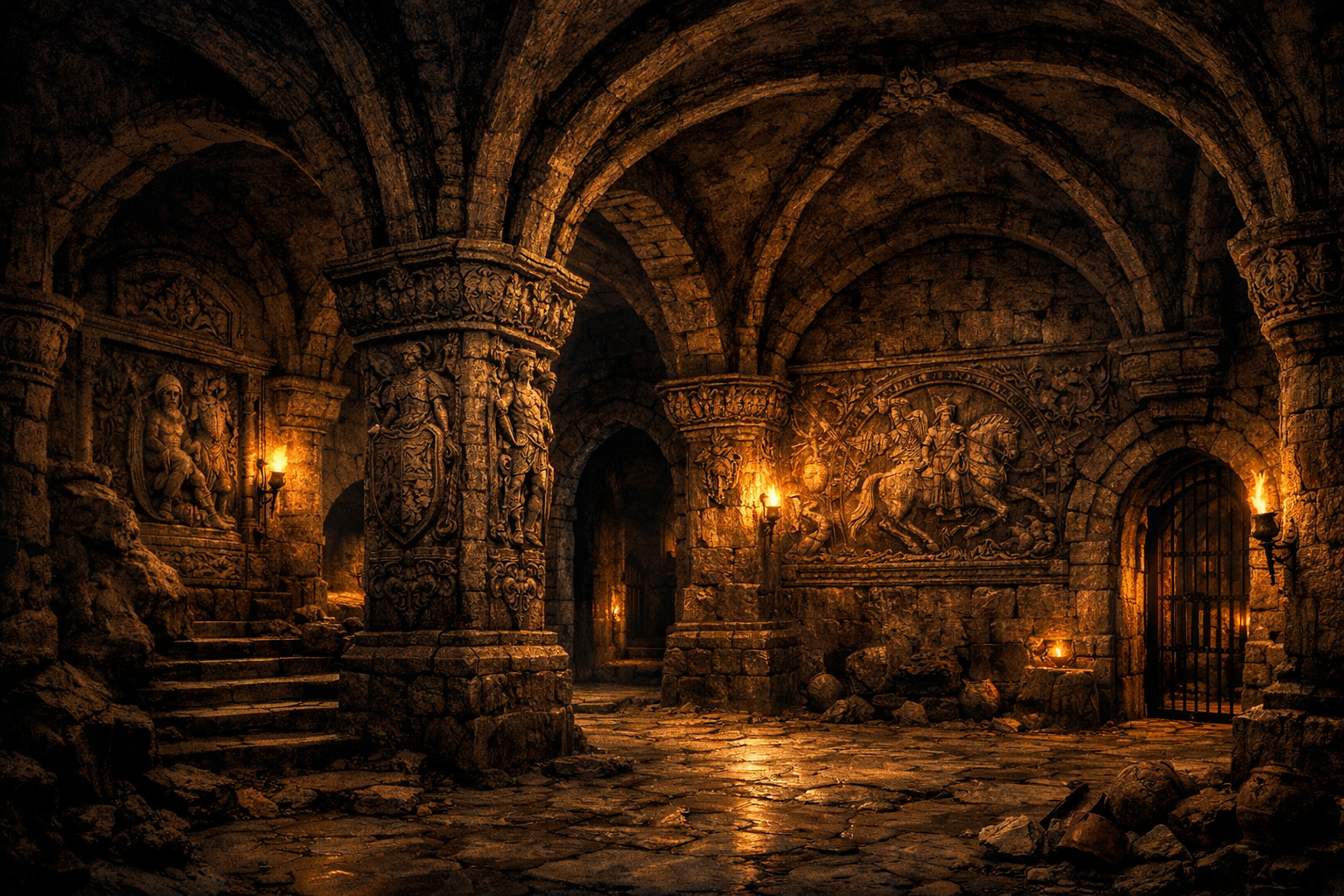
Individual rooms form the building blocks of great dungeon adventures. Learn how to design chamber encounters that engage players, reward creativity, and drive your story forward.
Players explore a dungeon one space at a time.
They may eventually remember the entire ruined fortress, flooded temple, or underground city, but many of the strongest memories come from individual places:
- The chamber where they talked a monster out of attacking
- The flooded archive where something moved beneath the water
- The bridge they deliberately collapsed behind them
- The throne room where they realized the supposed villain was telling the truth
- The storage room they barricaded and turned into a temporary stronghold
A memorable dungeon room is therefore more than a container for a monster, puzzle, treasure chest, or clue.
It is a playable space.
Players should be able to perceive useful information, interact with features, make decisions, and produce consequences.
That does not mean every room needs a major encounter.
Some spaces exist primarily to establish geography, atmosphere, history, or distance.
The goal is not to make every chamber spectacular.
The goal is to make important rooms usable.
This guide focuses on the design of individual dungeon spaces: what players notice, what they can manipulate, what pressures exist, and how their decisions change what happens next.
For broader guidance on how rooms work together across an entire dungeon, see:
Room Purpose and Pacing in Dungeon Design
Start With the Room as a Place
Before deciding what encounter happens in a room, ask:
Why does this room exist?
That question concerns the fictional location rather than the adventure outline.
A monastery might contain:
- Chapel
- Dormitory
- Kitchen
- Library
- Storage
- Workshop
- Crypt
- Administrative offices
A fortress might contain:
- Gatehouse
- Barracks
- Armory
- Cistern
- Kitchen
- Command chamber
- Prison
- Supply rooms
A wizard's laboratory might contain:
- Research chambers
- Specimen storage
- Ritual rooms
- Libraries
- Workshops
- Containment areas
- Servant spaces
Once you know what a place was built for, ask what has happened to it since.
Perhaps the old barracks is now occupied by goblins.
Perhaps the chapel has flooded.
Perhaps the laboratory has been abandoned for a century.
Perhaps the crypt has become a smuggler route.
This immediately gives the room context.
A Room Can Have More Than One Role
A chamber can contribute to play in several ways simultaneously.
Useful room roles include:
Conflict Space
A place where combat, pursuit, defense, or another direct confrontation could occur.
Problem Space
A room containing an obstacle, mechanism, hazard, puzzle, or other problem to overcome.
Discovery Space
A location that rewards investigation through clues, history, secrets, useful information, or unusual features.
Resource Space
A location containing something useful:
- Supplies
- Healing
- Equipment
- Treasure
- Tactical leverage
- Information
- Access to another route
Relationship Space
A room where characters can interact with inhabitants, prisoners, rivals, allies, spirits, or factions.
These categories are design aids.
They are not official D&D room types, and a room does not need to fit neatly into one.
Consider an abandoned guardroom.
It might simultaneously:
- Contain evidence of a recent attack
- Give access to a secret passage
- Provide weapons
- Become defensible if the party barricades it
- Turn into a combat location if a patrol returns
Its purpose changes depending on what the players do.
That flexibility is valuable.
The Anatomy of a Playable Dungeon Room
A useful individual-room framework is:
- Purpose
- First impression
- Interactive features
- Pressure
- Payoff or consequence
You do not need to write five paragraphs for every chamber.
Often one or two lines per category is enough.
The framework simply helps ensure important rooms contain something the Dungeon Master can actually run.
1. Purpose: Why Is This Space Here?
Ask two different questions.
Fictional Purpose
What was the room built for?
Example:
Barracks for temple guards.
Current Purpose
How is it being used now?
Example:
A group of kobolds uses it as a sleeping area and lookout post.
That difference naturally produces details.
The original room might contain:
- Weapon racks
- Stone bunks
- Guard schedules carved into a wall
- A doorway overlooking the main hall
The kobolds might have added:
- Bedrolls
- Cooking gear
- Warning bells
- Small barricades
- Tunnels sized for themselves
Now the room communicates two layers of history.
That is more interesting than:
30-by-40-foot room. Four kobolds.
2. First Impression: What Do the Characters Immediately Know?
When characters enter a room, provide the information they could reasonably perceive.
Do not make players interrogate the Dungeon Master one feature at a time just to establish the basic scene.
Suppose the party enters a flooded archive.
A useful opening description might be:
Cold water reaches halfway up your boots. Rotting shelves line both walls, most of their books swollen beyond recognition. A raised stone reading desk remains dry in the center of the chamber, while broad ripples move slowly across the water near the far wall.
That gives the players several anchors:
- Flooded shelves
- Dry central desk
- Something disturbing the water
They can immediately choose where to focus.
Use a Few Strong Details
Justin Alexander has proposed several descriptive rules of thumb for Game Masters, including using multiple senses and keeping descriptions focused around a small number of evocative elements.
A practical version is:
Give players a few memorable anchors, then add detail as they interact.
Three anchors often work well for an ordinary room.
That is a heuristic, not a rule.
A simple corridor may need one important detail.
A magnificent throne room may deserve several.
A complicated tactical battlefield may require more information because positioning and environmental features directly affect decisions.
The goal is clarity plus evocation.
Describe What Could Affect Decisions
Prioritize details that characters would notice and that might change what they do.
For example:
The chamber contains a stone altar.
is less useful than:
A waist-high stone altar stands in the center of the chamber. Its surface is covered in fresh blood, and an iron chain runs from its base through a narrow hole in the floor.
The second version creates questions:
- Whose blood?
- Where does the chain go?
- Can we pull it?
- Is something beneath the floor?
- Is this mechanism connected to the altar?
Description becomes gameplay.
Progressive Disclosure
You do not need to explain everything when characters cross the threshold.
Give obvious information first.
Then reveal additional details when players investigate.
Initial:
A carved stone desk rises above the floodwater.
Closer inspection:
A leather journal has been chained to the desk. Beside it, three clay tablets sit in recessed slots.
Opening the journal:
Most pages have dissolved, but the final readable entry mentions someone deliberately opening the lower floodgates.
Each interaction rewards attention with more information.
3. Interactive Features: What Can the Players Actually Use?
One of the easiest ways to improve a room is to add features that are not merely decorative.
Players might:
- Move them
- Break them
- Climb them
- Hide behind them
- Open them
- Burn them
- Block them
- Read them
- Carry them
- Repair them
- Use them against enemies
- Use them to change the environment
Consider an orc barracks containing:
- Weapon racks
- Heavy tables
- Hanging lamps
- A narrow balcony
- An alarm bell
- A door barred from the inside
Those features create options.
During combat, players may:
- Overturn tables for cover
- Cut down a lamp
- Prevent someone from reaching the bell
- Reach the balcony
- Barricade the door
Outside combat, they might:
- Steal weapons
- Disable the alarm
- Search patrol maps
- Disguise themselves
- Question occupants
The room supports play instead of simply containing it.
Interactive Does Not Mean Everything Is a Puzzle
A chair can just be a chair.
A fireplace can just provide heat.
A cracked wall can merely indicate age.
Do not make every object secretly important.
Players need ordinary environmental context to understand what is unusual.
A dungeon where every statue conceals a lever and every carpet hides a trap quickly becomes less mysterious, not more.
Give Interactive Features a Reason to Exist
Dungeon elements feel more coherent when their presence follows the fiction.
An alarm bell belongs in a guardroom.
A massive counterweight belongs near a portcullis.
A drainage mechanism belongs in a flooded temple.
A surgical table belongs in a laboratory.
A ceremonial brazier belongs in a shrine.
That does not mean everything must be historically or architecturally perfect.
Fantasy locations can be strange.
The question is whether the room feels like a place rather than a collection of encounter props.
4. Pressure: What Makes the Room More Than a Static Description?
Pressure is whatever forces or encourages a decision.
It can be obvious:
- Hostile monster
- Fire
- Rising water
- Collapsing structure
- Ritual nearing completion
Or subtle:
- Footsteps approaching
- A creature that has not noticed the party
- Evidence that someone else recently passed through
- Limited time
- A suspicious NPC
- A difficult route choice
- Valuable information that could be lost
Not every room needs pressure.
Quiet spaces are important.
But memorable encounter rooms usually contain something that makes the players ask:
"What do we do?"
Pressure Does Not Mean Combat
Imagine a chamber with:
- Two exits
- A sleeping ogre
- A locked chest beside the ogre
- A rope bridge above the room leading to another passage
There is no automatic combat.
Players might:
- Sneak past
- Steal the chest
- Wake the ogre and talk
- Use the upper route
- Attack
- Leave
The tension comes from possibility.
Inhabitants Need Motives
When creatures occupy a dungeon room, ask:
Why are they here?
A guard may be protecting:
- A gate
- Supplies
- A prisoner
- An alarm system
- Another person
A scavenger might simply be feeding.
A rival adventurer may be searching for the same artifact.
A spirit may be unable to leave.
Those motives change behavior.
A guard protecting an alarm may prioritize reaching the bell instead of fighting until death.
A mercenary protecting treasure may surrender when continued resistance becomes unprofitable.
A frightened creature may retreat.
Once enemies have goals, combat becomes more than reducing Hit Points.
5. Payoff and Consequence: Why Did This Room Matter?
A room does not need treasure.
It does not even need a major clue.
But important rooms should usually change something.
The characters might gain:
- Information
- Access
- Treasure
- A relationship
- Safety
- A shortcut
- A tactical advantage
- A new problem
- An answer
- Another question
Or the dungeon itself might change.
Perhaps:
- Enemies become alerted
- A passage collapses
- Water begins draining
- A faction becomes hostile
- Prisoners escape
- Another route opens
- The party acquires an ally
The payoff is not always positive.
It simply means that interaction mattered.
The Difference Between a Reward and a Consequence
Suppose the characters defeat guards protecting a gate.
Reward:
They obtain the guards' keys.
Consequence:
Someone in the next area heard the fight.
Both matter.
The room has changed the party's options and the dungeon's state.
That creates continuity between spaces.
Meaningful Choices Inside a Room
A meaningful choice usually contains:
- More than one plausible option
- Enough information to reason about those options
- Different consequences
Consider:
A locked iron door blocks the only exit. The key is hidden beneath the third floor tile.
That is primarily a search procedure.
Now consider:
A locked iron door blocks the direct route. A sleeping guard wears the key. A narrow ventilation shaft disappears above the ceiling, and the hinges look old enough that the door might be broken with considerable noise.
Now players can weigh:
Stealth
Take the key.
Exploration
Investigate the ventilation shaft.
Force
Break the door.
Social Interaction
Wake the guard and try something else.
None needs to be equally easy.
The important thing is that the room presents a situation rather than one answer hidden in the Dungeon Master's notes.
Not Every Obstacle Needs Multiple Solutions
There is an important limit to this advice.
A particular lock may only open with a particular key.
A ceremonial mechanism may genuinely require a specific sequence.
That is fine.
Problems arise when essential progress requires the players to guess a solution they have no reasonable way to determine.
If the ritual sequence is specific, clues might exist through:
- Murals
- Religious records
- Inscriptions
- An NPC
- Another room
The mechanism can have one solution while the information necessary to understand it remains accessible through several avenues.
Environmental Storytelling
Dungeon rooms can reveal history without an exposition speech.
Ask:
What happened here, and what physical evidence did it leave?
A bedroom contains:
- Overturned furniture
- Deep claw marks
- A meal abandoned halfway through
- A shattered window
Players can infer:
Something happened suddenly.
Something violent was probably involved.
Someone may have escaped through the window.
You have communicated history through objects.
Layer Different Periods of Occupation
Many memorable dungeons have several historical layers.
Imagine an ancient dwarven fortress now occupied by goblins.
The room might contain:
Original architecture
- Stone bunks
- Geometric carvings
- Heavy iron ventilation shafts
Later damage
- Fire-blackened walls
- Collapsed doorway
- Broken masonry
Current occupation
- Goblin bedrolls
- Cooking fires
- Stolen furniture
- Crude warning signs
The players can read the location's history without receiving a lecture.
Contradictions Create Questions
A useful technique is placing two details together that do not seem to fit.
Examples:
An abandoned room covered in dust, except for one polished chair.
A tomb whose door has been sealed from the outside.
A torture chamber whose instruments are spotless despite decades of neglect.
A ruined temple with fresh flowers on the altar.
The contradiction creates a question.
Questions create investigation.
Let Rooms Remember Player Actions
If players change a dungeon, later spaces should sometimes reflect it.
Suppose the party floods the lower level.
Later they might discover:
- Waterlogged supplies
- Displaced creatures
- New blocked routes
- Floating debris
- Factions moving upward
- Previously inaccessible objects floating free
If they trigger an alarm:
- Doors become barricaded
- Guards relocate
- Prisoners are moved
- Valuable objects disappear
The dungeon becomes a responsive environment rather than a static map.
Combat Rooms: Build Around Objectives, Not Just Geometry
A 40-by-40-foot chamber is not automatically a tactical encounter.
Ask:
What is everyone trying to accomplish?
Perhaps the enemies need to:
- Reach an alarm
- Hold the doorway
- Protect a prisoner
- Complete a ritual
- Escape
- Capture someone
The party may need to:
- Cross the room
- Stop the ritual
- Rescue someone
- Hold the bridge
- Escape before the ceiling collapses
Now the room has an objective beyond:
Reduce the other side to zero Hit Points.
Let Terrain Matter
Useful combat features include:
- Cover
- Elevation
- Chokepoints
- Water
- Darkness
- Difficult terrain
- Doors
- Machinery
- Fire
- Breakable structures
- Narrow bridges
- Vertical shafts
Do not add environmental mechanics solely to make combat complicated.
Use features appropriate to the location.
A forge might contain:
- Furnaces
- Carts
- Chains
- Cooling channels
- Raised walkways
A crypt might contain:
- Sarcophagi
- Columns
- Stairs
- Burial niches
- Narrow passages
The room's fiction creates its tactical identity.
Puzzle and Mechanism Rooms
A puzzle works best when players can understand what they are interacting with.
Give feedback.
If pressing the wrong symbol causes:
- A faint click
- One rune to extinguish
- Water to rise slightly
players learn something.
If every incorrect attempt produces:
"Nothing happens."
the puzzle may become blind guessing.
Connect Mechanisms to the Location
A water temple might use:
- Channels
- Floodgates
- Pressure
- Reflections
An observatory might use:
- Stars
- Lenses
- Rotating rings
- Celestial alignments
A dwarven facility might use:
- Counterweights
- Gears
- Stone locks
- Pressure systems
The puzzle becomes part of the world rather than an arbitrary brainteaser inserted for the players.
Resource Spaces
Some rooms provide useful opportunities.
Examples:
- Armory
- Pantry
- Shrine
- Workshop
- Well
- Guard post
- Supply depot
- Hidden cache
A resource can create a decision.
The party finds three healing potions.
Do they use one now?
Save all three?
Give one to an NPC?
Trade them?
Likewise, discovering a defensible chamber might make resting more practical.
But the room does not automatically guarantee a Short Rest or Long Rest.
The circumstances still matter:
- Are enemies searching?
- Can the doors be secured?
- Is there time pressure?
- Does anyone know they are there?
Players can create safety.
The dungeon does not owe it to them.
Quiet Rooms Are Useful
A common dungeon-design mistake is believing every room must contain something mechanically important.
That can make the dungeon feel like a sequence of theme-park attractions.
A quiet room can contribute:
- Architecture
- Atmosphere
- Navigation
- History
- Contrast
- Distance
- Ordinary life
- A future tactical position
Imagine an abandoned dormitory.
It contains:
- Broken bunks
- Rotting blankets
- Washbasins
- Dust
- Two exits
No monster.
No treasure.
No secret.
The room still tells players:
People once lived here.
It also establishes space and provides another route.
That can be enough.
The problem begins when several rooms pass without adding any new:
- Information
- Decision
- Spatial understanding
- Atmosphere
- Threat
- Opportunity
Quiet does not mean meaningless.
Room Connections Matter
A memorable room does not exist in isolation.
Ask what connects it to nearby spaces.
Can characters:
- Hear something through a wall?
- Smell smoke from the next area?
- See torchlight beneath a door?
- Notice airflow?
- Hear running water?
- See another balcony across a shaft?
Those signals make geography legible before the party physically enters the next space.
Sight Lines Create Information
Suppose characters stand on a balcony overlooking a lower hall.
They can see:
- Guards
- Another doorway
- A strange statue
- A possible route
That lets them plan.
Likewise, arrow slits, windows, broken walls, balconies, wells, grates, and open staircases can connect spaces visually.
A dungeon becomes easier to understand when rooms communicate with one another.
Thematic Connections
Nearby rooms should often make sense together.
A temple might progress through:
- Public worship area
- Private chapel
- Clergy quarters
- Archive
- Crypt
A fortress might contain:
- Gatehouse
- Guardroom
- Barracks
- Armory
- Command area
The players begin understanding the building.
That knowledge can produce predictions:
"If this was the barracks, the armory may be nearby."
That is exploration skill emerging from architecture.
A Complete Example: The Sunken Shrine
Consider a chamber inside the flooded temple of Keth-Mara.
The party is investigating why the temple's clergy disappeared decades ago.
Purpose
Originally:
Ceremonial shrine controlling access to the lower sanctuary.
Now:
Partially flooded chamber occupied by an old magical guardian.
First Impression
You emerge into a round chamber beneath a cracked dome. Dark water fills most of the room nearly to the ceiling, leaving only a narrow pocket of air above the surface. Four carved pillars rise from the water at the corners, and a bronze door is visible beneath the surface on the far wall. Something pale moves slowly between the submerged statues below.
Players immediately know:
- The room is deeply flooded.
- Pillars provide handholds.
- A submerged door exists.
- Something is in the water.
Interactive Features
The room contains:
- Four climbable pillars
- Three submerged statue alcoves
- Bronze door
- Locking mechanism
- Broken drainage wheel
- Magical guardian
Each offers interaction.
Pressure
The guardian is wary rather than automatically hostile.
It was bound to protect the shrine.
It cannot leave.
The party might:
- Attack
- Communicate
- Distract it
- Free it
- Avoid it
Meanwhile, prolonged activity underwater creates practical challenges.
Discovery
The alcoves contain statues depicting the temple's final ritual.
Careful investigation reveals that the priests deliberately flooded the sanctuary.
That raises a larger question:
What were they trying to contain?
Mechanism
The bronze door requires three stone seals to be depressed simultaneously.
The seals appear in separate alcoves.
Possible approaches include:
- Multiple characters operating them
- Mechanical improvisation
- Magic
- Freeing the guardian, which knows the ritual
- Finding another route later
Consequences
If the guardian is freed, it may:
- Leave peacefully
- Share information
- Attack another dungeon faction
- Damage part of the shrine while escaping
If defeated:
- The party can search its binding site
- Nearby creatures may detect the battle
If ignored:
- The party may seek another entrance
Payoff
Beyond the door lies:
- Ceremonial equipment
- The high priest's final journal
- Another route toward the lower temple
The room is memorable not because it contains a monster, puzzle, and treasure simultaneously.
It is memorable because its pieces relate to one another and the players determine how those pieces interact.
Designing Room Descriptions
When writing room notes, separate DM information from initial player information.
DM Notes
- Guardian is bound to shrine.
- It attacks only if characters damage the door or binding stone.
- Flooding was deliberate.
- Drainage mechanism can lower water level.
- Journal is beyond bronze door.
Initial Description
- Deep water
- Submerged bronze door
- Four pillars
- Movement beneath surface
Now you know the truth without revealing it prematurely.
Compact Room Key Format
A practical room note might look like:
Flooded Shrine
Purpose: Seal to lower sanctuary.
Visible: Deep water, pillars, submerged bronze door, movement below.
Features: Three statue alcoves, broken drain wheel, ritual seals.
Occupant: Bound guardian, suspicious but capable of communication.
Clue: Statues depict clergy deliberately flooding temple.
Reward: High priest's journal and ceremonial cache beyond door.
Change: Freeing guardian affects later faction encounter.
That is often easier to run than several paragraphs of prose.
Pacing Inside a Room
This article focuses on individual rooms rather than whole-dungeon pacing, but pacing still matters at the chamber level.
Ask:
Has the room given the players enough information to make a decision?
If yes, give control back to them.
Do not continue describing for another two minutes merely because you wrote more material.
Likewise, if the group clearly understands a simple room and wants to move on, let them.
Not every chamber deserves equal table time.
Avoid Fixed Time Estimates
A combat might last:
- Ten minutes
- An hour
- Most of a session
A puzzle could take:
- Thirty seconds
- Twenty minutes
- Much longer than expected
A quiet room may become the session's longest scene because the players discover something fascinating there.
Design around decisions and complexity rather than predicting exact table time.
Common Dungeon Room Problems
Problem: The Room Is Just a Container
Four orcs stand in a square room.
Improve it by asking:
- Why are the orcs here?
- What are they doing?
- What does the room contain?
- What can everyone interact with?
Perhaps it becomes a barracks with:
- Alarm bell
- Patrol map
- Weapon racks
- Barricade
- Sleeping off-duty guards
Now the room supports more choices.
Problem: Nothing Is Visible to Interact With
If players repeatedly ask:
"Is there anything here?"
your descriptions may not be providing enough useful information.
Present obvious features clearly.
Do not hide every meaningful element behind an ability check.
Problem: Everything Is Important
If every object is:
- A clue
- A trap
- A secret
- A puzzle component
players may become exhausted.
Ordinary details create contrast.
Problem: One Exact Solution
If progress requires:
Guess the word I am thinking of.
the room is fragile.
Provide information players can reason from or alternate approaches where appropriate.
Problem: Encounter and Location Do Not Match
A giant creature in a six-foot-wide corridor may require explanation.
A military guard station with no way to raise an alarm may feel odd.
A secret treasure vault beside a public dining hall may need context.
Fantasy does not require realism.
It benefits from internal logic.
Problem: Nothing Changes
If players:
- Fight
- Investigate
- Negotiate
- Break machinery
and the surrounding dungeon behaves exactly the same, rooms can start to feel disconnected.
Allow meaningful actions to propagate.
Review Questions Before Play
For important rooms, ask:
Place
- Why was this room built?
- Who uses it now?
Information
- What is immediately visible?
- What additional details can investigation reveal?
Interaction
- What can players manipulate?
- What can they use creatively?
Pressure
- What might force or encourage a decision?
Agency
- Can more than one reasonable response matter?
Consequence
- What can change because of this room?
Connection
- What does this room reveal about nearby spaces or the larger dungeon?
You do not need perfect answers to every question.
They are diagnostic prompts.
Test the Obvious Approach
Imagine how players might respond first.
If they enter a room with a locked chest, someone will probably try to open it.
Know what happens.
If an obvious hallway leads toward chanting, someone may listen.
Know what they can reasonably learn.
Then ask:
What happens if they do something I did not expect?
You do not need to predict everything.
You need enough understanding of the room that you can adjudicate new ideas consistently.
Use the Room's Logic to Improvise
Suppose the party wants to collapse a ceiling you never expected them to touch.
Ask:
- What is the ceiling made of?
- Is it structurally damaged?
- What support exists?
- What tools or magic are being used?
- What is above it?
The room's established fiction helps determine the answer.
That is more reliable than deciding based on whether collapsing the ceiling would ruin the planned encounter.
How The Dungeon Trainer Can Support Room Design
The Dungeon Trainer does not replace the Dungeon Master's judgment or a dedicated dungeon-mapping tool.
Its existing tools can support several parts of the room-design process.
Scry
Scry examines an upcoming scene and projects plausible ways it could develop.
For a dungeon room, that can help reveal assumptions such as:
"I expect the party to fight the guardian."
Scry may surface alternatives:
- Negotiate
- Bypass
- Retreat
- Distract it
- Manipulate the environment
- Approach from another direction
The goal is not to predict the players.
It is to expose fragile preparation before play.
The Coach
The Coach provides self-contained practice situations followed by rubric-grounded feedback.
Relevant skills include:
- Exploration adjudication
- Player agency
- Information clarity
- Encounter management
- Pacing
- Responding to unexpected approaches
A Dungeon Master can practice making calls in exactly the kinds of situations a flexible room produces.
Generators
The Dungeon Trainer can generate:
- Locations
- Monsters
- NPCs
- Characters
- Magic items
- Spells
These can provide ingredients.
For example:
- Generate the guardian.
- Generate the abandoned shrine.
- Generate an item found in the room.
- Generate an NPC connected to its history.
Generated content still needs to be integrated.
Ask:
- Why is it here?
- What does it want?
- How does it connect to the dungeon?
- What can players do with it?
A generated chamber is not automatically a well-designed chamber.
Campaign Memory and Codex
Dungeon rooms often matter again later.
The Dungeon Trainer maintains searchable records of:
- People
- Places
- Quests
- Events
That can preserve what happened after the party:
- Flooded a chamber
- Freed a prisoner
- Met an NPC
- Changed faction relationships
- Discovered a secret
A dungeon map tracks spatial relationships.
Campaign memory tracks narrative continuity.
Fully Human-Run Play
The Dungeon Trainer supports human-run campaigns where the Dungeon Master keeps control of narration and adjudication.
The platform can maintain shared elements such as:
- Character sheets
- Dice
- Hit Points
- Conditions
- Initiative
- Combat state
- Shared transcript
- Campaign continuity
AI assistance remains optional.
That makes these room-design principles usable whether the Dungeon Master wants AI-assisted preparation or a completely human-run table.
How This Article Fits Into Dungeon Design
Individual room design is only one layer.
Dungeon Structure
Determines:
- Routes
- Loops
- Levels
- Entrances
- Shortcuts
Room Purpose
Determines:
- Why each space exists
- What it contributes
Room Design
Determines:
- What players perceive
- What they can interact with
- What pressures exist
- What consequences follow
Pacing
Determines:
- How pressure, information, decisions, and table time change
Factions
Determine:
- Who occupies the dungeon
- What they want
- How they react
Those layers work together.
A beautifully designed room inside a meaningless linear dungeon may still feel limited.
A brilliant nonlinear map filled with rooms that offer nothing to interact with may feel empty.
Strong dungeons combine both scales.
Building Better Rooms Over Time
Room design improves through actual play.
After the session, ask:
- Which feature did players notice first?
- Which features did they use?
- Did the room provide enough information?
- Did the environment matter?
- Were there meaningful choices?
- Did the room react to what happened?
- Did players discover something unexpected?
- Was anything confusing?
- What did they remember afterward?
Do not judge success by whether the players followed your intended solution.
They may:
- Turn your puzzle room into a combat
- Turn your combat room into a negotiation
- Turn your storage room into headquarters
- Ignore your treasure
- Become obsessed with a decorative statue
That is not automatically failure.
The purpose of room preparation is not to prescribe what happens inside it.
It is to give the table a coherent space in which something can happen.
Conclusion
Memorable dungeon rooms are not memorable because they contain more things.
They are memorable because the things inside them create opportunities for play.
Start by asking:
Why does this room exist?
Then establish:
What do the characters immediately perceive?
Give them:
Features they can interact with.
Add pressure when the situation calls for it.
Let investigation reveal more.
Allow inhabitants to have motives.
Connect the room to the spaces around it.
Then make sure what players do can actually matter.
A flooded shrine becomes memorable because the players can:
- Explore it
- Understand its history
- Manipulate its mechanisms
- Talk to its guardian
- Fight if they choose
- Change what happens elsewhere
A barracks becomes memorable because players turn its furniture into defenses and steal the patrol map.
A quiet bedroom becomes memorable because fresh flowers on a century-old grave tell them someone else is still here.
The map gives you a room.
Interaction turns it into an encounter.
Consequences turn it into part of the campaign.
That is how dungeon rooms become places players remember.
Sources and Further Reading
Adams, J. J. (Ed.). (2023). Kobold Guide to Dungeons. Kobold Press.
Alexander, J. (2010). Xandering the Dungeon. The Alexandrian. https://thealexandrian.net/wordpress/13085/roleplaying-games/xandering-the-dungeon
Alexander, J. (2017, September 4). Random GM Tip: Evocative Descriptions. The Alexandrian. https://thealexandrian.net/wordpress/39227/roleplaying-games/random-gm-tips-evocative-descriptions
Gygax, G., & Arneson, D. (1974). Dungeons & Dragons, Volume 3: The Underworld & Wilderness Adventures. Tactical Studies Rules.
Shea, M. E. (2018). Return of the Lazy Dungeon Master. Sly Flourish.
Wizards of the Coast. (2024). Dungeon Master's Guide. Wizards of the Coast.
The Dungeon Trainer. (2026). Room Purpose and Pacing in Dungeon Design. https://thedungeontrainer.com/blog/room-purpose-and-pacing-in-dungeon-design
Related reading
- Five Weeks in the Sunken Archive: Lessons from a Real Dungeon Crawl Campaign
A five-session dungeon crawl through a flooded library taught valuable lessons about pacing, player agency, and adaptive design. Discover what worked, what failed, and how these insights can improve your own adventures.
- Random Dungeon Generation vs. Hand-Crafted Design: Which Approach Works Best?
Random generation offers speed and surprise while hand-crafted dungeons provide narrative control. Compare both approaches to find the right balance for your table and campaign style.
- Essential Dungeon Master Tools: Your Checklist for Running Better Dungeon Adventures
Running smooth dungeon sessions requires the right preparation and resources. This comprehensive toolkit gives you everything you need to manage exploration, combat, and player engagement.