When Session Zero Prevents a Campaign Collapse: Lessons from a Failed Table
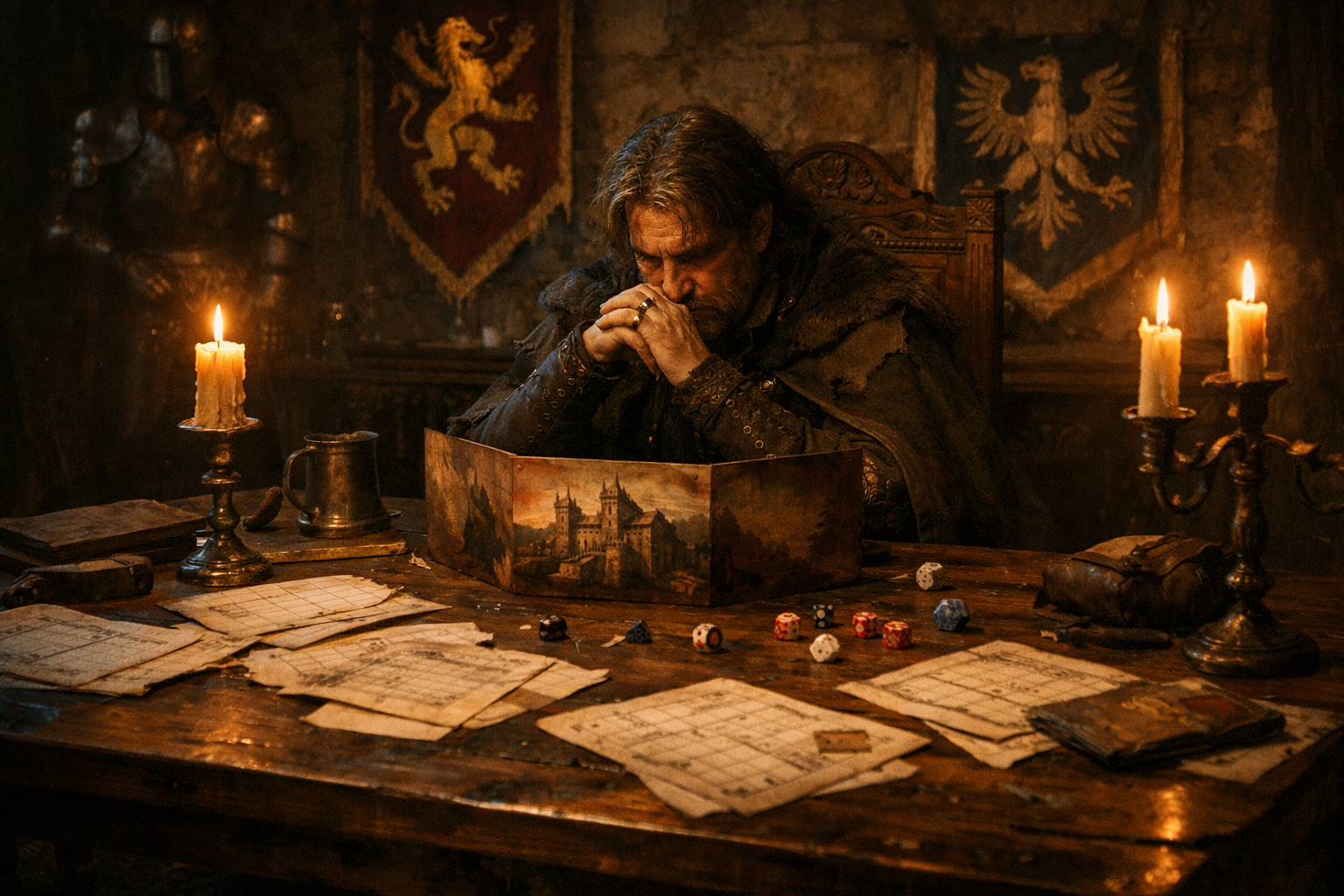
Not every campaign makes it to the end. See how one table's collapse revealed exactly why session zero matters, and what you can learn from their mistakes.
Not every campaign survives to reach its conclusion.
Sometimes the problem is scheduling. Sometimes players lose interest. Sometimes the Game Master burns out. Sometimes a campaign simply reaches a natural stopping point earlier than expected.
Other campaigns struggle because the people at the table entered the game with expectations that were never made explicit.
Session Zero cannot guarantee that a campaign will succeed, but it can expose important mismatches before players and Game Masters invest heavily in a game that different people imagine in very different ways.
The following is a fictional composite case study built from common tabletop problems. Marcus, Sarah, Tom, Khemenet, and the campaigns described here are illustrative rather than accounts of an identifiable real gaming group.
The point is not that every failed campaign could have been saved.
It is to examine which problems might have become visible much earlier if the group had talked about them before Session One.
The Campaign That Never Found Its Footing
Five players gather for what their Game Master, Marcus, describes as a political-intrigue campaign set in a desert city-state.
Marcus loves the premise.
He has spent months developing Khemenet, an elaborate city shaped by competing merchant houses, religious factions, political families, and criminal organizations.
He assumes the players understand the type of game he intends to run.
They do not.
By Session Six, attendance has become inconsistent and enthusiasm has noticeably declined.
Eventually, the campaign ends.
When Marcus speaks with the players individually afterward, several mismatches become clear.
Three players had imagined a campaign involving substantial dungeon exploration and tactical combat.
Sarah had become uncomfortable with subject matter involving coerced labor and exploitation that emerged in the merchant-house storyline.
Tom had created a character centered heavily on wilderness exploration because he had not realized how completely urban the campaign would be.
No single one of these problems necessarily had to destroy the campaign.
But all of them would have been easier to address if they had surfaced before or near the beginning of play.
What Went Wrong: A Timeline of Missed Signals
Before Session One: The Campaign Description Was Too Ambiguous
Marcus sends a short email describing:
"A campaign focused on intrigue and politics in the desert city of Khemenet."
He assumes those words communicate the experience.
Several players interpret them differently.
Three see "desert campaign" and imagine:
- Ancient tombs
- Desert monsters
- Ruined temples
- Dangerous expeditions
- Frequent combat
Marcus imagines:
- Political receptions
- Investigations
- Merchant negotiations
- Faction alliances
- Espionage
- Social consequences
Both interpretations are plausible from such a short description.
The problem is not that the players misunderstood.
The problem is that the description left too much important information unstated.
Character Concepts Develop Around Different Campaigns
Several players build characters designed primarily around combat because they expect frequent tactical encounters.
Sarah builds a character without knowing that exploitation, coerced labor, and similar themes may become prominent parts of the setting.
Those subjects are uncomfortable for her, but the group never discusses campaign content beforehand.
Tom builds a Ranger whose concept revolves heavily around wilderness expeditions, tracking through remote environments, and surviving beyond civilization.
That character could function mechanically in an urban campaign.
Rangers are not inherently limited to wilderness stories.
The problem is that the experience Tom built the character to have is largely absent from Marcus's campaign.
Tom wanted to explore dangerous territory.
Marcus planned almost everything inside one city.
Neither knew the mismatch existed.
A Session Zero could have surfaced all three issues before the characters and campaign preparation became heavily invested in different assumptions.
Session One: The Differences Become Visible
The campaign opens at a political reception in the estate of an influential merchant.
Marcus has prepared:
- Rival faction representatives
- Political conversations
- Subtle clues
- Economic tensions
- Potential alliances
- Information hidden behind social interaction
This accurately represents the campaign he wants to run.
Several players, however, expected something else.
After a long period of conversation and investigation, some become impatient.
One attempts to turn a confrontation with an NPC into a fight.
Marcus sees the decision as disruption of the political scenario he prepared.
The player sees it as finally creating the kind of action they expected from the game.
Nobody is necessarily acting maliciously.
They are operating from different assumptions.
Tom's Character Has a Different Problem
Tom looks for ways to use the character concept he created.
He asks about:
- Scouting
- Tracking
- Travel
- Nearby wilderness
- Expeditions outside the city
Marcus keeps redirecting events toward the merchant-house conflict because that is the campaign.
Again, the problem is not that a Ranger cannot work in a city.
An urban Ranger could be:
- A bounty hunter
- An investigator
- A monster tracker
- A scout working rooftops and alleys
- A guide through dangerous districts
- An expert on urban creatures or criminals
The problem is that Tom created a character around a specific type of play without knowing that type of play would rarely occur.
Sessions Two Through Four: The Mismatch Deepens
Marcus notices that several players are not engaging strongly with the political story.
He assumes they have not yet become invested.
So he prepares more intrigue.
The combat-focused players interpret the continuing absence of substantial combat as confirmation that the campaign is not what they expected.
Eventually a fight occurs.
Instead of feeling like a natural culmination of events, some participants experience it as though combat has been inserted merely because people complained.
Meanwhile, Sarah becomes increasingly uncomfortable as exploitation within the merchant houses becomes more prominent.
She does not immediately raise the issue.
There are many possible reasons a player might hesitate:
- They do not know whether changing campaign content is acceptable.
- They do not want to interrupt everyone else's fun.
- They are uncertain how the GM will react.
- They are not comfortable explaining their objection publicly.
- They may not yet have identified precisely what bothers them.
The group never established a procedure for handling that situation.
Tom continues searching for opportunities connected to the character he imagined.
The campaign continues moving in another direction.
None of these problems is addressed directly.
That is what makes them dangerous.
Sessions Five and Six: The Campaign Loses Momentum
Attendance begins to become less consistent.
It is important not to assume that missed sessions automatically mean players are dissatisfied.
People have jobs.
They have families.
They become sick.
Schedules change.
Real-world obligations do not disappear because someone loves a campaign.
But in this fictional example, conversations afterward reveal that declining enthusiasm was one factor.
By Session Six, only part of the group attends.
Marcus runs the prepared material, but the table has little momentum.
Shortly afterward, the group agrees to stop the campaign.
There is no dramatic argument.
There does not need to be.
A campaign can fail quietly.
What Session Zero Might Have Changed
Session Zero would not have guaranteed that this group stayed together.
It could, however, have exposed several mismatches while they were still easy to address.
Expectation Alignment Could Have Revealed the Play-Style Conflict
Imagine Marcus explaining the campaign like this:
"Khemenet is primarily an urban political-intrigue campaign. Investigation, negotiation, faction relationships, espionage, and social consequences will drive much of play. Combat will occur, but some sessions may have none. The campaign is not primarily about wilderness exploration or repeated dungeon delves."
The three players expecting frequent tactical combat now have useful information.
Marcus can ask:
"Does that sound like the campaign you want to play?"
Their answer might lead in several directions.
Option One: Adjust the Campaign
Marcus still runs political intrigue but adds more opportunities for tactical conflict.
An urban political campaign could include:
- Assassination attempts
- Gang conflicts
- Warehouse raids
- Criminal hideouts
- Underground ruins
- Smuggling operations
- Gladiatorial events
- Street battles
- Faction warfare
The campaign remains political while providing more combat than Marcus initially envisioned.
Option Two: Keep the Campaign as Designed
Marcus may decide the intrigue-heavy structure is what excites him enough to run the game.
That is valid.
Players who primarily want tactical dungeon adventures can then decide whether they still want to participate.
Some may.
Others may prefer another campaign.
Option Three: Choose Another Campaign Together
Perhaps Marcus has several ideas he would enjoy running.
If the entire group becomes excited about a different one, he might choose that instead.
That does not mean every campaign must be selected by committee.
A Game Master is also a participant and should run something they genuinely want to run.
Session Zero simply makes the decision informed.
A Campaign Pitch Reduces False Assumptions
Marcus's original description was not technically inaccurate.
It was incomplete.
A useful campaign pitch could cover:
Premise
"You are independent agents becoming entangled in a struggle among Khemenet's merchant houses, religious institutions, political families, and criminal networks."
Expected Play
"Expect significant investigation, negotiation, faction politics, information gathering, and difficult choices. Combat will matter but will not occur every session."
Tone
"The campaign deals with political corruption, economic inequality, divided loyalties, and morally complicated factions."
Campaign Structure
"Most of the campaign takes place inside Khemenet, although occasional adventures may leave the city."
What the Campaign Is Not
"This is not primarily a wilderness exploration campaign or traditional dungeon crawl."
That gives players information they can actually use when deciding whether to join and what characters to create.
Content Discussions Could Have Identified Sarah's Concern
Current D&D guidance explicitly describes Session Zero as a place to establish expectations, including subjects the group wants to avoid as well as subjects it wants to embrace.
Groups can approach this in several ways.
Possible tools and procedures include:
- Lines and Veils
- The X-Card
- Script Change
- Consent checklists
- Private messages
- Open-door policies
- Simple pause procedures
- Other methods the table understands
No single named tool is required.
What matters is that participants know:
- How to communicate a boundary
- Whether they can do so privately
- What happens when a boundary is raised
- That boundaries can change later
In the fictional Khemenet campaign, Marcus might describe likely themes before play:
"Merchant exploitation, economic inequality, corruption, religious conflict, and criminal violence may appear."
Sarah can then privately say:
"I don't want active slavery or coerced servitude to be part of the campaign."
Marcus does not need to ask why.
He now knows what the campaign needs to avoid.
The Campaign Can Change Without Losing Its Premise
Perhaps Marcus originally planned a merchant house built around indentured labor.
He could replace that element with:
- Predatory debt
- Monopolistic trade practices
- Corrupt taxation
- Political bribery
- Price manipulation
- Smuggling
- Wage exploitation
- Fraudulent contracts
The political conflict survives.
The specific unwanted content does not need to.
Or Marcus could decide that the subject is too central to the campaign he wants to run.
If so, the honest answer may be that this particular campaign is not appropriate for Sarah.
Finding that out before play is still better than discovering it after several difficult sessions.
Character Creation in Context Could Have Helped Tom
Tom's Ranger was never inherently unsuitable.
The problem was the mismatch between the campaign and the fantasy Tom wanted the character to fulfill.
Suppose Marcus explains:
"Almost the entire first arc takes place within Khemenet. There may eventually be travel, but this is fundamentally an urban campaign."
Tom now has choices.
He could still play a Ranger but reinterpret the concept.
Perhaps the character tracks:
- Criminals
- Missing people
- Monsters hiding in the city
- Smugglers through sewer networks
- Fugitives through crowded districts
Or Tom could decide that the wilderness-explorer fantasy is the reason he wanted to play a Ranger and choose a different character for this campaign.
Either outcome is better than discovering the mismatch after the campaign begins.
Group Character Creation Can Build Connections
Creating characters in conversation with one another can also reveal assumptions about the party.
Ask:
- Why does each character care about the central conflict?
- Why are they willing to work together?
- What connects them to Khemenet?
- Does anyone already know another character?
- What kind of problems is each character interested in solving?
Do not require mechanically perfect party balance.
D&D parties do not need one predetermined composition.
The goal is compatibility with the campaign and one another.
Lessons for Your Own Table
The fictional Khemenet campaign illustrates several principles that apply beyond this specific example.
Lesson One: Ambiguous Assumptions Create Risk
A short campaign description can mean different things to different people.
"Dark fantasy."
"Sandbox."
"Political campaign."
"Exploration."
"Roleplay-heavy."
"Old-school."
Different players may attach very different expectations to the same phrase.
Give examples.
Describe what characters are likely to spend their time doing.
Explain what will probably be uncommon.
Ask questions.
Session Zero helps turn vague labels into concrete expectations.
Lesson Two: Early Alignment Is Usually Easier Than Late Repair
Campaigns can change after they begin.
Sometimes they should.
But early changes are often easier because fewer decisions depend on the existing structure.
Before Session One:
- Characters can be redesigned easily.
- Themes can be adjusted.
- House rules can be discussed.
- Scheduling can be reconsidered.
- Players can decide whether the campaign interests them.
After twenty sessions, those decisions may be connected to substantial character and campaign history.
That does not make change impossible.
It makes early communication valuable.
Lesson Three: Not Every Player Fits Every Campaign
Session Zero does not exist to force incompatible preferences into one compromise.
Chris Chinn's Same Page Tool makes this distinction particularly clear.
Its purpose is to establish what game the group is actually going to play.
It is not a survey where everyone lists incompatible preferences and the GM calculates an average.
Sometimes the useful discovery is:
"I like playing with these people, but I don't think this particular campaign is for me."
That is not necessarily a failure.
Friends do not have to enjoy every game together.
A group can play one campaign together and have different participants for another.
Lesson Four: Make Content Communication Explicit
A group does not have to use the X-Card, Lines and Veils, Script Change, or any particular branded system.
It should have some understood way for participants to communicate when material needs to stop, change, or receive less detail.
The group should also understand that someone can discover a new boundary after Session Zero.
Silence during the initial meeting does not create permanent consent for every subject that later appears.
Lesson Five: Character Relevance Starts With Campaign Context
Players cannot reliably build campaign-connected characters if they do not understand the campaign.
Before character creation, tell them:
- Where the campaign begins
- What characters are expected to do
- What kinds of challenges are common
- Whether the campaign travels extensively
- How important combat is
- How common magic is
- What major organizations exist
- Any important character restrictions
Then let players decide how closely their characters connect to those elements.
Lesson Six: Ask Why Someone Chose the Character
Class alone tells you very little.
Two Ranger players might want completely different experiences.
One wants:
"I want to be an expert tracker who hunts dangerous creatures."
Another wants:
"I love the Ranger's mechanics and want to play a city bounty hunter."
Those characters may fit the same campaign differently.
Ask:
"What part of this character are you most excited to play?"
That answer often tells you more than the class name.
What Marcus Does Differently Next Time
Because Marcus is fictional, his second campaign is not evidence that Session Zero guarantees long-running success.
Instead, use it as an example of how the lessons could be applied.
Several months later, Marcus decides to start another campaign.
This time, he prepares three campaign concepts he would genuinely enjoy running:
Khemenet Intrigue
Urban politics, investigation, faction conflict, and morally complicated alliances.
The Shattered Deep
A traditional dungeon-focused campaign built around exploring an enormous underground complex.
Beyond the Ember Road
A wilderness campaign centered on exploration, lost settlements, and dangerous expeditions.
The players discuss the options.
This particular group becomes most excited about The Shattered Deep.
Marcus is also enthusiastic about it, so he runs that.
Before creating characters, the group discusses:
- Expected combat frequency
- Exploration
- Lethality
- Character death
- Campaign tone
- Content boundaries
- House rules
- Scheduling
- Party relationships
One player does not want spiders to feature prominently.
Marcus had planned giant spiders in one section of the dungeon.
He replaces them with another creature.
The dungeon still works.
Characters are created with the campaign premise in mind.
The important difference is not that this fictional second campaign is guaranteed to last eighteen months.
It is that everyone begins with a clearer understanding of what they are agreeing to play.
Applying These Lessons to a New Campaign
Before beginning a new campaign, consider scheduling a Session Zero or incorporating its essential conversations before regular play starts.
Cover the subjects that matter for your group.
At minimum, consider discussing:
- Campaign premise
- Tone
- Expected activities
- Character creation
- Character relationships
- Content boundaries
- Table procedures
- House rules
- Scheduling
- Attendance
- Communication
A short campaign or one-shot may only need a brief version.
A campaign expected to last for years may justify substantially more discussion.
Scale the process to the commitment.
Applying These Lessons to a Campaign Already in Progress
If a campaign already feels misaligned, Session Zero is not a one-time opportunity that has permanently passed.
Pause and recalibrate.
You might say:
"I think we may have different expectations about how much combat this campaign contains. Before I prepare the next arc, I'd like to talk about what everyone expected, what's working, and what we might want to change."
Ask:
- What has been working?
- What has not?
- Is the campaign what people expected?
- Does anyone want more or less of something?
- Are any current rules creating problems?
- Have content boundaries changed?
- Are the characters still a good fit?
- Is the schedule sustainable?
You do not need to repeat the entire original Session Zero.
Address what has become relevant.
Players Can Initiate the Conversation Too
Expectation-setting is not exclusively the Game Master's responsibility.
A player can say:
"Could we spend a little time before the next session checking in about the campaign? I think we may have different expectations around combat and investigation."
Or:
"There is a type of content that has started coming up that I'd rather not include. Can we talk privately before the next game?"
Players should not need to wait until dissatisfaction becomes severe before raising concerns.
A table works better when communication can move in both directions.
What Session Zero Can and Cannot Do
Session Zero is useful.
It is not magic.
It can help reveal:
- Different campaign expectations
- Incompatible character concepts
- Scheduling problems
- Content boundaries
- House-rule disagreements
- Different attitudes toward PvP
- Different expectations about lethality
- Campaign premises someone does not actually want to play
It cannot prevent:
- Unexpected life changes
- Every interpersonal conflict
- GM burnout
- Changing interests
- Scheduling emergencies
- Players discovering new preferences
- Campaign ideas that simply do not work as well in play as expected
Its value is not eliminating every reason campaigns fail.
Its value is reducing the number of problems caused by assumptions nobody ever discussed.
How The Dungeon Trainer Can Support Campaign Alignment
The Dungeon Trainer can support the campaign once those human conversations have established what the table wants.
A human Game Master can run the campaign while the platform maintains shared campaign state and records.
Human-DM campaigns can use:
- Character sheets
- Dice
- Hit Points
- Conditions
- Initiative
- Combat state
- Shared transcripts
- Campaign continuity
The platform also maintains campaign information such as characters, locations, quests, and established events.
AI participation is optional.
That makes the platform useful for preserving the campaign everyone agreed to play without requiring the AI to run the table.
The distinction matters.
A campaign-management platform cannot decide whether your group is comfortable with a particular theme.
It cannot determine whether your friends actually want political intrigue instead of dungeon exploration.
It cannot replace the conversation where a player explains what kind of game they want.
Technology can preserve decisions and reduce organizational friction.
The people at the table still need to make the decisions.
When Session Zero Helps Prevent a Campaign Collapse
The fictional Khemenet campaign does not fail because Marcus is a bad Game Master.
The players are not bad players.
They simply begin play with important assumptions that nobody verifies.
Marcus thinks he is running political intrigue for people who want political intrigue.
Several players think they are joining a substantially more combat-oriented desert adventure.
Tom imagines a wilderness-focused character experience that the campaign rarely offers.
Sarah encounters material she did not know would be prominent and does not have an established way to raise her concern.
Those differences remain mostly invisible until dissatisfaction has already accumulated.
Session Zero could have made them visible earlier.
Some might have been solved.
Others might have revealed that the campaign was not right for every participant.
Either result would have been useful.
That is the real value of Session Zero.
Not preventing every failed campaign.
Preventing avoidable misunderstandings from becoming the reason one fails.
Sources and Further Reading
Chinn, C. (2010, March 27). The Same Page Tool. Deeper in the Game. https://bankuei.wordpress.com/2010/03/27/the-same-page-tool/
Monte Cook Games. (2019, September 11). Consent in gaming. https://www.montecookgames.com/consent-in-gaming/
Shaw, K., & Bryant-Monk, L. (n.d.). TTRPG Safety Toolkit. https://ttrpgsafetytoolkit.com/
Stavropoulos, J. (2013). X-Card: Safety tools for simulations and role-playing games.
Wizards of the Coast. (2024). D&D Beyond Basic Rules: Creating a character. D&D Beyond. https://www.dndbeyond.com/sources/dnd/br-2024/creating-a-character
Related reading
- Session Zero vs First Session: When to Cover What
Understanding the difference between session zero and your first session helps you allocate time wisely and start your campaign with momentum instead of confusion.
- Session Zero Checklist: Essential Tools and Resources for Game Masters
A comprehensive toolkit for running productive session zero meetings, from character creation worksheets to safety tools and scheduling templates.
- Building Session Zero Around Different Play Styles
Players bring different goals to the table. Learn how to design a session zero that honors combat lovers, role-players, puzzle solvers, and explorers equally.