Understanding the Three Pillars of Dungeon Design: Combat, Exploration, and Interaction
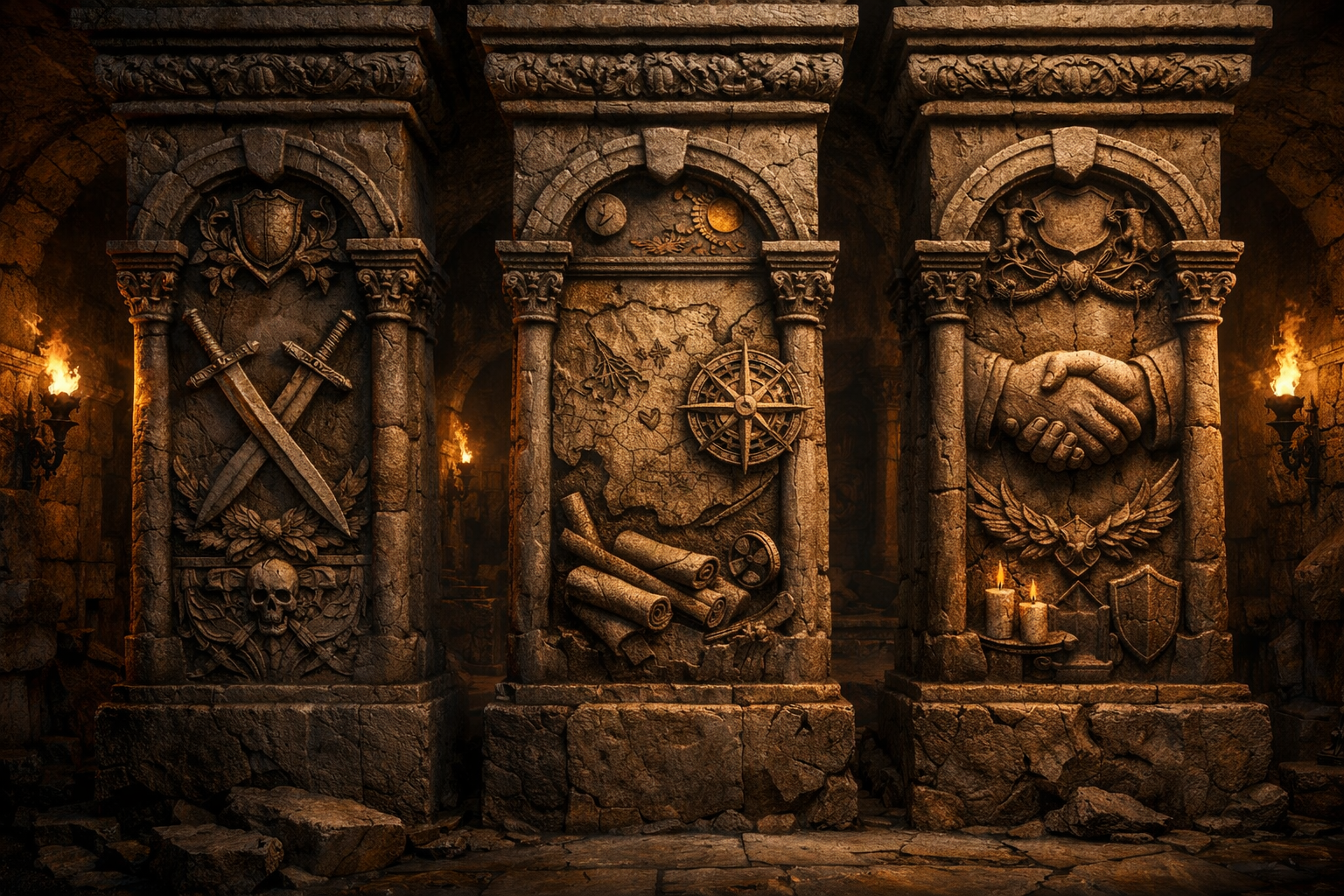
Great dungeons balance combat encounters, exploration challenges, and social interaction. Master these three pillars to create memorable underground adventures.
Dungeons are often associated with combat.
Open the door.
Roll Initiative.
Defeat the monsters.
Move to the next room.
But Dungeons & Dragons supports a much broader range of play.
The current D&D rules describe three main pillars:
- Social interaction
- Exploration
- Combat
These are not officially defined as "three pillars of dungeon design."
They are broader categories describing how D&D is played.
That distinction matters.
A good dungeon does not need equal amounts of all three, and it does not necessarily need all three at all.
Instead, Dungeon Masters can use the pillars as a design lens.
When examining a dungeon, ask:
- Where can players explore and discover?
- Where might they interact with creatures rather than immediately fight them?
- Where does combat make sense?
- Where can one type of play change another?
- Does the mix fit this particular location and this particular table?
Thinking this way helps turn a dungeon from a sequence of isolated rooms into a responsive place that supports different kinds of decisions.
What Are D&D's Three Pillars?
The current SRD 5.2 describes the three main pillars of D&D play as:
- Social interaction
- Exploration
- Combat
The 2024 Dungeon Master's Guide follows the same structure when discussing how Dungeon Masters run the game and plan encounters.
These pillars are broad categories rather than rigid encounter labels.
A single scene can involve more than one.
A fight might require environmental exploration.
A negotiation might happen during a dangerous chase.
Exploration might reveal information that prevents combat entirely.
That overlap is particularly useful in dungeon design.
Exploration
Exploration involves characters interacting with places, objects, environments, and situations.
In a dungeon, that might include:
- Choosing routes
- Searching rooms
- Examining doors
- Looking for traps
- Solving environmental problems
- Investigating clues
- Manipulating machinery
- Mapping
- Crossing hazards
- Discovering secret passages
- Understanding the dungeon's history
- Managing movement and equipment
- Deciding whether to continue or retreat
Exploration is not merely the quiet time between encounters.
In a dungeon crawl, it is often the structure connecting everything else.
Social Interaction
Social interaction occurs when characters engage with other creatures.
That can include:
- Negotiating
- Deceiving
- Questioning
- Bargaining
- Threatening
- Persuading
- Recruiting
- Seeking information
- Making alliances
- Resolving disputes
Dungeon inhabitants do not automatically need to be enemies.
A goblin sentry might surrender.
A ghost might want something.
A rival adventuring party might negotiate temporary cooperation.
A monster might be territorial rather than murderous.
A prisoner might possess information but distrust the party.
Social interaction turns dungeon inhabitants into people and creatures with goals rather than combat encounters waiting to happen.
Combat
Combat occurs when opposing creatures enter structured conflict and Initiative begins.
In a dungeon, combat can involve:
- Defending territory
- Stopping a ritual
- Fighting through an ambush
- Holding a chokepoint
- Escaping pursuing creatures
- Protecting another character
- Fighting while completing another objective
Dungeon combat becomes more interesting when the environment matters.
Walls, elevation, doors, hazards, cover, bottlenecks, furniture, machinery, water, darkness, and unstable terrain can all affect how a battle unfolds.
Environmental Hazards Are Usually Exploration
One useful distinction is that a dangerous feature is not automatically a combat encounter.
Examples include:
- Collapsing floors
- Poisonous gas
- Flooding
- A trapped hallway
- Falling rocks
- Extreme heat
- Rotating machinery
These are generally exploration challenges.
They may become part of a combat encounter when hostile creatures are also involved, but danger by itself does not move something into the combat pillar.
That distinction helps prevent "combat" from becoming shorthand for every situation that can harm a character.
Environmental Storytelling Is Exploration, Not Social Interaction
Another common classification mistake involves:
- Journals
- Inscriptions
- Murals
- Skeletons
- Magical recordings
- Old letters
- Abandoned equipment
These can provide voices from the past.
But reading a dead explorer's journal is not normally social interaction in D&D terms.
It is exploration.
The characters are examining and interpreting their environment.
A ghost that actually speaks with the party, however, can become a social interaction.
The difference is whether the characters are interacting with another creature rather than merely discovering information left behind.
Do Dungeons Need All Three Pillars?
No.
A sealed tomb abandoned for a thousand years might contain:
- Exploration
- Traps
- Puzzles
- Undead combat
and almost no social interaction.
That can be completely appropriate.
A criminal hideout might contain:
- Negotiations
- Bribery
- Deception
- Faction maneuvering
- Stealth
with little or no combat.
That can also work.
A fortress under active siege might produce several combats close together because sustained fighting makes sense there.
The goal is not:
Include combat, exploration, and social interaction in every dungeon.
The better question is:
Which forms of play make sense in this location, and which ones will make the experience interesting for this table?
Balance Does Not Mean Equal Distribution
There is no ideal ratio such as:
- 40% combat
- 30% exploration
- 30% social interaction
D&D does not prescribe one.
Dungeon design should follow:
- Location purpose
- Inhabitants
- Campaign tone
- Player interests
- Current story
- Desired pressure
- Available session time
Consider three very different dungeons.
The Siege Fortress
Likely emphasis:
- Combat
- Tactical movement
- Defenses
- Enemy patrols
Social interaction may still exist through:
- Surrender
- Prisoners
- Rival officers
- Defectors
But fighting may dominate.
The Lost Observatory
Likely emphasis:
- Exploration
- Machinery
- Environmental puzzles
- Lore
- Strange phenomena
Combat may be rare.
The Undercity Market
Likely emphasis:
- Social interaction
- Factions
- Negotiation
- Smuggling
- Investigation
Combat may be dangerous precisely because starting a fight creates political consequences.
All three can be excellent dungeons.
Their pillar profiles should be different.
Use Pillars as a Diagnostic Tool
The framework becomes most useful when a dungeon is not working as expected.
Suppose your notes contain:
- Fight
- Fight
- Fight
- Fight
- Boss fight
That does not automatically mean the dungeon is bad.
But you can ask:
Is repeated combat intentional?
If this is an enemy fortress being stormed, perhaps yes.
If this is supposed to be an ancient mystery, perhaps you have overlooked opportunities for exploration.
Similarly:
- Empty chamber
- Lore inscription
- Puzzle
- Empty corridor
- Environmental clue
- Puzzle
may work beautifully in an archaeological ruin.
But if your players have been hoping to interact with memorable NPCs, perhaps the location could support:
- Another expedition
- A surviving inhabitant
- A spirit
- A prisoner
- A rival faction
Use the pillars to examine what you created.
Do not use them as quotas.
Exploration: Make the Dungeon Worth Investigating
Dungeon exploration works best when paying attention changes player decisions.
Consider the forgotten temple of Keth-Mara.
The party enters a collapsed corridor.
At first glance, it appears to be ordinary structural damage.
Closer examination reveals:
- Tool marks
- Stones moved from the inside
- Broken tools abandoned nearby
- A section of wall deliberately weakened
The players now know:
Someone intentionally collapsed this passage.
That information creates new questions:
- Who?
- Why?
- What lies behind it?
- Was the collapse defensive?
- Is someone still nearby?
Environmental information has changed the dungeon from architecture into evidence.
Give Exploration Consequences
Useful exploration can reveal:
- Safer routes
- Hidden entrances
- Enemy weaknesses
- Faction territory
- Treasure
- History
- Traps
- Shortcuts
- Approaching threats
Suppose players find an old diagram showing ventilation shafts.
Later they encounter a locked laboratory.
That earlier discovery now matters because they might reach the room through the vents.
Exploration becomes satisfying when knowledge accumulates.
Nonlinear Layouts Strengthen Exploration
Justin Alexander's dungeon-design work emphasizes techniques such as:
- Loops
- Multiple entrances
- Multiple connections between levels
- Secret routes
- Unusual passages
These structures create navigation choices.
Compare:
Linear
Entrance → Hall → Shrine → Crypt → Boss
with:
Interconnected
Entrance connects to:
- Guard hall
- Old chapel
- Flooded passage
The chapel hides a stair.
The flooded passage reaches the crypt.
The crypt loops behind the guard hall.
Another tunnel exits outside.
Now players can:
- Bypass danger
- Approach areas from different directions
- Discover shortcuts
- Retreat intelligently
- Re-enter later through another route
Exploration becomes strategy.
Exploration Does Not Require a Puzzle in Every Room
Exploration can involve very simple choices.
For example:
The western corridor smells strongly of smoke. The eastern corridor slopes downward and contains standing water.
The players already have something to reason about.
You do not need:
- A riddle
- A lever puzzle
- A secret code
every time exploration appears.
Sometimes navigation itself is enough.
Designing Traps as Part of the Environment
Traps work best when they make sense within the location.
Ask:
- Who built it?
- Who was it meant to stop?
- Why is it here?
- How do normal inhabitants avoid it?
- What evidence might careful characters notice?
A trap guarding a treasury makes intuitive sense.
A pressure plate in the middle of the residents' dining hall requires more explanation.
Logical placement gives players information they can reason from.
Avoid Single-Solution Puzzles
A puzzle becomes fragile when the only solution is:
Guess exactly what the Dungeon Master was thinking.
Instead, consider allowing:
- Deduction
- Character abilities
- Alternate routes
- Resource expenditure
- Brute force
- Magical solutions
- Partial success
- Consequences for bypassing rather than solving
Players may solve the problem differently than you expected.
That is often one of the strengths of tabletop play.
Combat: Let the Room Participate
A dungeon combat should not always feel like monsters placed inside an empty box.
Ask what makes the room tactically distinctive.
Possibilities include:
- Elevation
- Cover
- Narrow bridges
- Water
- Difficult terrain
- Doors
- Machinery
- Fire
- Breakable structures
- Moving platforms
- Darkness
- Vertical shafts
Consider two encounters against identical monsters.
Empty Chamber
Twenty-foot square room.
Enemies stand opposite the party.
Foundry
The same enemies occupy:
- Elevated walkways
- A molten channel
- Hanging chains
- A furnace control
- Heavy carts that can be pushed
The stat blocks have not changed.
The decision space has.
Combat Should Follow the Dungeon's Logic
Ask why creatures are here.
Are they:
- Guards?
- Hunters?
- Residents?
- Invaders?
- Prisoners?
- Patrols?
- Rivals?
- Creatures attracted by food?
Then ask what they want.
Not every hostile creature needs to fight to the death.
It might:
- Retreat
- Surrender
- Call reinforcements
- Protect territory
- Bargain
- Run
- Attempt to capture someone
That can turn combat into a bridge toward social interaction or further exploration.
Combat Consequences Can Change the Dungeon
A battle might:
- Alert nearby inhabitants
- Block a corridor
- Damage machinery
- Destroy evidence
- Open another route
- Cause survivors to retreat
- Change faction behavior
- Spend important resources
This helps encounters feel connected.
The dungeon remembers what happened.
Social Interaction: Give Inhabitants Goals
Social play works best when creatures want something.
Consider goblins guarding a tunnel.
If their only purpose is:
Fight the party.
then combat is likely.
But perhaps they actually want:
- Food
- Payment
- Protection from another faction
- Safe passage out
- Revenge against their chief
- Information
- Recognition
Now players can discover alternatives.
They may still fight.
But violence is no longer the only meaningful interaction available.
Social Interaction Does Not Require Friendly NPCs
A Hostile creature can still talk.
The current D&D rules explicitly support social interaction with creatures whose attitudes may be Friendly, Indifferent, or Hostile.
That creates room for:
- Intimidation
- Deception
- Bargaining
- Threats
- Temporary truces
- Information exchange
A monster does not need to like the party for conversation to matter.
Factions Turn a Dungeon Into a Social Environment
Suppose Keth-Mara contains:
- Hobgoblin occupiers
- A hidden cult
- A trapped earth elemental
- Another adventuring party
Now relationships exist.
Perhaps:
- Hobgoblins hate the cult.
- The cult wants access to the shrine.
- The elemental wants freedom.
- The rival adventurers want treasure.
The party can:
- Ally with one faction
- Manipulate two against one another
- Trade information
- Remain neutral
- Betray an agreement
- Attempt to remove everyone
The dungeon becomes more than rooms and monsters.
It becomes a political environment contained inside a location.
Pillars Work Best When They Affect Each Other
The most interesting design often occurs where the pillars overlap.
Exploration Changes Combat
Players discover:
- A hidden firing position
- A secret passage
- A weak bridge
- A creature's vulnerability
That information changes a later fight.
Combat Changes Exploration
A battle:
- Collapses a floor
- Opens a sealed route
- Attracts patrols
- Destroys a bridge
The map now functions differently.
Social Interaction Changes Combat
Players convince one faction not to participate in a battle.
Or gain allies.
Or learn where the enemy will attack.
Combat Changes Social Interaction
The party captures an officer.
Another faction becomes frightened.
Survivors spread stories about what happened.
Exploration Changes Social Interaction
Players discover evidence proving an NPC has been lying.
They locate an item another faction desperately wants.
They find a hidden escape route that becomes bargaining leverage.
The pillars stop looking like three separate encounter categories.
They become interacting parts of the same location.
Example: A Chamber Using All Three
Consider a shrine inside Keth-Mara.
Exploration
Ancient inscriptions describe the mechanism controlling a sealed stone door.
Hidden alcoves contain damaged ritual components.
The floor around the altar is unstable.
Social Interaction
A bound earth elemental protects the shrine.
It initially assumes the characters serve the priests who trapped it.
Players can:
- Speak with it
- Learn why it is bound
- Offer freedom
- Deceive it
- Threaten it
Combat
If the situation turns violent, the elemental attacks.
The unstable floor and altar become relevant terrain.
But combat is only one possible outcome.
Consequences
Freeing the elemental might:
- Open the sealed door
- Make an ally
- Cause it to attack another faction later
- Damage part of the dungeon
Defeating it might:
- Preserve the bindings
- Yield different information
- Alert nearby inhabitants
Ignoring it might leave the shrine inaccessible.
All three pillars exist because the situation supports them.
They are not there because a checklist required one of each.
Player Choice Can Shift the Pillar
An encounter does not always arrive with a predetermined category.
Suppose guards block a doorway.
Players might:
Explore
Search for another route.
Socialize
Bribe, threaten, deceive, or negotiate with them.
Fight
Attack.
The Dungeon Master prepared:
Guards control this entrance.
The players help determine what type of encounter follows.
That flexibility is one of the most useful ways to apply the pillar framework.
Designing for the Players, Not Their Classes
Character abilities matter, but do not assume class determines player preference.
A Fighter may love mysteries.
A Bard may care most about tactical optimization.
A Rogue may prefer character drama.
A Wizard may hate puzzles.
The 2024 Dungeon Master's Guide encourages Dungeon Masters to learn what their players actually enjoy.
Use that information.
Character Capabilities Still Matter
If a character has:
- Thieves' Tools
- Divination magic
- Tracking abilities
- Social expertise
- Specialized combat features
look for reasonable opportunities where those abilities can matter.
That does not mean every dungeon must be custom-built to showcase every feature.
It means characters should occasionally get to use the capabilities their players intentionally selected.
Avoid "You Don't Have the Right Class"
Do not design an exploration obstacle that only works if the party contains a Rogue.
Do not make social progress impossible without a Bard.
Do not require a Wizard for every magical mystery.
Characters may solve problems using:
- Different skills
- Equipment
- Spells
- Allies
- Creativity
- Alternate routes
- Resource expenditure
Specific classes can provide advantages without becoming mandatory keys.
Pacing Is Not the Same as Pillar Rotation
One tempting formula is:
Exploration → Combat → Social → Exploration → Combat
That can create variety.
It can also become predictable.
Your existing dungeon fiction should determine much of the rhythm.
A barracks might naturally contain several combat-heavy areas close together.
An abandoned archive might contain a long stretch of exploration.
A faction-controlled settlement beneath the dungeon might produce sustained social play.
Think more broadly about pressure.
Pressure can rise through:
- Danger
- Time
- Uncertainty
- Resource loss
- Difficult decisions
- Escalating consequences
Pressure can decrease through:
- Reaching relative safety
- Learning useful information
- Resolving uncertainty
- Finding resources
- Opening a shortcut
Any of the three pillars can be high or low pressure.
A negotiation with a hostile dragon may be more intense than a routine combat.
Searching a flooded chamber while the water rises can be more stressful than either.
Do Not Assign Fixed Intensity to Each Pillar
Combat is not automatically high intensity.
Exploration is not automatically medium intensity.
Social interaction is not automatically low intensity.
Examples:
Low-Intensity Combat
A short fight against weak stragglers.
High-Intensity Exploration
Crossing a collapsing bridge while lava rises.
High-Intensity Social Interaction
Negotiating for a hostage's life.
Low-Intensity Social Interaction
Talking with a cooperative prisoner.
Use the actual stakes and circumstances to manage pacing.
Resource Use Also Crosses Pillars
Combat frequently consumes:
- Hit Points
- Spell slots
- Limited-use features
But other pillars can consume resources too.
Exploration may use:
- Time
- Equipment
- Spells
- Hit Points
- Hit Point Dice
- Consumables
Social interaction can cost:
- Money
- Favors
- Reputation
- Political capital
- Information
- Promises
A negotiated solution is not automatically "free."
That is another reason not to reduce the pillars to simplistic mechanical roles.
Room-by-Room Tagging Can Still Be Useful
A quick design technique is to mark areas with likely forms of play.
For example:
| Area | Likely Emphasis |
| ----------------- | -------------------- |
| Gatehouse | Combat / Social |
| Collapsed Gallery | Exploration |
| Goblin Market | Social / Exploration |
| Flooded Crypt | Exploration / Combat |
| Secret Shrine | Exploration |
| Command Chamber | Social / Combat |
The purpose is not to achieve a mathematically even spread.
It is to reveal patterns.
If every area says:
Combat
ask whether that is intentional.
If it is, keep it.
If not, the table may benefit from another kind of decision.
Use the Pillars During Revision
After creating a dungeon, ask:
Exploration
- Are there meaningful things to discover?
- Does geography matter?
- Can information change decisions?
- Are there alternate routes or secrets where appropriate?
Social Interaction
- Does anyone here have motives beyond fighting?
- Are any creatures willing or able to communicate?
- Could factions exist?
- Would negotiation make sense anywhere?
Combat
- Where does violence logically occur?
- Does terrain matter?
- Do enemies behave according to their goals?
- Can combat consequences affect nearby areas?
Then ask the most important question:
Which of these actually belongs in this dungeon?
Do not add an NPC conversation to an abandoned tomb merely because your social column is empty.
When a Missing Pillar Is a Feature
Imagine a sealed crypt.
No living inhabitants.
No ghosts.
No intelligent monsters.
Just:
- Tombs
- Traps
- Architecture
- Undead
- History
Social interaction may be almost nonexistent.
That reinforces isolation.
Now imagine a bustling underground trade city.
Most inhabitants have reasons not to attack strangers.
Combat may be rare.
That reinforces the social structure.
Absence can communicate tone.
Do not "correct" intentional design merely to satisfy a framework.
Using the Pillars With Different Dungeon Types
Tomb
Likely strengths:
- Exploration
- Traps
- History
- Environmental clues
Possible combat:
- Undead
- Guardians
- Rival tomb robbers
Possible social play:
- Intelligent spirits
- Rival explorers
Occupied Fortress
Likely strengths:
- Combat
- Patrols
- Tactical positioning
Exploration:
- Alternate entrances
- Security systems
- Shortcuts
Social:
- Prisoners
- Defectors
- Officers
- Surrendering guards
Underground Settlement
Likely strengths:
- Social interaction
- Factions
- Trade
- Politics
Exploration:
- Hidden districts
- Restricted areas
- Infrastructure
Combat:
- Gang conflict
- Political violence
- External threats
Ancient Magical Facility
Likely strengths:
- Exploration
- Machinery
- Magical hazards
Combat:
- Constructs
- Experiments
- Defenses
Social:
- Intelligent constructs
- Surviving researchers
- Rival expeditions
The same framework produces different results because the location changes.
Current D&D Already Supports This Approach
The current rules explicitly separate play into social interaction, exploration, and combat.
The 2024 Dungeon Master's Guide also provides guidance for:
- Running social interaction
- Running exploration
- Running combat
- Planning social interaction encounters
- Planning exploration encounters
- Planning combat encounters
- Designing dungeons
- Using doors, hazards, and traps
That means applying the three pillars to dungeon design is not inventing a new style of D&D.
It is using the game's existing encounter categories to examine a specific adventure environment.
How The Dungeon Trainer Can Help
The Dungeon Trainer currently supports adjacent parts of dungeon preparation rather than replacing dedicated dungeon-mapping software.
Scry
Scry helps a Dungeon Master examine an upcoming scene and project plausible ways it could develop.
For a dungeon encounter, that might expose questions such as:
- What if players negotiate with these guards?
- What if they bypass the encounter?
- What if they investigate instead of entering?
- Does progress depend on one clue?
- What complications could arise?
That makes Scry particularly useful when one prepared encounter could shift between exploration, social interaction, and combat.
It does not predict what players will do.
It helps reveal assumptions in preparation.
The Coach
The Coach provides self-contained practice situations followed by rubric-grounded feedback.
Dungeon-related practice can involve:
- Exploration adjudication
- Player agency
- Information clarity
- Pacing
- Combat decisions
- Social adjudication
- Unexpected approaches
Those are exactly the judgment calls that arise when the pillars overlap.
Generators
The Dungeon Trainer can generate:
- Monsters
- Characters
- NPCs
- Magic items
- Spells
- Locations
These provide ingredients for dungeon design.
For example:
- Generate a faction leader for a social encounter.
- Generate a creature for a combat area.
- Generate a strange location for exploration.
- Generate an item tied to the dungeon's history.
Generated material still needs to fit the location.
The tool supplies components.
The Dungeon Master supplies purpose and relationships.
Campaign Memory and Codex
The platform maintains searchable campaign records covering:
- People
- Places
- Quests
- Events
That continuity can make dungeon inhabitants and discoveries matter beyond one room.
A prisoner rescued underground can return later.
A faction agreement can create consequences.
A location can remain relevant after the party leaves.
Information the Dungeon Master has not revealed remains hidden from players.
Fully Human-Run Play
The Dungeon Trainer also supports campaigns where the human Dungeon Master retains full control.
The platform can handle:
- Character sheets
- Dice
- Hit Points
- Conditions
- Initiative
- Combat state
- Shared campaign continuity
AI participation is optional.
That means the same tools can support a traditional human-run dungeon without handing narration or adjudication to an AI Dungeon Master.
How This Fits With Other Dungeon Design Tools
The three-pillar framework answers one question:
What kinds of play does this dungeon support?
It does not replace other design lenses.
Room Purpose
Ask:
Why does this space exist?
Pacing
Ask:
How does pressure and table energy change?
Mapping
Ask:
How does geography create decisions?
Factions
Ask:
Who lives here, and what do they want?
Pillars
Ask:
How can the players engage with this situation?
These lenses complement one another.
A single room might:
- Have a clear architectural purpose
- Provide a shortcut
- Contain a hostile faction
- Begin as exploration
- Become negotiation
- Turn into combat if talks fail
That complexity is often what makes dungeon environments feel alive.
A Practical Three-Pillar Review
Before running your dungeon, try this quick review.
Exploration
- What can players discover?
- Which details communicate useful information?
- Does navigation create choices?
- Are hazards understandable?
- Can investigation change later decisions?
Social Interaction
- Which inhabitants can communicate?
- What do they want?
- What might they trade?
- Who could negotiate?
- Are there factions or relationships worth exploiting?
Combat
- Where is violence likely?
- Why would enemies fight?
- What terrain matters?
- Can enemies retreat or surrender?
- What changes after the battle?
Integration
- Can exploration prevent or improve a fight?
- Can negotiation reveal a safer route?
- Can combat change faction behavior?
- Can discoveries alter social leverage?
- Can players choose a different approach than I expect?
Table Fit
- Which activities does this group enjoy?
- Is the current emphasis intentional?
- Does the dungeon's mix support its theme?
- Am I adding something only to satisfy a checklist?
If you can answer those questions, you probably have a much clearer picture of how the dungeon will actually play.
Conclusion
Combat, exploration, and social interaction are not official "three pillars of dungeon design."
They are the three main pillars of D&D play.
But that makes them extremely useful for dungeon design.
They help Dungeon Masters ask:
Exploration: What can the characters investigate, discover, and manipulate?
Social Interaction: Who can they communicate with, and what does that creature want?
Combat: Where can violent conflict occur, and what makes that conflict interesting?
The goal is not equal representation.
It is not a required ratio.
It is not ensuring that every dungeon contains a fight, a puzzle, and a conversation.
The goal is intentionality.
A dungeon can be overwhelmingly exploratory.
Another can be combat-heavy.
Another can function as an underground political sandbox.
The pillars help you understand what kind of experience you are building and whether that experience matches the location and players.
The strongest dungeons often become memorable when the categories blur.
Players explore and discover evidence.
That evidence gives them leverage in a negotiation.
The negotiation prevents one fight but creates another alliance.
That alliance changes which parts of the dungeon are safe.
The party discovers a shortcut because of the new relationship.
Now geography, information, inhabitants, and consequences are all interacting.
That is no longer a map filled with encounter types.
It is a place responding to player decisions.
And that is the kind of dungeon players remember.
Sources and Further Reading
Alexander, J. (2010). Xandering the Dungeon. The Alexandrian. https://thealexandrian.net/wordpress/13085/roleplaying-games/xandering-the-dungeon
Logos, D. (2026). Maps. Dyson's Dodecahedron. https://dysonlogos.blog/maps/
Shea, M. E. (2018). Return of the Lazy Dungeon Master. Sly Flourish.
Wizards of the Coast. (2024). Dungeon Master's Guide. Wizards of the Coast.
Wizards of the Coast. (2024). Player's Handbook. Wizards of the Coast.
Wizards of the Coast. (2025). System Reference Document 5.2. Wizards of the Coast.
Related reading
- Five Weeks in the Sunken Archive: Lessons from a Real Dungeon Crawl Campaign
A five-session dungeon crawl through a flooded library taught valuable lessons about pacing, player agency, and adaptive design. Discover what worked, what failed, and how these insights can improve your own adventures.
- Random Dungeon Generation vs. Hand-Crafted Design: Which Approach Works Best?
Random generation offers speed and surprise while hand-crafted dungeons provide narrative control. Compare both approaches to find the right balance for your table and campaign style.
- Essential Dungeon Master Tools: Your Checklist for Running Better Dungeon Adventures
Running smooth dungeon sessions requires the right preparation and resources. This comprehensive toolkit gives you everything you need to manage exploration, combat, and player engagement.