Running Session Zero: A Step-by-Step Guide for Game Masters
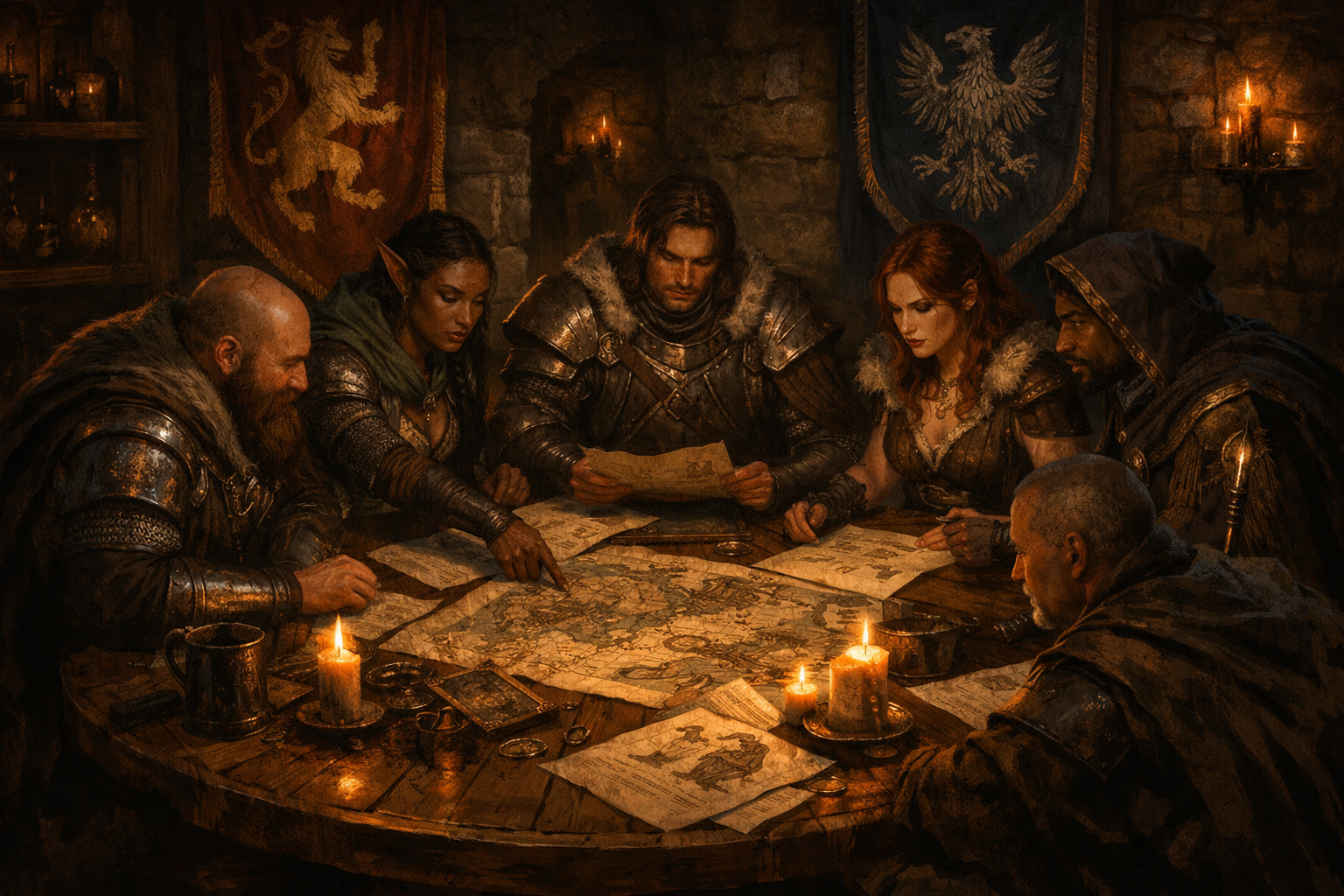
Learn how to plan and run an effective session zero that sets your campaign up for success. This practical guide walks Game Masters through preparation, facilitation, and follow-up.
Session Zero gives a tabletop roleplaying group a structured opportunity to establish expectations before a campaign gets underway.
Many Game Masters understand the general idea: discuss the campaign, create characters, talk about boundaries, and make sure everyone understands what kind of game they are about to play. The harder question is how to actually organize that conversation without turning it into either a lecture or several hours of unfocused discussion.
This guide provides a practical framework for preparing, facilitating, and following up on a Session Zero. The exact structure should change depending on the game, campaign, and people at the table.
Why Structure Matters
An entirely unstructured Session Zero can drift into unrelated conversation or jump directly into character creation before the group has established what those characters are being created for.
A useful structure makes sure important subjects have a place in the conversation while still leaving room for players to ask questions and influence the campaign.
Consider a new group forming around a fantasy campaign.
The Game Master imagines political intrigue in a low-magic city-state. Several players arrive expecting dungeon exploration, frequent combat, and dragon hunting.
None of those preferences is wrong.
The problem is that the participants may be imagining different campaigns.
Session Zero gives them an opportunity to discover that mismatch before several sessions have been spent trying to reconcile it during play.
Structure does not guarantee agreement.
It makes the important disagreements easier to discover.
Pre-Session Preparation
The GM's work begins before everyone gathers around the table.
Define Your Campaign Framework
Before Session Zero, identify which parts of the campaign are already established and which parts are open to discussion.
Consider questions such as:
- What game system and rules version will you use?
- What is the campaign's central premise?
- What tone are you aiming for?
- What themes or subject matter are likely to appear?
- What character options are available or restricted?
- What optional rules, house rules, or homebrew material will be used?
- What starting level will characters use?
- How will advancement work?
- How often do you expect to play?
- Approximately how long will sessions run?
- Which parts of the campaign are negotiable?
Separating fixed elements from flexible ones is important.
If you are committed to running an urban political campaign, players should know that before creating characters for a wilderness survival game.
For example, the fictional Millhaven campaign might use the 2024 Dungeons & Dragons rules with the following framework:
- Urban political intrigue in the trade city of Millhaven
- Themes of corruption, loyalty, ambition, and divided allegiance
- Characters beginning at level 3
- Milestone advancement
- Official character options unless otherwise discussed
- Magic items uncommon within the setting
- Combat present but less frequent than investigation and social interaction
- Sessions every other week for approximately three hours
That gives players enough information to determine whether the campaign interests them and begin thinking about appropriate characters.
Prepare a Short Campaign Brief
Consider creating a concise campaign document before Session Zero.
It does not need to be a setting encyclopedia.
One or two pages may be enough to cover:
- Campaign premise
- Starting location
- Important factions or conflicts
- Tone and themes
- Expected types of play
- Character creation guidelines
- Major house rules
- Scheduling expectations
- Anything players should know before creating characters
If media comparisons are useful, you can include them as shorthand for tone.
For example:
"Political tension inspired by court-intrigue fantasy, centered on competing merchant houses rather than royal succession."
Comparisons should support the explanation rather than replace it. Different people can interpret the same book, film, or game differently.
Send the campaign brief far enough in advance that players have a reasonable opportunity to review it.
Do not require extensive homework unless everyone has agreed to that kind of campaign.
Plan Your Agenda
An agenda keeps important subjects from disappearing when one conversation runs long.
A three-hour Session Zero might look like this:
- Welcome and introductions: 15 minutes
- Campaign premise and tone: 30 minutes
- Content boundaries and safety procedures: 20 minutes
- Table expectations and logistics: 20 minutes
- Character creation guidelines: 30 minutes
- Character connections and party formation: 30 minutes
- Questions and next steps: 15 minutes
- Breaks: approximately 20 minutes distributed throughout the session
These times are examples, not requirements.
D&D's own Session Zero guidance notes that the process can range from a short conversation to several hours.
An established group may move through table expectations quickly.
A new group might need considerably more time.
The purpose of the agenda is to make sure important conversations happen, not to end them because a timer expired.
Facilitating the Session
Once everyone gathers, the GM's role shifts from campaign planner to facilitator.
Set the Purpose
Begin by explaining why the group is meeting.
For example:
"We're here to make sure we understand what kind of campaign we're playing, establish how we want to play together, build characters who have reasons to participate, and cover anything we should agree on before Session One."
That frames Session Zero as collaboration rather than a list of rules being imposed by the GM.
If the players do not already know one another, introductions can also include a simple question about what each person enjoys in tabletop games.
You might ask:
- What parts of RPGs do you enjoy most?
- Is there something you have wanted to try in a campaign?
- Do you prefer tactical challenges, exploration, investigation, social interaction, character drama, or some combination?
- Is there anything that consistently makes a campaign less enjoyable for you?
Do not treat these answers as promises.
They are information that can help the group understand one another.
Present the Campaign Vision
Explain the campaign premise clearly and concisely.
Focus on what players need in order to make informed decisions.
For Millhaven, the GM might say:
"You'll be operating in a city where wealthy merchant families hold more practical power than the nominal duke. The campaign will focus heavily on investigation, negotiation, competing factions, and political consequences. Combat will still occur, but it will not be the solution to every problem. Magic exists, but obvious displays of powerful magic can attract attention."
Then invite questions.
Players might ask:
- How dangerous is the city?
- How common is magic?
- What organizations can characters belong to?
- Are morally questionable characters appropriate?
- Will the campaign leave the city?
- How much freedom will the group have to choose factions?
- How lethal is combat expected to be?
Questions like these often reveal assumptions that were not obvious from the original pitch.
Establish Content Boundaries and Safety Procedures
Session Zero is also an appropriate time to establish how the group will communicate about uncomfortable or unwanted content.
Several established tools can support this conversation.
Lines and Veils distinguish between material that should not appear in the game and material that may exist but should not receive explicit treatment.
The X-Card, created by John Stavropoulos, provides a way to signal during play that current content needs to be changed, skipped, or removed.
Other groups use different systems, private messages, pause procedures, check-ins, or combinations of tools.
No single method is mandatory for every table.
The important questions are:
- How can someone indicate that content needs to stop or change?
- Does everyone understand what happens when that signal is used?
- Can players communicate boundaries privately?
- Can boundaries be added or changed later?
Do not require people to explain why a subject is a boundary.
If enough clarification is needed to determine what content should be changed, ask only for the information necessary to make that adjustment.
Players should also have a way to communicate privately if they do not want to discuss a subject in front of the entire group.
Potential subjects can include:
- Graphic violence
- Torture
- Sexual content
- Harm involving children
- Animal cruelty
- Substance abuse
- Body horror
- Specific phobias
- Other material relevant to the campaign
These are examples, not a mandatory checklist.
Boundaries can also change during a campaign.
The fact that something was not mentioned during Session Zero does not mean a player has permanently consented to encountering it.
Define Table Culture
Session Zero should cover how the group intends to function during actual play.
Useful questions include:
- How will rules disputes be handled?
- When should rules be looked up during play?
- How will phones and unrelated distractions be handled?
- What happens if someone cannot attend?
- What happens if the GM cannot attend?
- Will absent characters remain in the story, disappear temporarily, or be controlled by someone else?
- How will character death and replacement be handled?
- Is player-versus-player conflict permitted?
- Can characters steal from one another?
- Are secret betrayals allowed?
- How should players communicate when they need a break?
- How will spotlight time be managed?
- What behavior is unacceptable at the table?
For Millhaven, the group might decide:
- Short rules questions can be resolved immediately, but longer disputes are noted and researched after the scene.
- Players minimize unrelated phone use during active play.
- If one player is absent, the game usually continues.
- Absent characters remain occupied with faction or personal business when practical.
- Character death is possible, but the GM will not alter outcomes solely to create arbitrary deaths.
- Player-versus-player violence and theft require agreement from the affected players.
The exact answers matter less than making sure everyone understands them.
Guide Character Creation
Once the campaign framework is clear, move into character creation or character review.
Specify:
- Starting level
- Available source material
- Species
- Classes
- Backgrounds
- Ability-score generation method
- Starting equipment
- Feats, if relevant
- Multiclassing expectations
- Homebrew options
- Backstory expectations
- Any campaign-specific restrictions
Current D&D guidance explicitly identifies Session Zero as an opportunity to create characters together and determine whether they already know one another.
Encourage characters who have reasons to engage with the campaign.
For Millhaven, useful concepts might include:
- A merchant's bodyguard investigating attacks against guild shipments
- A disgraced noble trying to rebuild political influence
- A former city investigator who knows too much about a powerful family
- A foreign envoy navigating unfamiliar alliances
- A cleric whose temple depends financially on one of the merchant houses
Be careful about declaring entire classes or archetypes incompatible.
A ranger can work perfectly well in an urban campaign.
A pacifistic character can create interesting tension in a military story.
The more important question is whether the character has a plausible reason to participate in the campaign and cooperate with the other player characters.
A character who refuses every adventure hook, will not cooperate with the party, or is designed primarily to sabotage the other characters creates a more fundamental problem than an unusual class choice.
Establish Character Connections
Once everyone has a rough concept, establish why these characters are together.
Ask each player to consider:
- How does your character know at least one other character?
- Why are you willing to work with this group?
- What connects you to the campaign's central situation?
- What does your character want personally?
- Is there another character you trust?
- Is there another character you owe something to?
- What could make you remain with this group when circumstances become difficult?
For Millhaven, the bodyguard might have known the disgraced noble before their political fall.
The former investigator might have once protected the foreign diplomat from a false accusation.
The cleric's temple might owe money to the same merchant family the group is investigating.
These connections do not need to eliminate disagreement between characters.
They give the characters reasons to continue interacting when disagreement happens.
Consider Collaborative Worldbuilding
Some groups enjoy allowing players to contribute details to the setting.
You might ask:
"What neighborhood did your character grow up in?"
"What is one place in that district that matters to them?"
"Which merchant house has your character dealt with before?"
"What rumor have you heard about the duke?"
The GM can retain final responsibility for campaign continuity while still incorporating player-created details.
This is optional.
Some groups prefer discovering the setting entirely through play.
Close With Clear Next Steps
Before ending Session Zero, establish what happens next.
Confirm:
- Date and time of Session One
- Expected session length
- Location or online platform
- Anything players need to finish
- How the group communicates between sessions
- Whether characters require GM approval
- Whether any unresolved campaign questions remain
- What players need to bring
- Whether the opening situation requires any special preparation
You can also give players a spoiler-free sense of how Session One begins.
For example:
"Session One will begin at a merchant guild reception shortly before an important political announcement."
Players now know enough to imagine why their characters are there without knowing what will happen next.
Common Pitfalls to Avoid
Even an organized Session Zero can go poorly if its purpose becomes distorted.
Talking Too Much
Session Zero is not a campaign-setting lecture.
If the GM does nearly all of the talking, the group has little opportunity to surface its own assumptions.
Provide necessary information, then ask questions.
A useful facilitator listens for disagreement, uncertainty, and assumptions that deserve clarification.
Treating Safety Tools as a Formality
Do not introduce a tool simply so the group can say it has one.
Everyone should understand how the agreed procedure actually works.
For example, if you introduce the X-Card, players should know:
- Who can use it
- How to signal it
- What happens immediately afterward
- That they do not have to justify why the content is uncomfortable
Likewise, Lines and Veils only help if the GM remembers and respects the boundaries the group established.
Pressuring Players to Disclose Personal Information
A player should not have to reveal trauma, medical information, or personal history to justify a content boundary.
"I don't want that in the game" can be enough.
Give players a private communication option when practical.
Approving Characters That Cannot Participate
Character conflict can be interesting.
Campaign incompatibility is different.
If a character fundamentally refuses the campaign premise, the GM and player should address that before play.
For example, if the campaign is explicitly about members of an adventuring expedition, a character whose defining concept is refusing to travel or take risks will require additional work.
Ask:
"What would make this character choose to participate?"
Often a small change to motivation solves the problem without changing the character's identity.
Overlooking Logistics
Campaigns require schedules as well as stories.
Clarify:
- Frequency
- Session length
- Expected start time
- Cancellation procedures
- Minimum number of players needed to run
- How absences are handled
- Where scheduling communication happens
These decisions do not need to be complicated.
They need to be known.
Rushing Character Creation
Completing character sheets during Session Zero is perfectly reasonable if the group has time.
The problem occurs when mechanical character creation consumes the entire gathering and prevents discussion of campaign expectations.
If necessary, finish equipment choices, spell selections, or other mechanical details afterward.
Alignment comes before optimization.
Post-Session Follow-Up
Session Zero should produce usable information, not just a conversation everyone gradually forgets.
Distribute a Session Summary
Soon after Session Zero, summarize the important agreements.
That might include:
- Campaign premise
- Tone and themes
- Character creation rules
- House rules
- Scheduling
- Attendance policy
- Player-versus-player expectations
- Communication procedures
- Session One details
- Important group-level content boundaries
Handle private boundaries carefully.
If someone communicated a concern privately, do not identify that person or disclose unnecessary personal information in a group document.
The group may only need to know:
"Detailed drowning scenes will not be included."
They do not need to know who requested the boundary or why.
Incorporate Player Input
Review what players told you about the campaign.
Look for:
- Character goals
- Important NPC relationships
- Organizations
- Places
- Themes players found interesting
- Gameplay preferences
- Questions that generated enthusiasm
- Potential character connections
- Material the campaign should avoid
Do not promise to include every suggestion.
Use the information to understand what your players are interested in engaging with.
Prepare Session One Accordingly
The opening session should resemble the campaign the group just agreed to play.
If Session Zero established an investigation-heavy political campaign, opening with an unrelated dungeon crawl may immediately undermine expectations.
For Millhaven, Session One might begin with the characters attending a merchant guild gathering when news arrives that a council representative has been murdered.
That opening:
- Establishes the political setting
- Creates an investigation
- Gives faction relationships immediate relevance
- Allows several character types to contribute
- Connects directly to the campaign premise
It does not determine how the players must respond.
It gives them a situation worth responding to.
Tools and Resources
Several established resources can help structure Session Zero.
The Same Page Tool
The Same Page Tool was created by Chris Chinn and published through his Deeper in the Game blog.
It is designed to clarify what kind of game a group is actually going to play.
Importantly, Chinn specifically warns against having everyone complete it separately and then comparing answers as though it were a player-preference survey.
Instead, the group uses it together to establish a clear understanding of the game being played.
Its questions address areas such as:
- Whether the player characters are expected to cooperate
- How much authority players have over the fiction
- What kinds of conflict are expected
- How rules interact with character behavior
- What kinds of characters suit the game
It is particularly useful for exposing assumptions that players may otherwise believe are universal.
The CATS Method
The CATS Method was created by Patrick O'Leary and published as part of the 2016 200 Word RPG Challenge supplements.
CATS stands for:
- Concept: What is the game about?
- Aim: What are the players trying to accomplish?
- Tone: What mood and style are appropriate?
- Subject Matter: What material might the game explore, and where are the group's boundaries?
It provides a compact structure for aligning expectations before play.
TTRPG Safety Toolkit
The TTRPG Safety Toolkit is a free, living resource co-curated by Kienna Shaw and Lauren Bryant-Monk.
It collects and references tools created by many different designers for use before, during, and after tabletop play.
The toolkit itself should not be credited as the creator of every tool it contains.
Individual tools have their own creators and attribution requirements.
Examples include:
- X-Card, created by John Stavropoulos
- Lines and Veils, created by Ron Edwards
- Script Change, created by Beau Jágr Sheldon
The toolkit is useful when a group wants to compare different approaches and select methods that fit its needs.
Consent in Gaming
Consent in Gaming, written by Sean K. Reynolds and Shanna Germain and published by Monte Cook Games in 2019, discusses how groups can approach potentially challenging subject matter while respecting participant boundaries.
It includes practical guidance and a consent checklist that can support pre-game discussions.
Using Digital Tools
Digital tools can help preserve Session Zero decisions and reduce the chance that important agreements disappear into old messages or handwritten notes.
The Dungeon Trainer supports human-run campaigns with campaign organization, shared campaign records, preparation tools, game-management features, and optional AI assistance.
After Session Zero, a GM can use campaign-management tools to preserve information such as:
- Campaign premise
- Character relationships
- Important NPCs
- Locations
- Quests
- Campaign events
- House-rule notes
- Other information needed for continuity
The goal is not to replace the Session Zero conversation.
It is to preserve and support the campaign that conversation established.
Adapting Session Zero for Different Groups
No single Session Zero format works for every table.
Online vs. In-Person
Online groups can use:
- Voice chat
- Video chat
- Shared documents
- Virtual tabletops
- Private messages
- Digital character sheets
- Asynchronous discussion channels
Video is not automatically better than text for every group.
Accessibility, bandwidth, communication preferences, privacy, and familiarity with the platform all matter.
Some groups may prefer to handle the main discussion synchronously and finish character creation asynchronously.
Others may complete nearly everything together.
Use the format that makes communication easiest for the participants involved.
Experienced vs. New Players
New players may need additional explanation about:
- What tabletop roleplaying is
- What the GM does
- What players control
- How character sheets work
- Ability checks
- Combat turns
- Dice
- Roleplaying
- Character creation choices
Do not overwhelm new players by attempting to teach every rule before Session One.
Focus on what they need to create a character and begin making meaningful decisions.
More experienced groups can usually spend less time on basic procedures and more time discussing the specific campaign.
Established vs. New Groups
A group that has played together for years may already have established norms.
Do not assume those norms automatically transfer to every campaign.
A new horror campaign may introduce subject matter that never appeared in the group's previous heroic fantasy game.
A highly lethal dungeon campaign may require a different discussion of character death.
A political campaign may raise new questions about secrets and player-versus-player actions.
Reuse established agreements when they still fit.
Revisit them when the new campaign changes the context.
Measuring Success
Session Zero does not need to produce perfect agreement about every possible situation.
A useful Session Zero leaves the group with answers to the major questions.
Before Session One, check whether:
- Players understand the campaign premise.
- Players understand the intended tone.
- Character concepts have plausible reasons to participate.
- Characters have reasons to cooperate.
- Major house rules are documented.
- Scheduling expectations are understood.
- The group knows how absences will be handled.
- Player-versus-player expectations are clear.
- Everyone knows how to communicate or update content boundaries.
- Everyone understands the safety or check-in procedures the group chose.
- The GM knows what parts of play most interest the players.
- Everyone knows what needs to be completed before Session One.
If something important remains unresolved, address it before it becomes relevant during play.
Conclusion
Running an effective Session Zero requires preparation, but it should remain a conversation rather than a presentation.
The GM brings a campaign framework.
Players bring characters, preferences, questions, boundaries, and ideas.
Together, the group determines what game it is actually agreeing to play.
The Millhaven campaign is better prepared because its participants know that they are entering an urban political game, understand how the table will operate, have characters connected to the premise, and have established procedures for communicating when something needs to change.
That preparation does not guarantee a perfect campaign.
Nothing can.
What Session Zero provides is a clearer starting point.
When everyone understands the premise, the table expectations, the character relationships, and the ways they can communicate during play, the group can spend less time discovering preventable misunderstandings and more time actually playing the campaign it intended to create.
Sources and Further Reading
Chinn, C. (2010, March 27). The Same Page Tool. Deeper in the Game.
Haeck, J. (2021, January 8). How to run a Session 0 for your D&D game. D&D Beyond.
O'Leary, P. (2016, April 12). CATS. 200 Word RPG.
Reynolds, S. K., & Germain, S. (2019). Consent in gaming. Monte Cook Games.
Shaw, K., & Bryant-Monk, L. (n.d.). TTRPG Safety Toolkit.
Wizards of the Coast. (2024). Basic Rules for Dungeons & Dragons. D&D Beyond.
Related reading
- When Session Zero Prevents a Campaign Collapse: Lessons from a Failed Table
Not every campaign makes it to the end. See how one table's collapse revealed exactly why session zero matters, and what you can learn from their mistakes.
- Session Zero vs First Session: When to Cover What
Understanding the difference between session zero and your first session helps you allocate time wisely and start your campaign with momentum instead of confusion.
- Session Zero Checklist: Essential Tools and Resources for Game Masters
A comprehensive toolkit for running productive session zero meetings, from character creation worksheets to safety tools and scheduling templates.