Building Session Zero Around Different Play Styles
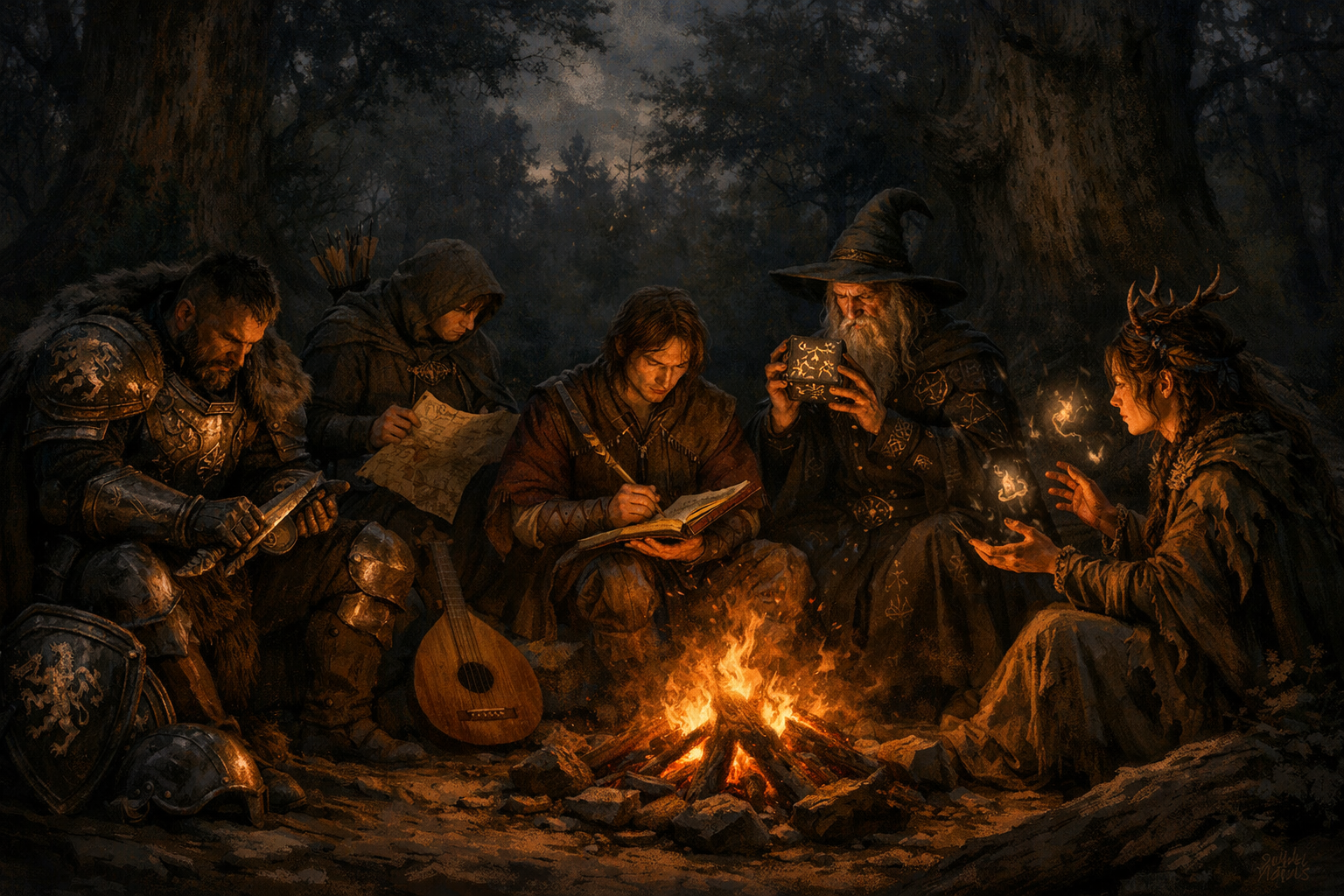
Players bring different goals to the table. Learn how to design a session zero that honors combat lovers, role-players, puzzle solvers, and explorers equally.
Every player arrives at the table hoping to get something slightly different from the game.
One player may look forward to tactical battles. Another wants to inhabit a character and interact with memorable NPCs. Someone else wants to uncover forgotten places, solve mysteries, push buttons just to see what happens, build the strongest character they can, or simply spend an enjoyable evening with friends.
Those differences are normal.
Problems arise when everyone assumes the rest of the table wants the same things they do.
Session Zero is an ideal place to make those preferences visible. The goal is not to assign every player a personality type or create a rigid formula for campaign design. It is to understand what kinds of play engage the people at your table and determine whether the campaign you are offering can give those interests meaningful room.
There Is No Single Universal Player-Type System
Game Masters have used several frameworks over the history of tabletop roleplaying to describe what different players enjoy.
Robin D. Laws's influential Robin's Laws of Good Game Mastering, published in 2002, describes seven player types: the Power Gamer, Butt-Kicker, Tactician, Specialist, Method Actor, Storyteller, and Casual Gamer.
Other designers and games have used different classifications.
The 2024 Dungeon Master's Guide takes a particularly practical approach. Instead of treating people as fixed personality types, its "Know Your Players" guidance describes eight activities players may enjoy:
- Acting
- Exploring
- Fighting
- Instigating
- Optimizing
- Problem-solving
- Socializing
- Storytelling
These categories are useful because they describe preferences rather than identities.
A player can enjoy several of them.
Preferences can also change from one campaign to another or even during the same campaign.
The purpose of identifying them is not to say:
"You are an Explorer."
It is to understand:
"Exploration is one of the things that makes this game exciting for you."
Eight Useful Play Preferences
Acting
Players who enjoy acting like inhabiting their characters.
They may enjoy:
- Speaking in character
- Developing personality and motivation
- Interacting with NPCs
- Exploring relationships
- Making decisions from the character's perspective
- Connecting current events to their character's history
This does not require accents, costumes, or theatrical performance.
A player quietly describing what their character thinks or feels may be just as interested in acting as someone who performs every conversation in character.
During Session Zero, useful questions include:
- Do you enjoy extended conversations in character?
- Are character relationships important to you?
- Do you want your backstory to become relevant during play?
- Do you enjoy scenes focused primarily on character development?
Exploring
Players who enjoy exploration want to discover what is out there.
That might mean:
- Mapping a dungeon
- Exploring wilderness
- Discovering hidden locations
- Learning about strange cultures
- Investigating unusual objects
- Finding secret passages
- Uncovering forgotten history
- Learning how the fictional world works
Exploration is not limited to wilderness travel.
A player can explore a ruined fortress, a magical university, a criminal underworld, an unfamiliar city, or the politics of a distant culture.
Session Zero questions might include:
- How much freedom do you want to choose where the party goes?
- Do hidden locations and secrets excite you?
- Do you enjoy maps and navigation?
- How much detail do you want around travel and discovery?
Fighting
Some players particularly enjoy fantasy combat.
They may look forward to:
- Dangerous enemies
- Dramatic battles
- Using powerful abilities
- Tactical positioning
- Interesting terrain
- Protecting allies
- Defeating major villains
- Seeing their character perform impressive feats
Fighting and optimization are related for some players, but they are not the same preference.
A player might love cinematic combat without caring about maximizing their character's statistics.
Another might enjoy optimization as an intellectual exercise even when combat is relatively infrequent.
Ask:
- How often do you hope combat occurs?
- Do you prefer quick fights or complex tactical encounters?
- Do maps and positioning matter to you?
- Do you enjoy combat with objectives beyond simply defeating every enemy?
- How dangerous should combat feel?
Instigating
Some players enjoy making things happen.
They push the button.
They open the suspicious door.
They provoke the arrogant duke.
They volunteer for the dangerous mission.
They would rather make an imperfect decision and see the consequences than spend an hour planning the safest possible approach.
This preference can bring tremendous energy to a campaign.
It can also conflict with players who enjoy cautious planning.
Session Zero can establish how the table feels about risk-taking.
Ask:
- Do you enjoy making bold choices even when they may go badly?
- How much planning do you enjoy before the party acts?
- How should the group handle disagreements about risky decisions?
- Are you comfortable when player choices create serious consequences?
The goal is not to suppress an instigating player.
It is to make sure everyone understands how much impulsive action fits the campaign.
Optimizing
Players who enjoy optimization like understanding the mechanics of their characters and using those mechanics effectively.
They may enjoy:
- Comparing character options
- Creating effective combinations
- Planning advancement
- Finding useful equipment
- Improving important statistics
- Understanding action economy
- Finding creative mechanical interactions
- Demonstrating what their character is particularly good at
Optimization is not inherently disruptive.
A problem arises when the table has incompatible expectations.
If one player constructs a highly optimized character while the others deliberately choose mechanically modest builds for thematic reasons, a large performance gap can affect encounter design and spotlight.
Session Zero questions might include:
- How optimized do we expect characters to be?
- Are powerful combinations welcome?
- Are there character options or combinations the group wants to restrict?
- Would large differences in character effectiveness bother anyone?
- Do we expect difficult encounters to require strong mechanical builds?
Problem-Solving
Problem-solving players enjoy situations that reward thought, planning, deduction, and creative approaches.
They may enjoy:
- Mysteries
- Puzzles
- Heists
- Tactical planning
- Political maneuvering
- Investigations
- Complex NPC motivations
- Resource management
- Finding unexpected solutions
A useful problem does not necessarily have one predetermined answer.
If the GM has decided that a puzzle can only be solved through one exact sequence of actions, creative players may feel punished for thinking differently.
Ask:
- Do you enjoy puzzles and mysteries?
- How much information do you want before making major decisions?
- Do you enjoy planning as a group?
- How do you feel about problems with several possible solutions?
- Do you want failure to close paths or create new complications?
Socializing
For some participants, one of the most important parts of tabletop gaming is spending time with the people at the table.
They may enjoy the game while caring less about mastering rules, building elaborate character arcs, or driving the plot.
That is a legitimate reason to play.
A social player should not automatically be treated as disengaged.
The important question is whether they are participating at the level they actually want.
Session Zero can establish:
- How much casual conversation fits the table
- Whether meals or social time are part of game night
- How focused everyone expects sessions to be
- How long sessions should run
- Whether everyone is comfortable with different levels of engagement
Do not force someone into greater narrative involvement simply because they participate differently from the most enthusiastic role-player at the table.
Storytelling
Players who enjoy storytelling care about the developing narrative.
They may be particularly interested in:
- Long-term consequences
- Recurring characters
- Character arcs
- Foreshadowing
- Major revelations
- Relationships between earlier and later events
- Decisions that change the campaign
- Seeing the party leave a lasting effect on the world
Storytelling is not the same as following a predetermined plot.
Players can care deeply about narrative while also wanting substantial agency over where that narrative goes.
Ask:
- Do you enjoy long-running story arcs?
- How important are consequences from earlier decisions?
- Do you want character backgrounds connected to the campaign?
- Do you enjoy recurring NPCs and factions?
- How much control do you want over the direction of the story?
Identifying Preferences During Session Zero
Direct conversation is more reliable than trying to diagnose players from behavior.
A player drawing a map might enjoy exploration.
They might also simply be the only person who remembered graph paper.
A player who knows every combat rule might enjoy optimization.
They might also just have more experience than everyone else.
Ask first.
Observe later.
Ask About Previous Experiences
Useful questions include:
- What is one RPG session you really enjoyed?
- What happened that made it memorable?
- What part of D&D are you most excited to do?
- What type of session would disappoint you if the campaign rarely included it?
- Is there something you have always wanted to try in a campaign?
Concrete memories are often easier to discuss than abstract player categories.
Use Scenario Questions
You can also present a hypothetical situation.
For example:
"You learn that an ancient shrine has been discovered somewhere inside the Thornwood. What makes you want to investigate it?"
Possible answers might include:
"I want to know what monsters live there."
"I want to discover who built it."
"I want to see whether it connects to my character's religion."
"I want to figure out how to reach it without the rival expedition finding us."
"I want whatever powerful relic is supposedly inside."
"I want to convince the rival expedition to work with us."
Each answer reveals something useful without forcing anyone into a category.
Let Players Choose Several Interests
Avoid asking players to select one play style.
Instead, present several activities and ask:
- Which sound especially fun?
- Which are you interested in sometimes?
- Which could you happily see less often?
- Is anything missing from this list?
A player might care equally about acting, fighting, and storytelling.
Another might primarily enjoy socializing and exploration.
Those combinations are normal.
Designing a Campaign Around Player Preferences
Once you understand what interests the group, compare those interests with the campaign you intend to run.
The goal is not to make every campaign equally about everything.
A political-intrigue campaign should still feel like political intrigue.
A megadungeon should still involve extensive dungeon exploration.
A war campaign should not pretend combat will be rare simply because one player prefers social scenes.
Session Zero should answer two questions:
- What experience is the GM offering?
- Does that experience contain enough of what these players enjoy?
Sometimes the answer reveals an easy adjustment.
Sometimes it reveals that the campaign and a player's expectations are fundamentally different.
Discovering that before Session One is useful.
When Fighting and Optimization Are Major Interests
A table that enjoys combat and optimization may appreciate:
- Meaningful encounter objectives
- Varied terrain
- Enemies with different capabilities
- Opportunities to use specialized character abilities
- Equipment and advancement decisions
- Situations where tactical choices change outcomes
Do not assume that this means every session requires combat.
Ask the group what frequency actually sounds satisfying.
If another player strongly prefers acting or storytelling, connect important combats to relationships and consequences.
A duel can determine whether an NPC respects the party.
A siege can force a character to choose which allies to protect.
A monster hunt can reveal something about the history of the region.
Combat can serve more than one preference at once.
When Acting and Storytelling Are Major Interests
A group interested in character and narrative development may appreciate:
- Recurring NPCs
- Relationships that change over time
- Personal goals
- Consequences that persist
- Faction relationships
- Character-specific decisions
- Opportunities for player choices to reshape later events
Combat does not need to disappear.
Its purpose may simply change.
A battle becomes more meaningful when the opponent is someone the party knows, when victory creates political consequences, or when characters must decide what they are willing to sacrifice.
When Exploring and Problem-Solving Are Major Interests
These tables often thrive when the campaign contains meaningful information and meaningful choices.
Consider:
- Multiple routes
- Discoverable locations
- Clues pointing toward additional opportunities
- Factions with understandable motives
- Environmental information players can use
- Problems with more than one viable approach
- Consequences for choices without predetermined solutions
Scenario structures such as node-based design can be useful for investigations and other situations where discoveries lead naturally to additional places, people, or questions.
The important part is that players can act on what they learn.
Discovery without meaningful choice eventually becomes sightseeing.
When Instigating Is a Major Interest
Give players things worth interacting with.
A suspicious lever should sometimes do something interesting.
A volatile NPC should respond when challenged.
A dangerous opportunity should create a real possibility of reward.
At the same time, consequences should remain understandable.
An instigating player generally needs permission to affect the world, not immunity from the results.
If the table includes cautious planners as well, establish how the group wants to handle disagreements.
This is ultimately a party decision problem, not something the GM needs to solve by favoring either side.
Mixed Tables Are Normal
The 2024 Dungeon Master's Guide explicitly recognizes that tables commonly contain people who enjoy different parts of the game.
That diversity can be useful.
Consider a party investigating disappearances around the mining town of Copperfall.
One situation might contain several different forms of engagement:
Fighting: Corrupted creatures attack workers in an unstable mine.
Acting: A frightened foreman knows more than he initially admits.
Exploring: Abandoned tunnels lead into an older complex beneath the mine.
Problem-solving: Mining records reveal a pattern connecting the disappearances.
Instigating: The party can descend immediately despite warnings that another collapse is imminent.
Optimizing: Different character abilities offer meaningful ways to navigate hazards and combat.
Storytelling: The disappearances connect to a decision the party made earlier in the campaign.
Socializing: The table still has room for ordinary conversation, humor, and the social experience of playing together.
You do not need to deliberately place all eight categories into every adventure.
The example demonstrates that one situation can naturally support several preferences at once.
Avoid Turning Preferences Into Quotas
One of the easiest mistakes is converting Session Zero feedback into a production schedule.
For example:
"Jordan likes social interaction, so every session needs one negotiation."
"Taylor likes combat, so every game must contain a fight."
"Morgan likes acting, so every session needs a fifteen-minute character scene."
That approach becomes mechanical quickly.
Preferences should guide preparation, not create contractual content requirements.
Instead, look across several sessions.
Ask:
- Has someone repeatedly lacked opportunities to engage with the part of the game they enjoy?
- Is one activity dominating because the campaign requires it, or simply because the GM defaults to it?
- Are players voluntarily pursuing certain types of scenes?
- Has someone's interest changed?
Patterns matter more than a single session.
Hybrid Encounters
One of the most useful techniques for mixed tables is designing situations that support several forms of engagement.
A Diplomatic Summit
A summit might involve:
- Acting through conversations with rival delegates
- Problem-solving through political leverage
- Storytelling through consequences tied to previous alliances
- Instigating when someone publicly challenges an important official
- Fighting if negotiations break down
A Ruined Observatory
An observatory might contain:
- Exploration through hidden chambers
- Problem-solving through a damaged celestial mechanism
- Fighting against creatures occupying the ruins
- Storytelling through evidence connected to an earlier mystery
- Optimization through environmental challenges that reward specialized abilities
Hybrid encounters do not guarantee universal engagement.
They simply provide several ways for players to interact with the same situation.
Play-Style Conflicts to Discuss
Different preferences can occasionally pull the table in opposite directions.
Session Zero cannot eliminate those conflicts, but it can make them easier to manage.
Acting vs. Pacing
One player may enjoy long in-character conversations.
Another may become restless when a scene does not involve the rest of the party.
Instead of imposing a universal time limit, discuss expectations.
Useful questions include:
- Are extended one-on-one scenes enjoyable for everyone watching?
- Should some personal scenes happen between sessions?
- When should the GM move the spotlight?
- Are players comfortable briefly observing another character's important moment?
The appropriate answer depends on the group.
Planning vs. Instigating
One player wants to prepare every detail of the heist.
Another wants to climb through the window immediately.
Both approaches can be fun.
The party needs a way to decide when enough planning is enough.
The GM can help by making information clear and signaling when additional planning is unlikely to reveal anything new.
Ultimately, however, the characters still need to choose.
Exploration vs. Narrative Direction
Exploration-oriented players may want broad freedom.
Story-focused players may want developing arcs and recurring conflicts.
These interests are not automatically incompatible.
A campaign can have strong ongoing conflicts without determining the route characters must take through them.
Clarify during Session Zero whether the campaign is:
- Primarily open exploration
- Primarily mission-based
- Primarily focused on a continuing central conflict
- A mixture of these structures
Do not promise a sandbox if the campaign depends on characters following a tightly defined sequence of events.
Optimization Differences
Large differences in mechanical optimization can create problems even when everyone is acting in good faith.
A combat encounter challenging enough for one extremely optimized character might overwhelm everyone else.
An encounter balanced around the rest of the group may allow that character to dominate.
Discuss expectations before characters are finalized.
The answer does not need to be "nobody optimizes."
The group may simply agree on a rough level of mechanical intensity.
A Sample Session Zero Conversation
Imagine a campaign built around exploring the Frontier Marches, an unsettled region beyond the kingdom's borders.
The GM explains:
"This campaign focuses on expeditions into largely unmapped territory. You'll discover ruins, interact with isolated communities, encounter dangerous creatures, and decide how your discoveries affect the kingdom and the people already living there."
Then the GM asks:
"Which parts of that premise sound most exciting to you?"
Ava wants fights in unusual terrain and enjoys building mechanically effective characters.
Benson wants to map the region and discover lost settlements.
Carmen is interested in a character seeking redemption somewhere nobody knows their history.
Devon wants ancient mysteries, clues, and complicated problems.
Elena likes meeting new cultures and wants the party's decisions to change relationships between settlements.
Those answers reveal overlapping interests:
- Ava: fighting and optimizing
- Benson: exploring
- Carmen: acting and storytelling
- Devon: problem-solving and exploring
- Elena: acting, exploring, and storytelling
The GM does not need to turn those preferences into five separate content quotas.
Instead, they can build locations that support several of them.
An abandoned border fortress might contain:
- Evidence revealing why it was abandoned
- A dangerous creature using its collapsed walls as a lair
- Tactical terrain
- Surviving descendants who dispute the kingdom's claim to the site
- A hidden road leading farther into the frontier
- A connection to Carmen's character history
One location now offers several ways to engage.
The GM can ask:
"Does that general mix sound like the campaign you want to play?"
That question matters more than assigning anyone a label.
Play Preferences and Character Creation
Player preferences can also inform character creation without determining it.
A player who enjoys optimization may want enough time to understand available character options.
A player interested in acting may care more about relationships, ideals, and personal history.
An explorer may enjoy a character connected to navigation, scholarship, wilderness travel, or curiosity.
A problem-solver may want abilities that gather information or create unusual options.
An instigator may build someone with a strong reason to take risks.
A storyteller may want connections to factions or unresolved events.
A social player may simply want a straightforward character that is easy to operate while spending time with friends.
None of those players must build characters that directly mirror their preferences.
The purpose is to ensure the campaign gives them opportunities to enjoy what they came to the table for.
Character Connections Can Support Different Preferences
Relationships between characters can help players participate in one another's preferred forms of play.
The tactical fighter and curious ranger might have served together as scouts.
The character-focused bard and puzzle-loving rogue might have worked together in a traveling theater troupe that secretly gathered intelligence.
The optimizer's heavily armored guardian may have sworn to protect the storyteller's politically important heir.
These connections give players reasons to participate even when the current scene primarily interests someone else.
The fighter has a reason to care about the bard's negotiation.
The bard has a reason to care when the fighter's rival challenges them.
Their preferences remain different, but the characters connect those moments.
Tools for Maintaining Balance
Session Zero establishes expectations.
Actual play tells you whether those expectations were accurate.
Ask Specific Check-In Questions
Every few sessions, ask questions such as:
- What have you enjoyed most recently?
- Is there something you want more of?
- Is there something you want less of?
- Have you discovered something you enjoy that you did not expect?
- Is your character giving you the kinds of opportunities you hoped for?
Specific questions usually produce more useful feedback than:
"Is everyone having fun?"
Review Recent Sessions
The GM can also review their own preparation.
Ask:
- Have recent sessions been dominated by one type of activity?
- Was that intentional?
- Are players repeatedly pursuing content I did not expect them to care about?
- Is someone receiving fewer meaningful opportunities to participate?
- Are my assumptions from Session Zero still accurate?
Do not treat this as a scoring system.
You are looking for patterns.
Preview Unusually Focused Sessions
Sometimes a session will naturally emphasize one activity.
It can help to tell players.
For example:
"Next session will probably contain a substantial tactical assault on the fortress."
Or:
"The next game is likely to focus heavily on investigation and conversations with the council."
This can help players arrive with appropriate expectations.
Avoid revealing surprises or outcomes that should remain unknown.
Preferences Change
Session Zero captures what people think they want before the campaign begins.
Actual play may change those preferences.
A player who initially cared almost entirely about combat may become deeply invested in an NPC relationship.
Someone who expected to love mysteries may discover they prefer exploration.
A player who built an optimized character may become more interested in the character's developing personality than mechanical advancement.
Treat those changes as useful information.
Do not tell someone:
"But you said you were the combat player."
They were never a category.
They were a person describing what interested them at that point in time.
Ask again later.
How The Dungeon Trainer Can Support Different Play Preferences
Digital tools can help a Game Master prepare and preserve varied campaign material, but they should support rather than define the campaign.
The Dungeon Trainer allows a human Game Master to retain narration and adjudication authority while using the platform for shared campaign state and records.
AI participation remains optional.
Scry
Scry helps a GM prepare by considering plausible ways a scene could develop.
It can surface:
- Likely branches
- Possible complications
- Pacing risks
- Preparation needs
That can be useful when preparing a scene that needs to support several possible player approaches.
Generators
The platform can generate campaign material including:
- Monsters
- Characters and NPCs
- Magic items
- Spells
- Locations
A Game Master can adapt that material to the interests established during Session Zero.
Generated content still requires judgment.
A generated monster does not automatically create a meaningful combat encounter.
A generated location does not automatically produce interesting exploration.
The GM decides how the material fits the campaign.
Campaign Memory and Shared Records
Campaign records can help preserve:
- Characters
- NPCs
- Locations
- Quests
- Events
- Important campaign developments
That continuity can support storytelling, exploration, and character-focused play across longer campaigns.
The Coach
The Coach provides practice situations where Game Masters and players can work through decisions and receive structured feedback.
This can help develop skills involving areas such as pacing, player agency, encounter management, and communication.
Optional AI Roles
Groups can also use optional AI participation or an autonomous AI Dungeon Master when they specifically want those experiences.
Human-run campaigns do not require AI.
The important principle remains the same:
Technology does not determine what your players enjoy.
Session Zero does.
Practical Takeaways
Building Session Zero around play preferences begins with a simple idea:
Different people can enjoy the same game for different reasons.
Do not assume every player wants the experience you want.
Do not force people into rigid player types.
Do not promise artificial quotas of combat, roleplay, exploration, or puzzles.
Instead:
- Explain the campaign you are offering.
- Ask players which parts interest them.
- Identify strong preferences and potential conflicts.
- Build characters with reasons to participate together.
- Create situations that can support several approaches when appropriate.
- Watch patterns across multiple sessions.
- Ask again as preferences change.
The goal is not to make every minute equally satisfying for every person.
That is unrealistic.
The goal is for everyone to understand what kind of campaign they are joining and to have meaningful opportunities to engage with the parts of tabletop roleplaying that bring them back to the table.
When Session Zero makes those preferences visible, the GM can prepare more intentionally and players can better understand one another.
That is a stronger foundation than any player-type label.
Sources and Further Reading
Laws, R. D. (2002). Robin's laws of good game mastering. Steve Jackson Games.
Shea, M. E. (2021, April 5). Running session zeros. Sly Flourish.
Wizards of the Coast. (2024). Dungeon master's guide. Wizards of the Coast.
Alexander, J. (2010). Node-based scenario design. The Alexandrian.
Related reading
- When Session Zero Prevents a Campaign Collapse: Lessons from a Failed Table
Not every campaign makes it to the end. See how one table's collapse revealed exactly why session zero matters, and what you can learn from their mistakes.
- Session Zero vs First Session: When to Cover What
Understanding the difference between session zero and your first session helps you allocate time wisely and start your campaign with momentum instead of confusion.
- Session Zero Checklist: Essential Tools and Resources for Game Masters
A comprehensive toolkit for running productive session zero meetings, from character creation worksheets to safety tools and scheduling templates.