A Table-Side Toolkit for Lightening Cognitive Load During a Session
Written with AI. An AI model drafted this article. How we use AI
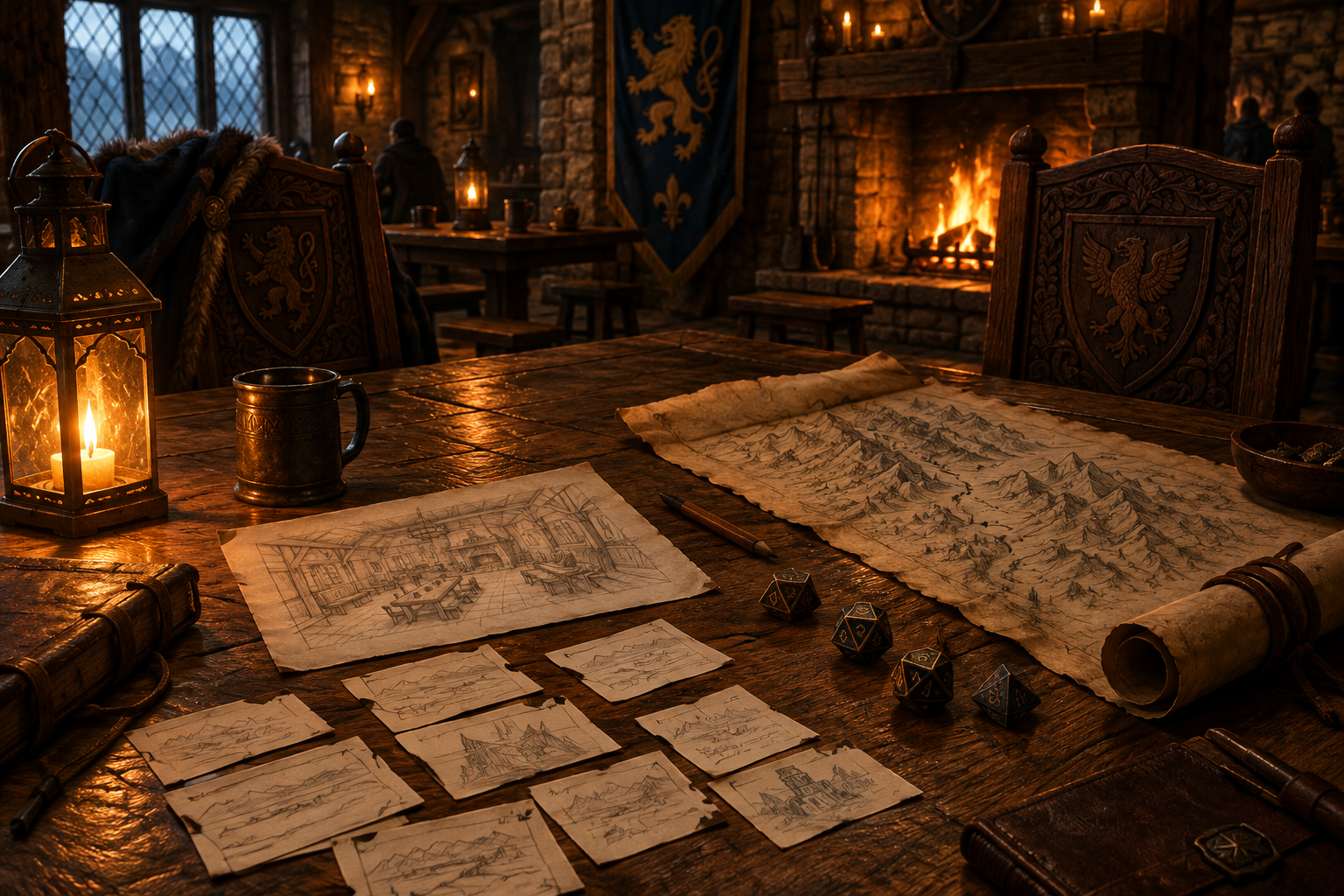
Cognitive load is easier to understand than to manage in the moment. This practical guide covers recap lines, name cards, sketch maps, and shortlists you can use during play.
Most advice about information overload at the gaming table lands in the abstract. Two earlier articles in this cluster covered why a table goes quiet when too much piles up and how education research on cognitive load maps onto play. This guide is the working companion: a set of concrete practices a game master or player can apply during a session, with notes on when each one helps and when it gets in the way.
None of these are rules of the game. They are table habits, and whether they suit your group is a matter of preference. Treat the list as a menu, not a procedure.
A quick refresher on why this matters
Cognitive load theory comes from educational psychology. Sweller (1988) examined how the demands of problem solving can use up working memory and interfere with learning. The theory is about instruction, not tabletop games, so any application to RPGs is an analogy. It is a useful analogy, though, because a session asks everyone to hold names, positions, rules, and options in their heads at once, while also deciding what to do.
A reasonable working assumption, offered as a heuristic rather than a measured fact about any group: when a player goes quiet, asks for a name to be repeated, or says "wait, where is everything?", the table may be carrying more than it can comfortably hold. The techniques below are ways of moving some of that weight onto paper, onto the table, or onto the rhythm of the scene.
Principle one: put memory on the table, not in heads
The simplest family of fixes externalizes information. If something can be seen, nobody has to remember it.
Name cards and a shared reference spot
When a scene introduces several non-player characters, a short written note for each one removes the need to memorize on the spot. A workable format is an index card or sticky note with three things:
- The name
- One memorable trait (how they look, sound, or behave)
- One want
Placing the cards where everyone can see them turns "who was the tax collector?" from an interruption into a glance. A player who is new to the group, or new to the hobby, gets particular value from this, because they are the least likely to ask for repeats out loud.
A few practical notes:
- Keep the cards short. A card that needs a paragraph has become a handout, which is a different tool.
- Let players write their own. A player jotting a name in their own words often remembers it better than reading one the game master wrote.
- Retire cards when a character leaves the scene so the pile does not become its own source of clutter.
The rough sketch
A quick drawing of the space (a rectangle with the door, the hearth, and the exit marked) answers most spatial questions before they are asked. It does not need to be a polished battle map. The goal is that nobody has to hold the layout in their head while also thinking about their character's next move.
Keep the sketch visible and update it as the scene changes. If a table prefers theater of the mind, a verbal landmark list repeated once and written on a scrap of paper does a similar job. Tools for drawing maps are covered in other articles on this blog; for this purpose, a pencil and a sheet of paper are enough. For a broader look at what physical tools earn their place, see The Dungeon Trainer's overview of essential game master tools (The Dungeon Trainer, 2026).
A visible list of open threads
A short written list of what the party is currently trying to do ("reach the next town before the pass closes", "find who forged the tax seal") keeps the table's goals out of anyone's working memory. Update it between scenes, not during them.
Principle two: control the rate at which information arrives
External aids help with storage. Pacing helps with intake. Even clearly written cards cannot rescue a scene where ten facts arrive in thirty seconds.
Introduce things one at a time
A long block of narration that names several characters in a row asks listeners to encode all of them before any has had a chance to settle. Presenting characters individually, each with a beat of interaction before the next arrives, gives the table time to attach a name to a face and a want.
Writers on game mastering have discussed the related skill of knowing when to stop talking. The Angry GM (2025) addresses when a game master should stop narrating, which is relevant here because the urge to keep describing is often the source of overload. Consult that piece for its specific reasoning rather than relying on a summary here.
Short bursts, then a question
A useful rhythm is a brief description followed by an invitation to engage, rather than one long description followed by a single question at the end. The table gets repeated chances to react, and the game master gets repeated signals about whether the information landed.
This is related to general advice about pacing. Alexander (2013) discusses the art of pacing in roleplaying games, and Shea (2022) offers practical suggestions for improving pacing at the table. Both are worth reading for fuller treatment, and both frame pacing as a skill to be developed rather than a formula.
Hold some information back on purpose
Not everything prepared needs to appear in the scene. A game master who has written eight details about a location might deliver only the two that matter for the moment and keep the rest ready for when a player asks. Alexander (2017) offers guidance on evocative descriptions, and the underlying idea, that a few well-chosen details often do more than an exhaustive list, applies directly to load management. Whether less description always serves a given table is a matter of preference; some groups enjoy lavish detail and handle it well.
Principle three: recap and re-anchor
Sessions are often separated by days or weeks. Everyone's memory of the last one has decayed unevenly, and the start of a session is a high-risk moment for overload because the table is trying to rebuild context while also absorbing new material.
The one-line recap
A single sentence stating the party's current goal and the most pressing complication does a lot of work. "You're escorting the caravan to the next town and the pass closes soon." That line gives everyone the same starting frame in a few seconds. Longer recaps have their place, but a short anchor is often enough to get a scene moving.
Let players do the recap
Asking a player to summarize the last session in their own words has two benefits. It rebuilds shared memory, and it reveals what the table actually remembers versus what the game master assumes it remembers. Differences between those two are useful information. Some players enjoy this role; others do not, so offer it rather than assigning it.
Re-anchor after tangents
When a scene wanders, a quick restatement of where things stand ("so the tax collector is still waiting for your answer") brings everyone back without the game master having to steer by force.
Principle four: shape the choices, not just the information
Number of options is a kind of load too. A prompt like "what do you do?" is fully open, which is sometimes exactly right and sometimes paralyzing.
The loose shortlist
When a scene reaches a decision, a game master can name two or three obvious directions while making clear that they are suggestions: "You could help the innkeeper, question the tax collector, or keep an eye on the rival caravan master. Or something else entirely." The shortlist reduces the blank-page problem for hesitant players without removing anyone's freedom.
The risk is that a shortlist can feel like a menu that limits imagination, especially at tables that prize open exploration. Signaling that the list is not exhaustive is the usual remedy. At some tables, even that is too much structure, and that is a legitimate preference.
Make consequences legible
Players choose more confidently when they have a rough sense of what each option risks or offers. This does not mean revealing outcomes. It means stating the stakes plainly enough that a decision does not require guessing at hidden information. Writers on game mastering have long discussed the value of giving players enough information to make meaningful choices, including Alexander's (2008) work on ensuring that players are not stranded without leads.
Limit simultaneous demands
When multiple decisions land at once (a combat situation, a social complication, and a resource question), it can help to sequence them. Resolve the most urgent first and bring the others back in turn.
Principle five: reduce rules friction
Rules lookups are a recognized source of stalls. They draw attention away from the fiction and demand that players hold two models at once, the story and the mechanics.
Keep a short personal reference
A one-page summary of the rules most likely to come up (the ones your group actually uses) saves time. This is a personal tool, and its contents depend on the game and the group. Players can keep their own, listing their character's most frequent actions and how they work.
For tables playing the current edition of the world's best-known fantasy game, the official free rules are available online (Wizards of the Coast, 2024). Consult the current rulebooks directly for authoritative wording instead of relying on memory or secondhand summaries.
Decide quickly, revisit later
A common table practice is to make a fast ruling in the moment and look up the exact rule after the session. Whether this suits a given group is a matter of preference. Some groups are comfortable with it; others find that unresolved rules questions linger and distract. If you adopt it, saying out loud that the ruling is provisional helps the table trust the process.
Pre-explain the unusual
If a scene will rely on a mechanic the table rarely uses, a short explanation before the scene starts costs less than interrupting mid-scene. Keep it to the essentials.
Principle six: protect the quiet players
Overload does not announce itself evenly. Experienced players may absorb a lot without visible strain, while newer or more reserved players quietly disengage. The hobby has no universal signal for "I am lost."
Check in without spotlighting
A low-pressure way to check in is to offer a quick table-wide pause: "Anything you want repeated or clarified before we continue?" Phrasing it as a general offer avoids singling anyone out.
Make asking easy
Tables where it is normal to say "remind me who that is?" tend to carry load better than tables where asking feels like admitting a failure. This is about culture rather than technique. Safety and communication tools discussed elsewhere in the hobby, such as the materials gathered by Shaw and Bryant-Monk (n.d.), are aimed at different problems, but the underlying idea that players should have easy, low-cost ways to signal what they need is similar. Do not conflate the two; overload is a pacing and comprehension issue, not a safety issue, and the tools are not interchangeable.
Let notes be normal
Encouraging everyone to jot down names and goals normalizes the practice. If only one person takes notes, it can feel like a chore; if everyone does, it is just how the table works.
Principle seven: prepare in a way that makes light delivery possible
Many load problems begin before the session, in how the material was prepared. A game master who has written everything in dense prose has to translate it live. One who has prepared in scannable pieces can deliver in the same pieces.
Prep in chunks
Breaking a scene into discrete elements (characters with trait and want, places with a few landmarks, a clear goal) makes it easier to deliver one element at a time. Shea (2018) describes a lightweight preparation approach built around prepping only what is useful at the table, and Shea (2024) discusses where preparation time yields the most value. Both are worth reading if you want to match your prep to the load you want to deliver.
Prepare the handout, not the lecture
If a piece of information would take a minute to say aloud and could fit on a card, make the card. Reading aloud is slow, and listeners cannot re-read.
Cap your own cast
A useful self-imposed limit is a small number of named characters per scene, with others kept anonymous ("a traveler", "a guard") unless they matter. The right number depends on the group and the scene; there is no universally correct figure, and any specific count is a preference rather than a finding.
Putting it together: a small checklist
Here is a compact version you might adapt:
- Before the session: Write character cards (name, trait, want). Sketch key spaces. Draft a one-line recap.
- Opening: Deliver the recap. Post the open-threads list.
- During scenes: Introduce characters one at a time. Use short bursts followed by prompts. Keep the sketch visible.
- At decisions: Offer a loose shortlist if the table is hesitant. State stakes plainly.
- When rules come up: Rule quickly, flag provisional calls, look it up afterward if needed.
- Throughout: Offer table-wide check-ins. Make asking for repeats normal.
- After the session: Note what confused people and adjust next time.
Every item is optional. A group that thrives on dense, improvisational play may need almost none of this; a group with newer players or long gaps between sessions may find most of it useful.
When these techniques backfire
Load-reduction habits can be overdone. A few failure modes to watch for:
- Over-structuring. If every scene arrives with cards, sketches, shortlists, and recaps, the game can feel procedural. Use tools where load is actually a problem.
- Underestimating players. Some players want the full, rich description and enjoy keeping track of a big cast. Reading the table matters more than following a rule of thumb.
- Shortlists that become rails. If players start choosing only from the list, the shortlist is steering too hard. Widen the invitation.
- Confusing simplicity with shallowness. Lightening the load is about delivery, not about reducing the depth of the fiction.
The goal is a table where people can think about what their characters want, not a table where nothing is complicated.
Example: The Lantern Road Company
This is an illustrative scenario, not a report of an actual game. It shows how the table-side tools above might combine for a fictional group.
The Lantern Road Company is a four-player party escorting a merchant caravan through a mountain pass. Their next session opens at the crowded waystation, and the game master has had a rough first attempt at this scene in mind: a long narration with many names. This time the game master tries a different approach.
Before play. The game master prepares three index cards. The innkeeper is warm and hurried and wants help with a broken cart. A rival caravan master is smug and wants to leave first. A tax collector is nervous and wants an escort. A sheet of paper shows a rough rectangle for the common room with the hearth, the door, and the stable yard marked. The game master also writes an open-threads list with one line: reach the next town before the pass closes.
Opening. The game master gives a single-sentence recap: the caravan is stopped at the waystation, and the pass will not stay open forever. A player asks whether anyone remembers how many days the party has left, and another player, who has been jotting notes, reads it out. The table is working from the same page within a minute.
During the scene. The game master presents the innkeeper first, as a short burst, and sets her card on the table. The player with the cautious scout writes the name on a personal card. The rival caravan master follows, then the tax collector, each with a beat of interaction before the next. When a player asks where the exit is, the game master points to the sketch rather than describing it again.
At the decision point. The table pauses, and the game master offers a loose shortlist: help the innkeeper, question the tax collector, or watch the rival master, or do something else. The scout's player, who might otherwise have stayed quiet, volunteers to watch the rival master. Another player ignores the list entirely and goes to inspect the stable yard, which the game master welcomes.
Afterward. The game master asks whether anything felt confusing and notes that two players found the rival master easier to track than the tax collector. That becomes input for the next session's cards.
The fiction in this version is the same as in an overloaded one. What changed is how much the table had to carry and where it was carried.
Where The Dungeon Trainer fits
If you prefer to keep session notes in one place, The Dungeon Trainer is a tool built for playing together and improving your craft, and its optional AI Dungeon Master is there for groups who want it, not as a replacement for a human game master. Plain paper and index cards work just as well for everything in this guide.
Sources and Further Reading
Alexander, J. (2008, May 8). The Three Clue Rule. The Alexandrian. https://thealexandrian.net/wordpress/1118/roleplaying-games/three-clue-rule
Alexander, J. (2013). The Art of Pacing. The Alexandrian. https://thealexandrian.net/wordpress/31509/roleplaying-games/the-art-of-pacing
Alexander, J. (2017, September 4). Random GM Tip: Evocative Descriptions. The Alexandrian. https://thealexandrian.net/wordpress/39227/roleplaying-games/random-gm-tips-evocative-descriptions
Shaw, K., & Bryant-Monk, L. (n.d.). TTRPG Safety Toolkit. https://ttrpgsafetytoolkit.com/
Shea, M. E. (2018). Return of the Lazy Dungeon Master. Sly Flourish.
Shea, M. E. (2022). Improving Pacing. Sly Flourish. https://slyflourish.com/pacing.html
Shea, M. E. (2024, June 3). High Value Prep. Sly Flourish.
Sweller, J. (1988). Cognitive load during problem solving: Effects on learning. Cognitive Science, 12(2), 257–285.
The Angry GM. (2025, July 31). When to stop narrating. The Angry GM.
The Dungeon Trainer. (2026). Essential Dungeon Master Tools: What You Actually Need at the Table. https://thedungeontrainer.com/blog/essential-dungeon-master-tools-what-you-actually-need-at-the-table
Wizards of the Coast. (2024). Basic Rules for Dungeons & Dragons. D&D Beyond. https://www.dndbeyond.com/sources/dnd/br-2024/
Play 5E at your own table
Play with friends or solo, run your own campaign, and keep the dice and character math in code. An optional AI Dungeon Master can run the game when you want one. Free to start, no card required.
Related reading
- Chunking, Handouts, and Pacing: Cognitive Load Theory Applied to RPG Tables
Cognitive load theory comes from education research, not gaming, but its core ideas map neatly onto tabletop play. This analysis looks at what the theory claims, where the analogy holds, and where it stops.
- Cognitive Load at the Gaming Table: How Too Much Information Can Stall a Game
Cognitive load theory, an idea from learning research, offers one useful lens on why a table can go quiet when rules, names, and options pile up. Here is the concept, what it means for game masters and players, and ways to lighten the load.
- Downtime in Tabletop RPGs: The Quiet Gears of a Campaign
Downtime is the stretch of play between adventures when characters rest, train, craft, and pursue personal goals. Here is what it is, what it does for a campaign, and how tables handle it.