Downtime in Tabletop RPGs: The Quiet Gears of a Campaign
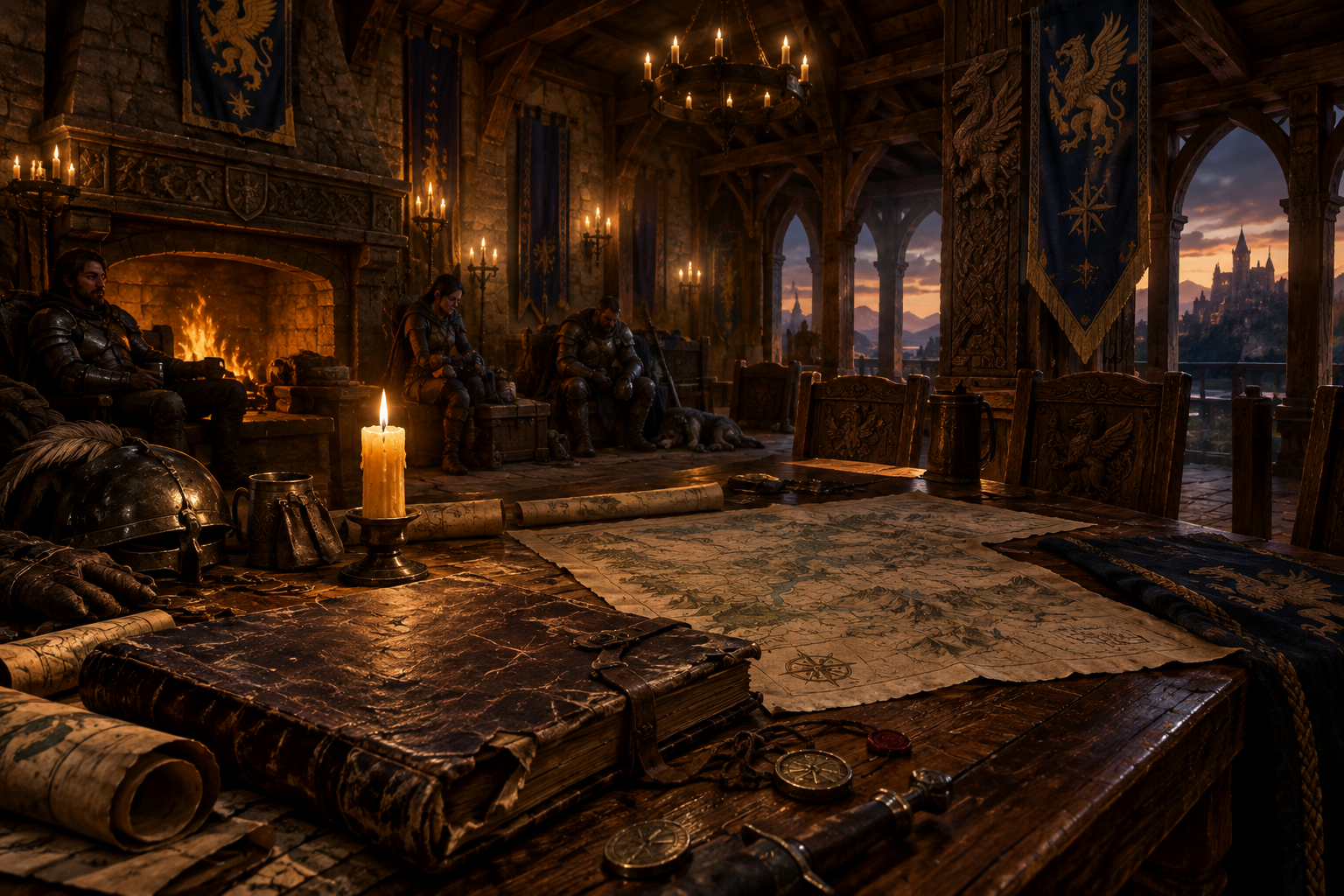
Downtime is the stretch of play between adventures when characters rest, train, craft, and pursue personal goals. Here is what it is, what it does for a campaign, and how tables handle it.
Many groups remember a campaign mainly for its dungeons, battles, and betrayals. Yet between those peaks sits a quieter layer of play that shapes how a campaign feels over months: downtime. This article explains what downtime is, what it does for a game, the main ways tables structure it, and the trade-offs of each approach. It is a concept explainer, so the goal is a clear mental model you can apply at any table, in any system.
What Downtime Means in Tabletop RPGs
Downtime is the time in the fiction when the characters are not actively pursuing an adventure's central problem. They have returned to town, the road is closed for winter, the ship is in dock for repairs, or the siege has ended and the dust is settling. The story clock slows, and the game shifts from risk and exploration to recovery, preparation, and personal pursuits.
Two things are worth separating here, because they are often confused.
- Downtime in the fiction: an in-world span of days, weeks, or months when characters do things other than adventure.
- Downtime at the table: the real-world portion of a session spent on that material, which may be a few minutes of narration or an entire scene.
A campaign can have long fictional downtime that takes ninety seconds at the table ("you spend the winter in the city, here is what changed") or a short fictional downtime that fills an evening because the players want to dig into it. Neither is wrong. Which one fits depends on what your group enjoys, which is a matter of table preference.
A Brief History of the Idea
The concept is older than the word suggests. Many players trace the habit of delving, returning to a base, and spending treasure before setting out again back to early Dungeons & Dragons. Volume 3 of the original game, The Underworld & Wilderness Adventures (Gygax & Arneson, 1974), names both underworld and wilderness adventures in its title. Many players see the original game's rhythm of going out and coming back as an early form of what tables now call downtime.
Fifth edition's 2014 Player's Handbook describes downtime activities between adventures. The 2014 Dungeon Master's Guide adds more in its 'Between Adventures' chapter, such as building a stronghold, carousing, and crafting a magic item (Wizards of the Coast, 2014). The 2024 Dungeon Master's Guide gives a whole chapter to Bastions: a base of operations that a character gains at level 5 and runs with the help of hirelings (Wizards of the Coast, 2024). If you want the exact current rules for any specific activity, read them in those books rather than relying on a summary, since details such as costs and time requirements are rules text that this article does not restate.
Other systems treat the same space differently. Torchbearer, a dungeon crawl RPG from the creators of the Mouse Guard RPG, has a separate town phase in its structure, so returning to safety is part of its design rather than an afterthought (Olavsrud & Crane, 2013). The point is that downtime shows up in several systems and editions, not just one.
What Downtime Does for a Campaign
Downtime earns its place because it does several jobs that action-heavy play handles poorly. Here are the main ones.
It paces the campaign
The Angry GM (2016) advises GMs to vary the pace by alternating fast and slow scenes. Alexander (2013) frames pacing as skipping the empty time between meaningful choices. Many GMs find downtime a useful way to slow the tempo on purpose.
It lets characters become people
In the field, characters are defined by what they do under pressure. In downtime, they are defined by what they want when nothing is forcing their hand. A fighter who spends a quiet week repairing a dead mentor's armor tells the table more about who that character is than another sword fight might.
It makes the world feel continuous
When the party leaves town, the world should keep moving. Downtime is the natural moment to show the consequences: prices have shifted, a rival has gained influence, a rumor has spread. This pairs well with approaches that prepare situations and let them develop rather than scripting plots (Alexander, 2009).
It creates player-driven goals
Downtime is where players can propose their own objectives: build a workshop, find a lost sibling, earn a license, found a guild. Those goals can then feed back into the next adventure, giving players a stake they authored themselves.
It manages resources and recovery
In many games, time spent in safety between adventures is when characters recover and resupply. How easily that happens changes how tense the adventuring portion feels. Writers on the topic note that the pace of rest and recovery shapes a game's rhythm and difficulty, which is why rest rules are worth a deliberate choice (Shea, 2021b).
The Common Activity Categories
Whatever system you play, downtime activities tend to fall into a handful of buckets. Naming them helps you plan and helps players imagine options.
- Recovery: healing wounds, resting, recuperating from curses or exhaustion.
- Preparation: shopping, repairing gear, hiring help, scouting the next destination.
- Training and growth: learning a skill, practicing a language, studying under a teacher.
- Creation: crafting items, writing scrolls, building or improving a base.
- Social and political: cultivating contacts, running for office, spreading or suppressing rumors, repaying favors.
- Investigation: researching lore, following up on a loose thread, cross-referencing clues.
- Personal: pursuing a relationship, tending to family, observing a religious practice, running a small business.
These are descriptive categories, not rules. Your system may formalize some of them and leave others to improvisation.
Four Ways Tables Structure Downtime
There is no single correct approach. Here are four structures tables use, with honest trade-offs for each. Which one works is largely table preference, shaped by how much time your group has and what it enjoys.
1. The summary montage
The Game Master (GM) narrates the passage of time in a few sentences, perhaps asking each player for one line about what their character does. Nothing is rolled or tracked.
- Strengths: fast, low prep, keeps momentum.
- Weaknesses: can feel thin if players want mechanical payoff, and gives little structure to long-term goals.
- Best for: groups with limited session time or a preference for steady forward motion.
2. The rules-driven activity system
Players choose from a defined list of activities, spend time or money, and resolve outcomes with a rule or a roll. Fifth edition's published downtime activities are an example, and the Bastion system is a more elaborate one (Wizards of the Coast, 2014, 2024).
- Strengths: predictable, fair, gives players clear choices and tangible results.
- Weaknesses: can feel like bookkeeping, and may crowd out roleplay if every activity reduces to a single roll.
- Best for: groups that enjoy systems and want downtime to have mechanical weight.
3. The scene-based approach
Instead of resolving activities in the abstract, the GM frames short scenes around what a character is doing. A craft project becomes a conversation with a supplier who has a problem. A research task becomes a visit to a suspicious archivist.
- Strengths: keeps downtime interactive and story-rich, and ties naturally into the setting.
- Weaknesses: takes table time, and can leave some players waiting while others have their scene.
- Best for: groups that treat downtime as a chance for character-focused roleplay.
4. The pressure-limited approach
Downtime exists, but the world presses on it. Time is limited by an approaching deadline, so every choice costs something. A festival ends in two weeks, a rival expedition leaves at dawn, a debt is due.
- Strengths: forces meaningful choices and keeps downtime from feeling like free time.
- Weaknesses: can make players feel rushed, and may frustrate those who wanted a calm interlude.
- Best for: groups that like tension even in quiet moments.
Some tables blend these, for example a brief montage for most characters plus one or two full scenes for whoever has the most interesting goal.
Common Problems and Honest Fixes
Downtime can stall if it is not handled with some thought. The following issues come up often enough to name, though how often they appear at your table depends entirely on your group.
Players do not know what to do
Open-ended freedom can paralyze. If a player stares at the table when asked what their character does, offer a short menu drawn from the categories above, or ask a prompting question about something their character cares about. A session zero, where the group agrees what the campaign is and ties the characters to the world and its story, can bring these goals up before play begins (Shea, 2021a).
One player dominates
Because downtime is often individual, a vocal player can absorb the time. A simple fix is to go around the table in order and give each player a similar slice, or to have the GM set a timer for each turn. This is a facilitation habit, and your group may prefer a looser touch.
It becomes pure bookkeeping
If activities reduce to "roll, record, move on," players lose interest. Pair at least some activities with a complication, a person, or a decision, so that the result is a story beat as well as a number.
It breaks the campaign's tension
If characters can recover everything instantly, risk in the field loses its edge. This is a design choice rather than a flaw. Some tables enjoy a forgiving pace, and others want recovery to cost time, money, or opportunity. Deciding on purpose is better than drifting into either extreme (Shea, 2021b).
Downtime and the clock disagree
If the GM has prepared advancing threats, long downtime lets those threats act. That can be exciting, but it can also feel unfair if players were not warned. Signal clearly when time pressure applies, so that players can weigh a long project against a looming deadline.
Planning Downtime as a Game Master
You do not need heavy prep. A small amount of structure goes a long way. One reasonable approach is to prepare three things.
- A list of what changed. Two or three developments in the wider world that occurred while the party was away. These can be small: a new tax, a missing person, a rumor.
- A handful of named contacts. Individuals players might visit, each with a want and a secret. A few well-chosen people go further than a large cast.
- A few open offers. Opportunities that players can accept or decline, such as a job, a lesson, or a favor. Preparing a short set of options rather than a plot keeps you flexible, in the spirit of advice to prepare situations and possibilities rather than fixed storylines (Alexander, 2009; Shea, 2025).
This kind of light preparation fits approaches that prioritize high-value prep over exhaustive detail (Shea, 2024).
Planning Downtime as a Player
Players shape downtime as much as GMs do. A few habits help.
- Arrive with a goal. Even a one-line ambition gives the GM something to build on.
- Tie it to your character. The best downtime goals come from a character's history, relationships, or flaws.
- Offer a stake. If your project could go wrong in an interesting way, say so. It gives the GM permission to complicate it.
- Share the spotlight. If someone else's project is more urgent, make room.
- Connect it outward. A goal that links to another character's or to the wider world is more likely to matter.
Downtime and Different Play Styles
The right amount of downtime depends on what kind of game you are running.
- Dungeon-focused campaigns often use downtime as a reset between delves, with the emphasis on recovery and resupply.
- In some sandbox campaigns, downtime becomes a planning phase for choosing the next destination.
- Some story-driven campaigns use it for character development and for showing consequences.
- Short or episodic games may skip downtime entirely, handing the characters off to the next session's problem.
None of these is superior. A game that never pauses and a game that frequently does can both be excellent, depending on what the table wants.
Example: The Ledger's Shadow
This is an illustrative scenario, described in the third person, meant to show how the ideas above might look in play rather than a record of any real game.
Imagine a campaign called The Ledger's Shadow, in which a merchant house has quietly been buying up debts across a river city. After the party breaks into the house's counting rooms and escapes with a damaged ledger, the Game Master calls a downtime period of two weeks, with a clear pressure: the house will notice the theft within ten days.
The Game Master opens with three changes in the wider world: the harbor tax has doubled, a clerk who helped the party has gone missing, and a rumor says the house is hiring hunters. Then each player names one thing their character does.
The party's scout wants to decode the ledger. Rather than rolling once, the Game Master frames a short scene with a retired archivist who can read the cipher but demands a favor. The party's cleric wants to find the missing clerk, so the Game Master runs a brief investigation scene in a flooded district. The party's fighter, who has no specific plan, is offered a menu: train with a duelist who owes the party a debt, repair armor damaged in the escape, or hire a few locals as lookouts. The fighter chooses lookouts, which quietly pays off later when the hunters arrive.
Because of the ten-day pressure, the group cannot do everything. The scout's decoding takes longer than the cleric's search, and the table has to decide which matters more. The downtime does several jobs at once: it reveals the world's movement, gives each character a personal beat, creates choices with costs, and sets up the next adventure without scripting it.
Notice what the example does not require. There were no elaborate tables and no long preparation, only a short list of changes, a few named people, and a deadline. A group that preferred a faster pace could have run the same material as a ninety-second montage, and a group that loved crunch could have attached rules to each project. The structure bends to the table.
Tools That Can Help
Any notebook works for tracking downtime projects, but a few kinds of tool are worth knowing about if you want more structure.
- A project tracker. A simple list or card for each ongoing effort, with a goal, a deadline, and a status. Some groups use clocks or progress tracks to show this.
- A campaign wiki or notes tool. Keeping names, contacts, and open offers in one place helps when players return after a long gap. General-purpose campaign managers exist for this purpose, such as Kanka, LegendKeeper, and World Anvil (Kanka, n.d.; LegendKeeper, n.d.; World Anvil, n.d.).
- A shared group channel. Because downtime can happen between sessions, some groups handle part of it asynchronously, with players posting what their characters do and the GM replying with results. This saves table time for scenes that benefit from live play.
A human GM running downtime with a notebook is a perfectly complete setup.
Quick Reference
Use this short checklist when planning or running downtime.
- Decide how much table time downtime should get, and tell the players.
- Pick a structure: montage, rules-driven, scene-based, or pressure-limited, or a blend.
- Prepare a few changes in the world, a few named contacts, and a few open offers.
- Give every player a comparable share of attention.
- Attach at least some activities to a person, a complication, or a decision.
- Make time pressure visible if it applies.
- Connect results back to the next adventure.
Key Takeaways
Downtime is the play between adventures: recovery, preparation, growth, creation, and personal pursuit. It paces a campaign, deepens characters, shows the world continuing to move, and gives players ways to set their own goals. The amount of table time it deserves, and the structure that fits, are matters of table preference. Start small, prepare situations instead of plots, and adjust based on what your group actually enjoys.
Sources and Further Reading
- Alexander, J. (2009, March 23). Don't Prep Plots. The Alexandrian. https://thealexandrian.net/wordpress/4147/roleplaying-games/dont-prep-plots
- Alexander, J. (2013). The Art of Pacing. The Alexandrian. https://thealexandrian.net/wordpress/31509/roleplaying-games/the-art-of-pacing
- Gygax, G., & Arneson, D. (1974). Dungeons & Dragons, Volume 3: The Underworld & Wilderness Adventures. Tactical Studies Rules.
- Kanka. (n.d.). Kanka overview.
- LegendKeeper. (n.d.). RPG campaign manager with maps, wikis, and whiteboards.
- Olavsrud, T., & Crane, L. (2013). Torchbearer. Burning Wheel Headquarters. https://www.torchbearerrpg.com/
- Shea, M. E. (2021a, April 5). Running session zeros. Sly Flourish. https://slyflourish.com/runningsessionzeros.html
- Shea, M. E. (2021b, February 15). Manage Rests. Sly Flourish. https://slyflourish.com/handling_rests.html
- Shea, M. E. (2024, June 3). High Value Prep. Sly Flourish.
- Shea, M. E. (2025, July 21). Prep three quests. Sly Flourish. https://slyflourish.com/prepthreequests.html
- The Angry GM. (2016, March 23). Keeping pace. The Angry GM.
- Wizards of the Coast. (2014). Dungeon Master's Guide. Wizards of the Coast.
- Wizards of the Coast. (2024). Dungeon Master's Guide. Wizards of the Coast.
- World Anvil. (n.d.). RPG campaign manager and worldbuilding tools.
Play 5E at your own table
Play with friends or solo, run your own campaign, and keep the dice and character math in code. An optional AI Dungeon Master can run the game when you want one. Free to start, no card required.
Related reading
- Six Sessions Under the Ledger's Shadow: A Case Study in Advancing Threats
A reflective, illustrative case study of one advancing threat across six sessions, with an honest look at what the approach did well, where it strained, and what to adjust.
- Clocks, Fronts, or Faction Turns: Three Ways to Make a Threat Move
Countdown clocks, fronts, and faction turns all make a threat advance without the party. Here is how they differ, what each costs in prep, and which fits your table.
- The Front Builder's Toolkit: Cards, Clocks, and Checklists for Advancing Threats
A practical toolkit of index cards, clock templates, trigger lists, and between-session checklists for Game Masters who want advancing threats that are easy to run and fair to players.