The Front Builder's Toolkit: Cards, Clocks, and Checklists for Advancing Threats
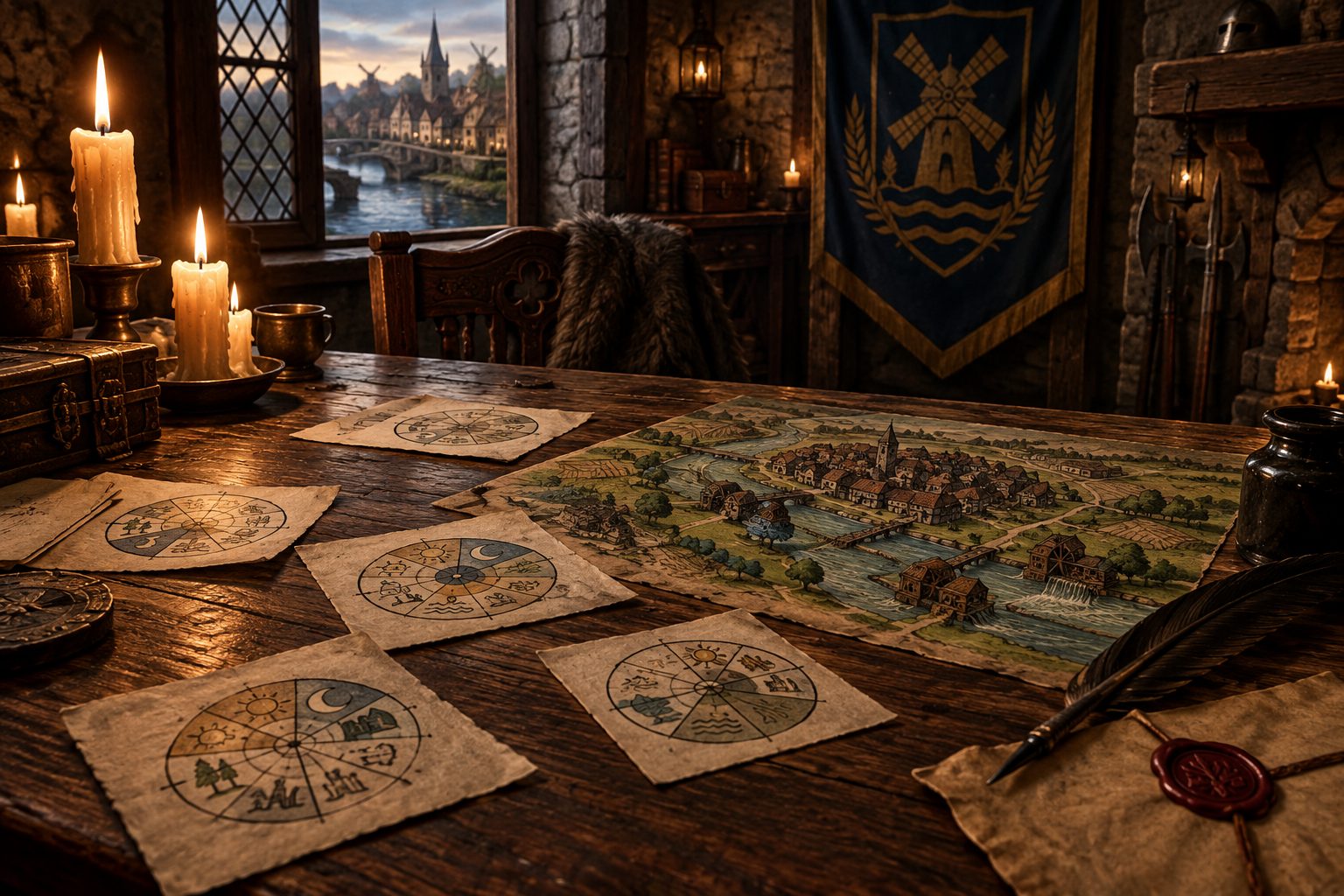
A practical toolkit of index cards, clock templates, trigger lists, and between-session checklists for Game Masters who want advancing threats that are easy to run and fair to players.
Advancing threats are easy to admire and surprisingly easy to neglect. It is easy for a Game Master to build a front with enthusiasm and then lose track of it a few sessions in. The idea was never the problem. The tooling around it was.
This article is a toolkit rather than a theory piece. It collects the physical and digital aids, templates, and checklists that make an advancing threat cheap to maintain and easy to run. Where a tool comes from a specific published source, that source is named. Where something is table preference, the article says so.
It assumes you already know the basics of fronts and clocks and want the practical kit.
What a Threat Toolkit Needs to Do
Before picking tools, it helps to name the jobs they perform. A threat that moves between sessions needs four things.
- A place to live. The threat's wants, methods, and steps need to sit somewhere you can see them at a glance.
- A way to measure progress. Something has to show how far along the plan is.
- A way to decide when it moves. Triggers need to be written down, not remembered.
- A way to show the players. A threat that only exists in your head cannot be responded to.
Every tool below serves one or more of those jobs. If a tool does not, it is clutter, however attractive.
This follows a broader principle in prep. Advice from Sly Flourish stresses spending limited prep time on the activities that matter most for running a great game (Shea, 2024). A threat toolkit applies that to opposition: record only what you will use during play.
Tool One: The Front Card
The single most useful tool is also the cheapest: one index card per threat.
A front card holds the threat's whole identity on a surface small enough to sit beside your notes. A workable layout:
- Name. The faction or villain, in a few words.
- Want. One sentence. What do they ultimately seek?
- Method. How they pursue it. This is where the threat gets its flavor.
- Stake. What changes in the world if they succeed?
- Steps. Three to six concrete events, in order.
- Clock. A drawn circle divided into segments.
- Counterplay. Two or three ways the players could slow or stop it.
The card works because it forces compression. If you cannot state the want in a sentence, the threat is not ready to run.
Index Card RPG: Master Edition (Runehammer Games, 2022) is a streamlined d20 game that puts its rules, settings, and GM advice in one book, and it takes its name from the index card. You do not need to adopt that system to borrow the habit of prepping on cards. A card is a prep unit you can hold, shuffle, and discard.
Why Card Size Matters
A card is small on purpose. When a threat's information is limited to a few lines, you are forced to decide what matters. When it is spread across pages of notes, you will not read it mid-session. Table preference applies here: some Game Masters prefer a half sheet or a digital note. The principle is the same. Keep it small enough to glance at.
Tool Two: Clock Templates
In this article, a clock is a circle divided into segments, filled in as a threat advances. Some games make it a formal rule. Elsewhere it works as a visual shorthand that any Game Master can adapt.
Four, six, and eight segments are convenient sizes. The suggestions below are rules of thumb and table preference, not requirements.
| Clock size | Best for | Feel |
|---|---|---|
| 4 segments | A short plot, a single scene's pressure, a minor faction | Fast and tense |
| 6 segments | A standard faction plan across several sessions | Balanced |
| 8 segments | A large, slow-burn campaign threat | Epic and patient |
The right size depends on how many sessions you want the threat to run and how often your triggers will fire.
Printable and Reusable Clock Options
You have several ways to produce a clock quickly:
- Hand-drawn. A circle with lines through it on an index card. It is fast, and for many tables it is enough.
- Dry-erase. A laminated card or small whiteboard lets you reuse the same clock for different threats.
- Printed templates. A sheet of pre-drawn clocks in several sizes, kept in a folder.
- Digital. Virtual tabletops and note apps can host a simple progress tracker. Several campaign tools, such as Kanka (n.d.) and LegendKeeper (n.d.), offer ways to store notes and maps for a campaign. Whether any of them fits your table is a preference call, and none is required.
Pick whichever you will actually use. A fancy tracker you abandon is worse than a scribble you keep.
Labeling Clocks Clearly
Name each clock for the threat, not for the outcome. "The Ashen Ledger" tells you whose plan this is. "Town Gets Taken Over" tells you only the ending and invites vagueness. A named clock also makes it easier to run several at once without confusion.
Tool Three: The Trigger List
A clock without triggers is decoration. The trigger list is the tool that turns "the threat advances" into a decision you can make quickly and fairly.
Write triggers as plain conditions. Common categories:
- Failed rolls tied to the threat. A roll related to the villain's plan fails.
- Elapsed time. A set amount of in-fiction or real time passes without the threat being addressed.
- Player action that helps the threat. A clumsy intervention that accidentally serves the villain.
- Neglect. A full session passes without anyone looking at the problem.
- Opportunity. The threat's agents seize a chance the world offers.
A good rule is to write two or three triggers per clock and no more. Too many, and you will advance the clock constantly and flatten the players' sense of control. Too few, and the threat stalls.
Keeping Triggers Fair
Fairness comes from legibility. Players should be able to understand, at least in broad terms, what makes a threat move. That does not mean you announce the triggers. It means that when the clock ticks, the players can trace it to something that happened or failed to happen, rather than to your mood. A tick the table cannot explain feels arbitrary.
This connects to a wider concern in game-mastering guidance. On pacing, The Alexandrian (Alexander, 2013) places a Game Master's control of pacing at the moment of responding to the players, and Sly Flourish (Shea, 2022) advises turning things over to the characters' actions as fast as possible. Triggers are a pacing tool. They let the world push forward without you overriding player choices.
Tool Four: The Clue Trail Check
An advancing threat is only useful if the players can find it. This is where a classic piece of scenario advice earns its place in the toolkit.
Justin Alexander's Three Clue Rule (Alexander, 2008) holds that for any conclusion the players need to reach, you should provide at least three clues pointing toward it. The reasoning is that players will miss, misread, or ignore individual clues, so redundancy keeps the investigation from stalling.
Apply this to your front. For each step on the card, ask: how could the players learn this is happening? If the answer is "only if they happen to enter one specific room," the threat is invisible, and the clock will tick toward a surprise the players had no chance to prevent.
A simple clue trail check for each step:
- Name the step (for example, "a mill changes hands").
- List three ways evidence of it could surface (a rumor, a changed sign, a displaced family).
- Confirm at least one of those ways can reach the players without requiring a specific action.
This tool is the difference between a threat the players can respond to and one that simply happens to them.
Tool Five: The Between-Session Checklist
The hardest moment for an advancing threat is the gap between sessions. This is when you decide what moved. A short checklist keeps that from becoming a chore.
Run this after each session, before you plan the next:
- Review each active clock. Look at the card and the current segment count.
- Check the triggers. Did any fire during play? Did a full session pass with the threat ignored?
- Advance or hold. Mark any ticks. Note what changed in the fiction.
- Write the visible consequence. For each tick, write one concrete thing the players could notice. A tick with no visible consequence is wasted.
- Reconsider counterplay. Did the players do something that removes a step or wins a segment back? Update the card.
- Decide what surfaces next. Choose one or two clues to seed in the coming session.
This takes minutes, not hours. It fits the spirit of lightweight prep that Shea (2018) describes in the Lazy Dungeon Master approach, where preparation is kept proportionate to what will help at the table.
Keeping a Threat Log
A short running log helps you remember what you decided and why. One line per session is plenty:
- Session number
- What triggered a tick (or that nothing did)
- The visible consequence
- What the players now believe
The log protects you from a common drift, where you forget the reasoning behind an earlier tick and contradict it later. It also gives you material for recaps. In a long campaign it is easy to lose track of earlier decisions, and a log is a low-effort defense.
Tool Six: A Fairness Pass
Before a session, spend two minutes checking whether your threat is fair. This is a quality control step rather than a game rule, and it reflects table preference. Some groups want a harsh, unforgiving world; others want a gentler one. Establishing which your table prefers belongs in your early conversations, and session zero guidance from D&D Beyond (Haeck, 2024) and Sly Flourish (Shea, 2021) offers frameworks for that discussion.
A fairness pass asks:
- Can the players learn about this? (The clue trail check.)
- Can they act on it? Is there at least one concrete counterplay option?
- Does the tick follow from something? Is the trigger traceable?
- Is the pace survivable? If the clock fills, will the players still have meaningful choices afterward, or does it end the story?
That last question is important. A clock reaching its final segment should change the situation dramatically, but it should not necessarily end the campaign. The best threats leave the players with a new problem rather than no options.
Tool Seven: A Compact Reference Table
Keep one summary page that lists every active threat on a single sheet. For each, record the name, current segment count, and the next likely step. This is a dashboard.
| Threat | Clock | Next step | Visible sign |
|---|---|---|---|
| (Name) | 2 of 6 | (Event) | (What players might notice) |
When you run several fronts at once, the dashboard prevents you from forgetting that one of them is quietly one segment from completion. It also helps you avoid advancing everything at once, which can overwhelm players. Moving only one or two clocks per session is one table preference, not a rule.
Tool Eight: A Toolkit for Running at the Table
Prep matters, but the toolkit also needs to work during play. A few small habits help:
- Keep cards at hand. Place the active front cards where you can see them without shuffling notes.
- Mark ticks immediately. Fill in the segment when the trigger fires, not at the end of the session, so you do not forget.
- Narrate consequences, not mechanics. Tell the players what changed in the world, not that "the clock moved." The clock is your tool; the fiction is theirs.
- Decide whether the clock is public or hidden. Some tables like showing the clock to the players, which creates open tension. Others prefer to keep it behind the screen so consequences arrive as surprises. Both are legitimate. Choose and stay consistent.
On narration, guidance on evocative description from The Alexandrian (Alexander, 2017) is useful when you need to turn a tick into something vivid. A displaced family in the street communicates more than a number does.
Putting the Toolkit Together: A Minimal Kit
If you want the smallest version that still works, assemble this:
- One index card per threat, with want, method, stake, steps, and counterplay.
- A clock drawn on each card.
- Two or three written triggers per clock.
- A three-clue check for each step.
- A short between-session checklist.
- A one-page dashboard if you run more than one threat.
That is the whole kit. Everything else is optional polish. A newer Game Master can start with a single card and a single clock and add the rest as the campaign demands it.
Example: The Millbrook Reckoning
Here is an illustrative scenario showing the toolkit in use. It is a hypothetical, not a record of a real game.
In the river town of Millbrook, a Game Master prepares a front card for the Ashen Ledger, a quiet rival buying out the mill owners' guild through debt. The card records the want (own the guild's debts), the method (lending to struggling millers, then calling the loans in), the stake (one hidden hand sets the town's grain price), and four steps: Miller Dovane takes a loan he cannot repay, two mills change hands quietly, the guild's treasurer is bribed, and the loans are called in.
On the card, the Game Master draws a four-segment clock and writes two triggers: a failed roll to investigate the lending, or a full session passing without anyone looking into the millers' debts.
The Game Master then runs the clue trail check on the second step. Three ways evidence of the mills changing hands could surface: a new sign over a mill door, a miller's family seen with their belongings in the street, and a grain merchant complaining about unfamiliar paperwork. At least one of these can reach the party without a specific action.
In the first session, the party spends its time on a wolf hunt in the hills. During the between-session checklist, the Game Master sees that a full session passed without anyone touching the lending question. That fires the neglect trigger. The Game Master fills one segment and writes the visible consequence: a mill has changed owners, and the miller's family is in the street. In the next session, the players notice the displaced family and ask questions, a hook with weight.
The Game Master also updates the dashboard: Ashen Ledger, one of four, next step the treasurer, and a planned visible sign for when the clock reaches two of four: the treasurer seen with unfamiliar company. That single line is enough to plan the next session around.
The party can still intervene. They can protect the treasurer, expose the Ledger's agent, or rally the millers to pool their debts. Each is recorded as counterplay on the card, so the Game Master knows in advance what winning a segment back might look like. The toolkit did not decide the outcome. It kept the threat legible, fair, and cheap to run.
Where Software Fits
A toolkit like this is mostly paper and habit, and it works at any table, with or without software. The cards, clocks, and checklists above are yours to run however suits your table.
Common Toolkit Mistakes
A few patterns undermine an otherwise good kit.
- Over-building. Six threats with eight steps each is a lot to track. Starting with one or two is easier.
- Hiding everything. A threat with no visible signs cannot be answered. Always seed clues.
- Ticking by whim. Advance only on written triggers, or the table will stop trusting the clock.
- Forgetting the log. Without notes, you will contradict yourself or lose the thread across weeks.
- Making clocks lethal to the campaign. Plan what happens when a clock fills so the story continues.
Quick Reference: The One-Page Summary
For a fast recap, here is the toolkit in a list you can screenshot or copy:
- Front card: want, method, stake, steps, counterplay.
- Clock: four, six, or eight segments, named for the threat.
- Triggers: two or three plain conditions.
- Clue check: three ways each step can surface.
- Between-session checklist: review, check triggers, advance or hold, write the visible consequence, update counterplay, choose clues.
- Fairness pass: learnable, actionable, traceable, survivable.
- Dashboard: one page for all active threats.
Sources and Further Reading
- Alexander, J. (2008, May 8). The Three Clue Rule. The Alexandrian. https://thealexandrian.net/wordpress/1118/roleplaying-games/three-clue-rule
- Alexander, J. (2013). The Art of Pacing. The Alexandrian. https://thealexandrian.net/wordpress/31509/roleplaying-games/the-art-of-pacing
- Alexander, J. (2017, September 4). Random GM Tip: Evocative Descriptions. The Alexandrian. https://thealexandrian.net/wordpress/39227/roleplaying-games/random-gm-tips-evocative-descriptions
- Haeck, J. (2024, March 11). How to run a Session 0 for your D&D game. D&D Beyond. Original work published January 8, 2021.
- Kanka. (n.d.). Kanka overview.
- LegendKeeper. (n.d.). RPG campaign manager with maps, wikis, and whiteboards.
- Runehammer Games. (2022). Index Card RPG: Master Edition. Runehammer Games.
- Shea, M. E. (2018). Return of the Lazy Dungeon Master. Sly Flourish.
- Shea, M. E. (2021, April 5). Running session zeros. Sly Flourish. https://slyflourish.com/runningsessionzeros.html
- Shea, M. E. (2022). Improving Pacing. Sly Flourish. https://slyflourish.com/pacing.html
- Shea, M. E. (2024, June 3). High Value Prep. Sly Flourish.
Play 5E at your own table
Dice and character math run in code, and an optional AI Dungeon Master can run the game for you. Free to start, no card required.
Related reading
- Designing Threats That Escalate: A Design Perspective on Advancing Fronts
A design-focused look at what makes an advancing threat work: wants, methods, stakes, visible steps, and counterplay. Learn to build opposition that grows without railroading.
- Building Your First Countdown Clock: A Practical Guide for Game Masters
A practical walkthrough for turning a villain's plan into a countdown clock you can run: choosing a size, writing triggers, setting steps, and keeping the pace fair.
- Why Advancing Threats Work: Agency, Stakes, and the Moving World
A close look at why threats that advance on their own make player choices matter more, what the approach costs, and how the structure of a countdown supports fair play.