Why Advancing Threats Work: Agency, Stakes, and the Moving World
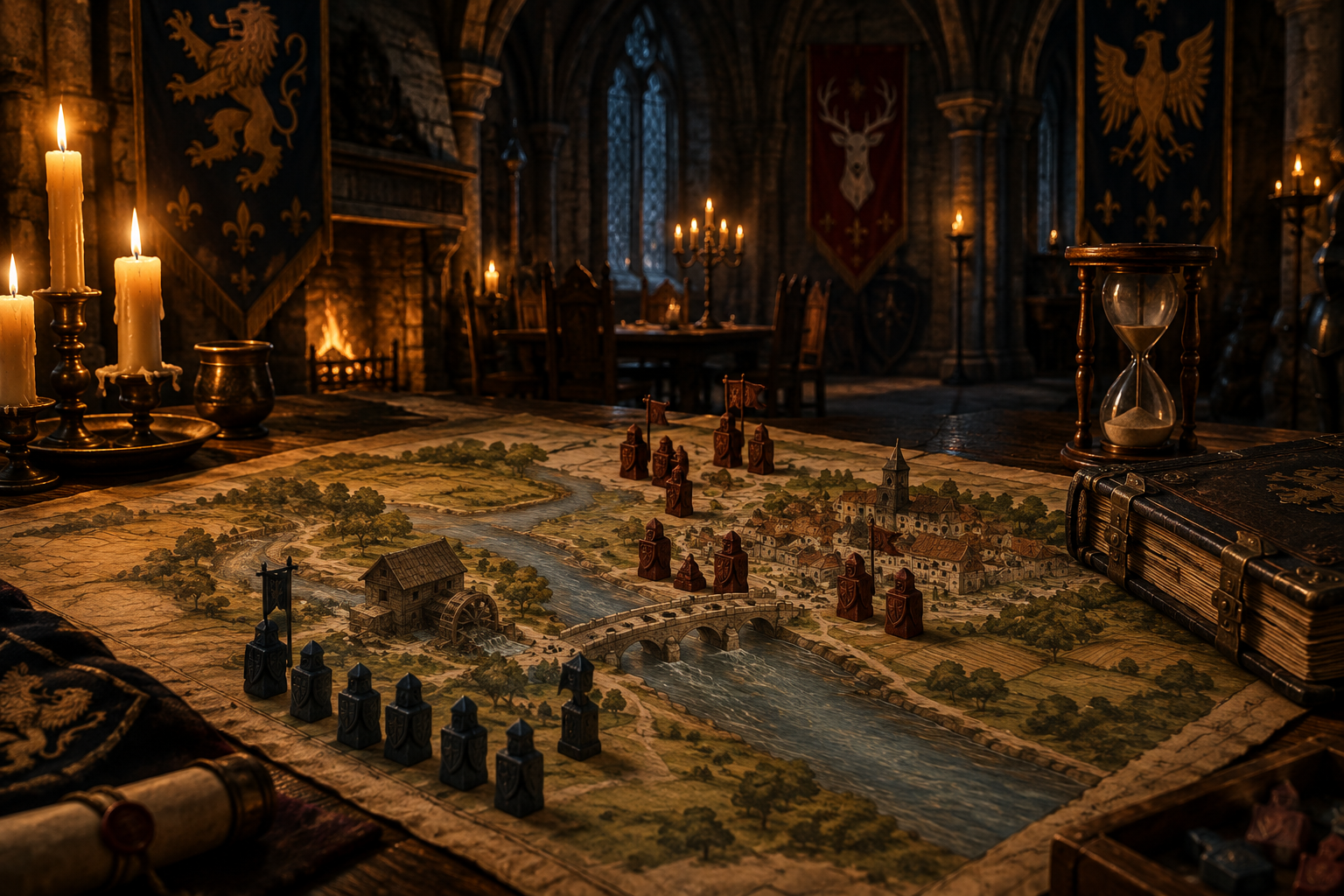
A close look at why threats that advance on their own make player choices matter more, what the approach costs, and how the structure of a countdown supports fair play.
The idea of a world that moves on its own often feels right to Game Masters before they can say why it works. That gap matters, because a technique you cannot explain is a technique you cannot adjust when it misfires at your table.
This article is an analysis rather than a tutorial. It asks what advancing threats actually do to the experience of play, which psychological and structural mechanisms are likely at work, where the approach strains, and what table preferences should decide whether you use it. Here the focus is the reasoning underneath.
What an Advancing Threat Is, Briefly
An advancing threat is any opposing force that pursues a goal whether or not the players interact with it. A rival faction buys debt. A cult nears its ritual. A fever spreads along a trade road. The defining feature is that progress is tied to the passage of time or to specific triggers, not only to the party's attention.
The contrast is a static world, where situations wait in suspended animation until the players arrive. In a static world, a villain's plan begins the moment the party walks into the room. In a moving world, the plan has a start date, and the party may be late.
One well-known formalization in tabletop design is the front tracked with countdown clocks, but the underlying idea is older than any single system. Published rules from the mid-1970s already tied time to risk: the referee rolled for a wandering monster at the end of every turn in the dungeon (Gygax & Arneson, 1974). Arguably, what modern designers added is a deliberate, visible structure for the pressure.
The Core Argument: Choices Need Opportunity Costs
The strongest reason advancing threats work is simple. A choice only matters if choosing one thing means not choosing another. If a world is static, the party can do everything eventually, in any order, and nothing is lost by delay. Every decision becomes a sequencing preference rather than a commitment.
When a threat advances, time becomes a resource. Spending a session on a wolf hunt is no longer free, because something else moved while the party was away. That single change converts ordinary decisions into real ones.
This connects directly to a principle many Game Masters will recognise from Justin Alexander: prepare situations, not plots. Alexander (2009) argues against prepping a fixed sequence of events and in favor of prepping a situation that the players can then disturb. An advancing threat is one of the cleanest ways to build a situation, because it supplies motion without dictating what the players do about it.
Opportunity cost is not the same as punishment
One possible misreading is that advancing threats exist to punish players for wasting time. The better framing is that they exist to make time meaningful. If the party chooses the wolf hunt over the investigation, nothing has gone wrong. The world has simply answered their choice with information they can now act on.
That distinction affects how the Game Master delivers consequences. In the author's view, punishment can feel arbitrary and invite resentment, while consequence that grows out of a visible, understandable structure is more likely to feel fair, even when it is unwelcome.
Mechanism One: Stakes That Exist Before the Roll
A second reason the approach works is that it separates stakes from individual dice rolls. At some tables, tension appears only at the moment of a check, and the consequence of failure is invented on the spot and often feels arbitrary.
A pre-built threat gives failure somewhere to go. When a roll to investigate the lending fails in the Millbrook scenario described later, the Game Master does not have to improvise a punishment. The clock simply ticks. The consequence was already waiting, already understood, and already proportionate to the threat.
This also reduces cognitive load at the table. Cognitive load theory, introduced by Sweller (1988), describes how the limited capacity of working memory constrains learning and problem solving, and the broader lesson for table prep is that every decision you pre-make is a decision you do not have to make under pressure. A Game Master who has already decided what happens when a clock fills can spend live attention on the players instead of on inventing outcomes.
Mechanism Two: Information as a Reward for Attention
Advancing threats generate something many players are likely to value: information that rewards paying attention. Because the world moves in ways players can observe, observation becomes a skill that pays off.
Consider the difference between two ways of revealing a rival's progress. In one, the Game Master announces, "The villain has completed step three." In the other, the party notices that a mill has changed owners and a family is in the street. The second method turns a bookkeeping change into a scene with emotional weight, and it rewards players who ask questions.
This pairs naturally with the discipline of giving players more than one path to a discovery. Alexander (2008) describes the three clue rule, which advises that for any conclusion the players need to reach, you should make sure at least three clues point toward it. An advancing threat leaves a trail of visible evidence behind it, so the same logic applies: the more the moving world leaves traces, the less likely the party is to miss the thread entirely.
Mechanism Three: A Shared Picture of Pressure
A subtle benefit is that a visible structure can give the whole table a common reference. When players understand that something is advancing, even if they cannot see its details, they share a sense of urgency and can plan around it together.
Whether to reveal the clock itself is a genuine table preference. Some groups enjoy seeing a segmented countdown and reasoning about how much time they have. Others prefer the dread of an unseen timer, with only its effects visible. Neither is objectively correct. A reasonable middle path is to show the effects and keep the mechanism private, then adjust based on how your players respond.
It is worth being honest that no source cited here establishes that one approach produces better outcomes than the other. The choice rests on the temperament of the group, which is why a short conversation about preferences, ideally in a session zero, is a useful step; Shea (2021) describes session zero as a way to get everyone on the same page about the game the table plans to play.
Mechanism Four: Pacing Without Railroading
Pacing is an important skill that many new Game Masters find challenging, and advancing threats offer a quiet structural aid. Sly Flourish discusses pacing as a matter of managing how a session unfolds and where energy rises and falls (Shea, 2022), and Alexander (2013) frames pacing in roleplaying games as identifying and skipping 'empty time', moving the players efficiently to their next meaningful choice.
A moving threat contributes to pacing in a specific way. It supplies a background beat that can surface when a session needs a jolt. If the party has spent an hour in conversation and energy is sagging, a development from the threat can reintroduce stakes without forcing the party onto a particular path. The players still decide what to do. They simply do it with a changed situation.
This is the difference between pacing and railroading. A railroad decides the outcome in advance. An advancing threat decides only the starting conditions and the rate of change, leaving the response entirely to the players.
Where the Approach Strains
An honest analysis has to cover the costs. Advancing threats are not free, and they fail in recognizable ways.
The treadmill problem
If every session carries urgent deadlines, players can feel they are always behind. A table that wanted leisurely exploration may find the constant pressure exhausting. This is a mismatch between the technique and the group's goals, not a flaw in the technique, but it is a real risk.
One mitigation is to vary clock speeds. A slow-burning threat that advances over many sessions creates a different texture than a fast one that threatens to resolve in two. Mixing them gives the world both background hum and occasional urgency.
The invisible-consequence problem
A threat that advances entirely offscreen, with no visible traces, can feel to players like the Game Master simply changing things behind a curtain. If the world shifts without any way for the players to perceive or influence it, the structure has not created agency. It has created a sense of being managed.
The fix is the principle already mentioned: every advancement should leave evidence and offer a chance to respond. If the players cannot affect a clock, it is a cutscene, not a threat.
The punishment-by-clock problem
It is tempting to advance a clock every time the party fails a roll. If that happens too often, failure stacks into inevitability, and the players learn that their rolls only ever make things worse. A healthier design lets success do something too: remove a step, win back a segment, or reveal information. Consequence should flow in both directions.
Prep that grows without bound
A Game Master who maintains many fronts can drown in bookkeeping. The point of the structure is to reduce live decision-making, not to add paperwork. Shea (2024) emphasizes spending prep on the highest-value material, and the same instinct applies here: in the author's view, a small number of well-chosen threats is often easier for a table to manage than a sprawling web that no one can track. How many to run is a judgment call that depends on your own tolerance for tracking and your players' appetite for complexity.
Comparing Static and Moving Worlds
It can help to compare the two approaches on the dimensions that matter at the table. The following is a framing for thought, not a ranking, since both have legitimate uses.
| Dimension | Static world | Moving world |
|---|---|---|
| Cost of delay | Low, players can do things in any order | Real, time is a resource |
| Source of failure consequences | Improvised at the moment | Pre-built into the threat |
| Prep style | Detailed locations and contents | Situations plus a rate of change |
| Risk | Choices feel like sequencing preferences | Pressure can feel relentless |
| Best suited to | Relaxed exploration, episodic play | Campaign arcs, political intrigue |
Neither column is wrong. A West Marches style table, for example, which Robbins (2007) describes as having no regular party, sessions scheduled by the players, and no overarching plot, may lean more on exploration than on advancing factions. A political or intrigue campaign, on the other hand, may depend almost entirely on factions that move.
Why This Is Rooted in Older Practice
It would be easy to present advancing threats as a recent invention, but the idea has deep roots. Early published rules treated time as something that costs the party, through wandering monster checks made every dungeon turn and time-based wilderness travel rules, and that framing appears in the original game's underworld and wilderness volume (Gygax & Arneson, 1974). The 1979 Dungeon Masters Guide also insists that game time matters, declaring that a meaningful campaign is impossible without strict time records (Gygax, 1979).
What has changed is mostly vocabulary and visibility. Modern fronts and clocks arguably give a name and a diagram to a habit some referees have long practiced: asking what the world's other inhabitants are doing while the party is busy. Treating the technique as an old idea with new packaging is more accurate than treating it as a breakthrough, and it reminds us that the underlying logic has survived many changes in game design.
What the Technique Asks of Players
A full analysis should also consider the players, because the approach changes what is asked of them. In a static world, a player can be passive and the world will wait. In a moving world, the player is invited to take initiative, and some players find that thrilling while others find it stressful.
This is a table-culture question, and it is a good reason to discuss expectations early. Resources on session zero emphasize aligning on the kind of game a table wants to play (Haeck, 2024), and the amount of pressure a group enjoys belongs on that list. A group that wants to be pushed will thrive on a moving world. A group that wants a gentle, contemplative game may find the same structure grating.
There is also a fairness expectation to manage. Many players are likely to accept consequences more readily when they understand the rules of the world they are operating in. If the Game Master signals early that threats advance when the party is absent or when investigations fail, the players can plan accordingly and feel that outcomes are earned rather than imposed.
A Short Checklist for Evaluating Your Own Use
If you already use advancing threats, or are considering them, a few diagnostic questions can reveal whether the structure is helping:
- Can players perceive evidence of the threat's progress, and can they respond to it?
- Does success change the situation as meaningfully as failure does?
- Are there a manageable number of active threats, tracked in a way you can maintain?
- Does the pressure match what the group said it wants?
- When a threat advances, does it open a new scene or hook, rather than just closing a door?
A table that answers yes to most of these is probably getting the benefits of the approach without the worst of its costs. A table that answers no to several may need to slow the clocks, make the evidence more visible, or reduce the number of active threats.
Example: The Millbrook Reckoning
Here is an illustrative scenario that shows the analysis in motion. It is a hypothetical, not a record of a real game.
In the river town of Millbrook, the mill owners' guild controls grain. A quiet rival, the Ashen Ledger, wants to buy the guild out through debt, lending coin to struggling millers and then calling the loans in all at once. The Game Master's front lists a four-step plan: Miller Dovane takes a loan he cannot repay, two mills change hands quietly, the guild's treasurer is bribed, and the loans are called in. A four-segment clock carries the Ledger's name.
Now apply the mechanisms discussed above.
Opportunity cost. In the first session, the party chooses a wolf hunt in the hills. That choice costs something, because nobody investigates the lending. The Game Master fills one segment, and a mill has changed owners. The party was not punished. Their choice had a price, and the price is now visible.
Stakes before the roll. In the second session, a player fails a roll to follow the Ledger's agent unseen. The Game Master does not have to invent a penalty on the spot. The clock ticks, the agent becomes alert and cautious, and the situation is harder than before. The consequence was already built into the structure.
Information as reward. The displaced miller's family, standing in the street, is a hook that arrives through observation. Players who ask about it learn more. At two of four segments, the Game Master mentions that the treasurer has been seen with unfamiliar company, a trace that rewards players who were paying attention.
Agency preserved. Throughout, the party can still act. They can protect the treasurer, expose the agent, or rally the millers to pool their debts. Each of those wins back a segment or removes a step. The clock is not a countdown to a fixed ending. It is a measure of how hard the situation is, and the players' choices move it in both directions.
The costs, honestly. Suppose this group had asked for a relaxed, exploration-heavy game. The Game Master might slow the Ledger's clock so that it advances only when a full session passes with no attention to the lending, rather than on every failed roll. That keeps the threat alive while respecting the table's preference. The adjustment is a reminder that the technique serves the group, not the other way around.
Putting the Analysis to Work
The practical takeaway is that advancing threats are best understood as a way to create opportunity costs, pre-build consequences, and reward attention, while preserving the players' freedom to respond. They work because they make time and choice meaningful, not because they pressure players into particular outcomes.
They strain when the pressure outruns the group's appetite, when consequences become invisible, or when failure stacks without any offsetting success. Each of those problems has a reasonable fix, and none requires abandoning the approach.
If you are building your own threats and want a place to keep them organized, tools that help a group track a campaign together can reduce the bookkeeping burden. Use whatever helps you keep your attention on the people at the table.
Sources and Further Reading
- Alexander, J. (2008, May 8). The Three Clue Rule. The Alexandrian. https://thealexandrian.net/wordpress/1118/roleplaying-games/three-clue-rule
- Alexander, J. (2009, March 23). Don't Prep Plots. The Alexandrian. https://thealexandrian.net/wordpress/4147/roleplaying-games/dont-prep-plots
- Alexander, J. (2013). The Art of Pacing. The Alexandrian. https://thealexandrian.net/wordpress/31509/roleplaying-games/the-art-of-pacing
- Gygax, G. (1979). Dungeon Masters Guide. TSR.
- Gygax, G., & Arneson, D. (1974). Dungeons & Dragons, Volume 3: The Underworld & Wilderness Adventures. Tactical Studies Rules.
- Haeck, J. (2024, March 11). How to run a Session 0 for your D&D game. D&D Beyond. Original work published January 8, 2021.
- Robbins, B. (2007, October 17). Grand Experiments: West Marches. Ars Ludi. https://arsludi.lamemage.com/index.php/78/grand-experiments-west-marches/
- Shea, M. E. (2021, April 5). Running session zeros. Sly Flourish. https://slyflourish.com/runningsessionzeros.html
- Shea, M. E. (2022). Improving Pacing. Sly Flourish. https://slyflourish.com/pacing.html
- Shea, M. E. (2024, June 3). High Value Prep. Sly Flourish.
- Sweller, J. (1988). Cognitive load during problem solving: Effects on learning. Cognitive Science, 12(2), 257-285.
Play 5E at your own table
Dice and character math run in code, and an optional AI Dungeon Master can run the game for you. Free to start, no card required.
Related reading
- Designing Threats That Escalate: A Design Perspective on Advancing Fronts
A design-focused look at what makes an advancing threat work: wants, methods, stakes, visible steps, and counterplay. Learn to build opposition that grows without railroading.
- Building Your First Countdown Clock: A Practical Guide for Game Masters
A practical walkthrough for turning a villain's plan into a countdown clock you can run: choosing a size, writing triggers, setting steps, and keeping the pace fair.
- Fronts and Clocks: The Idea Behind Worlds That Move Without You
A plain-language explainer on advancing threats, countdown clocks, and why a world that keeps moving between sessions gives players real consequences.