Fronts and Clocks: The Idea Behind Worlds That Move Without You
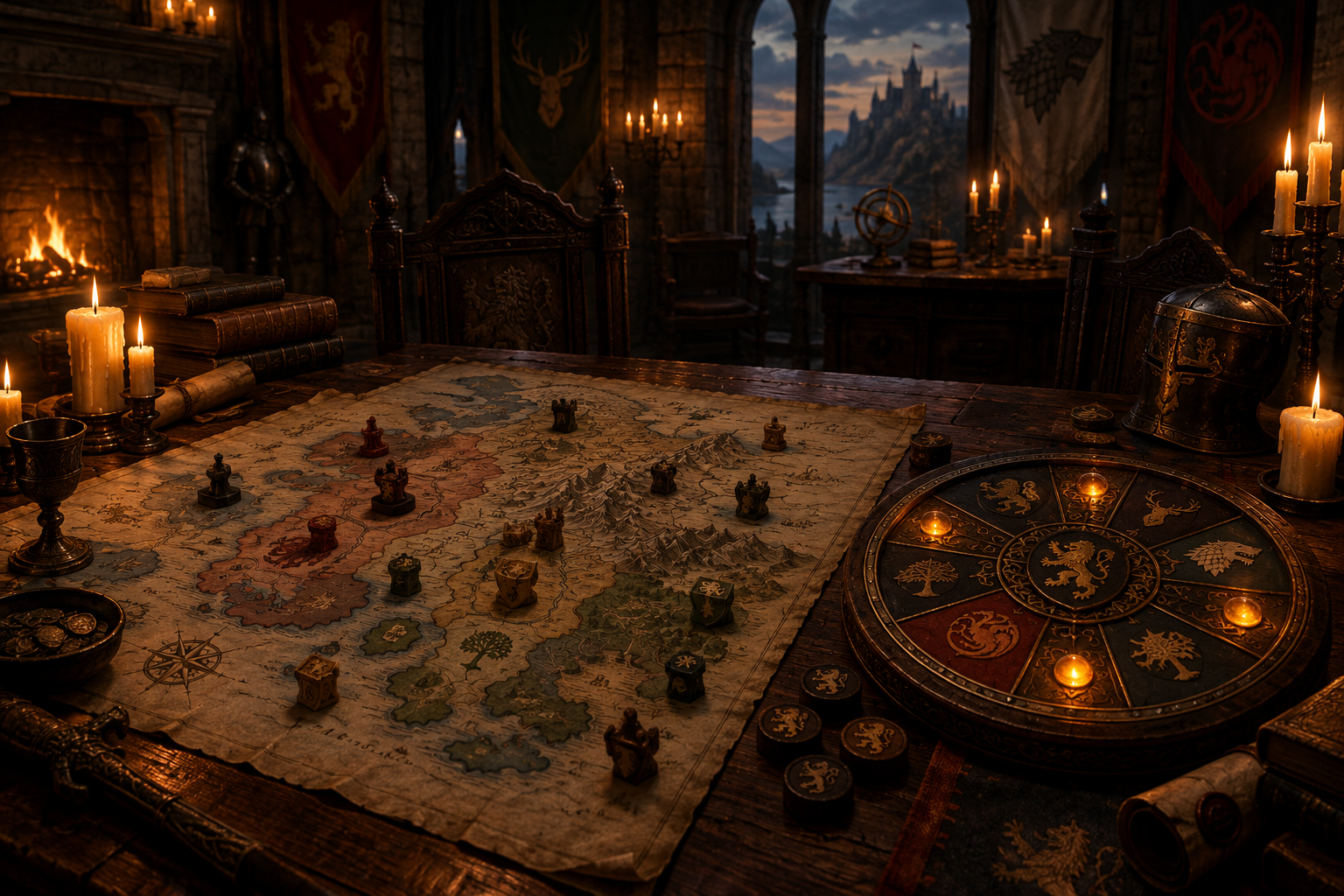
A plain-language explainer on advancing threats, countdown clocks, and why a world that keeps moving between sessions gives players real consequences.
Some campaigns feel like stage sets. Everything waits politely until the players walk through the door, and then the scene starts. Other campaigns feel like places where things are already happening. A rival faction has been buying up the harbor. A cult is closer to finishing its ritual than anyone realizes. The players do not have to chase every thread, but they can feel the pressure of time.
Often, the difference may not be the amount of preparation. It is a small structural idea: some things in the world have goals and a schedule, and they advance whether or not the players are watching. Two tools from published games can hold that idea in place: fronts and clocks.
This article explains what each one is, where the thinking comes from, why it changes play, and where the idea can go wrong. It is a concept explainer. Nothing here needs a specific rules system, and the steps are deliberately simple.
What a Front Is
In Dungeon World, a front is a collection of linked dangers, built between sessions, together with one or more impending dooms: the bad things that will happen if the players don't intervene. A smuggling ring wants control of the docks. A dying lord's heirs want his seat. A sleeping horror under the hills wants to wake.
The term is best known from the tabletop game Dungeon World, but it is older than that game: Apocalypse World used a system of fronts before its second edition replaced them with a threat map. The core of it is more general than any one game: you do not prepare a plot that the players will walk through. You prepare opposing forces and let the players collide with them. The Alexandrian makes a related argument in "Don't Prep Plots" (Alexander, 2009), which holds that prepping a predetermined sequence of events tends to fall apart on contact with player choices, and that preparing situations is sturdier.
One simple way to sketch a front, looser than Dungeon World's own structure of dangers, impending doom, grim portents, stakes questions, and cast, uses four parts:
- A want. What the force is trying to accomplish.
- A method. How it goes about it, including who does the work.
- A stake. What gets worse for the world if it succeeds.
- Steps toward the goal. A short ordered list of things that happen if nobody interferes.
That last part is the engine. A front without steps is just a villain description. A front with steps is a thing that moves.
What a Clock Is
A clock is a visible counter attached to something that is coming. In Blades in the Dark, a progress clock is a circle divided into segments, with 4, 6, or 8 segments for increasingly complex obstacles. Each time the threat advances, you fill a segment. When a danger clock is full, the danger comes to fruition.
Clocks appear in published games such as Blades in the Dark, which uses several kinds of clock, and the details vary from game to game. The portable idea is simple: take a vague worry ("the ritual is progressing") and turn it into something concrete the table can see ("the ritual is at three of six").
A clock does three jobs.
It makes pressure legible. Players can see that time matters without the Game Master repeating it.
It gives advancement a rule. You decide ahead of time what moves the clock: a failed roll, a day passing, the party resting in a dangerous place, or the party ignoring the threat for a session.
It gives a clean ending. When the last segment fills, you do not have to decide whether it is dramatically appropriate for the bad thing to happen. You already decided that.
How Fronts and Clocks Fit Together
The two tools do different work. A front is the what and why: a force with an agenda. A clock is the when: how close that agenda is to landing. One front can own several clocks, or a front can be a single clock with a name and a paragraph attached.
A simple way to think about it:
- The front tells you what the cult wants and who is involved.
- The clock tells you how many steps remain before the ritual finishes.
- The steps on the front tell you what each tick looks like in the fiction.
If you are ever unsure whether something is a front or a clock, ask whether it has intent. Intent suggests a front. A pure countdown, like a collapsing ceiling or a tide coming in, is often just a clock.
Why This Idea Changes Play
Choices carry weight
When the world is static, choosing to spend a session on a side errand costs nothing. When the world moves, that choice has a price. Players who understand that time is passing start to weigh priorities, because doing one thing means not doing another. For many players, that weighing can be a large part of what makes decisions feel meaningful.
The Game Master stops deciding "what happens next" from scratch
A pre-written set of steps removes a recurring burden. Between sessions, or when a lull arrives, you can ask a mechanical question instead of a creative one: did the party do anything that would advance or delay this front? If not, does time alone move it? This is a lighter prep load than inventing events, and it produces events that feel connected to something.
Failure becomes interesting
At some tables, a failed attempt can leave the group with little to do but try again. If a failure moves a clock, then failure produces forward motion. The party did not stop the ritual's next step. Something new is now true. That is often more engaging than a flat "nothing happens."
Success becomes visible
The reverse also matters. When players disrupt a front, you can wind a clock back or remove a step. They get to see that their actions changed the shape of the world. Visible consequence is one of the plainest rewards a campaign can offer.
Where the Idea Comes From
The thinking behind fronts is older than any single game. Node-based design writing argues that a linear, plotted scenario lacks flexibility and works against meaningful player choice (Alexander, 2010). Related pacing advice, such as skipping the empty time between one meaningful choice and the next, shows up in writing on running games more generally (Alexander, 2013).
Clocks and fronts are one practical packaging of those ideas. You do not need to adopt a specific game's vocabulary. The useful move is the underlying habit: write down what the opposition wants, decide how it advances, and let the calendar be a source of pressure.
How to Build a Front in Five Steps
You can do this on an index card.
- Name the force. A few words are enough: the Harbor Syndicate, the Pale Choir, the Drowned Court.
- Write its want in one sentence. Specific beats grand. "Control every ferry crossing" is more useful than "rule the city."
- List three to five steps. Each step should be something visible if the players look. Do not write steps that require the players to fail.
- Attach a clock if a deadline matters. Decide how many segments and what advances it.
- Note one way the players can intervene at each step. This keeps the front a situation rather than an inevitability.
That last step is easy to skip and important to include. A front the players cannot affect is a railroad with extra steps. The goal is pressure, not predestination.
Deciding What Advances a Clock
The trigger is an easy part to leave vague. Pick one or two triggers and tell the table.
Common triggers, all of which are table preference rather than rule:
- A failed roll in a relevant scene. The consequence of failure is that the threat moves.
- Time passing. A day, a week, or a long rest, depending on your campaign's pace.
- Player inaction. If the party goes a full session without engaging the threat, it ticks.
- A specific event. A guard captain is bribed, a gate is opened, a witness dies.
Whichever you choose, consistency matters more than which you choose. If players cannot predict what moves a clock, it stops feeling fair and starts feeling arbitrary.
Sizing and Pacing Clocks
A clock's segment count signals how urgent the threat is. As a rough table guideline, four segments can feel fast, six can suit a mid-sized arc, and eight or more can suit slow-burn campaign threats. A four-segment threat can land within a session or two. A longer clock works only if you can resist ticking it so slowly that nobody feels it.
Blades in the Dark ties segment count to how complex the obstacle is. Beyond that, it's a matter of table preference. The real question is how much of your table's attention you want the threat to occupy. If a clock sits untouched for several sessions, it has stopped doing its job, and you can either advance it or retire it.
Revealing Fronts to Players
Whether to show the table your clocks is a real choice with real tradeoffs, and tables differ.
Showing the clock makes pressure explicit. Players know a threat exists and roughly how close it is. Some tables find that showing the clock encourages proactive play and reduces the feeling of being ambushed. The downside is that it can feel mechanical, and it may push players to treat the world as a to-do list.
Hiding the clock preserves surprise and mystery. Players discover threats through the fiction. The risk is that they never notice the pressure, and a threat that nobody perceives does not change anyone's choices.
A middle path is to hide the specifics but make the effects visible. Players do not see a six-segment circle, but they see the harbor growing quieter, prices rising, and patrols doubling. The clock exists behind the screen, and the fiction shows its footprints. Whatever you choose, the principle of fairness holds: players should be able to find out about a threat through reasonable investigation before it lands. The Three Clue Rule, which says that for any conclusion you want the players to reach you should include at least three clues, is a useful companion here (Alexander, 2008).
Common Pitfalls
Too many fronts at once. Each front is a promise to keep time. Many Game Masters may find three or four active threats plenty. More than that and none of them get enough attention to feel alive.
Clocks that only tick against the players. If every tick is bad news, the world starts to feel punitive. Let clocks also tick for the players: an ally's rescue operation, a bridge being repaired, a trial date approaching.
Steps that assume what players will do. Write steps as things that happen in the world, not things that happen to the party.
Letting the clock override the table. A clock is a tool for pressure. If everyone is clearly having a better time doing something else for a session, the clock can wait. It is yours to run, not a verdict.
Forgetting to ask what the opposition would do. When something goes wrong for a front, such as a leader captured or a plan exposed, the front should adapt rather than freeze. Fronts that react feel like real opponents.
Fronts, Clocks, and Other Structures
These tools are not the only way to make a world feel alive, and they are not required. Some groups might prefer the pressure of a published adventure's schedule, and others an open sandbox where the world's state is rolled at the start of each session. Others use tension mechanics such as a dice pool that fills as players spend time on time-consuming actions and is rolled when they act recklessly (The Angry GM, 2021).
What fronts and clocks offer is a lightweight, low-prep way to make time matter. Fronts and clocks can often sit alongside other approaches as a layer rather than a replacement. A dungeon crawl can have a clock on the reinforcements arriving. A hexcrawl can have a front for the faction expanding its borders hex by hex.
Example: The Millbrook Reckoning
Here is an illustrative scenario showing the idea in motion. It is a hypothetical, not a record of a real game.
A party arrives at the river town of Millbrook, where the mill owners' guild controls grain, and a quiet rival, the Ashen Ledger, wants to buy the guild out through debt. A Game Master sketches one front on an index card.
Front: The Ashen Ledger.
- Want: Own the guild's debts so it can seize the mills without a fight.
- Method: Lending coin to struggling millers, then calling the loans in all at once.
- Stake: If it succeeds, the town's grain price is set by one hidden hand.
- Steps: (1) Miller Dovane takes a loan he cannot repay. (2) Two mills change hands quietly. (3) The guild's treasurer is bribed. (4) The loans are called in.
The Game Master adds a four-segment clock labeled with the Ledger's name and decides it advances when the party fails a roll to investigate the lending, or when a full session passes without anyone looking into the millers' debts.
In the first session, the party spends its time on a wolf hunt in the hills. Nobody touches the lending question, so the Game Master fills one segment: a mill has changed owners, and the miller's family is now in the street. The players notice the displaced family and ask questions. That is a hook with weight, and it arrived because the world moved while they were elsewhere.
In the second session, the party tracks the lender's agent and fails a roll to follow him unseen. The clock ticks again, and the agent is now alerted and cautious. The players are not stopped, but the situation is harder than it was. At two of four segments, the Game Master mentions that the treasurer has been seen with unfamiliar company.
The party can still intervene. They can protect the treasurer, expose the agent, or rally the millers to pool their debts. Each of those wins a segment back or removes a step. The point of the example is not the outcome. It is that one index card produced a living pressure without requiring the Game Master to script a plot.
A Short Checklist Before You Use This Idea
Before adding a front or clock to your next session, check these:
- Does the force have a clear want?
- Are its steps things that happen in the world, not to the party?
- Do the players have at least one way to intervene at each step?
- Have you decided what advances the clock, and will you tell the table?
- Can the clock tick in the players' favor too?
- Is there room for it to be ignored without breaking your campaign?
If you can answer yes to most of these, the idea is probably ready to try.
Using Digital Tools to Track Them
Clocks are easy to track on paper, on a whiteboard, or in a notes document. If your group plays online, a shared note or a simple image can serve the same purpose. The Dungeon Trainer is one option for groups who want a shared place to plan and run campaigns together. Its human-DM mode lets a person run the table, and its AI Dungeon Master is optional, though it can also run solo adventures. A pencil and an index card work just as well.
Key Takeaways
- In simplified terms, a front is a threat with goals and steps toward them, and a clock is a segmented circle that tracks how close a coming consequence is.
- Together they let the world move between and during sessions, which gives player choices weight.
- Prep situations, not plots (Alexander, 2009).
- Decide what advances a clock, tell the table, and apply it consistently.
- Keep the number of active fronts small, let clocks tick in players' favor too, and always leave room to intervene.
- Whether to show the clock or only its effects is a table preference.
Sources and Further Reading
- Alexander, J. (2008, May 8). The Three Clue Rule. The Alexandrian. https://thealexandrian.net/wordpress/1118/roleplaying-games/three-clue-rule
- Alexander, J. (2009, March 23). Don't Prep Plots. The Alexandrian. https://thealexandrian.net/wordpress/4147/roleplaying-games/dont-prep-plots
- Alexander, J. (2010, May 27). Node-based scenario design, part 1: The plotted approach. The Alexandrian. https://thealexandrian.net/wordpress/7949/roleplaying-games/node-based-scenario-design-part-1-the-plotted-approach
- Alexander, J. (2013). The Art of Pacing. The Alexandrian. https://thealexandrian.net/wordpress/31509/roleplaying-games/the-art-of-pacing
- The Angry GM. (2021, September 15). The Angry GM's Tension Pool: A Comprehensive, Definitive, Final Guide. The Angry GM.
Play 5E at your own table
Dice and character math run in code, and an optional AI Dungeon Master can run the game for you. Free to start, no card required.
Related reading
- Running the Iron Span: A Worked Example of Hit Points in Play
An illustrative fight on a collapsing bridge, walked through decision by decision with SRD 5.2.1 numbers, shows where hit points shape choices in play and what to watch for at your own table.
- Hit Points Across Systems: Comparing How Different RPGs Handle Damage and Survival
Hit points are not universal. Comparing how different tabletop RPG systems handle damage, survival, and attrition reveals design choices that shape play in distinct ways.
- Hit Point Reference: Essential Charts and Quick Tables for Combat
Combat moves faster when you have the right information at hand. These reference charts, condition thresholds, and quick-lookup tables help you track hit points, adjudicate damage, and narrate outcomes without breaking your table's momentum.