Hit Point Reference: Essential Charts and Quick Tables for Combat
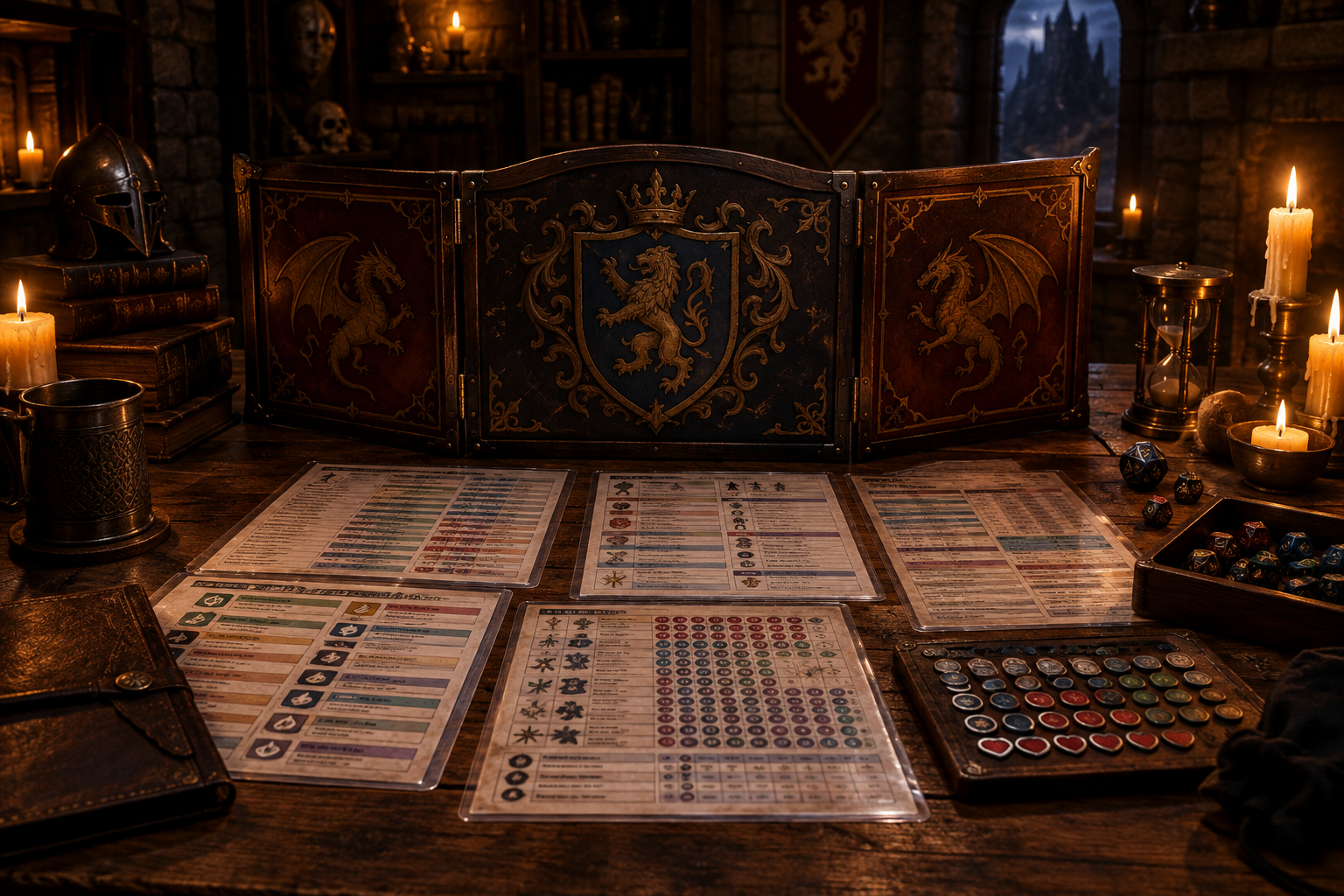
Combat moves faster when you have the right information at hand. These reference charts, condition thresholds, and quick-lookup tables help you track hit points, adjudicate damage, and narrate outcomes without breaking your table's momentum.
Combat tracks a lot of moving numbers. Hit point totals shift every round, damage types interact with resistances and vulnerabilities, and players ask questions that demand immediate answers. The difference between a smooth combat encounter and a halting, reference-heavy slog often comes down to whether you have the right information within arm's reach.
This article collects practical reference charts, condition thresholds, and quick-lookup tables that help you track hit points, adjudicate damage, and narrate outcomes without breaking your table's momentum. The rules values below come from the System Reference Document 5.2.1, the free rules reference for 5E-compatible play (Wizards of the Coast, 2025); adjust them for any house rules you use.
Why Reference Materials Matter During Combat
You make dozens of micro-decisions during every combat round. Is the fighter still capable of taking a hit? Should this attack drop the enemy, or leave them barely standing? Does the wizard's spell overcome the creature's resistance?
Each question pulls your attention away from the fiction and into the numbers. Reference materials reduce that friction. A well-organized chart lets you answer a question in seconds, maintain narrative momentum, and keep players engaged with the action rather than waiting while you flip through rulebooks.
The goal is not to eliminate all page-turning or mental calculation. The goal is to identify the questions you answer most frequently and provide quick, accurate answers when those questions arise.
Creature Hit Point Ranges by Challenge Rating
Understanding the hit point ranges of creatures at each Challenge Rating helps you gauge encounter difficulty, improvise stat blocks, and adjudicate edge cases during play. The table below is computed from the 327 creature stat blocks in the SRD 5.2.1 (Wizards of the Coast, 2025): for each Challenge Rating up to 20, how many stat blocks it has, the lowest and highest hit points among them, and the median. CR 18 has no stat block in the SRD.
Hit Points by Challenge Rating in the SRD 5.2.1
| Challenge Rating | SRD stat blocks | HP range | Median HP |
|-----------------|-----------------|----------|-----------|
| 0 | 30 | 1-19 | 3 |
| 1/8 | 19 | 5-17 | 9 |
| 1/4 | 32 | 9-22 | 13 |
| 1/2 | 27 | 10-32 | 19 |
| 1 | 27 | 5-45 | 25 |
| 2 | 40 | 27-85 | 45 |
| 3 | 24 | 45-90 | 65 |
| 4 | 16 | 5-120 | 75 |
| 5 | 25 | 67-147 | 104 |
| 6 | 10 | 81-152 | 118 |
| 7 | 6 | 119-168 | 126 |
| 8 | 10 | 85-184 | 136 |
| 9 | 8 | 45-200 | 156 |
| 10 | 6 | 136-229 | 178 |
| 11 | 7 | 168-248 | 199 |
| 12 | 2 | 170-178 | 174 |
| 13 | 6 | 123-230 | 189 |
| 14 | 3 | 184-228 | 195 |
| 15 | 4 | 187-247 | 209 |
| 16 | 5 | 212-262 | 220 |
| 17 | 4 | 199-356 | 249 |
| 19 | 1 | 287-287 | 287 |
| 20 | 3 | 332-337 | 333 |
The ranges are wide because Challenge Rating also weighs Armor Class, damage output, resistances, and special abilities. A creature with strong defenses or dangerous abilities often has fewer hit points than others at its rating, and a durable brute has more. Where a rating has only a few stat blocks, treat the median as a rough guide.
Use this table when you need to improvise a creature on the fly, check whether a homebrew stat block looks reasonable, or estimate how much punishment a creature can take before it falls.
Player Character Hit Point Benchmarks
Player characters gain hit points as they level, but the rate varies by class. Understanding typical hit point totals helps you calibrate encounter difficulty and anticipate how much damage a party can absorb before a fight turns deadly.
Typical PC Hit Points by Level (No Constitution Modifier)
| Level | d6 Hit Die (Sorcerer, Wizard) | d8 Hit Die (Bard, Cleric, Druid, Monk, Rogue, Warlock) | d10 Hit Die (Fighter, Paladin, Ranger) | d12 Hit Die (Barbarian) |
|-------|-------------------------------|----------------------------------|---------------------------------------|-------------------------|
| 1 | 6 | 8 | 10 | 12 |
| 2 | 10 | 13 | 16 | 19 |
| 3 | 14 | 18 | 22 | 26 |
| 4 | 18 | 23 | 28 | 33 |
| 5 | 22 | 28 | 34 | 40 |
| 6 | 26 | 33 | 40 | 47 |
| 7 | 30 | 38 | 46 | 54 |
| 8 | 34 | 43 | 52 | 61 |
| 9 | 38 | 48 | 58 | 68 |
| 10 | 42 | 53 | 64 | 75 |
| 11 | 46 | 58 | 70 | 82 |
| 12 | 50 | 63 | 76 | 89 |
| 13 | 54 | 68 | 82 | 96 |
| 14 | 58 | 73 | 88 | 103 |
| 15 | 62 | 78 | 94 | 110 |
| 16 | 66 | 83 | 100 | 117 |
| 17 | 70 | 88 | 106 | 124 |
| 18 | 74 | 93 | 112 | 131 |
| 19 | 78 | 98 | 118 | 138 |
| 20 | 82 | 103 | 124 | 145 |
These values follow the rules: the maximum of the Hit Point Die at 1st level, then the fixed value per level (4, 5, 6, or 7 by Hit Point Die) at every level after (Wizards of the Coast, 2025). Most characters have higher totals once you add their Constitution modifier, and some features, feats, and magic items raise maximum hit points further.
Add the character's Constitution modifier times their level to these base values for a more accurate estimate. A 5th-level Fighter with a +2 Constitution modifier has approximately 44 hit points (34 base plus 10 from Constitution).
Condition Severity Thresholds
Hit point totals tell you more than just how close a creature is to death. They signal exhaustion, desperation, confidence, and tactical position. Dividing a creature's hit points into narrative zones helps you describe combat in ways that reflect the fiction.
Narrative Zones by Remaining Hit Points
| Remaining HP | Narrative Zone | Typical Description |
|--------------|----------------|---------------------|
| 100%-75% | Fresh | Confident, mobile, making tactical choices |
| 74%-51% | Hurt | Injured but functional, beginning to feel pressure |
| 50%-25% | Bloodied | Visibly wounded, reconsidering tactics, looking for escape |
| 24%-1% | Critical | Barely standing, survival instinct overriding strategy |
| 0 HP | Down | Unconscious or dead (hit points can't go below 0) |
These zones are not mechanical triggers. They are narrative cues that help you describe what players see and hear. A creature at 80% hit points shrugs off a sword blow with minimal reaction. A Bloodied creature at 30% hit points staggers, bleeds, and shows signs of impending collapse.
One of these zones is already a rule. A creature is Bloodied while it has half its Hit Points or fewer (Wizards of the Coast, 2025), and some creatures' abilities key off it. The other zones are narrative only. Whether you use formal mechanics or purely narrative description, these thresholds give you language to describe what the numbers mean in the fiction.
Damage Type Quick Reference
Damage types interact with Resistance, Vulnerability, and Immunity. The rules give each type examples of what deals it (Wizards of the Coast, 2025):
Damage Types and Examples
| Damage Type | Examples |
|-------------|----------|
| Acid | Corrosive liquids, digestive enzymes |
| Bludgeoning | Blunt objects, constriction, falling |
| Cold | Freezing water, icy blasts |
| Fire | Flames, unbearable heat |
| Force | Pure magical energy |
| Lightning | Electricity |
| Necrotic | Life-draining energy |
| Piercing | Fangs, puncturing objects |
| Poison | Toxic gas, venom |
| Psychic | Mind-rending energy |
| Radiant | Holy energy, searing radiation |
| Slashing | Claws, cutting objects |
| Thunder | Concussive sound |
Which creatures resist or are harmed by a type is set by each stat block, not by the type, so check the stat block rather than a general rule. A few SRD examples show why: a Skeleton has Vulnerability to Bludgeoning damage and Immunity to Poison, and a Magma Mephit has Immunity to Fire and Vulnerability to Cold (Wizards of the Coast, 2025). When you improvise a creature, the fiction is a reasonable guide: a creature made of ice might resist cold and take extra damage from fire. Mark any such call as your ruling rather than the rules.
Healing and Recovery Rates
Healing restores hit points during and between encounters. Understanding typical healing rates helps you anticipate how quickly characters recover and whether they need additional rest.
Common Healing Sources and Rates (SRD 5.2.1)
| Healing Source | Amount | Frequency | Notes |
|----------------|--------|-----------|-------|
| Potion of Healing | 2d4 + 2 (avg. 7) | Once per potion | Drink it or give it to a creature within 5 feet as a Bonus Action |
| Cure wounds (level 1) | 2d8 + spellcasting modifier | Per spell slot | +2d8 per slot level above 1; touch |
| Healing word (level 1) | 2d4 + spellcasting modifier | Per spell slot | Bonus Action, 60 feet; +2d4 per slot level above 1 |
| Short Rest (Hit Point Dice) | Roll each die spent + Constitution modifier (minimum 1) | Each Short Rest (1 hour) | Limited by unspent Hit Point Dice; requires at least 1 Hit Point to start |
| Long Rest | All lost Hit Points and all spent Hit Point Dice | At least 16 hours between Long Rests | Requires at least 1 Hit Point to start |
| Second Wind (Fighter) | 1d10 + Fighter level | Two uses at level 1; one returns on a Short Rest, all on a Long Rest | Bonus Action |
| Lay On Hands (Paladin) | Pool of 5 × Paladin level | Pool refills on a Long Rest | Bonus Action; spend 5 from the pool to remove the Poisoned condition instead |
All values are from the SRD 5.2.1 (Wizards of the Coast, 2025). Other systems and house rules may alter healing rates, restrict the availability of healing potions, or change how rest works.
Tracking how much healing a party has available helps you calibrate encounter difficulty. A party with a Cleric, Paladin, and a bag full of healing potions can sustain more damage than a party with no dedicated healer and limited consumables.
Unconsciousness and Death Saves
When a creature reaches 0 hit points, the rules determine what happens next. A character who doesn't die outright falls unconscious and makes Death Saving Throws. A monster dies the instant it drops to 0, unless the Game Master decides to treat it like a character (Wizards of the Coast, 2025).
Death Saving Throw Outcomes
| Result | Effect |
|--------|--------|
| Natural 20 | Regain 1 Hit Point (which ends the Unconscious condition) |
| 10 or higher | One success |
| 2-9 | One failure |
| Natural 1 | Two failures |
| Three successes | Stabilized, unconscious but not dying |
| Three failures | Dead |
The count of successes and failures resets when a character regains any Hit Points or becomes Stable. A Stable character stops making death saves but stays at 0 Hit Points and Unconscious; if not healed, it regains 1 Hit Point after 1d4 hours. Stabilizing someone takes the Help action and a successful DC 10 Wisdom (Medicine) check (Wizards of the Coast, 2025).
Damage taken while at 0 hit points causes a death save failure, or two if the damage is from a Critical Hit, and damage that equals or exceeds the character's Hit Point maximum kills them. Massive damage can also kill before a character ever makes a death save: when damage reduces a character to 0 and the damage left over equals or exceeds their Hit Point maximum, they die instantly (Wizards of the Coast, 2025).
Damage Resistance, Vulnerability, and Immunity Quick Math
Resistance: Damage is halved (round down).
Vulnerability: Damage is doubled.
Immunity: Damage is reduced to zero.
Resistance and Vulnerability do not cancel out. Modifiers apply in order: bonuses and penalties first, then Resistance (halve, round down), then Vulnerability (double). The rules' own example: 28 Fire damage reduced by 5 becomes 23, halved for Resistance to 11, then doubled for Vulnerability to 22 (Wizards of the Coast, 2025).
Multiple instances of Resistance or Vulnerability to the same damage type count as only one instance. A creature with Resistance to fire damage from two different sources still only halves fire damage once (Wizards of the Coast, 2025).
Quick Damage Calculation Examples
| Base Damage | Resistance (Halved) | Vulnerability (Doubled) |
|-------------|---------------------|-------------------------|
| 10 | 5 | 20 |
| 15 | 7 (rounds down) | 30 |
| 23 | 11 (rounds down) | 46 |
| 8 | 4 | 16 |
| 1 | 0 (rounds down) | 2 |
Keeping these calculations visible saves time during combat. When a player rolls 17 fire damage against a creature with fire resistance, you can immediately call out 8 damage without pausing to do mental math.
Temporary Hit Points
Temporary hit points are a buffer that absorbs damage before it touches a creature's actual hit point total. They do not stack. When a creature gains temporary hit points, they choose whether to keep their current temporary hit points or replace them with the new amount.
Temporary hit points last until they are depleted or the creature finishes a Long Rest, and receiving them at 0 hit points doesn't restore consciousness (Wizards of the Coast, 2025).
Examples of Temporary Hit Points and Related Effects (SRD 5.2.1)
| Source | Amount | Duration |
|--------|--------|----------|
| False life (level 1) | 2d4 + 4, +5 per slot level above 1 | Until depleted or a Long Rest |
| Potion of Heroism | 10 | 1 hour, with the bless spell's effect |
| Aid (level 2) | Hit Point maximum and current Hit Points +5 (not temporary) | 8 hours |
Temporary hit points are not healing: they can't be added to Hit Points, healing can't restore them, and receiving them doesn't count as healing (Wizards of the Coast, 2025). Effects that trigger when a creature takes damage may still trigger even if temporary hit points absorb all the damage, depending on the specific wording.
Example: The Collapse of the Iron Span
In this illustrative scenario, you are running combat on the Iron Span, the week's recurring bridge over a river chasm. The party is fighting a group of bandits and their ogre enforcer. The 5th-level Fighter is at 22 hit points out of 44 (50%, now Bloodied). The Wizard has 18 hit points out of 22 (82%, still fresh). The ogre, which has 68 hit points in the SRD (Wizards of the Coast, 2025), has taken 35 damage and has 33 remaining (49%, Bloodied).
You narrate the Fighter's wounds with language that reflects their Bloodied state: "The bandit's axe catches you across the ribs. You're still on your feet, but every breath hurts." For the Wizard, who is barely scratched, you describe a near miss: "The arrow whistles past your ear and clatters off the stone behind you."
The ogre, now Bloodied, shifts tactics. Instead of standing its ground, it charges the nearest character, hoping to shove them off the bridge. You describe it as a wounded, panicking creature rather than a confident bruiser: "The ogre roars, blood streaming from a gash across its shoulder, and lunges toward you with wild, desperate eyes."
The Fighter's player asks how much healing they need to feel safe. You consult your party hit point benchmarks and see that the Fighter should have roughly 34 hit points at this level before Constitution modifiers. With a +2 Constitution modifier, their total is 44. You note that they are at half health and suggest that 15 or 20 points of healing would put them back in a comfortable range.
The Cleric casts cure wounds with a level 2 spell slot, rolling 4d8 + 3 for a total of 21 hit points (Wizards of the Coast, 2025). The Fighter is now at 43 of 44. You describe the wounds closing, the Fighter steadying their stance, and the narrative shifts from desperate defense to confident counterattack.
Your reference charts let you make all these calls without pausing the action. The Bloodied threshold told you when to shift the ogre's behavior. The healing rates told you how much recovery to expect. The player hit point benchmarks helped you advise the Cleric on healing targets. The combat moved smoothly because the information you needed was within arm's reach.
Organizing Your Reference Materials
The best reference chart is the one you can find when you need it. Organize your materials in a way that matches how you run the game.
Some Game Masters keep a laminated cheat sheet behind their screen, visible at a glance. Others use a tablet or laptop with a digital document open in a second window. Some print tables on index cards and stack them by category (damage types, healing rates, condition thresholds).
Test your setup during a low-stakes session. If you find yourself flipping through pages or scrolling to find a table you use every round, move that table closer. If a reference chart sits unused for three sessions, remove it from your active materials.
The goal is not to memorize every table or eliminate all reference-checking. The goal is to reduce friction during play so that combat moves at the pace your table prefers.
Customizing Charts for Your Table
Every table runs hit points slightly differently. Some give the Bloodied condition extra effects of their own. Others treat temporary hit points as ablative armor that prevents all damage until depleted. The rules make drinking a Potion of Healing a Bonus Action; some tables make it a full action.
Your reference materials should reflect the rules you actually use. If your table uses a house rule that healing potions restore 2d4 + 4 instead of the standard 2d4 + 2, update your healing rate table. If you have ruled that creatures with vulnerability to fire take triple damage from critical hits, note that exception.
Mark your house rules clearly so that you do not confuse them with standard rules when adjudicating edge cases or explaining mechanics to new players.
Balancing Reference Tools and Table Presence
Reference materials help you make faster, more accurate rulings, but too much reference-checking can pull you out of the fiction and slow the game. Balance your use of tools with the need to stay present and engaged with your players.
When a ruling is straightforward, make the call and move on. When a ruling involves edge cases, complex interactions, or precedent-setting decisions, take the time to check your references and get it right.
Some Game Masters adopt a "rule now, reference later" approach. Make a quick ruling that keeps the game moving, then look up the official rule after the session and clarify for next time. Other Game Masters prefer to pause briefly, check the rule, and establish the correct precedent immediately.
Choose the approach that supports your table's flow. If your players value accuracy and consistency, taking thirty seconds to verify a rule may be worth the pause. If your players value momentum and immersion, making a quick call and moving forward may serve the game better.
Supporting Players with Quick References
Players benefit from reference materials as much as Game Masters do. Providing quick reference sheets for damage types, healing sources, and condition effects helps players make informed tactical decisions without interrupting the flow of play.
Some tables keep a shared reference binder at the center of the table. Others distribute individual reference cards to each player. Digital tables use shared documents or pins in the virtual tabletop.
Encourage players to learn the rules that apply to their characters. A player who knows that their raging Barbarian has Resistance to Bludgeoning, Piercing, and Slashing damage can calculate their own damage reduction without asking you every round.
Tools That Support Hit Point Tracking
Several tools help you track hit points during combat:
Initiative trackers with built-in hit point fields (physical or digital) keep all combat information in one place.
Index cards for each creature, labeled with current hit points and conditions, let you shuffle and reorder as initiative changes.
Dry-erase tokens or markers placed directly on the battlemap show hit point totals at a glance.
Digital tools like virtual tabletops and dedicated combat trackers can track hit points and conditions for you; how much damage math they automate depends on the tool and its game-system support.
Experiment with different tools to find what works for your table. The best tool is the one that supports your game without demanding more attention than it saves.
Final Thoughts
Hit points are the mechanical foundation of combat, but they mean nothing without context. Reference charts give you that context. They tell you when a creature shifts from confident to desperate, how much healing a character needs to feel safe, and what damage types matter against a specific enemy.
Build your toolkit to match your table's needs. Start with the charts you reference most often. Add tools as you identify gaps. Remove materials that do not serve you. Organize everything so that the information you need is within arm's reach when combat starts.
Combat runs smoothly when you can answer questions quickly, narrate outcomes confidently, and keep players engaged with the action. Reference materials help you do all three.
Sources and Further Reading
Wizards of the Coast. (2025). System Reference Document 5.2.1.
This work includes material from the System Reference Document 5.2.1 ("SRD 5.2.1") by Wizards of the Coast LLC, available at https://www.dndbeyond.com/srd. The SRD 5.2.1 is licensed under the Creative Commons Attribution 4.0 International License, available at https://creativecommons.org/licenses/by/4.0/legalcode.
Play 5E at your own table
Dice and character math run in code, and an optional AI Dungeon Master can run the game for you. Free to start, no card required.
Related reading
- Designing Hit Point Systems That Support Your Table's Fiction
Hit points work differently at every table because they serve the fiction you create together. Understanding design choices behind hit point systems helps you run them with confidence and customize them when your game needs it.
- Narrating Hit Point Loss: Techniques for Describing Damage at the Table
Hit point totals drive combat, but your descriptions make them meaningful. Learn practical techniques to narrate damage that respects the fiction, supports player engagement, and keeps combat moving.
- Hit Points Under Stress: What the Numbers Actually Tell You During Play
Hit point totals shift meaning as combat unfolds. Understanding what those numbers signal helps you pace encounters, adjudicate rulings, and narrate outcomes that respect both the fiction and the mechanics.