Designing Hit Point Systems That Support Your Table's Fiction
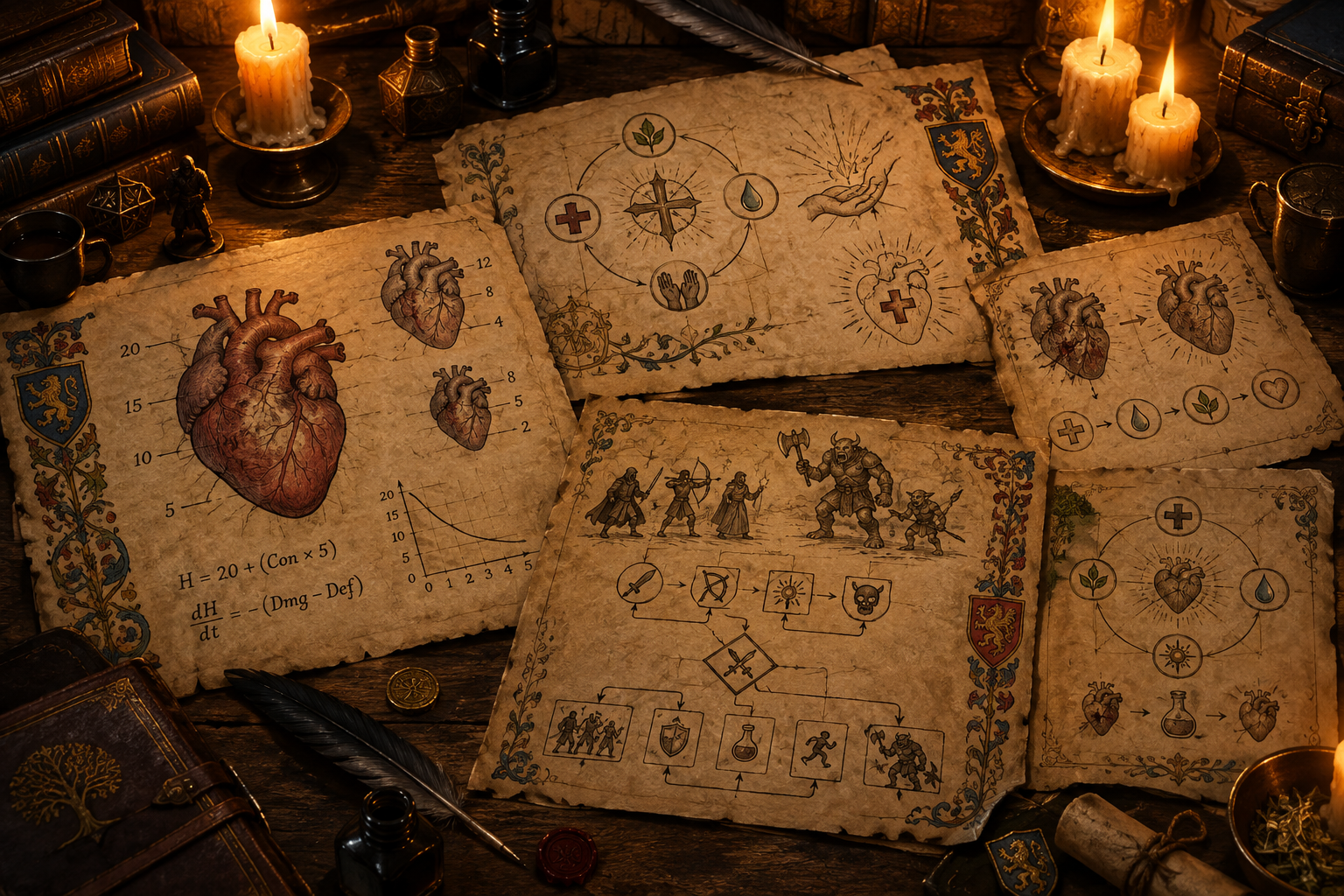
Hit points work differently at every table because they serve the fiction you create together. Understanding design choices behind hit point systems helps you run them with confidence and customize them when your game needs it.
Hit points appear in nearly every tabletop RPG, but they function differently from system to system and table to table. Understanding the design decisions that shape how hit points work helps you run them with confidence, adjudicate edge cases consistently, and modify them when your group's needs change. This article examines hit point systems from a design perspective, exploring the choices designers make, the trade-offs those choices create, and what they mean for your table.
What Hit Point Systems Actually Do
Hit point systems serve multiple functions simultaneously. They track attrition, create tension, pace encounters, and communicate stakes to players. A well-designed hit point system supports all these functions without demanding constant adjudication or breaking immersion.
At the mechanical level, hit points provide a reservoir that depletes over time. That depletion creates gameplay pressure: players must balance risk against resources, decide when to press forward and when to retreat, and allocate healing tactically. The size of that reservoir, the rate at which it depletes, and the methods available to restore it define much of a system's tactical texture.
At the narrative level, hit points represent whatever your table decides they represent. Some groups treat them as literal wounds. Others treat them as exhaustion, luck, divine favor, narrative momentum, or some combination. Rules rarely dictate this interpretation. The current 5E-compatible rules define Hit Points only as "a measure of how difficult it is to kill or destroy a creature or an object" (Wizards of the Coast, 2025), though some mechanics (like damage types or healing methods) can nudge the fiction in particular directions.
Core Design Variables
Every hit point system makes choices about several core variables. Understanding these variables helps you see why different systems feel different in play and how small changes ripple through the rest of the game.
Starting Values and Scaling
How many hit points characters begin with and how that total grows over time fundamentally shapes gameplay. Systems with low starting values (like early editions of D&D, where many first-level characters had a single-digit total) create fragility and caution. A single successful attack can end a character, which encourages careful planning and risk mitigation.
Systems with higher starting values (like the current rules, where a first-level character starts with the maximum of their Hit Point Die, 6 to 12, plus their Constitution modifier; Wizards of the Coast, 2025) create resilience and encourage engagement. Characters can absorb multiple hits, which supports heroic action and reduces the likelihood of anticlimactic deaths.
Scaling determines whether this dynamic remains consistent. Linear scaling (adding the same amount each level) maintains relative fragility. Exponential scaling (where higher-level characters have vastly more hit points than lower-level ones) shifts the experience over time, making high-level play feel fundamentally different from low-level play.
The current rules use linear scaling with class-based variation. After 1st level, a Fighter gains 1d10 or a fixed 6 hit points per level, while a Wizard gains 1d6 or a fixed 4, each plus the character's Constitution modifier (Wizards of the Coast, 2025). Over twenty levels this creates significant differences in total hit points, but the rate of growth remains steady.
Depletion Rate
How quickly hit points deplete during typical encounters determines pacing and tension. Depletion rate depends on several factors: enemy damage output, player armor values, the number of attacks per round, and the availability of healing during combat.
Systems where hit points deplete slowly create endurance challenges. Encounters become wars of attrition where resource management and positioning matter more than individual attack rolls. Systems where hit points deplete quickly create volatility and high stakes. A few bad rolls can shift the entire encounter.
Many D&D-derived systems aim for moderate depletion: a typical encounter reduces the party's total hit points by a meaningful percentage without threatening a total party kill.
Recovery Mechanisms
How characters restore hit points defines the game's pacing at every scale. Recovery mechanisms operate at different time scales: in-combat healing, short rest recovery, long rest recovery, and out-of-session recovery.
In-combat healing (spells, potions, abilities) creates tactical choices during fights. If healing is plentiful and efficient, players can sustain longer fights and take more risks. If healing is scarce or inefficient, players must weigh the cost of keeping someone conscious against other tactical options.
Short rest recovery (abilities that restore hit points after brief pauses) determines how many encounters a party can handle between extended breaks. Systems with generous short rest healing support adventuring days with many encounters. Systems with limited short rest healing create pressure to conserve resources.
Long rest recovery (typically restoring all or most hit points after a night's sleep) defines the baseline expectation. If characters return to full strength each morning, yesterday's encounters have no mechanical consequence for today's challenges. If recovery is slower, previous sessions continue to matter.
The current rules use all three: healing spells and potions during combat, Hit Point Dice spent during a one-hour Short Rest, and a Long Rest that restores all lost Hit Points and all spent Hit Point Dice (Wizards of the Coast, 2025).
Zero and Below
What happens when hit points reach zero shapes the game's lethality and creates critical decision points. Systems handle zero hit points in several ways.
Some systems treat zero as immediate death or unconsciousness. This creates clear stakes but can feel anticlimactic or punitive, particularly if a character dies from a minor enemy's lucky roll.
Other systems (including the current 5E-compatible rules) use a death saving throw mechanic. When a character reaches zero hit points and doesn't die outright, they fall unconscious. At the start of each of their turns they roll a d20: 10 or higher is a success, lower is a failure, a 1 counts as two failures, and a 20 restores 1 Hit Point. Three successes mean they stabilize; three failures mean they die (Wizards of the Coast, 2025). This creates tension and gives allies time to intervene without eliminating lethality entirely.
Some systems use negative hit points instead. The first Dungeon Masters Guide made a creature at 0 hit points unconscious, losing a further point each round until it died at -10, unless someone gave it aid (Gygax, 1979, p. 82). This extends the window for dramatic reversals but can feel mechanically fiddly.
Your table's tolerance for character death should influence how you run zero hit points. Under the rules, a stable character who isn't healed regains 1 Hit Point after 1d4 hours (Wizards of the Coast, 2025). Groups that want heroic resilience might let a stabilized character regain consciousness with 1 hit point as soon as combat ends. Groups that want mortality to feel real might rule that any healing spell cast on a dying character requires a check or that stabilized characters remain unconscious for hours.
Hit Points and Fictional Positioning
One of the most challenging aspects of hit point design is reconciling the abstract mechanical resource with the concrete fictional events at the table. When a character has 45 hit points and takes 8 damage, what actually happened in the fiction?
Some systems lean into abstraction. They acknowledge that hit points represent many things and trust the Game Master and players to narrate appropriately based on context. This creates flexibility but requires consistent adjudication.
Other systems build narrative scaffolding into the mechanics. They might separate hit points into multiple tracks (like Flesh and Grit), each representing different fictional elements, or they might key different mechanical effects to different hit point thresholds.
The current rules stay abstract: they say what Hit Points measure, not what losing them looks like (Wizards of the Coast, 2025). This allows tables to interpret hit points however best serves their fiction, but it also means Game Masters must develop their own practices for narrating damage consistently.
Consider how fictional positioning affects your rulings. If a character is at full hit points and takes 5 damage from a dart trap, you might describe it as a near miss that forces them to strain a muscle dodging. If they're at 3 hit points and take the same 5 damage, you might describe a direct hit that knocks them unconscious. The mechanical damage is identical, but the fictional context changes how you present it.
Customizing Hit Point Systems
Understanding hit point design allows you to modify the system when your table's needs diverge from the default assumptions. Common modifications address pacing, lethality, or narrative coherence.
Adjusting Starting Values
The rules already give every character the maximum of their Hit Point Die at first level, and let players take a fixed value instead of rolling at later levels (Wizards of the Coast, 2025). If your group still finds first-level play too fragile, you could grant all characters a flat bonus to hit points at first level (perhaps equal to their proficiency bonus). This raises the floor without significantly affecting higher-level play. Requiring the fixed value rather than rolls removes the variance between otherwise identical characters.
Modifying Recovery
If you want grittier play where injuries matter across sessions, consider slowing recovery. One approach: long rests restore only half of maximum hit points, and full recovery requires several days of downtime. This makes every fight consequential and encourages players to seek allies, negotiate, or avoid combat when possible.
If you want faster-paced heroic play, consider letting characters spend a Hit Point Die in combat as a Bonus Action. The current rules already restore all spent Hit Point Dice on a Long Rest (Wizards of the Coast, 2025); the 2014 rules restored only half.
Adding Injury Systems
Some tables add injury mechanics to create consequences that persist even after hit points are restored. When a character drops to zero hit points, they might roll on an injury table that imposes a lasting penalty until they receive specific treatment. This separates the mechanical pacing resource (hit points) from the fictional consequences of near-death experiences.
The 2014 Dungeon Master's Guide includes an optional Lingering Injuries rule in chapter 9 (Wizards of the Coast, 2014). These create additional bookkeeping but can make survival feel more meaningful.
Separating Depletion Tracks
Some Game Masters split hit points into multiple tracks to make the abstraction more concrete. One popular approach divides hit points into Stamina (representing dodges, blocks, and minor scrapes) and Wounds (representing actual injuries). Characters might have many Stamina points but few Wound points. Attacks deplete Stamina first; only critical hits or attacks that overcome armor significantly affect Wounds.
This approach makes the abstraction more transparent and allows for clearer narration, but it adds mechanical overhead and requires rebalancing many spells and abilities.
Hit Points and System Assumptions
Hit point systems exist within larger design ecosystems. Changing how hit points work affects other subsystems, and changes to other subsystems affect how hit points feel in play.
Encounter Design
The number of encounters expected between long rests directly impacts how hit points feel. If the game assumes six to eight medium or hard encounters per day (the adventuring-day guidance in the 2014 Dungeon Master's Guide; Wizards of the Coast, 2014), hit point depletion creates long-term resource pressure. Each fight chips away at the party's collective resilience, and later encounters become more dangerous as resources dwindle.
If the game assumes one or two high-stakes encounters per day, hit points become a per-encounter resource. Characters can spend them freely, knowing they'll recover fully before the next challenge. This shifts tactical considerations and makes burst damage and nova strategies more attractive.
Whatever your rules assume, calibrate encounter difficulty and recovery pacing to match your group's actual play pattern.
Healing Availability
The abundance and efficiency of healing dramatically shapes hit point dynamics. In systems where healing is readily available and action-efficient, hit points become renewable mid-combat. Characters can sustain longer fights, and tactics shift toward maximizing damage output rather than minimizing damage taken.
In systems where healing is scarce or action-inefficient, hit points become a finite resource that depletes over the session. Characters must control the battlefield, prevent damage, and choose fights carefully.
The current rules provide substantial healing, particularly for classes like Clerics, Druids, and Paladins, which encourages engagement and allows for longer, more dynamic combats.
Death and Consequences
How your table handles character death affects how players approach hit points. If death is permanent and character creation is time-consuming, players will guard hit points carefully and retreat from dangerous situations. If resurrection is readily available or new characters integrate seamlessly, players may take more risks.
Some tables establish norms around death during session zero: Does the game world include resurrection magic? Is it expensive or easily accessible? Do players have backup characters prepared? These expectations shape how everyone approaches risk and resource management.
Example: The Collapse of the Iron Span
In this week's recurring illustrative scenario, the party confronts the collapse of the Iron Span, the bridge over a river chasm, which has trapped workers and cut a critical trade route. The Game Master uses this scenario to test several hit point design choices.
Initially, the Game Master runs the scenario using the unmodified 5E-compatible rules in the SRD 5.2.1. The party faces a combat encounter with animated rubble creatures, several skill challenges to stabilize the structure, and environmental hazards from falling debris. Characters take damage from attacks and falling rocks. By the end, the party's hit points are distributed unevenly: the Fighter is at 60% health, the Rogue at 80%, the Wizard at 40%, and the Cleric (who spent spell slots healing others) is at 50%.
After the session, the Game Master considers how the hit point system shaped the experience. The party never felt truly threatened with death, but they felt pressure to act quickly before resources depleted. The Cleric's healing allowed the party to sustain multiple hazards without retreating.
Curious about grittier play, the Game Master reruns the scenario with modified recovery rules: short rests restore no hit points, and long rests restore only half. This time, the party approaches more cautiously. They spend time securing the area before engaging the animated rubble, use terrain to minimize damage, and negotiate with a trapped merchant to secure healing potions. The same encounters feel more dangerous, and the party celebrates surviving without casualties.
Finally, the Game Master tests an injury system. When the Rogue drops to zero hit points after a falling beam, she stabilizes, and under the house rule being tested she rolls on an injury table. The result: a sprained ankle that imposes disadvantage on Dexterity checks until treated by a healer. This injury persists after her hit points are restored, creating a mechanical reminder of how close she came to death and encouraging the party to seek medical aid in the next town.
Each version of the scenario created different play experiences, all driven by adjustments to hit point design. The Game Master uses these observations to decide which approach best serves the campaign's long-term goals.
Practical Advice for Your Table
If you're considering modifying your hit point system, start small and communicate clearly with your players. Explain why you're making the change and what you hope it will accomplish. Run a trial session or arc with the new rules, then gather feedback.
Track how the changes affect play. Do combats feel more tense or less? Are players taking different tactical approaches? Do they enjoy the new dynamics, or do they miss the old system? Quantitative data (average combat length, number of characters who drop to zero, healing spell usage) can supplement qualitative feedback.
Be willing to adjust or revert. Not every modification will suit every group, and discovering that a change doesn't work is valuable information. The goal is to find the system that best supports the kind of game your table wants to play.
When introducing new players to your table, explain how you interpret hit points and any modifications you've made. This helps them understand the stakes, make informed tactical decisions, and narrate their actions in ways that align with the table's fiction.
Remember that hit points are a tool, not a sacred text. They serve your table's game, and adapting them to better serve that game is both reasonable and often necessary.
Common Pitfalls
Several common pitfalls trap Game Masters modifying hit point systems. Avoid these to keep your modifications functional and fun.
First, avoid inconsistency. If you establish that hit points represent stamina and near misses, don't later describe a character at full hit points as bloodied and battered. Consistency builds trust and helps players understand the game state.
Second, avoid surprise lethality. If you're increasing danger or slowing recovery, warn your players before they commit to risky actions. Springing new consequences on them mid-combat feels unfair and can sour the experience.
Third, avoid excessive complexity. Adding multiple hit point tracks, detailed injury tables, and intricate recovery mechanics can slow play and create cognitive overhead. Every modification should pull its weight, and simpler is usually better.
Fourth, avoid undermining player investment. If you've established that characters are resilient heroes who bounce back quickly, don't suddenly introduce permanent injuries or death spirals without discussion. Respect the social contract your table has built.
When to Leave Well Enough Alone
Not every table needs to modify hit points. If your current system supports the kind of play you enjoy, if your players understand how it works, and if it rarely produces confusing or frustrating outcomes, you may not need to change anything.
Modifications solve problems. If you don't have a problem, the modification isn't necessary. Focus your design attention on areas where the game isn't meeting your needs, and trust the default system in areas where it works well.
That said, understanding hit point design remains valuable even if you never modify the system. It helps you adjudicate edge cases, narrate damage consistently, and explain rulings when players ask why something works the way it does.
Looking Forward
Hit point systems will continue to evolve as tabletop design evolves. New systems will experiment with different abstractions, different pacing mechanisms, and different relationships between mechanics and fiction. Watching how other systems handle attrition and consequences can inspire ideas for your own table, even if you never switch systems entirely.
The Dungeon Trainer tracks hit points, conditions, and initiative during sessions, allowing you to focus on narration and pacing rather than arithmetic. Whether you run the default system or a customized variant, having reliable tools for the bookkeeping frees you to concentrate on the experience you're creating with your players.
Sources and Further Reading
Gygax, G. (1979). Dungeon Masters Guide. TSR.
Wizards of the Coast. (2014). Dungeon Master's Guide. Wizards of the Coast.
Wizards of the Coast. (2025). System Reference Document 5.2.1.
This work includes material from the System Reference Document 5.2.1 ("SRD 5.2.1") by Wizards of the Coast LLC, available at https://www.dndbeyond.com/srd. The SRD 5.2.1 is licensed under the Creative Commons Attribution 4.0 International License, available at https://creativecommons.org/licenses/by/4.0/legalcode.
Play 5E at your own table
Dice and character math run in code, and an optional AI Dungeon Master can run the game for you. Free to start, no card required.
Related reading
- Narrating Hit Point Loss: Techniques for Describing Damage at the Table
Hit point totals drive combat, but your descriptions make them meaningful. Learn practical techniques to narrate damage that respects the fiction, supports player engagement, and keeps combat moving.
- Hit Points Under Stress: What the Numbers Actually Tell You During Play
Hit point totals shift meaning as combat unfolds. Understanding what those numbers signal helps you pace encounters, adjudicate rulings, and narrate outcomes that respect both the fiction and the mechanics.
- Understanding Hit Points: What They Represent and Why It Matters at Your Table
Hit points measure more than raw physical damage. Understanding what they actually represent helps you narrate combat, pace encounters, and make rulings that feel consistent and engaging.