Chunking, Handouts, and Pacing: Cognitive Load Theory Applied to RPG Tables
Written with AI. An AI model drafted this article. How we use AI
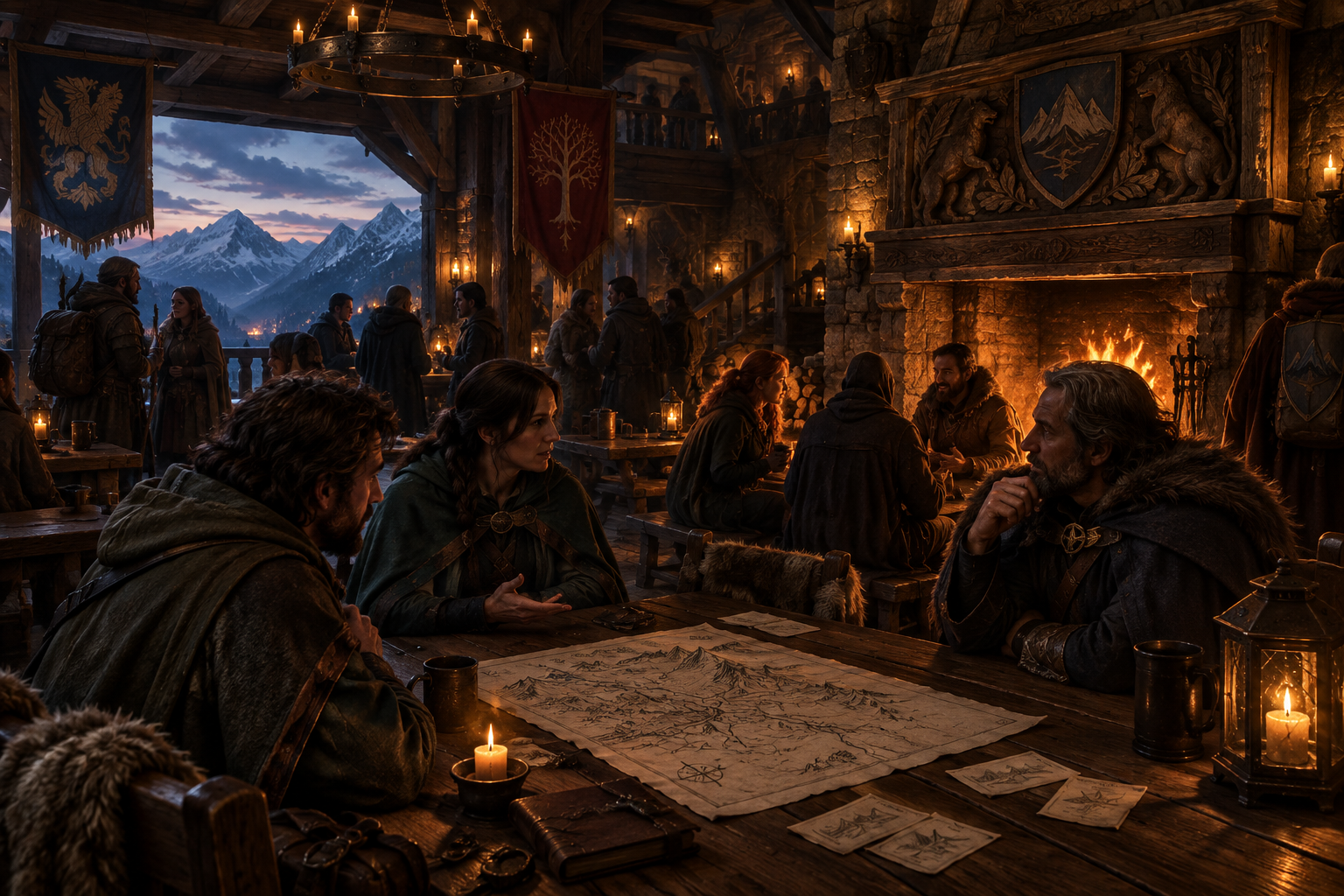
Cognitive load theory comes from education research, not gaming, but its core ideas map neatly onto tabletop play. This analysis looks at what the theory claims, where the analogy holds, and where it stops.
Tabletop games are made of talk. A game master describes a scene, players ask questions, rules get consulted, names get repeated, and somewhere in the middle everyone is expected to hold the situation in their heads and make a decision. When that works, the table hums. When it does not, people go quiet, ask the same question twice, or reach for their phones.
A useful lens for understanding why comes from outside gaming entirely. Cognitive load theory is a body of education research about how much a learner can process at once and how instruction can be designed around that limit. This article is an analysis of that theory as applied to tabletop RPG play: what the original research actually claims, which parts translate to a game table, which parts are a stretch, and what a game master or player can reasonably do with the idea.
A note on scope before starting. Cognitive load theory was developed to explain learning and problem solving in instructional settings. A game table is a different setting, with different goals. Everything below that connects the two is an analogy, offered as a way of thinking about table craft, not as an established finding about RPGs.
Where the theory comes from
The foundational paper is Sweller (1988), "Cognitive load during problem solving: Effects on learning," published in Cognitive Science. Sweller's central argument in that work concerns problem solving and learning. The paper contends that the processing demands of certain kinds of problem solving can interfere with the learning that the problem solving is supposed to produce (Sweller, 1988). In other words, the activity of working through a problem can consume the very mental resources a learner needs in order to absorb what the problem is meant to teach.
That is a narrow, careful claim made in a particular research context. It was later developed by Sweller and many other researchers into a larger framework. This article draws only on the 1988 paper as its verified source, so the broader framework is described here only in the general terms below, without attributing specific experimental results to anyone.
The general idea is easy to state. People can hold and manipulate only a limited amount of information at one time. When a task asks for more than that limit allows, performance and understanding suffer. Instruction, on this view, should be designed with that limit in mind.
The core idea in plain language
Strip the theory down and three practical ideas remain.
First, working capacity is limited. Anyone who has tried to remember a phone number while someone recites a second one knows the feeling. There is only so much a mind can juggle at once.
Second, not all mental effort is equal. Some effort goes toward the thing you actually care about (understanding a puzzle, weighing a decision), and some goes toward overhead (decoding confusing instructions, searching for a missing piece of information). A good design spends effort on the first kind and trims the second.
Third, the same content can be easier or harder depending on how it is presented. Two explanations of identical material can differ enormously in how much they demand of the listener.
None of that is exotic. What the theory adds is a vocabulary for talking about it and a prompt to ask, whenever something is going wrong, "is the material hard, or is the presentation expensive?"
Mapping the idea onto a game table
Here is where the analogy begins, and where honesty about its limits matters.
A tabletop RPG asks participants to do several things simultaneously. They track a fictional situation, remember who is who, understand the rules that apply, think about what their character wants, listen to other players, and decide what to do. Each of those draws on the same limited attention. It is reasonable to suppose, as a working hypothesis, that when a table goes quiet, one contributing cause is that too many of these demands have arrived at once.
That is a hypothesis about table behavior, not a measured result. There is no study cited here showing how often this happens or how large the effect is, and the reader should treat the framing as a thinking tool.
With that caveat in place, it helps to sort the demands of a game into three buckets, borrowing the spirit of the theory's distinction between effort that serves the goal and effort that does not.
Demands that are the point of the game
These are the choices and imaginative leaps people came to the table for. Should the party trust the tax collector? Is it worth risking the pass to reach town sooner? What does my character say to a rival who is stalling us? This is the effort worth protecting.
Demands that are overhead
These are the costs of simply keeping the game intelligible. Remembering a stranger's name. Recalling where the door is in a room described three minutes ago. Working out which of five options on the table is actually available. Looking up a rule. Overhead is not evil, since every game has some, but it competes with the first bucket for the same attention.
Demands that are optional texture
These are the embellishments: extra descriptive detail, background lore, additional non-player characters whose only function is color. Texture can enrich a game, and it can also quietly become overhead when it arrives faster than anyone can absorb it. Whether a given detail is flavor or burden depends on the table.
The practical question this sorting suggests is simple: for a given scene, how much of what the table has to carry is the point, and how much is overhead or surplus texture?
Four places the analogy is most useful
The following areas are where the framing seems most likely to help a game master or player. In each, the suggestions are offered as table-craft ideas that follow from the lens, not as proven remedies.
1. Introducing names and characters
Names are a classic source of overhead. A string of new proper nouns delivered in a row is hard to retain, and a new player may be the one who feels it most, since they are also learning the game and their own character.
Writers on game mastering have long addressed the broader problem of how a game master describes things. Alexander (2017), in a post on evocative descriptions, treats description as a craft with choices about what to include. Applied here, the lens adds a question about quantity as well as quality: how many distinct names is it reasonable to introduce in one go?
There is no number that is correct for every table. A group of experienced friends who have played together for years may handle a crowded scene easily. A group with newcomers may not. Reasonable techniques include introducing characters one at a time, tying each to a single memorable trait, and letting players write names down. Whether to do any of those is a matter of table preference.
2. Describing places
Spatial information is another heavy item. Describing a room in words alone asks everyone to build and hold a mental map. A rough sketch on the table moves that burden out of memory and onto a shared surface.
This ties into the broader practice of giving a table something to look at. A related discussion of physical aids appears in The Dungeon Trainer's piece on dungeon crawl props and tools (The Dungeon Trainer, 2026a), and in a general rundown of what a game master actually needs at the table (The Dungeon Trainer, 2026b). The cognitive-load framing offers one reason such aids can help: they hold information so that people do not have to.
Again, this is a suggestion, not a guarantee. Some tables prefer theater of the mind and find sketches distracting. That is a legitimate preference.
3. Presenting choices
When a game master asks "what do you do?" the question is open by design, and open questions are a hallmark of the form. But an open question after a heavy information dump can be hard to answer, because the player first has to reconstruct what is on offer.
One response is to offer a loose shortlist of possibilities while making clear that players may do something else. The shortlist lowers the cost of getting started without removing agency. This pairs naturally with the common practice of a game master ending a description on the situation that demands a decision. Alexander (2023), writing about pacing for beginning game masters, discusses pacing as a skill worth developing deliberately, which is consistent with treating the flow of information as something a game master shapes.
Whether a shortlist feels helpful or hand-holding depends on the group.
4. Rules lookups and mid-scene complexity
Rules are a different kind of load. A rule that must be looked up pauses the game and shifts everyone's attention from the fiction to the book. For games in the Dungeons & Dragons family, the current rules are published in the Player's Handbook and Dungeon Master's Guide (Wizards of the Coast, 2024c; Wizards of the Coast, 2024b), and the free Basic Rules are available online (Wizards of the Coast, 2024a). Familiarity with the rules that come up most often reduces lookup time.
A related idea is that a game master can decide in advance how much rules machinery a scene will use. Shea (2024), in a post on high value prep, argues for focusing preparation effort where it pays off at the table. Read through the load lens, that advice has a natural corollary: prepare the things that would otherwise force a stop. Whether to adjudicate a ruling quickly and check later, or pause to get it exactly right, is a table-culture decision that groups settle in different ways.
What the theory does not tell us
It is worth being direct about the limits, because it is easy to overreach when borrowing a concept from another field.
It does not say that less is always better. The theory is about matching demands to capacity, not about minimizing information. A group that enjoys dense, intricate play may be well within its capacity. Stripping everything down could make such a table bored.
It does not measure your table. The original research was about learning and problem solving (Sweller, 1988). Nothing in it quantifies how much a group of friends can handle in a fantasy scene. Capacity varies from person to person and from evening to evening, and tiredness, noise, and unfamiliarity all matter.
It does not replace reading the room. The most reliable signal that a table is overloaded is the behavior of the people at it: repeated questions, silence, side conversations. A game master who watches for those signals is doing something the theory can describe but cannot automate.
It does not dictate a play style. Games vary widely in how much they ask of participants. Some are built around heavy bookkeeping, others around light improvisation. Neither is wrong. The lens is only useful for asking whether the demands on a given table fit that table.
A short diagnostic for game masters
If you want to use the lens without turning it into a rulebook, a few questions can guide preparation and in-the-moment adjustments. These are prompts, not requirements.
- What is the single decision this scene is building toward?
- Of everything I plan to say, what does the table need in order to make that decision?
- Which items are overhead I could move onto a card, a sketch, or a recap?
- Which items are optional texture I could trim, delay, or reveal only if asked?
- Is there a new player or a player who tends to go quiet, and how is the scene landing for them?
- If the table stalls, is the problem difficulty or presentation?
That last question is the heart of the lens. A stalled table is often assumed to be a content problem (the puzzle is too hard, the choice too grim). Sometimes it is a delivery problem, and delivery is easier to fix.
A short diagnostic for players
The lens is not only for the person running the game. Players shape the load on the table too.
- Jot down names and one-line notes, so the game master does not have to repeat them.
- Ask for a quick recap when you are lost. Others are often lost too.
- Say aloud what you are trying to do, so the table can help you find the right rule or option.
- When it is not your turn, listen for information that bears on your next decision.
- Be patient with new players. Everything is new to them at once.
None of these is a requirement. They are habits that a table can adopt if it wishes, and a conversation about them can happen at the start of a campaign. For guidance on setting expectations early, see the discussion of opening conversations in D&D Beyond's session zero guidance (Haeck, 2024), which covers how a group can align on style and expectations before play begins.
Example: The Lantern Road Company
This is an illustrative scenario, not a report of an actual game. It shows how the ideas above might look in practice for a fictional group.
The Lantern Road Company is a four-player party escorting a merchant caravan through a mountain pass. At the crowded waystation, the game master wants a lively opening. Consider how the lens helps sort the scene's demands.
Sorting the demands. The point of the scene is a decision about how to spend limited time before the pass closes. The overhead is the cast and the room layout. The optional texture is the weather and the bandit rumor.
Moving overhead off memory. The game master prepares a short note card with three characters, each given one trait and one want: the innkeeper (warm and hurried, wants help with a broken cart), a rival caravan master (smug, wants to leave first), and a tax collector (nervous, wants an escort). A rough sketch of the common room marks the hearth, the door, and the stable yard. A one-line recap restates the party's goal of reaching the next town before the pass closes.
Pacing the introductions. Instead of naming everyone in a single speech, the game master presents the three characters one at a time, in short bursts. The player running the cautious scout writes the names on a card. The sketch stays on the table, so no one has to remember where the door is.
Holding the texture back. The weather and the bandit rumor are not dropped into the opening. They wait. If a player asks about the weather, or if the scene lulls, the game master can offer them then.
Offering a loose shortlist. When the party reaches a choice, the game master mentions that they could help the innkeeper, question the tax collector, or watch the rival master, and makes clear that they are free to do something else entirely.
Notice what the lens does and does not claim here. It does not say the fiction became simpler, since the same characters and the same tension are present. It does not guarantee the scene will go well. It only suggests that the table is spending less effort on remembering and more on deciding, which is the point of the scene. Whether that actually produces a livelier game depends on the people in the room.
To keep the scenario honest: the lightened version is not presented as the correct way to run a waystation. A group that loves rapid-fire, crowded scenes might prefer the first version. The example only illustrates how the framing can be applied.
How this fits with other table-craft advice
The load lens does not stand alone. It overlaps with several established strands of game mastering advice, which is part of why it feels intuitive.
Pacing. Writers on pacing treat the rhythm of a session as something to shape. Alexander (2013) discusses the art of pacing as a deliberate skill, and Shea (2022) offers a page on improving pacing. The load lens adds a specific reason pacing matters: information delivered too fast can outrun the table's capacity to use it.
Preparation. Preparation advice often centers on what to prepare and what to leave alone. Shea (2018) argues in Return of the Lazy Dungeon Master for preparing only what will help at the table. Seen through the lens, that is a way of controlling how much material a game master must carry and deliver.
Description. Alexander (2017) addresses how to make descriptions evocative. A load-aware approach asks how long a description should run and how many distinct details it should hold before it exceeds what players can retain.
Stopping narration. The Angry GM (2025) has a piece on when to stop narrating, which speaks to the same instinct: a game master can talk too long, and knowing when to hand the scene back to the players is part of the craft.
Structure. Dungeon design writing, such as The Dungeon Trainer's discussion of room purpose and pacing (The Dungeon Trainer, 2026d) and of pacing and flow in dungeon sequences (The Dungeon Trainer, 2026c), makes related points about giving each space a clear function so that players are not asked to process aimless detail.
The common thread is that these sources, written for tabletop audiences, converge on practices that are compatible with the load lens. That is not proof that the theory explains why they work. It is only an observation that the lens and the craft advice point in similar directions.
Common misreadings to avoid
Borrowing a concept from research invites a few predictable errors.
- Treating a hypothesis as a finding. The idea that table silence often reflects overload is a plausible working assumption, not a result from a study of RPG groups.
- Treating the theory as a style mandate. It does not say tables should be simple.
- Treating one person's capacity as everyone's. What a seasoned game master finds easy may overwhelm a newcomer, and the reverse can also be true.
- Forgetting that engagement matters. A scene can be low in load and still dull. The goal is a fit between demand and capacity, not an empty scene.
Keeping these in mind lets the lens stay what it is: a way of asking better questions.
Putting it together
If one idea is worth carrying away, it is the question of whether a stall is about difficulty or presentation. Cognitive load theory, as introduced in Sweller's 1988 paper on problem solving and learning, gives researchers a way to think about how processing demands shape what people can do and learn (Sweller, 1988). Translated loosely to the game table, it prompts a game master or player to notice how much the group is being asked to hold at once, and to consider whether some of it could be moved onto a card, a sketch, a recap, or simply a slower pace.
That translation is a judgment call, and the right balance is a matter of table preference. Some groups thrive on density. Others need breathing room. The useful habit is to watch the people at the table and adjust.
If you want a place to prepare notes, share notes with your group, and practice the craft of running or playing with others, The Dungeon Trainer is built for people who want to play together and improve. It also includes an optional AI Dungeon Master, which a group can use to fill a seat or practice, and which is never meant to replace a human game master.
Sources and Further Reading
- Alexander, J. (2013). The Art of Pacing. The Alexandrian. https://thealexandrian.net/wordpress/31509/roleplaying-games/the-art-of-pacing
- Alexander, J. (2017, September 4). Random GM Tip: Evocative Descriptions. The Alexandrian. https://thealexandrian.net/wordpress/39227/roleplaying-games/random-gm-tips-evocative-descriptions
- Alexander, J. (2023, May 30). Pacing for the Beginning GM. The Alexandrian. https://thealexandrian.net/wordpress/49547/roleplaying-games/pacing-for-the-beginning-gm
- Haeck, J. (2024, March 11). How to run a Session 0 for your D&D game. D&D Beyond. Original work published January 8, 2021.
- Shea, M. E. (2018). Return of the Lazy Dungeon Master. Sly Flourish.
- Shea, M. E. (2022). Improving Pacing. Sly Flourish. https://slyflourish.com/pacing.html
- Shea, M. E. (2024, June 3). High Value Prep. Sly Flourish.
- Sweller, J. (1988). Cognitive load during problem solving: Effects on learning. Cognitive Science, 12(2), 257–285.
- The Angry GM. (2025, July 31). When to stop narrating. The Angry GM.
- The Dungeon Trainer. (2026a). Essential Dungeon Crawl Props and Tools: A Game Master's Toolkit. https://thedungeontrainer.com/blog/essential-dungeon-crawl-props-and-tools-a-game-master-s-toolkit
- The Dungeon Trainer. (2026b). Essential Dungeon Master Tools: What You Actually Need at the Table. https://thedungeontrainer.com/blog/essential-dungeon-master-tools-what-you-actually-need-at-the-table
- The Dungeon Trainer. (2026c). Pacing and Flow: Designing Dungeon Sequences That Keep Players Engaged. https://thedungeontrainer.com/blog/pacing-and-flow-designing-dungeon-sequences-that-keep-players-engaged
- The Dungeon Trainer. (2026d). Room Purpose and Pacing in Dungeon Design. https://thedungeontrainer.com/blog/room-purpose-and-pacing-in-dungeon-design
- Wizards of the Coast. (2024a). Basic Rules for Dungeons & Dragons. D&D Beyond. https://www.dndbeyond.com/sources/dnd/br-2024/
- Wizards of the Coast. (2024b). Dungeon Master's Guide. Wizards of the Coast.
- Wizards of the Coast. (2024c). Player's Handbook. Wizards of the Coast.
Play 5E at your own table
Play with friends or solo, run your own campaign, and keep the dice and character math in code. An optional AI Dungeon Master can run the game when you want one. Free to start, no card required.
Related reading
- Cognitive Load at the Gaming Table: How Too Much Information Can Stall a Game
Cognitive load theory, an idea from learning research, offers one useful lens on why a table can go quiet when rules, names, and options pile up. Here is the concept, what it means for game masters and players, and ways to lighten the load.
- Downtime in Tabletop RPGs: The Quiet Gears of a Campaign
Downtime is the stretch of play between adventures when characters rest, train, craft, and pursue personal goals. Here is what it is, what it does for a campaign, and how tables handle it.
- Six Sessions Under the Ledger's Shadow: A Case Study in Advancing Threats
A reflective, illustrative case study of one advancing threat across six sessions, with an honest look at what the approach did well, where it strained, and what to adjust.