5e Rules Adjudication That Keeps Play Moving
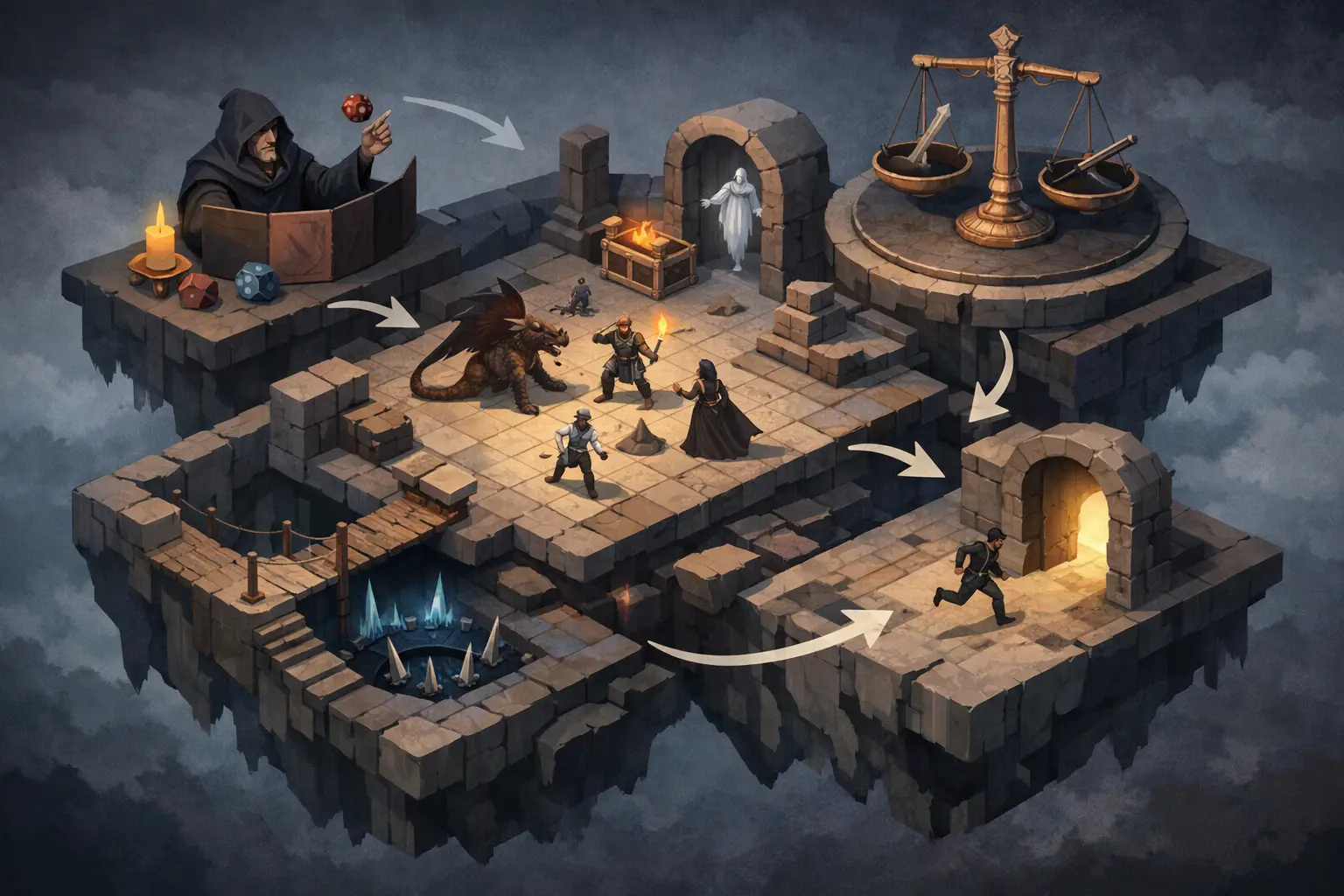
A wounded courier collapses through the waystation door at dusk, Gravehold riders less than a mile behind her. Before she loses consciousness, she presses a locked message case into the rogue's hands: proof that Ashwarren Keep has fallen and the Silence Bell breaks in five days. The case is sealed, the riders are clos…
A wounded courier collapses through the waystation door at dusk, Gravehold riders less than a mile behind her. Before she loses consciousness, she presses a locked message case into the rogue's hands: proof that Ashwarren Keep has fallen and the Silence Bell breaks in five days. The case is sealed, the riders are closing, and the rogue asks whether she can pick the lock before they arrive. This is where 5e rules adjudication earns its place at the table. The question is not simply whether a rule exists. The question is how to produce a fair ruling, communicate the stakes, and preserve the momentum of a scene that is already in motion.
Good adjudication is not a performance of perfect recall. It is a disciplined method for turning player intent into a clear resolution. When it works, players understand what they can attempt, why the dice matter, and what changes when they succeed or fail. The game remains dangerous, but never arbitrary.
What 5e Rules Adjudication Is Actually For
Rules adjudication sits between written mechanics and the living campaign. The rules provide procedures for familiar situations: attacks, saving throws, ability checks, conditions, movement, spell effects, and rests. But players do not experience adventures in neat categories. They try to tip statues onto enemies, distract guards with forged orders, drag unconscious allies through difficult terrain, and combine spells in ways no example can fully predict.
The GM's job is to identify the governing rule when one applies, then make a bounded ruling when the text leaves room for interpretation. That ruling should protect three things at once: player agency, campaign continuity, and the value of character abilities.
Player agency means choices produce intelligible consequences. If a player spends resources, takes a risk, or develops a clever plan, the resolution should acknowledge that decision. Campaign continuity means an answer given tonight should not quietly reverse next week because the scene has changed. And character abilities matter because a rogue who invested in thieves' tools, or a wizard who prepared feather fall, deserves for those choices to have reliable weight.
This does not mean every ruling must favor the players. A fair ruling can close a door, trigger an alarm, or send the party into a losing position. Fairness comes from clear stakes and consistent procedures, not from favorable outcomes.
Start With Intent, Fiction, and Stakes
Before calling for a die, establish what the player is trying to accomplish. "I make a Stealth check" is a mechanic, not an intent. Ask what the character is doing in the fiction.
Are they trying to cross the courtyard unseen? Get close enough to overhear the captain? Hide before a patrol rounds the corner? Each intent may call for a different resolution, even if Stealth is involved.
Then assess the fictional position. Is there a meaningful chance of success? Is there a meaningful cost for failure? If the answer to either is no, do not roll. A veteran thief opening an unsecured desk drawer succeeds. A character attempting to leap a fifty-foot chasm without magic or support does not turn that impossibility into a lucky DC 30 check.
When a roll is warranted, state the immediate stakes before the dice hit the table. "If you fail, the guard hears movement and comes to inspect the hall." That sentence gives players useful information without revealing every hidden branch. It also keeps failure active. A failed check should usually change the situation, consume time, expose danger, reduce an opportunity, or force a harder choice. It should not simply freeze the adventure behind a locked door.
The message case example
Return to the waystation. The rogue wants to pick the message case's lock while the riders close in.
There are several questions, and they should be resolved in order.
First, can the lock be picked with thieves' tools? If it is an ordinary lock, yes. Second, does the approaching danger matter? Yes, because failing light and trembling hands create pressure. Third, what is at risk? The riders may reach the waystation before the case is open, forcing a fight the party did not choose.
A strong ruling might be: "You can attempt it. This is a Dexterity check using thieves' tools. The failing light and your own nerves make careful work difficult, and you have one attempt before the riders arrive. On a failure, you do not break the lock, but you lose precious time."
This ruling does not invent a new subsystem. It applies existing tools, establishes a meaningful clock, and leaves the player room to choose another approach.
Use the Written Rule Before Building a House Rule
Many arguments at the table begin because a familiar rule was skipped too quickly. Before improvising, identify whether the game already gives you a procedure. Conditions, cover, visibility, grappling, spell targeting, travel pace, and exhaustion all have language that may resolve most of the question.
Read the operative text, not a remembered summary. Small words matter. "Can see," "willing," "hostile," "within range," and "until the start of your next turn" often determine the outcome. If the rule is clear, apply it even when a more dramatic answer feels tempting. Reliability creates trust, and trust gives players the confidence to make bold plans.
When the rule is unclear or the situation is genuinely novel, make the narrowest ruling that resolves the present scene. Avoid turning one unusual stunt into a broad permanent precedent unless you want it to become part of the campaign's operating logic.
For example, allowing a barbarian to swing from a chandelier and kick an enemy may be a flavorful improvised action. It does not automatically mean every chandelier grants free movement, extra damage, and forced displacement. Decide what happens now, explain why, and revisit the precedent between sessions if needed.
Set Difficulty From the Situation, Not the Desired Plot
Difficulty classes should reflect the obstacle in the fiction, not how badly the campaign needs a certain outcome. If the party must enter a vault for the story to continue, do not hide the only path behind a single pass-fail roll. Offer other approaches: obtain a key, bargain with a custodian, locate a drainage route, use magic, or accept a costly entrance.
A check can still determine which route is fastest, quietest, or least expensive. That is often more satisfying than making the entire adventure depend on one d20 result.
Likewise, do not raise a DC merely because a character has become skilled. Expertise is supposed to change what the party can accomplish. As characters advance, old problems may become routine. That is not a flaw in the game. It is evidence that the campaign world recognizes growth.
When several characters contribute, be precise about how. One character may make the check while another takes the Help action if the fiction supports assistance. A spell may remove a barrier altogether. A tool proficiency may make an attempt possible or improve the approach. Avoid asking every player to roll separately until someone succeeds. That approach inflates success odds while making specialists feel less relevant.
Keep Combat Rulings Fast and Visible
Combat adjudication carries a special burden because timing matters. A disputed reaction, line-of-effect question, or condition interaction can halt an entire round. The best practice is to make a quick ruling, state it plainly, and record it if it may recur.
Use a simple table language: "For this fight, we are treating the pillar as three-quarters cover from this angle." Or: "The spell cannot target through that closed window because it requires a clear path to the target." Players may disagree, but they can act on an answer.
If the ruling could materially affect a character build or a major resource, flag it for review after the session. Do not turn a tense encounter into a rules hearing unless the outcome is truly campaign-defining. A short note preserves the issue without sacrificing pacing.
Dice should remain independent from narration. The result comes first; the description follows. A code-rolled die or physical die establishes success, failure, damage, or duration. The GM then narrates what that result means in the current state of the scene. No invented percentages. No hidden adjustment because a dramatic outcome would be convenient.
Record Precedents That Change Future Choices
Not every ruling deserves a campaign document. But recurring answers should be captured in a short, accessible form. This is especially valuable for rulings about stealth, crafting, spell interactions, travel, resurrection, downtime, and companion creatures.
Write the ruling in operational language, and flag it clearly if it extends beyond the baseline rule: "Table variant: a creature can attempt to hide in lightly obscured terrain, but only when it has a plausible break in observation. This extends beyond the SRD's default Heavily Obscured requirement." Add the reason if it will help: "This preserves the value of darkness, cover, and features that explicitly allow hiding in limited concealment, while giving lightly obscured terrain a narrow, deliberate use."
Structured state matters here. A campaign is more than a stack of dramatic moments. It contains established rulings, active conditions, spent resources, NPC knowledge, map positions, and unresolved consequences. When those details persist, adjudication becomes more consistent and players can plan with confidence.
The Dungeon Trainer is built around that same principle: campaign state is structured, dice resolve in code rather than by model output, and an AI GM can make bounded rulings from the information the table has established. The aim is not to replace judgment with automation. It is to make the judgment legible, repeatable, and accountable.
When to Pause and When to Move On
Some decisions deserve a pause. Stop and verify the rule when a ruling could permanently remove a character, invalidate a major class feature, alter a high-level spell's intent, or decide an irreversible campaign outcome. Players should not lose a beloved character because everyone rushed through an obscure condition interaction.
Most decisions do not need that level of interruption. If the question concerns a minor tactical edge or an unusual environmental detail, make a temporary call and keep the scene moving. Explain that the ruling is provisional if necessary. "This is how it works tonight; I will check the exact interaction before next session."
That transparency matters. It tells players the GM is not claiming certainty where none exists. It also prevents a temporary call from becoming an accidental promise.
The strongest adjudication leaves players thinking about their next move, not litigating the last one. State what is true, name the risk, roll the dice, and let the consequences reshape the room. The riders are still closing. The message case is still sealed. What do you do?
Artwork on this page is generated by AI.
This work includes material taken from the System Reference Document 5.2.1 by Wizards of the Coast LLC and is licensed under the Creative Commons Attribution 4.0 International License (https://creativecommons.org/licenses/by/4.0/).
Related reading
- How to Predict Tabletop Campaign Outcomes
The party's informant is found dead in an alley behind the exchange at dawn, one torn page of a ledger still clutched in her hand. The rest of it, whatever it was, is already gone. The rogue recognizes the seal pressed into the wax on her wrist: House Vane. The cleric checks the wound and finds it professional, not de…
- Prepare Tabletop RPG Scenes Faster for Game Night
The choir hall beneath Ashwarren Keep has gone silent, and that silence is worse than the chanting. The high priest stands at the altar with both hands on the Silence Bell's cradle, and the last ward-stone is cracking under his palm. The rogue wants to pick the vestry lock behind the altar. The cleric wants to hold th…
- A Fair Dice Roller for RPGs You Can Trust
Chanting rises from the choir hall beneath Ashwarren Keep, low and steady, and it has not stopped in an hour. One night remains before the Silence Bell rings. The rogue slips through the dark toward the last guarded door, and the table reaches the moment that matters: a Stealth check. A fair dice roller for RPG play d…