What Is a Dungeon Master? Role, Responsibilities, and Why It Matters
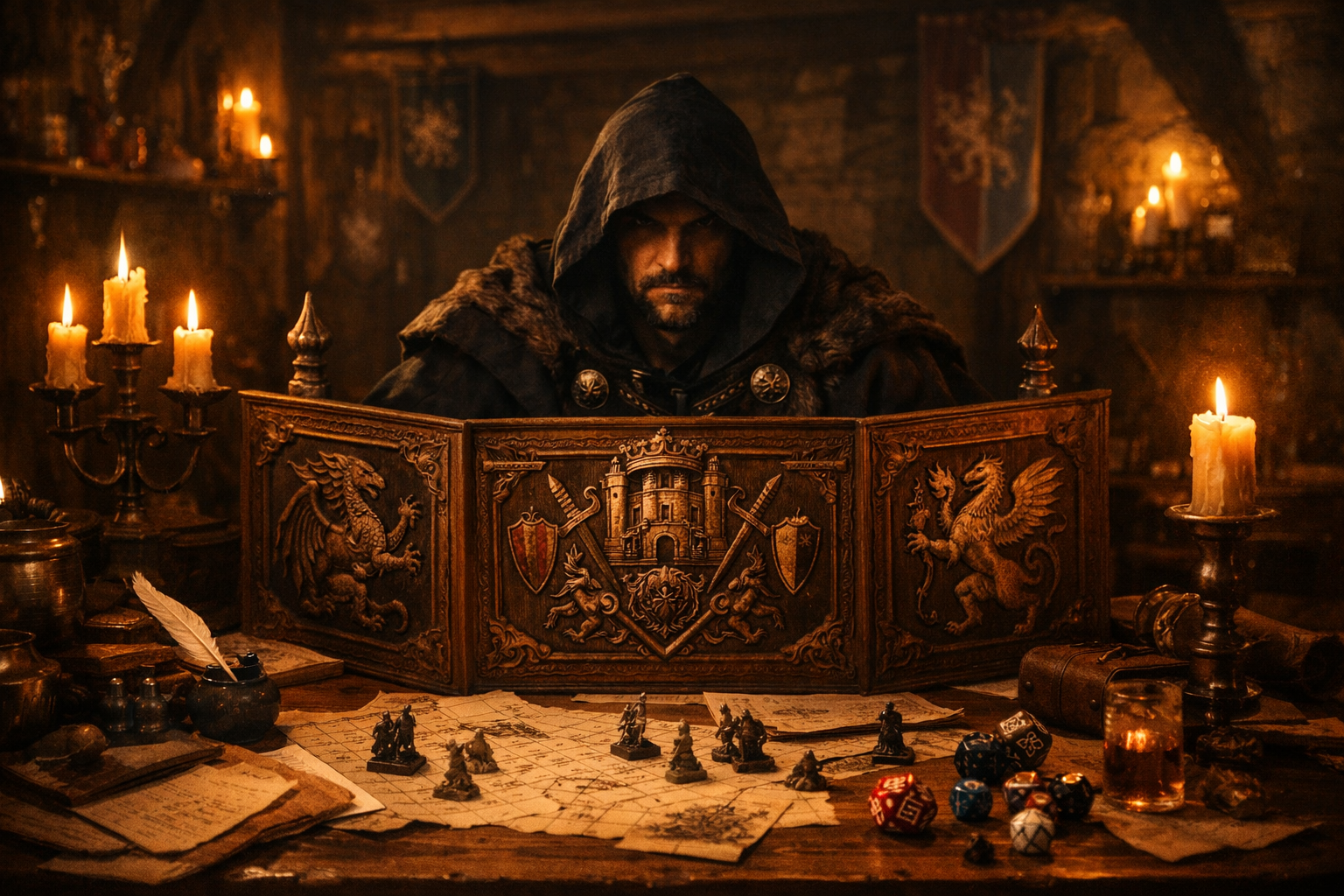
The Dungeon Master shapes every tabletop RPG session. Learn what a DM does, the responsibilities they carry, and why this role is essential to great gameplay.
If you have heard friends talk about Dungeons & Dragons or watched an actual-play show, you have probably encountered the term Dungeon Master.
The Dungeon Master, commonly shortened to DM, is the participant who facilitates a traditional game of Dungeons & Dragons. The DM presents the world, portrays its inhabitants, applies the rules, responds to player decisions, and helps maintain the pace and continuity of the game.
Understanding the role helps new players know what to expect and gives aspiring Dungeon Masters a clearer picture of what actually happens behind the screen.
The role carries significant responsibility, but it does not require perfect rules knowledge, professional acting ability, or complete control over the story.
D&D works through collaboration.
The Dungeon Master presents situations. The players decide how their characters respond. The rules and dice help determine uncertain outcomes. Those outcomes create new situations, and play continues from there.
Defining the Dungeon Master
A Dungeon Master is the participant who facilitates a game of Dungeons & Dragons.
In a typical D&D game, the other players each control a player character. The Dungeon Master controls the surrounding world, including:
- Non-player characters
- Monsters and other creatures
- Locations
- Environmental conditions
- Hazards
- Factions
- Events occurring outside the player characters' direct control
The DM also adjudicates rules and describes how the world responds to player decisions.
That does not mean the Dungeon Master single-handedly tells the story.
D&D's current rules describe play as a shared process. The DM describes a situation, the players describe what their characters attempt, and the DM determines and narrates the results using the rules when necessary.
Players contribute constantly through their characters' actions, dialogue, goals, questions, theories, relationships, and decisions.
Similar Roles in Other Games
Other tabletop role-playing games use related titles.
Examples include:
- Game Master (GM) in Pathfinder and many other RPGs
- Keeper of Arcane Lore, usually shortened to Keeper, in Call of Cthulhu
- Storyteller in World of Darkness games
- Referee in Traveller and some old-school games
These roles overlap, but they are not automatically identical.
Different game systems assign different responsibilities and levels of authority to the person facilitating play.
Some tabletop RPGs even support cooperative or solo play without a traditional Game Master.
For that reason, this article focuses specifically on the Dungeon Master's role in Dungeons & Dragons while noting principles that may transfer to other GM-led games.
Core Responsibilities of a Dungeon Master
The Dungeon Master's responsibilities can be divided into several practical areas.
Worldbuilding and Preparation
Before the session begins, the Dungeon Master prepares enough information to run the situations the characters are likely to encounter.
Preparation might include:
- Reviewing a published adventure
- Designing locations
- Creating or selecting NPCs
- Establishing NPC and faction motivations
- Preparing likely monsters or hazards
- Reviewing relevant rules
- Identifying important clues
- Preparing maps or visual aids
- Reviewing previous session notes
- Thinking through likely consequences
The amount of preparation varies considerably.
Some Dungeon Masters enjoy extensive worldbuilding.
Others prefer short notes and improvisation.
Neither approach is inherently better.
Preparation is useful when it helps the DM understand the situation well enough to respond consistently to player choices.
Example: Thornhill
Imagine a session set in the village of Thornhill.
Several livestock animals have disappeared during the night, and the villagers are becoming increasingly frightened.
Useful preparation might include:
Thornhill
- Small agricultural village
- Surrounded by fields and dense woodland
- Livestock disappearances began ten days ago
- No human casualties yet
- Local residents disagree about the cause
Mayor Aldric
- Wants the attacks stopped quickly
- Worried that merchants will avoid the village
- Publicly blames wolves
- Privately suspects something more dangerous
Possible clues
- Unusually large tracks near one livestock enclosure
- No blood where several animals disappeared
- Broken branches leading north
- A shepherd heard something moving after midnight
- Wolves have recently been seen closer to the village than usual
You do not need to decide exactly how the players will investigate.
Prepare the situation.
Let them determine the approach.
Narration and Description
The Dungeon Master communicates what the characters can perceive.
This may include:
- Sights
- Sounds
- Smells
- Temperature
- Movement
- Spatial relationships
- Obvious dangers
- Relevant objects
- Changes caused by previous actions
Good description provides enough information for players to make decisions without burying those decisions beneath unnecessary detail.
For example:
The tree line thickens ahead. The last daylight barely reaches beneath the branches, and the narrow trail disappears between tangled roots. Something rank hangs in the air, like spoiled meat. To your left, several branches have been snapped recently, all roughly chest-high.
The description establishes atmosphere while also providing actionable information.
Players might:
- Follow the trail
- Investigate the broken branches
- Search for tracks
- Retreat until daylight
- Approach from another direction
Description works best when it creates possibilities rather than merely decorating the scene.
Portraying NPCs and Monsters
The Dungeon Master portrays most characters and creatures that are not controlled by the players.
That can include:
- Villagers
- Merchants
- Nobles
- Guards
- Rivals
- Allies
- Villains
- Animals
- Monsters
- Intelligent magical creatures
You do not need acting training.
Distinct NPCs can be created through simple differences in:
- Vocabulary
- Goals
- Posture
- Speaking rhythm
- Confidence
- Humor
- Fear
- Attitude toward the party
Mayor Aldric might speak quickly and constantly redirect conversations toward solving the immediate crisis.
A local blacksmith might answer questions slowly and distrust outsiders.
A frightened shepherd may repeatedly insist that whatever took the animals was "too quiet to be a wolf."
The most useful NPC preparation is often motivation.
If you know what someone wants, you can improvise their responses to questions you never anticipated.
Rules Adjudication
The Dungeon Master oversees how the group applies D&D's rules.
When the outcome of an action is obvious, no roll may be necessary.
When success is impossible under the circumstances, rolling does not automatically make it possible.
When both success and failure are plausible and the outcome matters, the DM may call for the appropriate game mechanic.
In current D&D, many uncertain actions are resolved through D20 Tests:
- Ability checks
- Attack rolls
- Saving throws
The Dungeon Master determines when an ability check is appropriate and establishes the Difficulty Class when the rules do not already specify one.
Unusual Actions
Players routinely attempt things that the rulebook does not describe with a dedicated procedure.
Suppose a character wants to carry an unconscious companion while crossing a damaged rope bridge.
The Dungeon Master should first consider the established rules and fictional circumstances:
- Can the character carry that much weight?
- How stable is the bridge?
- Is anyone attacking them?
- Is the surface difficult to cross?
- Is there meaningful uncertainty?
- What happens if the attempt fails?
The answer might require no check.
It might involve movement or carrying restrictions.
It might call for a Strength (Athletics) or Dexterity (Acrobatics) check if the situation genuinely tests one of those capabilities.
The important principle is that the mechanic should follow the situation rather than being selected arbitrarily.
When You Do Not Know the Rule
No Dungeon Master remembers every rule.
When a question appears, you can:
- Look up the rule immediately
- Ask a knowledgeable player to locate it
- Make a temporary ruling
- Record the question for later review
Looking up the rule immediately makes sense when:
- The decision has major consequences
- The rule affects a character's defining ability
- The rule will recur repeatedly
- The correct answer is easy to find
A temporary ruling may work better when:
- The issue is obscure
- The consequences are limited
- Research would substantially interrupt play
If you make a temporary ruling, tell the group.
For example:
I'm going to rule it this way tonight so we can keep moving. I'll verify the actual rule before our next session.
If that ruling turns out to be wrong, correct it.
Consistency matters, but preserving an incorrect ruling forever is not necessary.
Pacing and Spotlight Management
Dungeon Masters influence the pace of play.
That does not mean keeping the game moving as quickly as possible.
Good pacing means spending table time where it remains interesting and meaningful.
A DM might:
- Summarize uneventful travel
- Give an important conversation more time
- End a combat once meaningful resistance has disappeared
- Transition away from repetitive searching
- Slow down during an important revelation
- Provide a break after a demanding scene
The Dungeon Master also helps make space for everyone to participate.
If one player has dominated the conversation, you might ask:
What is Kaelen doing while this discussion is happening?
If another character has expertise relevant to the situation, you can make sure the player knows what their character would reasonably recognize.
Avoid assigning rigid jobs based solely on class.
A locked door does not automatically belong to the rogue.
The fighter might break it.
The wizard might use magic.
The bard might persuade someone to provide the key.
The party might discover another route entirely.
The goal is to create opportunities for different characters to matter without deciding in advance who is supposed to solve each problem.
Designing Challenges
Dungeon Masters present challenges that create decisions.
Those challenges might involve:
- Combat
- Exploration
- Investigation
- Negotiation
- Resource management
- Environmental hazards
- Puzzles
- Moral decisions
Not every challenge needs to be perfectly balanced for direct confrontation.
A dangerous monster can be much stronger than the party if the players receive enough information to recognize the threat and have meaningful alternatives.
They might:
- Retreat
- Negotiate
- Avoid it
- Gather information
- Find allies
- Change the environment
- Return later
Challenge becomes frustrating when players have no reasonable opportunity to understand what they are facing or when the outcome ignores their decisions.
Adjusting Encounters During Play
Prepared encounters sometimes behave differently than expected.
Players may roll exceptionally well.
A creature's abilities may interact with the party in a way you did not anticipate.
The players may discover an effective strategy that makes a supposedly difficult encounter easy.
Let earned success matter.
Do not automatically increase enemy hit points, invent a hidden second phase, or add reinforcements merely because the party performed better than expected.
Likewise, if an encounter becomes unexpectedly dangerous, avoid making enemies suddenly incompetent solely to protect the party.
Instead, rely on elements already supported by the situation.
Enemies may:
- Retreat
- Surrender
- Negotiate
- Protect an objective
- Attempt to escape
- Call for help if allies are actually nearby
- Change tactics when their original strategy fails
In Thornhill, suppose the characters are fighting predators near a ruined barn.
If the creatures are injured animals defending territory, they may retreat when seriously wounded.
That makes sense because of their motivation.
It is different from reducing their statistics secretly because the characters are struggling.
Managing the Table
The Dungeon Master often helps establish structure for the group, but healthy table dynamics are a shared responsibility.
The DM may help:
- Clarify expectations
- Facilitate rules disagreements
- Maintain the campaign's agreed tone
- Make space for quieter participants
- Pause when someone appears uncomfortable
- Keep scenes focused when necessary
Players also have responsibilities.
They should:
- Respect other participants
- Learn the basics of their characters
- Communicate scheduling problems
- Participate in establishing boundaries
- Avoid deliberately undermining the agreed game
- Share the spotlight
- Communicate concerns appropriately
Scheduling, hosting, note-taking, snacks, and group administration do not automatically belong to the Dungeon Master.
Those responsibilities can be shared.
What the Dungeon Master Is Not
Understanding the Dungeon Master's boundaries is just as important as understanding their responsibilities.
The DM Is Not the Players' Adversary
The Dungeon Master controls creatures and villains that may desperately want to defeat the player characters.
That does not mean the DM personally competes against the players.
Enemies can use intelligent tactics.
A villain can lie.
A dragon can exploit terrain.
Guards can call reinforcements.
The difference is that those decisions should come from the creatures, situation, and established world rather than from the DM trying to "beat" the players.
The DM possesses information and authority the players do not.
Using that authority competitively creates an unfair game.
The DM Does Not Control Player Characters
Players ordinarily determine their characters':
- Decisions
- Beliefs
- Voluntary actions
- Interpretations
- Emotional reactions
The Dungeon Master describes circumstances and consequences.
Game mechanics can sometimes impose limitations.
Spells, conditions, supernatural effects, or other rules may influence movement, behavior, perception, or emotional state.
Those mechanical effects should be applied according to the rules.
Outside such effects, the DM should not simply announce:
Your character falls in love with this NPC.
or:
Your character is terrified and runs away.
Instead:
The creature's appearance is horrifying. What does your character do?
This preserves player agency while still allowing the DM to establish tone.
The DM Is Not Solely Responsible for Fun
The Dungeon Master has substantial influence over the session.
They are not solely responsible for whether the group enjoys itself.
Players also contribute through:
- Engagement
- Creativity
- Respect
- Communication
- Cooperation
- Character decisions
- Willingness to interact with the campaign premise
A great session is collaborative.
A group that expects one person to produce entertainment while everyone else passively consumes it places an unrealistic burden on the DM.
Why the Dungeon Master Role Matters in D&D
Standard Dungeons & Dragons assumes that one participant fills the Dungeon Master role.
The DM provides several functions that allow the game's open-ended structure to work.
Maintaining the World
The Dungeon Master determines how the environment and its inhabitants respond.
If the party burns down a bandit camp, warns the local authorities, captures the leader, or negotiates peace, the campaign should remember those decisions.
The world becomes convincing when consequences persist.
Adjudicating Uncertain Situations
Rules cannot anticipate every action players might attempt.
The Dungeon Master interprets the rules and circumstances when an unusual situation occurs.
That human judgment is one reason D&D can support actions that were never explicitly listed on a menu.
Presenting Challenges and Information
The Dungeon Master controls information the player characters have not yet discovered.
The DM decides:
- What is obvious
- What requires investigation
- What NPCs know
- What enemies intend
- What environmental clues exist
The players then decide how to use that information.
Maintaining Continuity
Campaigns can extend across many sessions.
Someone must preserve:
- Established facts
- NPC relationships
- Faction changes
- Character consequences
- Unresolved threats
- Location states
- Campaign history
The DM commonly maintains much of that information, although tools and players can help.
Not Every RPG Requires This Structure
The Dungeon Master is essential to standard D&D because the game is designed around that role.
That does not mean tabletop role-playing games inherently require one person to perform all of these functions.
Some RPGs distribute narrative responsibility differently.
Some rotate facilitation.
Some support cooperative play without a GM.
Others support solo play using structured procedures, prompts, or automated systems.
The appropriate structure depends on the game being played.
Skills That Help Dungeon Masters Improve
Dungeon Mastering develops through practice.
You do not need to master every skill before beginning.
Rules Familiarity
Understanding frequently used rules reduces interruptions.
Focus first on:
- D20 Tests
- Combat flow
- Conditions
- Character abilities likely to appear
- Movement
- Concentration
- Death saving throws
- Resting
- Rules relevant to the current adventure
Rules familiarity means knowing enough to run the game and knowing where to find what you do not remember.
Improvisation
Players will surprise you.
Improvisation becomes easier when you prepare flexible information such as:
- NPC motivations
- Name lists
- Locations
- Faction goals
- Portable clues
- Environmental complications
- Common creature statistics
Understanding why characters and factions behave as they do is often more useful than scripting what they must say.
Active Listening
Listen to what the players actually discuss.
Their conversations reveal:
- What they think is important
- What they misunderstood
- Which NPCs interest them
- What they fear
- What they plan
- What they expect from the situation
That information can help you clarify confusion and prepare material the group genuinely cares about.
Organization
Use a system you can maintain.
It might be:
- A notebook
- Markdown files
- Campaign-management software
- A spreadsheet
- Index cards
- A virtual tabletop
- A shared document
The best system is not necessarily the most sophisticated.
It is the one that lets you retrieve information when you need it.
Feedback
Ask targeted questions after sessions.
Examples include:
- Which scene was most engaging?
- Was anything confusing?
- Did combat move at a comfortable pace?
- Was the objective clear?
- Is there anything you want more or less of?
- What are you most interested in pursuing next?
You do not need to implement every suggestion.
Look for repeated patterns.
Learning from Actual-Play Media
Actual-play shows, podcasts, and streams can demonstrate:
- Description
- Pacing
- Character interaction
- Improvisation
- Combat management
- Rules adjudication
They can be useful learning resources.
They are not necessarily realistic benchmarks for a home game.
Actual-play productions may involve:
- Highly experienced players
- Professional performers
- Editing
- Production staff
- Extensive preparation
- Audience-focused pacing
- Custom sets, audio, and visual effects
Study techniques that interest you.
Do not assume your home game needs to look or sound like a professional production.
Tools and Resources for Dungeon Masters
Dungeon Masters can use many types of support.
Published Adventures
Published adventures provide:
- Locations
- NPCs
- Encounters
- Maps
- Story situations
- Creature references
- Rewards
They can reduce original preparation, especially for a new DM.
Treat them as material to run and adapt rather than scripts that players must follow exactly.
Rulebooks and References
For current D&D, the 2024 Dungeon Master's Guide provides updated guidance on:
- Running sessions
- Adjudicating outcomes
- Combat
- Exploration
- Social interaction
- Creating adventures
- Creating campaigns
- Common DM subsystems
The Basic Rules provide the core play procedures and are useful as an accessible reference.
Community Resources
Blogs, videos, forums, subreddits, and communities can expose you to many game-running approaches.
Useful sources include:
- Sly Flourish
- The Alexandrian
- Matt Colville's Running the Game
- D&D Beyond
- Tabletop RPG communities
Advice should always be evaluated against:
- Your game system
- Your group
- Your campaign style
- Your own strengths
A technique that works for another Dungeon Master may not solve a problem at your table.
The Dungeon Trainer
The Dungeon Trainer can support both human-run and AI-led tabletop play.
In a human-DM campaign, the Dungeon Master retains narration and adjudication authority while the platform can maintain:
- Character sheets
- Dice rolls
- Initiative
- Conditions
- Hit points
- Campaign continuity
- Shared transcripts
Human-DM turns do not require AI model calls.
AI participation is optional.
A group can invite AI into limited roles, use an autonomous AI Dungeon Master for a separate campaign, or leave AI out entirely.
The platform also includes preparation and learning tools such as:
- Scry scene forecasting
- Dungeon Master coaching
- Campaign memory
- Searchable campaign records
- Monster, NPC, item, spell, and location generators
- Rules-supported character management
These tools should supplement the person running the game rather than dictate how a human Dungeon Master must run a table.
Use the features that reduce workload or improve preparation.
Ignore the ones your table does not need.
The Collaborative Nature of Dungeon Mastering
D&D works best when the Dungeon Master provides structure without treating the players as passengers.
Players should be able to affect:
- Relationships
- Objectives
- Locations
- Factions
- Conflicts
- Consequences
- The direction of the campaign
Collaboration does not mean every player statement automatically becomes true.
Suppose a player says:
My character probably knows someone in Thornhill.
Instead of immediately accepting or rejecting the idea, the DM might ask:
Who do you think you would know here, and why?
The player might describe an old traveling companion.
The DM can then decide whether that relationship fits established campaign facts.
Likewise, if players pursue an investigation route you did not anticipate, adapt when the situation supports it.
Do not force them back to the exact sequence you prepared simply because you have notes for it.
Player decisions should influence what happens next.
Getting Started as a Dungeon Master
If you want to run your first D&D game, keep the initial scope manageable.
1. Learn the Core Rules
You do not need to memorize the books.
Understand:
- Basic D20 Tests
- Combat flow
- Your players' major abilities
- The rules central to the adventure
2. Establish Expectations
Discuss:
- Campaign premise
- Tone
- Character creation
- Schedule
- Table conduct
- Content boundaries
- House rules
3. Start With a Manageable Situation
A first adventure might involve:
- One village
- A few important NPCs
- One central problem
- Several clues
- One or two meaningful locations
- One primary threat
- Multiple possible approaches
You do not need a continent.
4. Prepare Situations Instead of Scripts
Know:
- What is happening
- Who wants what
- What information exists
- What happens if nobody intervenes
Then let player choices determine how events develop.
5. Record What Happens
Write down:
- Decisions
- New NPCs
- Improvised facts
- Consequences
- Rules questions
- Intended next actions
Those notes become your preparation for the next session.
6. Improve Incrementally
After each session, identify one or two things to improve.
Maybe:
- Your monster statistics need to be easier to find.
- Your clues need to be clearer.
- Descriptions need to be shorter.
- Players need a visible initiative order.
- You need better NPC notes.
Change what solves an actual problem.
Do not rebuild your entire style after every game.
Conclusion
The Dungeon Master is the participant who facilitates a traditional game of Dungeons & Dragons.
The role combines several responsibilities:
- Presenting the world
- Portraying NPCs and monsters
- Adjudicating rules
- Preparing situations
- Managing pacing
- Preserving continuity
- Responding to player decisions
The Dungeon Master has substantial authority over the fictional environment, but that authority exists within a collaborative game.
The DM is not competing against the players.
The DM does not ordinarily control player characters' voluntary decisions.
The DM is not solely responsible for entertaining everyone at the table.
Players and Dungeon Masters create the experience together.
You do not need perfect rules knowledge, professional acting skills, or years of preparation before running your first session.
Start with a manageable situation.
Understand the important rules.
Listen to your players.
Make fair rulings.
Record the consequences.
Then improve through practice.
That is how Dungeon Masters develop their craft.
Sources and Further Reading
- Alexander, J. (2009, March 23). Don't prep plots. The Alexandrian.
- Chaosium Inc. (n.d.). What is Call of Cthulhu? Call of Cthulhu RPG Wiki.
- Colville, M. (n.d.). Running the Game [Video series]. MCDM.
- Shawn Tomkin. (n.d.). Ironsworn. Tomkin Press.
- Shea, M. E. (2018). Return of the Lazy Dungeon Master. Sly Flourish.
- Wizards of the Coast. (2024). Basic Rules for Dungeons & Dragons. D&D Beyond.
- Wizards of the Coast. (2024). Dungeon Master's Guide.
- Wizards of the Coast. (2025). System Reference Document 5.2.1.
---
Ready to improve your skills behind the screen? The Dungeon Trainer supports human Dungeon Masters with campaign organization, code-resolved tabletop mechanics, Scry session preparation, coaching, generators, and optional AI roles. Run the table yourself, invite AI only where it helps, or use an autonomous AI Dungeon Master for a separate adventure.
This work includes material from the System Reference Document 5.2.1 (“SRD 5.2.1”) by Wizards of the Coast LLC, available at https://www.dndbeyond.com/srd. The SRD 5.2.1 is licensed under the Creative Commons Attribution 4.0 International License, available at https://creativecommons.org/licenses/by/4.0/legalcode.
Related reading
- When Session Zero Prevents a Campaign Collapse: Lessons from a Failed Table
Not every campaign makes it to the end. See how one table's collapse revealed exactly why session zero matters, and what you can learn from their mistakes.
- Session Zero vs First Session: When to Cover What
Understanding the difference between session zero and your first session helps you allocate time wisely and start your campaign with momentum instead of confusion.
- Session Zero Checklist: Essential Tools and Resources for Game Masters
A comprehensive toolkit for running productive session zero meetings, from character creation worksheets to safety tools and scheduling templates.