Preparing Your First Dungeon Master Session: A Step-by-Step Guide
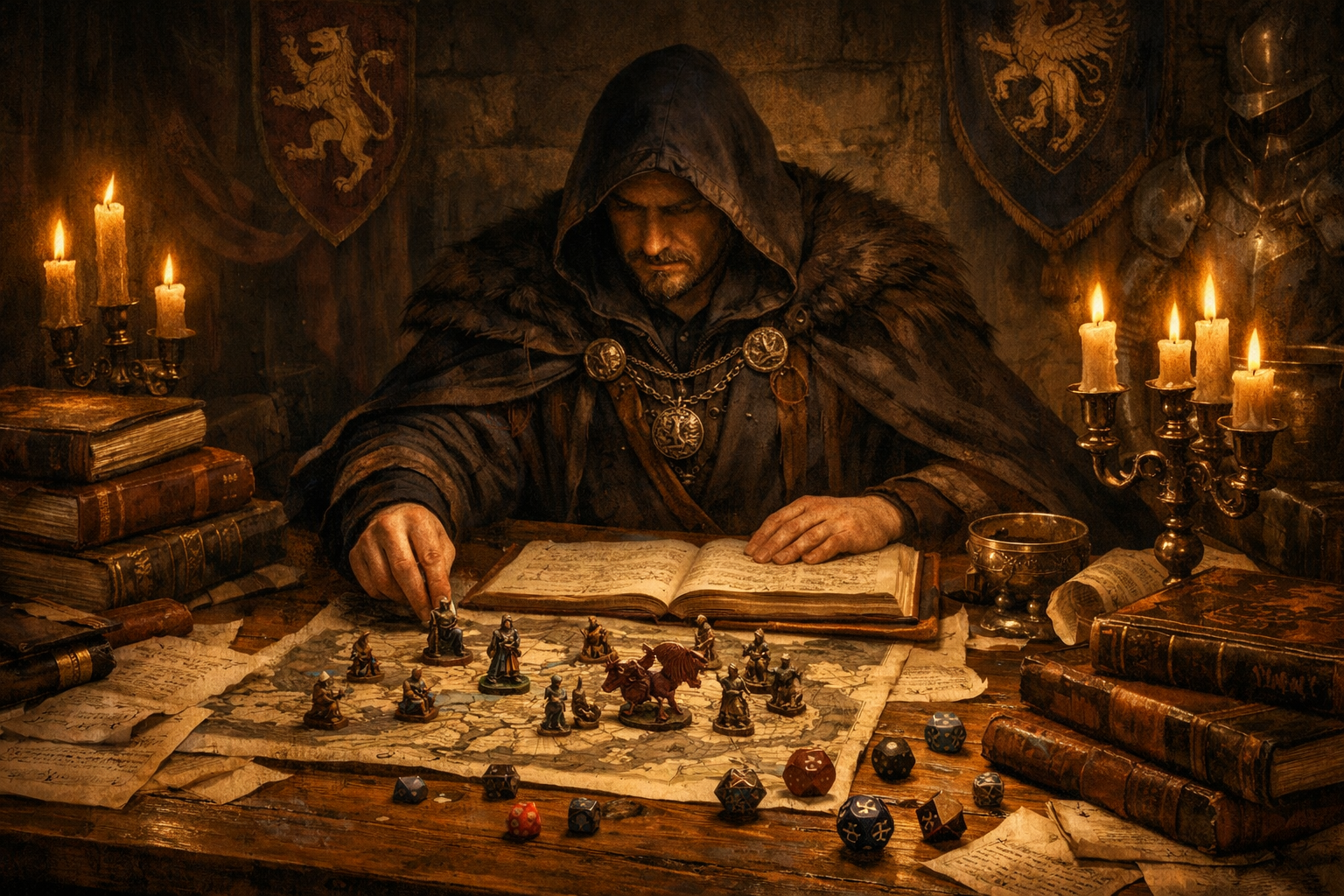
Your first session as Dungeon Master doesn't have to be overwhelming. This practical guide walks you through every preparation step, from choosing an adventure to managing your notes.
Preparing to run your first session as Dungeon Master can feel very different from preparing to play a character.
You are not responsible for memorizing an entire world or predicting everything the players might do. You are preparing enough information to present a situation, portray its inhabitants, apply the rules, and respond when the players begin making decisions.
That still involves several moving parts.
The key is knowing which preparation directly helps you run the next session and which work can wait.
This guide walks through practical preparation steps that work whether you are running a published adventure or creating your own material. Each step is intended to reduce cognitive load during play while leaving enough flexibility for player choices to matter.
Start With Session Zero and Shared Expectations
Before preparing detailed adventure content, establish what kind of game everyone is agreeing to play.
A Session Zero is a structured conversation where the group can align expectations, create or finalize characters, discuss boundaries, and establish practical table procedures.
It does not always need to consume an entire separate gathering.
Depending on your group, Session Zero might be:
- A dedicated meeting
- Part of the first game night
- A video call before the campaign
- A written discussion followed by a shorter conversation
- Character creation combined with campaign planning
The important part is the conversation, not the label.
During Session Zero, discuss topics such as:
- Tone and themes: Is this heroic fantasy, dangerous exploration, political intrigue, horror, comedy, or a mixture?
- Campaign premise: What are the characters expected to be doing?
- Content boundaries: What subjects should be excluded, handled off-screen, or approached carefully?
- Safety and check-in tools: How can someone pause or redirect content if necessary?
- Scheduling: How often will you meet, and approximately how long will sessions run?
- Attendance: What happens when someone cannot attend?
- House rules: Are you changing or adding any rules?
- Player-versus-player behavior: Is conflict between characters allowed, and under what circumstances?
- Character connections: Why are these characters adventuring together?
- Player preferences: Which parts of the game interest the group most?
For example, suppose you are preparing an adventure involving a missing caravan near the village of Thornhaven.
During Session Zero, the group might establish that all the characters have some connection to the local merchant guild. One may be a hired guard, another a relative of someone traveling with the caravan, and another an investigator hired by the guild.
The characters now have different motivations but a shared reason to engage with the opening situation.
Session Zero also helps identify preferences.
If several players enjoy tactical combat while another is particularly interested in mysteries, that information can help you create opportunities for both.
You do not need to satisfy every preference equally in every session.
Use the conversation to understand the kind of campaign the group wants to create together.
Choose an Adventure You Can Understand
For a first session, keeping the adventure manageable usually makes preparation easier.
Published adventures can reduce the amount of original design you need to do because they may already provide:
- Locations
- NPCs
- Encounters
- Maps
- Clues
- Rewards
- Creature references
- Adventure structure
Published material is not automatically perfectly balanced or perfectly suited to your group.
You still need to understand what it contains and determine whether anything should be adjusted for:
- Party size
- Character level
- Player experience
- Campaign tone
- Available session time
- Content boundaries
Short adventures and introductory scenarios are often useful starting points because they limit the amount of material you need to understand at once.
A one-shot is generally designed around a self-contained adventure that can be completed in a relatively short period, often one sitting. Actual play may still run longer than expected.
When evaluating a short adventure, look for:
- A clear premise
- A manageable number of locations
- Understandable NPC motivations
- Several meaningful decisions
- Multiple ways to obtain essential information
- Encounters appropriate for the characters
- A natural conclusion or stopping point
Read the entire short adventure before running it when practical.
You should understand:
- What happened before the characters arrive
- What the primary NPCs want
- Where important information exists
- What threats are active
- What changes if the characters delay
- How the adventure can end
If you create your own material, keep the first scenario limited.
A single primary location can provide plenty of play.
Examples include:
- A haunted mill
- A bandit camp
- A ruined watchtower
- A corrupted grove
- A merchant warehouse
- A small crypt
- A remote monastery
Give the characters a clear situation:
- Rescue someone
- Find a missing caravan
- Recover an object
- Investigate disappearances
- Stop a ritual
- Protect a location
- Determine what happened
You can expand the campaign after you have actually run the first session.
Prepare Important NPCs
Non-player characters help make the world responsive.
You do not need extensive biographies for everyone the party might meet.
Focus preparation on characters who matter to the current situation.
For important NPCs, record:
- Name
- Role
- One or two memorable details
- Motivation
- Immediate problem
- Attitude toward the characters
- Useful information
- What might change their position
For example:
Mira, Merchant Guild Representative
- Anxious but determined
- Constantly reviews a damaged shipping ledger
- Wants the missing caravan recovered
- Worried that merchants will abandon the route
- Knows the caravan departed three days earlier
- Has not told the town guard that one passenger was carrying a valuable sealed package
Kellan, Retired Guard
- Walks with an old leg injury
- Distrusts supernatural explanations
- Saw strange lights near the northern forest
- Wants someone to investigate before villagers panic
Thresh, Stable Master
- Speaks only when necessary
- Knows animals extremely well
- Found tracks near the road that do not resemble ordinary wolves
- Does not want to leave the village himself
These notes provide enough information to improvise conversations.
You know what each person wants and what each person knows.
You do not need to script what they will say.
Prepare Names for Unexpected NPCs
Players regularly interact with characters you did not anticipate.
Keep a small list of setting-appropriate names.
You can optionally add short descriptors:
- Friendly
- Suspicious
- Impatient
- Exhausted
- Cheerful
- Nervous
- Arrogant
- Curious
When a player suddenly decides to question a stable worker you never prepared, assign a name and descriptor.
Record whatever you establish.
An improvised NPC may become important later.
Understand Your Locations
Maps are tools for understanding space.
You do not need an elaborate battle map for every location.
For each important location, determine the spatial information that could affect player decisions.
That may include:
- Entrances and exits
- Important distances
- Connected areas
- Elevation
- Cover
- Obstacles
- Hazards
- Interactive objects
- Inhabitants
- Hidden features
- Alternate routes
A rough sketch may be sufficient.
If precise positioning does not matter, theater of the mind may work better than a detailed map.
Learn Published Maps Before Play
If the adventure includes a map, study it before the session.
Ask:
- How are rooms connected?
- Which routes can the players choose?
- Where can creatures hear activity from nearby areas?
- Where can enemies retreat?
- Which doors are locked?
- Where are important clues?
- Are there loops or alternate entrances?
- What changes if an alarm is raised?
Understanding the map helps you respond when the players do something unexpected.
Thornhaven Example
Suppose the missing caravan is found near a forest clearing.
The location might contain:
- An overturned wagon
- Scattered cargo
- Several sets of tracks
- A damaged tree
- A stream crossing the northern edge
- A narrow trail into the woods
- Signs that something was dragged away
- A concealed observation point overlooking the road
The location does not need to tell the players where to go next automatically.
It gives them evidence and options.
Organize Your Notes for Retrieval
Good notes are not necessarily detailed notes.
They are notes you can find while running the game.
You may simultaneously be:
- Listening to a player
- Portraying an NPC
- Tracking a condition
- Looking for a rule
- Remembering what happened last session
- Deciding how the environment responds
Your preparation should reduce that workload.
Use a Scannable Session Outline
A useful outline might contain:
- Current situation
- Strong opening
- Potential scenes or locations
- Important NPCs
- Secrets and clues
- Relevant threats
- Possible developments
- Rewards or discoveries
- Natural stopping points
Notice that these are possibilities, not required story beats.
You are preparing what might happen.
The players will determine what actually happens.
Keep NPC Information Together
Place important NPCs on one page or in one searchable section.
Record:
- Name
- Motivation
- Current attitude
- Information
- Location
Keep Encounter Information Accessible
For creatures likely to appear, prepare:
- Armor Class
- Hit Points
- Speed
- Important attacks
- Damage
- Saving throw difficulties
- Relevant traits
- Reactions
- Resistances or immunities when applicable
- Basic motivation
You do not need to rewrite an entire stat block if you can access it quickly elsewhere.
Create a Session Dashboard
A one-page dashboard can contain:
- Current objective
- Important NPC names
- Active threats
- Essential clues
- Relevant rules reminders
- Possible developments
- Session-ending options
The purpose is not to predict the next three events.
It is to keep the most useful information visible.
Prepare Encounters Thoughtfully
An encounter is any situation that asks the players to make meaningful decisions.
It does not need to involve combat.
Encounter types can include:
- Combat
- Investigation
- Negotiation
- Exploration
- Hazards
- Puzzles
- Resource decisions
- Chases
- Stealth
- Moral or strategic dilemmas
Your first session does not need a predetermined number of each type.
Prepare the encounters that naturally follow from the adventure.
Combat Encounters
For combat, consider:
- Difficulty: Does the current encounter-building guidance suggest an appropriate threat level?
- Objective: What does each side want?
- Terrain: Does the location create meaningful movement or positioning decisions?
- Information: Do players understand the obvious danger?
- Alternative outcomes: Can creatures flee, surrender, negotiate, or accomplish another goal?
- Resources: What abilities or supplies might matter?
Current D&D encounter-building guidance provides a useful baseline, but encounter calculations do not guarantee how difficult a battle will feel.
Actual difficulty can change because of:
- Party composition
- Available resources
- Terrain
- Number of opponents
- Monster abilities
- Surprise
- Objectives
- Player tactics
Review creature abilities before play.
A monster that appears simple may have a reaction, aura, mobility option, resistance, or other feature that changes how it functions.
Social Encounters
For important NPC interactions, prepare:
- What the NPC wants
- What the NPC knows
- What they will share voluntarily
- What they want from the characters
- What could change their attitude
- What they are unwilling to do
Do not assume every conversation requires a Charisma check.
If an NPC has no reason to refuse a reasonable request, a roll may be unnecessary.
Likewise, a high roll does not automatically make an impossible request possible.
The player describes an approach.
The Dungeon Master determines how the NPC responds based on the circumstances and uses the rules when the outcome is meaningfully uncertain.
Exploration Encounters
For exploration, prepare:
- What can be discovered
- What is dangerous
- What routes exist
- What changes over time
- What resources matter
- What choices the players can make
Essential information should rarely depend on one fragile clue.
If the characters must discover something for the adventure to continue, provide several reasonable ways to learn it.
Vary the Experience Without Using a Formula
Variety can help maintain engagement.
That does not mean a four-hour session requires exactly one combat, two conversations, and three exploration scenes.
One group may spend most of a session negotiating with one NPC and love it.
Another may spend the evening exploring a dungeon.
A third may have several tactical battles.
Pay attention to your group's preferences and the needs of the scenario.
Use variety when it improves the session, not because you are trying to satisfy a predetermined ratio.
Learn the Rules You Are Likely to Use
You do not need to memorize the entire rulebook before running your first game.
You should understand the procedures most likely to appear.
Review:
- Ability checks
- Attack rolls
- Saving throws
- Advantage and disadvantage
- Initiative
- Movement
- Common combat actions
- Damage and healing
- Concentration
- Conditions likely to appear
- Death saving throws if relevant
- Your monsters' important abilities
- Your players' major character features
The goal is familiarity.
Know the basics and know where to find the details.
Handle Rules Questions Deliberately
"Make a quick ruling and look it up later" can be useful advice, but it should not apply to every question.
Look up a rule immediately when:
- The outcome has major consequences
- It affects a character's defining ability
- The question will recur throughout the session
- The correct answer is easy to locate
- Reversing the outcome later would be difficult
Use a temporary ruling when:
- The rule is obscure
- The immediate stakes are limited
- Research would significantly interrupt play
You might say:
I'm going to rule it this way for this situation so we can continue. I'll verify the rule before next session.
Record the question.
If the ruling was incorrect, explain the correct rule before it matters again.
Players benefit from consistency, but consistency does not require preserving mistakes forever.
Prepare a Strong Opening
The beginning of a session should help everyone move from conversation around the table into the fictional situation.
A strong opening usually establishes:
- Where the characters are
- What is happening
- Why it matters
- Something they can respond to
It does not need to begin with combat.
A strong start might involve:
- An attack
- A messenger arriving
- A discovery
- A difficult question
- A public accusation
- A disappearance
- A strange event
- A negotiation already underway
- An immediate decision
A tavern is not automatically a weak opening.
"You're sitting in a tavern. What do you do?" provides little direction.
This is stronger:
The tavern door opens hard enough to strike the wall. Mira, the merchant guild representative you met yesterday, stands in the doorway soaked with rain. "They're missing," she says. "Five wagons and twelve people. They should have reached Thornhaven before sunrise."
Now the players have:
- An NPC they recognize
- A problem
- Stakes
- A reason to ask questions
- An opportunity to decide what happens next
Prepare the first few sentences if doing so makes starting the session easier.
Do not script what happens after the players respond.
Prepare the Physical or Digital Table
The environment should make play easier rather than creating additional distractions.
In Person
Before the session:
- Clear enough table space for necessary materials
- Make pencils or writing tools available
- Prepare dice
- Set out maps or tokens if needed
- Make rules references accessible
- Provide adequate lighting
- Agree on expectations for device use
- Make water available
- Plan reasonable breaks
Snacks, music, lighting effects, miniatures, and decorations are optional.
Add them when they improve the experience without creating excessive work.
Online
Before the session:
- Test your microphone
- Verify players can access the platform
- Load required maps
- Confirm character permissions
- Test any virtual tabletop features you intend to use
- Open relevant notes and rules
- Establish a backup communication method if the primary service fails
Do not make your first session depend on complicated technology you have never tested.
Build Flexibility Into Your Preparation
The players will make decisions you did not predict.
That is not a failure of preparation.
It is one of the primary reasons tabletop RPGs can support open-ended play.
Prepare flexibility by understanding:
- The current situation
- NPC motivations
- Faction goals
- Important locations
- Essential information
- Consequences
- Potential developments
Do not prepare a list of events that absolutely must occur.
Use Potential Scenes, Not Mandatory Scenes
It can be useful to outline scenes you think may happen.
For example:
- The party meets Mira.
- They inspect the caravan route.
- They question Kellan.
- They investigate the abandoned wagon.
- They encounter whoever attacked the caravan.
These are possibilities.
If the characters skip Kellan and discover the relevant information elsewhere, do not force them into his scene merely because you prepared it.
Use Modular Material Carefully
Some prepared elements can move.
Others should remain where the fiction places them.
Mobile elements might include:
- Patrols
- Wandering creatures
- Rival adventurers
- Reinforcements
- Traveling NPCs
Fixed elements might include:
- A shrine built into a crypt
- A prisoner locked inside a particular cell
- A geographic landmark
- A clue physically created at the site of an event
- A trap integrated into a specific mechanism
Do not automatically move every encounter to whichever path the characters choose.
If avoiding the cave also avoids the creatures living in that cave, the choice should matter.
Thornhaven Example
Suppose bandits have established a camp in caves north of the road.
If the characters instead create an ambush along the trade route, the entire cave should not magically move to the road.
However, if the bandits regularly raid that route, a patrol or raiding party might plausibly encounter the characters there.
The situation responds to their plan without erasing the consequences of where they chose to go.
Practice Clear Descriptions
Description improves through practice.
Read important opening descriptions aloud before the session if that helps you identify awkward or excessively long phrasing.
For major locations, prepare a few concrete details.
A useful pattern is:
- Establish the most obvious sensory information.
- Identify the features that could affect decisions.
For example:
The clearing smells of wet wood and crushed herbs. Two wagons lie overturned beside the road, cargo scattered between them, while deep gouges in the mud continue toward the northern trees.
The players now have something to investigate.
Do not force every description into a fixed number of sentences or senses.
Some situations need one sentence.
Others need more.
Prioritize clarity and actionable information.
Manage Your Energy and Expectations
Running a session requires sustained attention.
You may be:
- Listening
- Describing
- Adjudicating
- Tracking
- Improvising
- Looking up information
- Monitoring the table
Your first session may feel mentally demanding.
Expect imperfections.
You may:
- Forget an NPC name
- Miss a modifier
- Need to check a rule
- Lose track of time
- Describe something poorly
- Need a moment to review your notes
- Prepare content the players never see
None of those automatically ruins a session.
Take reasonable breaks.
Keep water nearby.
If you become overwhelmed, pause briefly, review the situation, and ask the players to give you a moment to organize your notes.
You are allowed to think before answering.
After the session, record anything you will need next time while the events are still reasonably fresh.
The Day-of Checklist
Before your first session, confirm the essentials:
- [ ] Session Zero or expectations discussion completed
- [ ] Campaign premise understood by the group
- [ ] Player characters reviewed
- [ ] Strong opening prepared
- [ ] Current situation understood
- [ ] Important NPC motivations ready
- [ ] Likely locations reviewed
- [ ] Essential clues prepared through multiple paths
- [ ] Relevant creature statistics accessible
- [ ] Important rules reviewed
- [ ] Maps or visual aids ready if needed
- [ ] Note-taking method ready
- [ ] Natural stopping points identified
- [ ] Physical or digital table tested
- [ ] Backup communication option ready for online play
You do not need every box to involve elaborate preparation.
"NPC motivations ready" may mean three bullet points.
"Map ready" may mean a rough sketch.
Preparation should make play easier, not become a second hobby unless you enjoy it.
Using The Dungeon Trainer for Preparation
The Dungeon Trainer can support preparation without requiring a Dungeon Master to hand control of the campaign to AI.
Human-DM Campaigns
A human Dungeon Master can run the table while the platform maintains shared game state such as:
- Character sheets
- Dice
- Initiative
- Conditions
- Hit Points
- Combat rounds
- Campaign continuity
- Shared transcripts
AI participation is optional.
A human-run campaign can operate without model calls.
Scry
Scry helps forecast plausible ways a scene could develop before you run it.
It can highlight:
- Likely branches
- Potential complications
- Pacing risks
- Possible failure points
- Preparation considerations
The purpose is not to determine what players will do.
It helps the Dungeon Master prepare for several plausible directions.
The Coach
The Coach provides practice scenarios for Dungeon Masters and players.
You make a decision and receive feedback based on the tradeoffs involved.
This can provide a low-stakes way to practice adjudication, pacing, encounter decisions, and table situations before facing similar choices during a live game.
Campaign Memory and Codex
The platform maintains searchable campaign records for:
- Characters
- Locations
- Quests
- Events
Information the Dungeon Master has not revealed remains hidden from players.
This can reduce the amount of duplicate campaign bookkeeping you maintain separately.
Generators
The Dungeon Trainer can also generate:
- Monsters
- NPCs
- Characters
- Magic items
- Spells
- Locations
Generated material should still be reviewed and adapted before use.
Tools should support your preparation rather than dictate the campaign.
Use the features that solve actual problems for you.
After the Session
Your first session immediately gives you better preparation information than you had before running it.
Record:
- Major player decisions
- NPCs encountered
- New NPCs you improvised
- Locations visited
- Clues discovered
- Enemies defeated, escaped, or befriended
- Resources gained or lost
- New objectives
- Unresolved questions
- Rules questions
- The party's intended next action
Then ask yourself:
- Which preparation did I actually use?
- Where was I searching for information?
- What surprised me?
- Which scenes engaged the group?
- Where did the pace slow?
- Was anything confusing?
- What do I need to prepare next?
Do not automatically increase your preparation because something went wrong.
Sometimes the solution is less preparation presented more clearly.
Improve One Step at a Time
Your first session is the beginning of your Dungeon Mastering process.
The preparation techniques that work for another DM may not work for you.
You may discover that you need:
- More organized creature references
- Fewer written descriptions
- Better NPC notes
- A stronger opening
- More explicit clues
- Less detailed maps
- Better session recaps
- More time reviewing character abilities
Change one or two things before the next session.
Observe the result.
Keep what helps.
Discard what does not.
Moving Forward
Preparing your first Dungeon Master session is not about constructing every possible future.
It is about being ready to present the next situation.
Focus on:
- Shared expectations
- A manageable adventure
- Understandable NPC motivations
- Clear locations
- Accessible rules
- Relevant encounters
- Flexible information
- A strong opening
- A method for recording what changes
Then let the players make decisions.
Their choices will reshape what you prepared.
That is not the plan breaking.
That is the game beginning.
The missing caravan near Thornhaven awaits.
You know who sent it.
You know why it matters.
You know what happened on the road.
You know who is involved and what they want.
You do not yet know what the players will do about it.
That is the part you discover together.
Sources and Further Reading
- Ammann, K. (2019). The Monsters Know What They're Doing: Combat Tactics for Dungeon Masters. Saga Press.
- Reynolds, S. K., & Germain, S. (2019). Consent in Gaming. Monte Cook Games.
- Shea, M. E. (2018). Return of the Lazy Dungeon Master. Sly Flourish.
- Shea, M. E. (2023, October 23). The Eight Steps of the Lazy DM: 2023 Review. Sly Flourish.
- Wizards of the Coast. (2021, January 8). How to Run a Session 0 for Your D&D Game. D&D Beyond.
- Wizards of the Coast. (2024). Dungeon Master's Guide.
- Wizards of the Coast. (2024, November 8). Let's Prepare an Adventure Using the 2024 Dungeon Master's Guide. D&D Beyond.
- The Dungeon Trainer. (2026). The Dungeon Trainer.
---
Ready to prepare your first session? The Dungeon Trainer supports human Dungeon Masters with campaign organization, Scry scene preparation, coaching, code-resolved table mechanics, generators, and optional AI assistance. Prepare the situation, run the table your way, and let the players decide what happens next.
Related reading
- When Session Zero Prevents a Campaign Collapse: Lessons from a Failed Table
Not every campaign makes it to the end. See how one table's collapse revealed exactly why session zero matters, and what you can learn from their mistakes.
- Session Zero vs First Session: When to Cover What
Understanding the difference between session zero and your first session helps you allocate time wisely and start your campaign with momentum instead of confusion.
- Session Zero Checklist: Essential Tools and Resources for Game Masters
A comprehensive toolkit for running productive session zero meetings, from character creation worksheets to safety tools and scheduling templates.