Essential Dungeon Master Tools: What You Actually Need at the Table
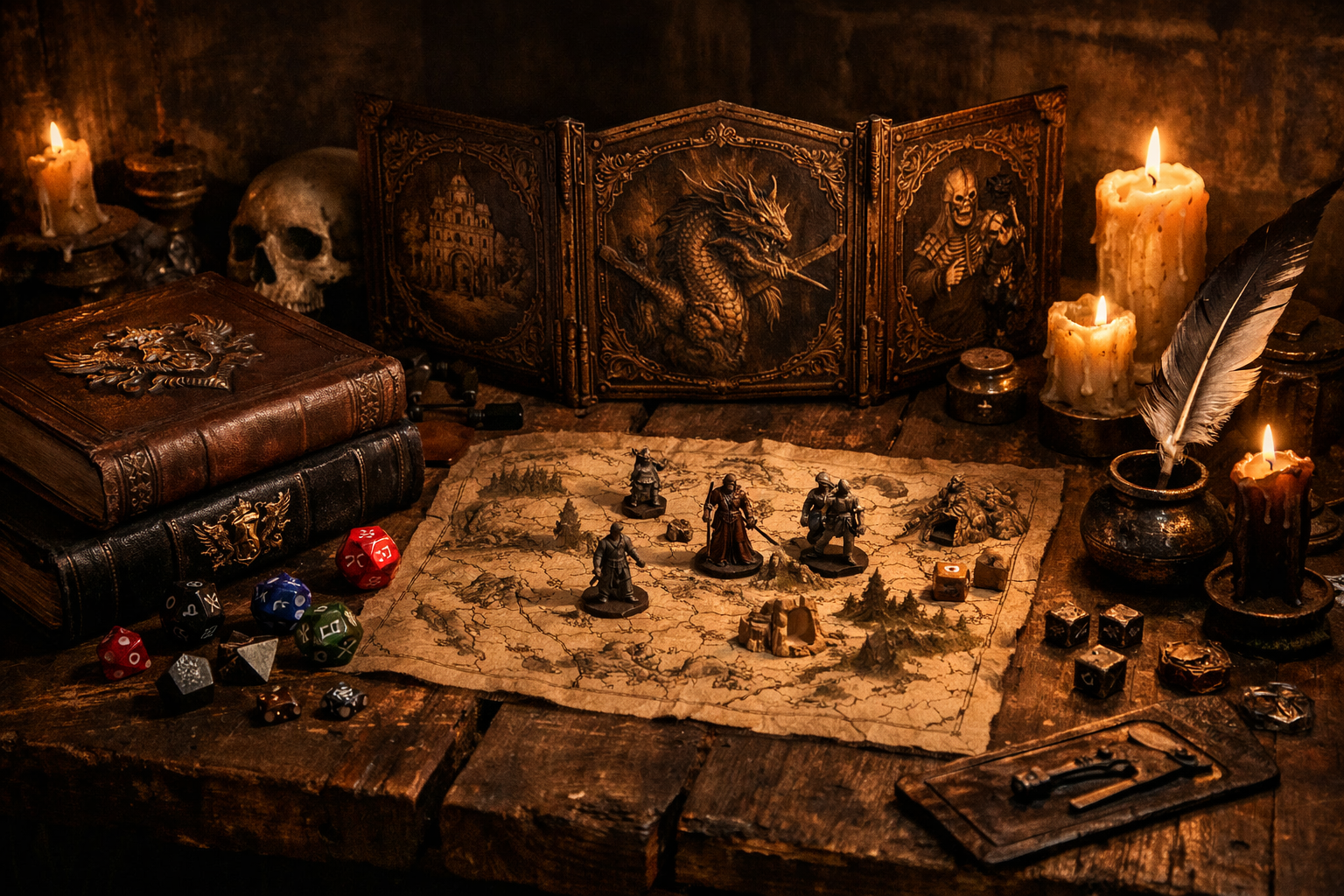
From dice and screens to digital helpers and reference cards, these are the tools that make running sessions smoother and more enjoyable for everyone.
Every Dungeon Master develops a toolkit over time.
Some DMs enjoy elaborate battlemaps, painted miniatures, custom screens, sound systems, and detailed campaign-management software. Others run long campaigns with a few notes, access to the rules, and a way to roll dice.
Neither approach is inherently better.
The useful question is not, "What tools should every Dungeon Master own?"
It is:
What problem does this tool solve at my table?
A good Dungeon Master toolkit reduces cognitive load, makes important information easier to retrieve, and helps the group spend more time playing.
A poor toolkit creates another layer of preparation, maintenance, expense, or distraction without meaningfully improving the game.
This guide separates the tools required to run D&D from optional tools that solve particular problems. Whether you play in person, online, or through a mixture of both, the goal is to build the smallest toolkit that reliably supports the way your group plays.
What You Actually Need
The minimum requirements for running D&D are simpler than most equipment lists suggest.
You need:
- Access to the rules you are using
- Player character information
- A way to resolve dice rolls
- The adventure, scenario, or situation you intend to run
- A way to track information that changes during play
Everything else depends on the game.
A tactical combat may benefit from an initiative tracker and map.
A theater-of-the-mind mystery may need neither.
A long political campaign may benefit from detailed faction records.
A one-shot may require only a single page of notes.
Start with what allows the game to function.
Add tools when actual play reveals a reason for them.
Rules Access
You need access to the rules you are running.
That does not necessarily mean purchasing every core rulebook before your first session.
The current D&D Free Rules provide a free starting point for revised fifth-edition play. They contain the basic rules for playing the game along with a selection of character options, spells, equipment, monsters, and other material.
For groups that want the complete core rules, the primary books expand that foundation:
- Player's Handbook: Expanded character options, spells, equipment, and player-facing rules
- Dungeon Master's Guide: Guidance for running sessions, adjudicating situations, creating adventures and campaigns, encounter design, magic items, optional systems, and Dungeon Master tools
- Monster Manual: A much larger collection of creatures for encounters and adventure design
These books are valuable resources.
They are not all prerequisites for your first session.
A published starter adventure, the Free Rules, or another self-contained scenario may provide enough information to begin.
Physical or Digital?
Choose the format that makes rules easiest for you to retrieve.
Physical books provide:
- Easy browsing
- Bookmarks and tabs
- No device requirement
- A permanent table reference
Digital rules provide:
- Search
- Links between related rules
- Fast access to spells and creatures
- Less physical material at the table
Many Dungeon Masters use both.
The correct solution is whichever one lets you find information without repeatedly interrupting play.
Build a Quick-Reference System
You do not need to memorize everything.
Instead, identify rules you repeatedly consult.
Possible examples include:
- Conditions
- Concentration
- Cover
- Initiative
- Movement
- Common actions
- Death saving throws
- Resting
- Rules central to the current adventure
Bookmark, tab, or record those references.
Your quick-reference system should evolve based on what you actually forget.
Dice and Randomization
D&D uses polyhedral dice, but physical dice are not mandatory.
A standard physical set includes:
- d4
- d6
- d8
- d10
- d12
- d20
- Percentile dice
For an in-person game, having one or more physical sets is convenient.
Extra dice can help when:
- Several creatures attack at once
- Multiple damage dice are rolled
- A player forgets theirs
- You want to roll several similar effects together
Digital dice rollers work equally well when the group prefers them.
They are especially useful for:
- Online games
- Accessibility
- Automatically adding modifiers
- Large dice pools
- Keeping a shared record of rolls
The choice between physical and digital dice is primarily one of preference and workflow.
Use the method your group understands and trusts.
A Reliable Note-Taking System
Campaign continuity becomes increasingly important as sessions accumulate.
You need some way to record what actually happened.
That may be:
- A notebook
- Index cards
- Markdown files
- A word-processing document
- A spreadsheet
- A note-taking application
- A campaign-management platform
- A tool built into your virtual tabletop
The best system is the one you will consistently maintain.
A sophisticated wiki provides little value if you never update it.
A simple notebook can support an entire campaign if you can reliably find the information you need.
Useful Note Categories
Consider tracking:
Session Summaries
Record:
- Major events
- Important decisions
- New objectives
- Unresolved problems
- Intended next actions
NPCs
Record:
- Name
- Role
- Motivation
- Relationship with the party
- Important information
- Last known location
Locations
Track:
- Important features
- Discoveries
- Changes caused by player actions
- Faction control
- Remaining threats
Character Information
You may want quick access to:
- Character goals
- Important relationships
- Background hooks
- Significant items
- Ongoing personal objectives
Players should normally maintain their own character sheets and resources, but these notes can help you prepare material that connects to the characters.
Improvised Information
Record things you invent during play.
If the players meet a wine merchant named Marguerite during the autumn festival and promise to investigate her missing supply barrels, that information may matter several sessions later.
Once you establish something at the table, it becomes part of the campaign.
Write it down.
A Way to Track the Current Scene
Not every session requires the same tracking tools.
During combat you may need to track:
- Initiative
- Hit Points
- Conditions
- Concentration
- Creature positions
- Environmental effects
- Round-based events
During an investigation you may instead need:
- Clues discovered
- Suspects
- Time progression
- Faction reactions
During travel you might track:
- Distance
- Resources
- Weather
- Time
- Encounters
Use the tracker appropriate to the activity rather than trying to build one universal dashboard for everything.
Initiative Trackers
An initiative tracker is useful when combat order becomes difficult to remember.
Options include:
- Paper lists
- Index cards
- Magnetic trackers
- Dry-erase boards
- Virtual tabletop initiative systems
- Campaign applications
A visible initiative order can help players know when their turn is approaching.
That may encourage them to prepare decisions before their turn begins.
However, the tracker does not need to be elaborate.
If writing the initiative order on a sheet of paper works reliably for your group, you already have a functioning system.
Upgrade only when you encounter a problem the current method does not solve.
The Dungeon Master Screen
A Dungeon Master screen is useful, but optional.
It can provide:
- Privacy for notes
- Space for reference tables
- Protection for unrevealed maps
- A place to organize reminders
- Separation between public and hidden information
Many commercial screens contain commonly used reference material.
A custom screen can instead contain information specific to your campaign.
Possible references include:
- Conditions
- Important Difficulty Classes
- Current faction information
- Character reminders
- House rules
- Common environmental rules
Not every Dungeon Master prefers a screen.
Some like an open workspace.
Others use a laptop or tablet instead.
Some roll all dice in public.
Others keep certain rolls private when the result itself may reveal information.
The screen is a tool, not a requirement or statement about how authoritative the DM should be.
Use one when it makes the table easier to manage.
Battle Maps and Positioning Tools
Maps become most useful when spatial information affects player decisions.
This is common during tactical combat, but maps can also help with:
- Exploration
- Investigations
- Dungeons
- Political geography
- Travel
- Chase routes
- Complex buildings
You do not need a detailed battle map for every scene.
Reusable Battlemats
Reusable grids provide a fast way to sketch tactical areas.
Before purchasing one, check which markers are safe for that particular surface.
Some mats are designed for wet-erase markers, others support different marker types, and using the wrong marker can permanently stain the surface.
A basic map only needs to communicate information that matters.
For example:
- Walls
- Doors
- Obstacles
- Cover
- Elevation
- Hazards
- Creature positions
- Important objects
Artistic quality is optional.
Clarity is not.
Miniatures, Tokens, and Markers
Miniatures help represent position but are not mechanically necessary.
Alternatives include:
- Coins
- Numbered tokens
- Wooden pieces
- Dice
- Paper standees
- Flat markers
- Digital tokens
The important information is usually:
- Who is where?
- How far apart are they?
- What terrain matters?
- Which creature is which?
Detailed painted miniatures can be an enjoyable hobby and create impressive visual moments.
Do not mistake them for a requirement.
A numbered token can communicate the same mechanical information.
Theater of the Mind
Some groups prefer to resolve combat through verbal description instead of precise maps.
This works especially well when:
- There are few combatants
- Terrain is simple
- Exact positioning is not central to the encounter
- The group prefers faster abstraction
When using theater of the mind, establish spatial information clearly.
Players should still understand:
- Relative distances
- Nearby threats
- Available cover
- Major hazards
- Important exits
Maps and theater of the mind are not competing philosophies.
Use whichever method makes a particular encounter easier to understand.
Reference and Improvisation Tools
Some of the most useful Dungeon Master tools exist primarily to reduce improvisational pressure.
Random Tables and Generators
Random tables can quickly provide:
- Names
- Personality traits
- Weather
- Rumors
- Encounters
- Treasure
- Shop details
- Minor complications
- Environmental details
A short list prepared specifically for your setting can be more useful than a large generic generator.
For example, if the party spends significant time in a port city, prepare names that fit that region and several recurring dockside complications.
Random generation is best treated as inspiration.
Review the result before making it part of the world.
Ask:
- Does this fit the setting?
- Does it contradict anything?
- Does it create something useful?
- Is it interesting enough to remember?
You do not have to accept every generated result.
Campaign Calendars and Timelines
Time matters more in some campaigns than others.
A campaign calendar may help track:
- Travel
- Holidays
- Deadlines
- Political events
- Faction plans
- Character downtime
- Weather
- Long-term projects
Suppose the characters met Marguerite during an autumn festival.
If they return several weeks later, a timeline helps you determine:
- Whether the festival has ended
- What happened to her missing barrels
- Whether she acted without the party
- Which other events progressed
You do not need to record every hour.
Track time at the level of detail that affects decisions.
Condition and Status Markers
Conditions can be easy to forget during complex encounters.
Physical or digital reminders may help track:
- Poisoned
- Frightened
- Restrained
- Stunned
- Invisible
- Concentration
- Other temporary effects
Possible tools include:
- Cards
- Rings placed around miniatures
- Tokens
- Whiteboard notes
- Virtual tabletop markers
- Digital condition trackers
Use them when forgotten effects are creating rules mistakes.
Digital Tools
Digital tools can combine several Dungeon Master functions.
Depending on the platform, they may handle:
- Character sheets
- Rules references
- Maps
- Dice
- Initiative
- Notes
- Handouts
- Chat
- Campaign history
The question is whether that consolidation actually saves you work.
Virtual Tabletops
Virtual tabletops can be useful for remote groups and for in-person groups that want digital maps or automation.
They may provide:
- Shared maps
- Tokens
- Measurement
- Initiative
- Dice rolling
- Character sheets
- Fog of war
- Lighting
- Handouts
- Journals
A VTT is not required for online play.
A remote group can also use:
- Voice or video chat
- Shared documents
- Theater of the mind
- Simple image sharing
- Digital dice
Use a VTT when its features solve problems your group actually has.
Do not spend hours configuring automation that saves only seconds during play unless you enjoy that process.
Digital Rules Search
Searchable rules can substantially reduce lookup time.
Useful capabilities include:
- Spell search
- Creature search
- Rules glossary
- Condition reference
- Item lookup
Keep official or otherwise authorized rules sources accessible.
Avoid opening so many different tools that finding the correct browser tab becomes its own problem.
A small number of well-organized references is usually easier to manage than a screen full of applications.
Campaign Management Platforms
Dedicated campaign-management systems can help long-running games organize:
- NPCs
- Locations
- Quests
- Factions
- Timelines
- Maps
- Secrets
- Session logs
- Player handouts
These become particularly useful when the volume of campaign information exceeds what your current notes can comfortably handle.
They also have costs.
You may need to:
- Learn the platform
- Enter existing information
- Maintain it
- Keep duplicate records
- Pay for advanced features
Do not migrate a functioning campaign simply because another tool has more features.
Switch when the benefits justify the effort.
Music and Ambient Sound
Music is an enhancement, not an essential Dungeon Master tool.
Some groups find it immersive.
Others find it distracting.
Possible uses include:
- Exploration ambience
- Taverns
- Wilderness
- Tense investigations
- Combat
- Horror
- Emotional scenes
Keep background audio below conversation level.
Avoid spending the session searching for tracks.
If you use music regularly, organize it before play into broad mood categories rather than trying to assign a unique song to every scene.
Ask your players whether audio improves the experience.
Accessibility and sensory preferences matter.
The Dungeon Trainer
The Dungeon Trainer can combine several conventional Dungeon Master tools while allowing the human DM to decide how much automation or AI involvement they want.
Human-DM Mode
A human Dungeon Master can run the campaign while the platform maintains shared mechanical state in code.
This can include:
- Character sheets
- Dice
- Initiative
- Damage and healing
- Conditions
- Rests
- Death saves
- XP
- Combat rounds
- Campaign continuity
AI is optional.
A human-DM turn does not require a model call, so a group can use the platform as a digital tabletop without inviting AI into the campaign.
Optional AI Roles
A group can selectively use AI when it solves a particular problem.
Optional roles can support specific characters or functions without handing the entire campaign to an AI Dungeon Master.
If the group does not enable those roles, AI stays out of the human-run campaign.
Autonomous AI Dungeon Master
The platform also supports separate solo or multiplayer campaigns run by an autonomous AI Dungeon Master.
This creates another play option for people who want to play without waiting for someone to prepare and run the session.
It is distinct from human-DM mode rather than replacing it.
Scry
Scry is a preparation tool that forecasts plausible ways an upcoming scene could develop.
It can highlight:
- Likely branches
- Potential complications
- Pacing risks
- Single points of failure
- Preparation considerations
The purpose is not to predict what players must do.
It helps a human Dungeon Master prepare for several possible directions.
The Coach
The Coach provides practice scenarios for Dungeon Masters and players.
You make a decision and receive feedback about the tradeoffs involved.
This can help practice:
- Adjudication
- Pacing
- Player-agency decisions
- Encounter management
- Table situations
Campaign Memory and Codex
The Dungeon Trainer maintains campaign continuity and creates searchable records of people, places, quests, and events encountered during play.
Dungeon Master secrets remain hidden from players until revealed.
This can reduce the need to maintain the same information in several separate systems.
Generators
The platform can generate:
- Monsters
- NPCs
- Items
- Spells
- Locations
Generated content should still be reviewed before use.
A generator provides material.
The Dungeon Master decides whether it belongs in the campaign.
Organizing Your Session Materials
Even excellent tools become frustrating when you cannot find what you need.
Before a session, create a compact set of current-session information.
This might be a physical folder, a digital document, a campaign dashboard, or a small collection of tabs.
Include only what is likely to matter.
Possible contents include:
- Session outline
- Current objectives
- Important NPCs
- Relevant maps
- Creature statistics
- Clues
- Handouts
- Rules references
- Player-character reminders
Keep archival campaign material somewhere else.
You should not need to search through months of notes to find tonight's encounter.
Physical Storage
If you use physical materials, give them consistent storage.
Useful options include:
- Game bags
- Craft organizers
- Small parts containers
- Card boxes
- Miniature cases
- Binders
If you regularly run games away from home, maintain a small portable kit.
It might contain:
- Dice
- Writing materials
- Current session notes
- Rules access
- Tokens
- Appropriate map markers
- Any physical references you regularly use
Build the bag around your actual game.
Do not turn portability into another excuse to buy equipment.
What You Can Skip
A surprising amount of Dungeon Master equipment is optional.
Elaborate Props
Letters, physical puzzles, maps printed on specialty paper, coins, costumes, and other props can create memorable moments.
They can also consume substantial preparation time.
Use them when:
- You enjoy making them
- They communicate something important
- They create a specific experience you want
Do not feel obligated to create props for routine sessions.
Expensive Miniatures and Terrain
Miniatures and terrain can be beautiful.
They are also an independent hobby.
If you enjoy collecting, painting, printing, or building terrain, the hobby can enhance your sessions.
If you do not enjoy it, use tokens.
The mechanical requirement is communication, not decoration.
Complex Campaign Databases
Do not create a database simply because your campaign might eventually become complicated.
Start with simple notes.
When you repeatedly struggle to retrieve information, then consider a more structured system.
Complexity should be a response to actual organizational pressure.
Too Many Apps
Every application introduces:
- Another interface
- Another login
- Another place to store information
- Another potential interruption
A dedicated spell app, initiative app, campaign database, map tool, music application, rules database, and notebook may each be useful individually.
Together, they may create more fragmentation than they solve.
Consolidate when practical.
Building Your Personal Toolkit
Do not build your toolkit from someone else's inventory.
Build it from your own friction.
After a few sessions, ask:
- What repeatedly slows me down?
- What information do I keep losing?
- Which rules do I repeatedly search for?
- What am I tracking manually that could be simpler?
- Which tool am I maintaining but never using?
Then make targeted changes.
If Combat Order Is Confusing
Try:
- Initiative cards
- A visible list
- A digital tracker
If NPC Details Are Disappearing
Improve:
- NPC notes
- Search
- Session recaps
- Campaign memory
If Improvisation Is Stressful
Prepare:
- Name lists
- NPC motivations
- Random tables
- Reusable locations
- Generic complications
If Tactical Positioning Is Unclear
Try:
- A rough map
- Tokens
- A reusable battlemat
- A VTT
If Rules Lookup Is Slow
Improve:
- Bookmarks
- Tabs
- Digital search
- A one-page reference sheet
If Campaign Continuity Is Becoming Difficult
Consider:
- Structured campaign notes
- A timeline
- Faction records
- A campaign-management system
- Searchable campaign memory
A tool has earned a place in your toolkit when you can identify the problem it solves.
Try Before You Invest
Whenever practical, test a workflow before committing money or significant time.
You might:
- Use paper tokens before buying miniatures
- Sketch maps before purchasing terrain
- Test a free digital tool before subscribing
- Use a simple document before building a campaign wiki
- Borrow a battlemat
- Try theater of the mind before assuming maps are required
This helps distinguish an actual need from an imagined one.
The Toolkit Mindset
The best Dungeon Master tools become almost invisible during play.
They provide information when needed and stay out of the way when they are not.
A useful tool:
- Solves a recurring problem
- Fits your workflow
- Reduces cognitive load
- Makes information easier to retrieve
- Does not require excessive maintenance
- Supports the experience your table wants
A poor tool:
- Solves a problem you do not have
- Creates substantial maintenance
- Fragments your information
- Distracts you during play
- Requires you to abandon a functioning process without a clear benefit
- Exists mainly because other Dungeon Masters use it
Your toolkit serves the game.
The game does not exist to justify the toolkit.
Start small.
Run sessions.
Notice friction.
Add targeted solutions.
Remove tools that no longer provide value.
Great Dungeon Mastering still comes from understanding the situation, communicating clearly, listening to players, applying the rules fairly, and responding to unexpected decisions.
Tools cannot replace those skills.
They can give you more attention to spend on them.
Sources and Further Reading
- Ammann, K. (2019). The Monsters Know What They're Doing: Combat Tactics for Dungeon Masters. Saga Press.
- Shea, M. E. (2018). Return of the Lazy Dungeon Master. Sly Flourish.
- Wizards of the Coast. (2024). Dungeon Master's Guide.
- Wizards of the Coast. (2024). D&D Free Rules. D&D Beyond.
- Wizards of the Coast. (2025). System Reference Document 5.2.1.
- The Dungeon Trainer. (2026). The Dungeon Trainer.
---
Ready to build a toolkit around the way you actually run games? The Dungeon Trainer supports human Dungeon Masters with code-resolved table mechanics, campaign continuity, Scry preparation, coaching, generators, multiplayer tools, and optional AI. Use the support that solves problems for your table and leave the rest out.
This work includes material from the System Reference Document 5.2.1 (“SRD 5.2.1”) by Wizards of the Coast LLC, available at https://www.dndbeyond.com/srd. The SRD 5.2.1 is licensed under the Creative Commons Attribution 4.0 International License, available at https://creativecommons.org/licenses/by/4.0/legalcode.
Related reading
- When Session Zero Prevents a Campaign Collapse: Lessons from a Failed Table
Not every campaign makes it to the end. See how one table's collapse revealed exactly why session zero matters, and what you can learn from their mistakes.
- Session Zero vs First Session: When to Cover What
Understanding the difference between session zero and your first session helps you allocate time wisely and start your campaign with momentum instead of confusion.
- Session Zero Checklist: Essential Tools and Resources for Game Masters
A comprehensive toolkit for running productive session zero meetings, from character creation worksheets to safety tools and scheduling templates.