Building Encounters That Challenge Without Frustrating Players
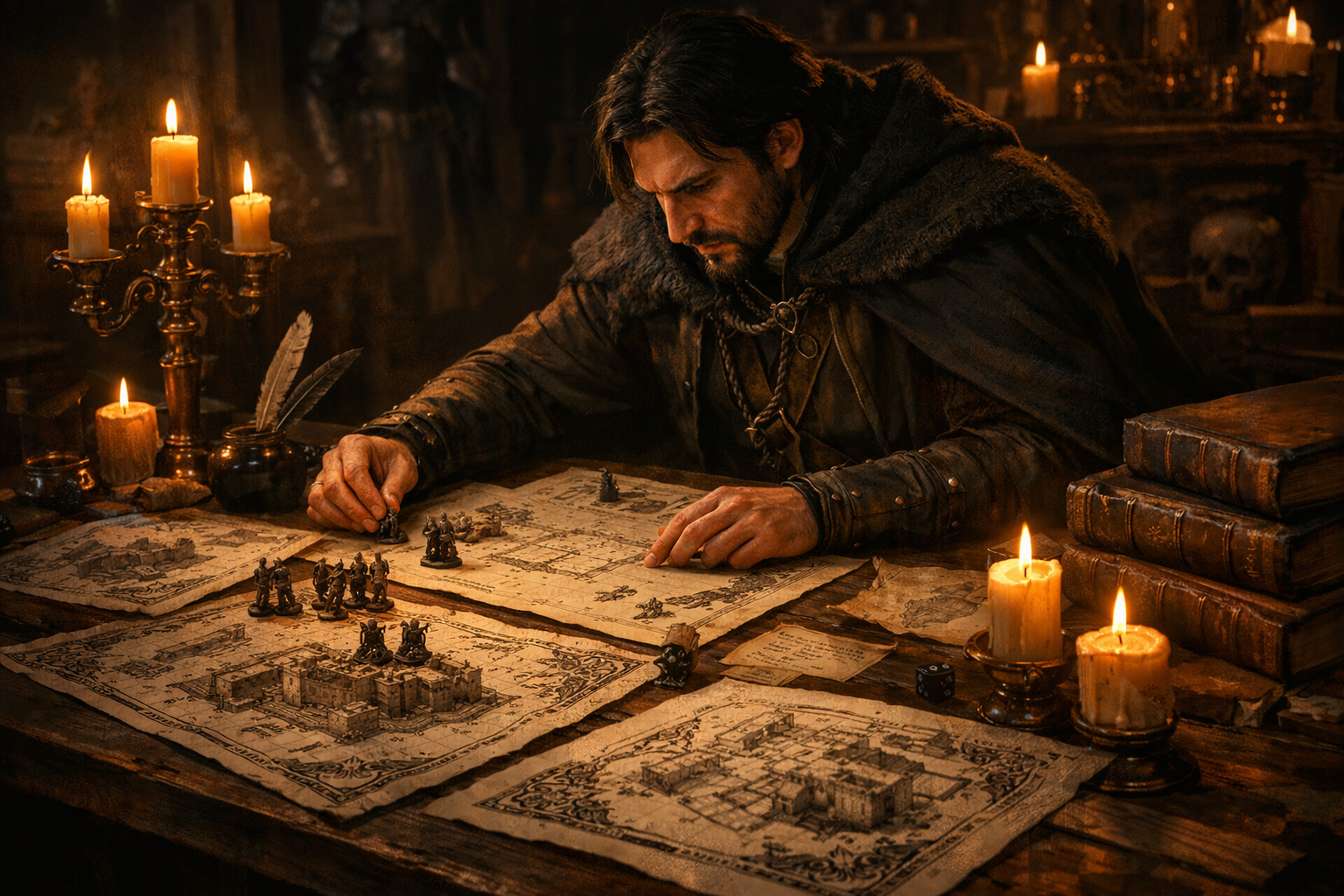
Great encounters balance challenge and fun without overwhelming your table. Learn the design principles behind memorable combat, puzzle, and social encounters that keep players engaged.
Every Dungeon Master eventually faces the same practical problem: creating encounters that test player judgment, creativity, and character capabilities without making the table feel powerless or confused.
A memorable encounter does not need to be perfectly balanced.
It needs to give players enough information to make decisions, meaningful ways to influence the situation, and consequences that follow from what they choose.
This applies to combat, exploration, puzzles, investigations, and social encounters.
The difference between productive challenge and frustration often comes down to whether players can understand the situation, attempt reasonable solutions, and see how their decisions affect what happens next.
This guide examines the principles that help encounters remain demanding without becoming arbitrary or overwhelming.
What Makes an Encounter Challenging Instead of Frustrating?
Challenge and frustration are not exact opposites.
A difficult encounter can still be enjoyable when players understand the danger and believe their decisions matter.
An easier encounter can become frustrating when the rules, objectives, or available options feel arbitrary.
Several factors contribute to productive challenge:
- Clear enough information to make decisions
- Meaningful choices
- Understandable stakes
- Consequences connected to player actions
- Opportunities to use character abilities
- Consistent adjudication
- A reasonable relationship between risk and available information
Frustration becomes more likely when:
- Important information was impossible to discover
- One hidden solution is required
- Reasonable approaches are repeatedly rejected
- Player preparation is invalidated without cause
- Encounter difficulty changes solely because players are succeeding
- Rules or environmental facts change unexpectedly
- Failure produces a dead end rather than a changed situation
Consider a scenario in which four adventurers need to recover an artifact from a fortified compound.
A decision-rich version might establish:
- Visible patrols
- Guard rotations
- Several entrances
- Nearby buildings
- A drainage channel
- Merchants who regularly enter the compound
- Information suggesting where the artifact is stored
The players might scout, disguise themselves, climb the walls, create a distraction, negotiate, bribe someone, or attack directly.
Not every approach must work equally well.
The important point is that the situation provides information and allows the players to make decisions.
A frustrating version might instead trigger an invisible magical defense that requires a password the players had no reasonable way to discover.
The problem is not that hidden magical wards exist.
The problem is that the players were given no meaningful opportunity to anticipate, investigate, or respond to them.
Three Useful Principles of Encounter Design
For this guide, three principles provide a practical foundation:
- Clarity of situation
- Meaningful approaches
- Consequences
These are not the only elements that matter. Difficulty, pacing, character resources, terrain, information, and player preferences also influence how an encounter performs.
These three principles provide a useful starting point because they apply across several encounter types.
Clarity of Situation
Players need enough information to make informed decisions.
They do not need complete information.
Mysteries, hidden enemies, secret doors, illusions, traps, and uncertain motives all depend on incomplete knowledge.
The distinction is between uncertainty and confusion.
Uncertainty means the players understand the situation but do not know everything about it.
Confusion means they do not understand basic facts their characters should reasonably perceive.
Combat Clarity
During combat, players should normally understand obvious information such as:
- Visible enemies
- Terrain
- Major obstacles
- Cover
- Elevation
- Obvious hazards
- Important exits
- Approximate distances
- Visible objectives
Players do not automatically know:
- Hidden creatures
- Secret abilities
- Enemy Hit Points
- Unrevealed reinforcements
- Exact creature statistics
- Invisible hazards they have not detected
Describe enough for players to form plans.
Puzzle Clarity
A puzzle should establish what the characters can interact with.
If a chamber contains four crystal pillars, describe four pillars.
If symbols appear on the floor, describe them.
If the mechanism makes a sound when manipulated, communicate that response.
Do not expect players to identify a hidden rule when they do not understand the available components.
Mystery can come from interpreting those components rather than searching blindly for something the DM has not described.
Social Clarity
In a social encounter, establish:
- Who the NPC is
- What the immediate situation is
- What the characters want
- What obvious pressures or stakes exist
Players do not need to know the NPC's complete motivation immediately.
They may need to discover it through conversation, observation, previous information, or investigation.
For example, characters negotiating with a guild leader might know that they need permission to cross guild-controlled territory.
They may not initially know that the leader is primarily concerned about protecting a lucrative trade agreement.
Discovering that motivation can become part of the encounter.
Meaningful Approaches
Meaningful player agency does not require every encounter to have five predetermined solutions.
Instead, design situations that can respond to reasonable approaches.
A warehouse occupied by smugglers might allow the party to:
- Attack directly
- Enter secretly
- Observe the building first
- Question neighboring workers
- Impersonate buyers
- Wait for the smugglers to leave
- Create a distraction
- Negotiate
The Dungeon Master does not need to write a complete solution tree for every possibility.
Prepare the situation:
- Who is inside?
- What do they want?
- What security exists?
- What do they know?
- What happens if they detect intruders?
- What happens if nobody intervenes?
Then adjudicate the players' plans.
Not Every Approach Should Work
Player agency does not mean every idea succeeds.
A frightened shopkeeper might respond to intimidation.
A proud military commander may become more hostile.
A corrupt official may accept money.
An idealistic priest may consider the bribe insulting.
Different approaches should interact with NPC motivations and circumstances.
Likewise, a wooden door may be broken down.
A reinforced vault door may not be.
Consistency gives choices meaning.
Meaningful Consequences
Choices become more important when the world remembers them.
Suppose the characters infiltrate a fortress without alerting the guards.
That might allow them to reach their objective quietly.
It might also mean they never learn information that captured soldiers could have provided.
If they instead attack the gate:
- The alarm may spread.
- Reinforcements may mobilize.
- Prisoners may be relocated.
- Nearby factions may hear about the attack.
- The party may gain information from surrendered guards.
Neither approach needs to be designated the "correct" choice.
They produce different consequences.
Consequences should not exist merely to punish players.
They should emerge from the situation.
Burning a warehouse may destroy evidence.
It may also eliminate the enemy's supplies.
Threatening a guild leader may secure immediate cooperation while damaging the relationship.
Helping that leader may create an ally but cost the characters time.
Trade-offs create meaningful decisions.
Calibrating Combat Difficulty
Combat encounters require additional consideration because D&D provides mathematical guidance for estimating their threat.
Under the 2024 rules, combat encounters use three broad difficulty categories:
- Low
- Moderate
- High
The Dungeon Master determines an XP budget based on the characters' levels, party size, and desired difficulty, then selects creatures whose combined XP fits within that budget.
These calculations are useful.
They are not predictions of exactly what will happen.
Actual combat difficulty can change because of:
- Party composition
- Current Hit Points
- Spell slots
- Limited-use features
- Magic items
- Monster abilities
- Terrain
- Starting positions
- Surprise
- Objectives
- Player tactics
- Number of creatures
- Previous encounters
Use encounter calculations as a baseline.
Use actual play to understand your specific group.
Action Economy Without Oversimplifying It
The number of creatures participating in combat matters because more combatants generally create more opportunities to act, move, interfere, and threaten different characters.
That does not mean every solo monster automatically loses against a party.
Creature design matters.
A single monster may have:
- Multiple attacks
- Reactions
- Mobility
- Area effects
- Defensive abilities
- Legendary or other off-turn mechanics when provided by its stat block
- Environmental advantages
- Lair or scenario-specific support
Likewise, adding many weaker monsters can make an encounter substantially more complicated and dangerous.
When preparing a solo confrontation, consider whether the creature's actual abilities allow it to remain relevant against the whole party.
Do not automatically invent additional actions because an enemy happens to be alone.
Use the creature's rules, an appropriate creature choice, supporting enemies, or environmental elements when the encounter calls for them.
Do Not Design Around Fixed Combat Lengths
There is no universal number of rounds that makes a combat encounter good.
A two-round ambush can be memorable.
A longer climactic confrontation can remain engaging if the situation continues to change and players continue making decisions.
Combat becomes tedious when the outcome is effectively decided but the table must continue repeating the same actions to finish resolving it.
Instead of targeting a particular round count, ask:
- Are meaningful decisions still occurring?
- Is the battlefield changing?
- Are objectives still uncertain?
- Are players still engaged?
- Have the enemies' motivations changed?
When appropriate, enemies may retreat, surrender, negotiate, or attempt another objective rather than fighting until the last Hit Point disappears.
Resource Pressure
A party's remaining resources affect combat difficulty.
Characters entering a Moderate encounter with most of their features available are in a different position from characters entering the same fight after exhausting healing, spell slots, and limited-use abilities.
Resource management can create meaningful decisions:
- Do we continue?
- Do we use this ability now?
- Is the objective worth additional risk?
- Do we retreat?
- Do we spend healing resources?
- Can we afford the time required to rest?
Do not assume every adventure needs a specific number of encounters before rest.
The appropriate amount depends on the scenario, system procedures, and campaign style.
Rest and Risk
Players should understand information their characters could reasonably know about resting.
They might know:
- The area is actively patrolled.
- Enemies are searching for them.
- The ritual continues while they wait.
- The current chamber can be barricaded.
- The wilderness appears relatively quiet.
They do not need perfect certainty.
Rest itself can involve risk.
The important point is that consequences should follow the fiction rather than exist solely because the DM wants to prevent recovery.
Terrain and Environment
Terrain turns positioning into a decision.
Useful battlefield features include:
- Cover
- Elevation
- Difficult terrain
- Narrow passages
- Doors
- Bridges
- Platforms
- Water
- Fire
- Machinery
- Movable objects
- Choke points
- Multiple routes
Environmental features should create opportunities and problems for both sides when appropriate.
A battle on a narrow bridge differs from a fight in an open courtyard because movement and positioning change.
Players might:
- Hold a choke point
- Cut a support
- Retreat across the bridge
- Knock an enemy over the edge
- Seek another crossing
Do not introduce useful environmental features only after a player asks whether something convenient happens to exist.
Describe important features when the characters can perceive them.
Environmental Hazards
Hazards can create pressure without adding more enemies.
Examples include:
- Rising water
- Spreading fire
- Collapsing structures
- Unstable platforms
- Magical surges
- Moving machinery
- Poisonous fumes
Whenever possible, make progression understandable.
For example:
Water rises several inches at the end of each round.
or:
Another section of the burning roof collapses every round.
The players can now plan around the danger.
Avoid arbitrary timers disconnected from the fictional situation.
Designing Puzzles That Do Not Stall the Game
Puzzle encounters can be rewarding, but they create a unique risk.
The player characters may be capable heroes even when the people playing them do not immediately recognize the DM's intended solution.
Do not assume something is obvious simply because you designed it.
Use Redundant Clues for Critical Conclusions
Justin Alexander's Three Clue Rule provides a useful principle for investigations:
For conclusions the characters need to reach, provide multiple independent clues.
The purpose is redundancy.
Players may:
- Miss a clue
- Misinterpret one
- Ignore one
- Forget one
If the adventure depends on discovering that the guild meets at the Copper Anchor, do not make one hidden note the only possible source.
They might learn it from:
- A captured guard
- A market notice
- A guild insignia found at the tavern
- An NPC who saw members meeting there
The Three Clue Rule does not mean every mechanical puzzle requires three hints pointing directly to its exact answer.
Use redundancy where missing information would otherwise stop the scenario.
Give Characters Opportunities to Help
Character abilities can provide information when appropriate.
An Intelligence (Investigation) check might reveal that a mechanical component is connected to another part of the room.
Arcana might reveal how magical symbols relate.
History or Religion might provide context.
The result should follow the character's capabilities and the situation.
Do not turn skill checks into an automatic "solve puzzle" button.
They can reveal information that gives the players something new to work with.
Do Not Add Time Pressure to Every Puzzle
A timer can improve a puzzle when the fiction supports it.
Examples include:
- Guards approaching
- A chamber filling with water
- A ritual nearing completion
- A bridge collapsing
- Poison spreading
But a puzzle does not automatically need a countdown.
Sometimes the challenge is simply understanding the mechanism.
Use time pressure when it creates meaningful decisions rather than because the scene feels too quiet.
Prepare Failure States
Ask what happens when a puzzle is not solved.
Possible outcomes include:
- Another route must be found.
- An alarm triggers.
- Additional time passes.
- A resource is spent.
- The party gets incomplete access.
- The villain gains time.
- The characters force their way through at a cost.
Not every puzzle requires guaranteed progress.
But critical campaign progress should rarely depend on one answer the players either guess or do not.
Designing Social Encounters
Social encounters are driven by goals, attitudes, leverage, information, and consequences.
Before an important conversation, ask:
- What does the NPC want?
- What is the NPC's current attitude?
- What does the NPC fear?
- What does the NPC know?
- What is the NPC willing to offer?
- What will the NPC refuse?
- What could change that position?
The players then decide what approach to take.
NPC Motivations and Boundaries
Suppose a fortress captain wants to protect an artifact and remain loyal to her ruler.
She may still have competing concerns.
She might:
- Want to avoid unnecessary casualties
- Distrust another officer
- Believe the artifact is dangerous
- Respect honorable opponents
- Need information the party possesses
Those motivations create possibilities.
They do not mean every social approach works.
Intimidation may harden her position.
Persuasion based on protecting her soldiers may resonate.
Evidence that her commander is compromised may change the entire encounter.
Social Checks Resolve Uncertainty
Do not reduce an entire negotiation to one automatic Charisma roll.
First establish:
- What the characters are asking
- How they approach the request
- What the NPC wants
- Whether the outcome is uncertain
Then use the appropriate rules when necessary.
A failed Influence or other Charisma-based check can have different consequences depending on the situation.
It might:
- Fail to change the NPC's attitude
- Increase suspicion
- Close one approach
- Cost the party leverage
- Require another offer
- End the conversation entirely
Failure does not always mean the NPC simply asks for another argument.
The result should follow the situation.
Information Asymmetry
Social encounters become interesting when neither side knows everything.
The players may not know:
- What the NPC truly wants
- Who the NPC serves
- Whether the NPC is lying
- What pressure the NPC is under
The NPC may not know:
- The party's true objective
- What evidence they possess
- Their capabilities
- Which allies they have
This creates opportunities for:
- Bargaining
- Bluffing
- Revealing information strategically
- Testing loyalties
- Negotiation
Reading Your Table Without Mind Reading
Dungeon Masters should pay attention to how encounters are landing.
But body language alone is unreliable.
A quiet player may be:
- Concentrating
- Tired
- Thinking
- Enjoying watching others
- Frustrated
- Distracted
A player checking a device may be looking at a character sheet or accessibility tool rather than disengaging.
Observe patterns, but ask when uncertain.
Useful questions include:
- "Is the situation clear?"
- "Do you feel like you have enough information?"
- "Do you want another clue, or are you still working through it?"
- "Is this combat still interesting?"
- "Does everyone understand the immediate objective?"
Direct communication is often more reliable than guessing.
Recognizing Frustration
Potential warning signs include:
- Repeated statements that no available option seems to work
- Players no longer understanding the objective
- Random guessing replacing deliberate decisions
- Repeated arguments about what the characters can perceive
- One participant clearly expressing frustration
Do not treat every difficult moment as an emergency.
Challenge can involve temporary uncertainty.
When frustration appears to result from unclear communication, clarify.
When it results from intentionally difficult circumstances, make sure the players still understand their options.
When someone directly says the experience is no longer enjoyable, address it rather than assuming the encounter must continue unchanged.
Adjusting During an Encounter
Responsive Dungeon Mastering is valuable.
Secretly forcing every encounter toward a predetermined difficulty is not.
If the Players Are Winning Easily
Let good decisions matter.
Do not automatically:
- Add reinforcements
- Increase Hit Points
- Invent a second phase
- Give enemies new abilities
If reinforcements were already nearby and an alarm was raised, they may arrive.
If the enemy has a retreat plan, it may use it.
If the players constructed an excellent strategy and ended the encounter quickly, they earned that outcome.
Use what you learned when preparing future encounters.
If Combat Is Harder Than Expected
First determine why.
Perhaps:
- The party misunderstood an obvious environmental feature.
- You misread a monster ability.
- The characters entered with fewer resources than anticipated.
- Dice results have been unusually severe.
- The encounter simply turned out dangerous.
Do not automatically weaken enemies secretly.
Use established motivations.
Enemies might:
- Retreat
- Accept surrender
- Pursue an objective other than killing everyone
- Take prisoners
- Break morale
- Change tactics
These options should make sense for the creatures involved.
If a Puzzle Stalls
Check whether the problem is lack of information.
If the characters should notice something, clarify it.
Allow additional investigation.
Reveal information through appropriate character abilities.
Do not make a completely unrelated clue materialize solely because the intended solution was not found.
Preserve Earned Success
Players should be able to outperform your expectations.
The encounter is not obligated to last as long as you planned.
Responsive design means responding to the game.
It does not mean secretly controlling the difficulty curve until every scene produces the result you wanted.
Balancing Lethality and Heroism
Different campaigns have different expectations around danger.
Some groups enjoy high lethality, careful resource management, and retreat.
Others prefer heroic adventures where characters usually survive but face serious narrative consequences.
Neither style is inherently correct.
Problems arise when the table expects one style and receives another.
Establish Expectations
Discuss:
- Character death
- Encounter lethality
- Resurrection
- Retreat
- Capture
- Permanent consequences
- Campaign tone
If the campaign contains enemies the party may be unable to defeat directly, communicate danger through the fiction.
Examples include:
- Evidence of previous victims
- NPC warnings
- Destructive abilities witnessed from a distance
- Overwhelming numbers
- Environmental devastation
Players do not need an exact numerical difficulty rating.
They should have enough information to make decisions when their characters would recognize extreme danger.
Retreat and Other Escape Valves
Retreat is an important tactical option when the situation permits it.
That does not mean every encounter must guarantee a safe escape route.
Some battles occur in:
- Sealed chambers
- Collapsing structures
- Enemy strongholds
- Ambushes
- Situations where previous choices removed an exit
When appropriate, consider possibilities such as:
- Retreat
- Surrender
- Negotiation
- Distraction
- Barricading
- Hiding
- Breaking pursuit
- Capture
A deadly encounter becomes more interesting when survival can involve decisions beyond defeating every opponent.
Common Calibration Mistakes
Several patterns frequently create avoidable frustration.
Assuming Player Knowledge
The Dungeon Master knows the entire scenario.
The players know only what has been communicated or discovered.
Do not assume they know:
- A secret entrance exists
- An enemy has a particular weakness
- An NPC is lying
- A ritual can be interrupted
- A particular object matters
Provide ways to discover important information.
Invalidating Player Preparation
If the party spends significant effort scouting and planning, allow the information they obtained to remain useful unless the situation has a logical reason to change.
Enemies can react when they discover they are being watched.
Patrols can change.
Prisoners can move.
But do not rewrite the situation simply because the players prepared too effectively.
Removing Capabilities Without Warning
Areas that suppress magic, prevent teleportation, damage equipment, or interfere with character abilities can create excellent challenges.
Whenever appropriate, provide clues.
Players might observe:
- Previous spells failing
- Magical symbols
- NPC warnings
- Dead magical creatures
- Environmental changes
Surprise can sometimes be legitimate.
Repeatedly negating important character abilities without meaningful warning or interaction is more likely to feel arbitrary.
Rejecting Reasonable Ideas Because They Were Not Prepared
"You can't do that because I didn't plan for it" is rarely a useful adjudication principle.
Instead ask:
- Is it physically possible?
- Do the rules support it?
- What would it require?
- What consequences might follow?
A creative solution does not have to succeed automatically.
It should be evaluated on the same fictional and mechanical basis as other actions.
Requiring One Hidden Solution
A specific puzzle can have a specific solution.
A particular magical lock may require a particular key.
That can work when the players have a fair opportunity to discover the necessary information.
Problems arise when the entire adventure stops because the group failed to guess the one solution in the DM's head.
Provide alternate routes or redundant information for critical progress.
Playtesting and Iteration
Encounter design improves through actual play.
After a session, record:
- Which encounters felt tense
- Which became repetitive
- Which rules caused confusion
- Which objectives players understood
- Which clues were missed
- Which monster abilities performed differently than expected
- Which character abilities mattered
- Where pacing slowed
Look for patterns across several sessions.
Do not overcorrect after one unusual result.
A combat may have been easy because the players rolled exceptionally well.
A puzzle may have been solved instantly because one player happened to recognize the concept.
A supposedly simple battle may become dangerous because of several unlucky saving throws.
Use repeated experience to calibrate your expectations.
If your group consistently handles combat more effectively than the standard encounter guidance predicts, account for that when preparing future encounters.
If puzzles repeatedly stall, examine the clarity and information structure before simply making them easier.
Tools and Resources
Tools can assist with preparation, but they do not replace encounter judgment.
Encounter builders can help calculate XP budgets under the current D&D rules.
Campaign tools can help track:
- Character resources
- Creature statistics
- Initiative
- Environmental conditions
- NPC motivations
- Clues
- Encounter consequences
These are planning aids.
They cannot predict:
- Player tactics
- Unexpected spell combinations
- Social decisions
- Resource expenditure
- Terrain use
- Creativity
- Dice results
Using The Dungeon Trainer
The Dungeon Trainer can support encounter preparation while leaving the final design and adjudication with a human Dungeon Master.
Scry
Scry forecasts plausible branches before a scene begins.
It can help identify:
- Likely approaches
- Possible complications
- Single points of failure
- Pacing risks
- Preparation considerations
The purpose is not to determine what players will do.
It helps the DM prepare for multiple possibilities.
The Coach
The Coach provides practice scenarios in which Dungeon Masters can make decisions and receive rubric-grounded feedback.
This can provide a low-stakes environment for practicing:
- Encounter adjudication
- Pacing
- Player-agency decisions
- Social situations
- Rules judgment
Campaign State
For human-run campaigns, the platform can track shared mechanical information such as:
- Character sheets
- Dice
- Hit Points
- Conditions
- Initiative
- Combat rounds
- Campaign continuity
AI remains optional in a human-DM campaign.
The platform can therefore handle bookkeeping while the Dungeon Master retains narration and adjudication authority.
Generators
Generators can help create:
- Monsters
- NPCs
- Locations
- Items
- Spells
Treat generated material as preparation input.
Review it before adding it to the campaign.
Building a Repeatable Encounter Design Process
A consistent process can make encounter preparation easier.
1. Identify the Purpose
Ask why this encounter exists.
Possible purposes include:
- Reveal information
- Create danger
- Test a resource
- Introduce a character
- Force a strategic decision
- Change the campaign situation
- Provide a major confrontation
- Give characters an opportunity to demonstrate growth
An encounter does not need to accomplish several purposes simultaneously.
2. Establish Stakes and Objectives
Ask:
- What do the characters want?
- What does the opposition want?
- What happens if the party succeeds?
- What happens if it fails?
- Does time matter?
Combat objectives might include:
- Stop the ritual
- Protect an NPC
- Escape
- Capture a target
- Hold a location
- Retrieve an object
Combat does not always need to end when every enemy is dead.
3. Understand the Situation
Establish:
- Terrain
- Participants
- Information
- Environmental features
- NPC motivations
- Threats
- Resources
- Routes
Players need enough of this information to make decisions as the encounter develops.
4. Consider Plausible Approaches
Do not write every possible solution.
Ask whether the situation reasonably supports:
- Direct confrontation
- Stealth
- Negotiation
- Investigation
- Environmental interaction
- Retreat
- Alternative routes
Not every encounter needs every option.
5. Prepare Essential Information
Identify conclusions the players must reach.
Provide redundant ways to obtain critical information.
Do not rely on one obscure clue when missing it would stop the adventure.
6. Consider Consequences
Ask what changes after:
- Success
- Partial success
- Failure
- Retreat
- Delay
- Escalation
These outcomes give the encounter weight beyond its immediate mechanics.
7. Check Combat Difficulty When Relevant
For combat, use the current encounter-building rules as a baseline.
Then review:
- Current party resources
- Monster abilities
- Terrain
- Number of creatures
- Objectives
- Unusual interactions
8. Prepare Fictionally Plausible Developments
Instead of preparing:
Add two enemies if the fight is too easy.
Prepare:
Two guards are stationed in the adjacent tower and respond if the alarm sounds.
Instead of:
Remove an enemy if the party struggles.
Prepare:
The mercenaries flee if their captain falls or if half their force is defeated.
You now have responsive tools grounded in the world.
9. Run the Encounter
During play:
- Describe clearly.
- Listen to player intent.
- Apply the rules consistently.
- Let clever solutions work.
- Follow NPC and creature motivations.
- Clarify information when needed.
- Allow the encounter to end differently than expected.
10. Review the Result
Afterward, ask:
- Was the objective clear?
- Were decisions meaningful?
- Did the difficulty match expectations?
- Was anything frustrating because of missing information?
- Did player preparation matter?
- Did the environment influence play?
- What would you change next time?
Conclusion
Great encounter design is not about guaranteeing that every battle lasts a certain number of rounds or that every puzzle takes exactly the amount of time you planned.
It is about creating situations players can understand, influence, and remember.
Challenge becomes rewarding when players have meaningful decisions.
Information lets them make those decisions.
Consequences make those decisions matter.
Difficulty supports the experience, but difficulty alone does not create it.
Use encounter-building tools as baselines.
Use clues to prevent unnecessary chokepoints.
Use NPC motivations to make social encounters responsive.
Use terrain to create tactical possibilities.
Use failure to change situations rather than automatically ending them.
Most importantly, let player preparation and creativity succeed when they deserve to.
You are not designing a predetermined result.
You are creating a situation and discovering what happens when the players interact with it.
That uncertainty is one of the strengths of tabletop role-playing games.
Sources and Further Reading
- Alexander, J. (2008, May 6). Three Clue Rule. The Alexandrian.
- Ammann, K. (2019). The Monsters Know What They're Doing: Combat Tactics for Dungeon Masters. Saga Press.
- Shea, M. E. (2018). Return of the Lazy Dungeon Master. Sly Flourish.
- Wizards of the Coast. (2024). Dungeon Master's Guide.
- Wizards of the Coast. (2024). Basic Rules for Dungeons & Dragons. D&D Beyond.
- Barker, D. (2025, February 4). Creating Combat Encounters Using the New Dungeon Master's Guide and Monster Manual. D&D Beyond.
- The Dungeon Trainer. (2026). The Dungeon Trainer.
---
Ready to build stronger encounters? The Dungeon Trainer supports human Dungeon Masters with code-resolved table mechanics, Scry scene forecasting, coaching, campaign continuity, generators, and optional AI assistance. Prepare the situation, understand the stakes, and let player decisions determine what happens next.
This work includes material from the System Reference Document 5.2.1 (“SRD 5.2.1”) by Wizards of the Coast LLC, available at https://www.dndbeyond.com/srd. The SRD 5.2.1 is licensed under the Creative Commons Attribution 4.0 International License, available at https://creativecommons.org/licenses/by/4.0/legalcode.
Related reading
- When Session Zero Prevents a Campaign Collapse: Lessons from a Failed Table
Not every campaign makes it to the end. See how one table's collapse revealed exactly why session zero matters, and what you can learn from their mistakes.
- Session Zero vs First Session: When to Cover What
Understanding the difference between session zero and your first session helps you allocate time wisely and start your campaign with momentum instead of confusion.
- Session Zero Checklist: Essential Tools and Resources for Game Masters
A comprehensive toolkit for running productive session zero meetings, from character creation worksheets to safety tools and scheduling templates.