Thirty Sessions in the Deepfall Chasm: An Illustrative Megadungeon Case Study
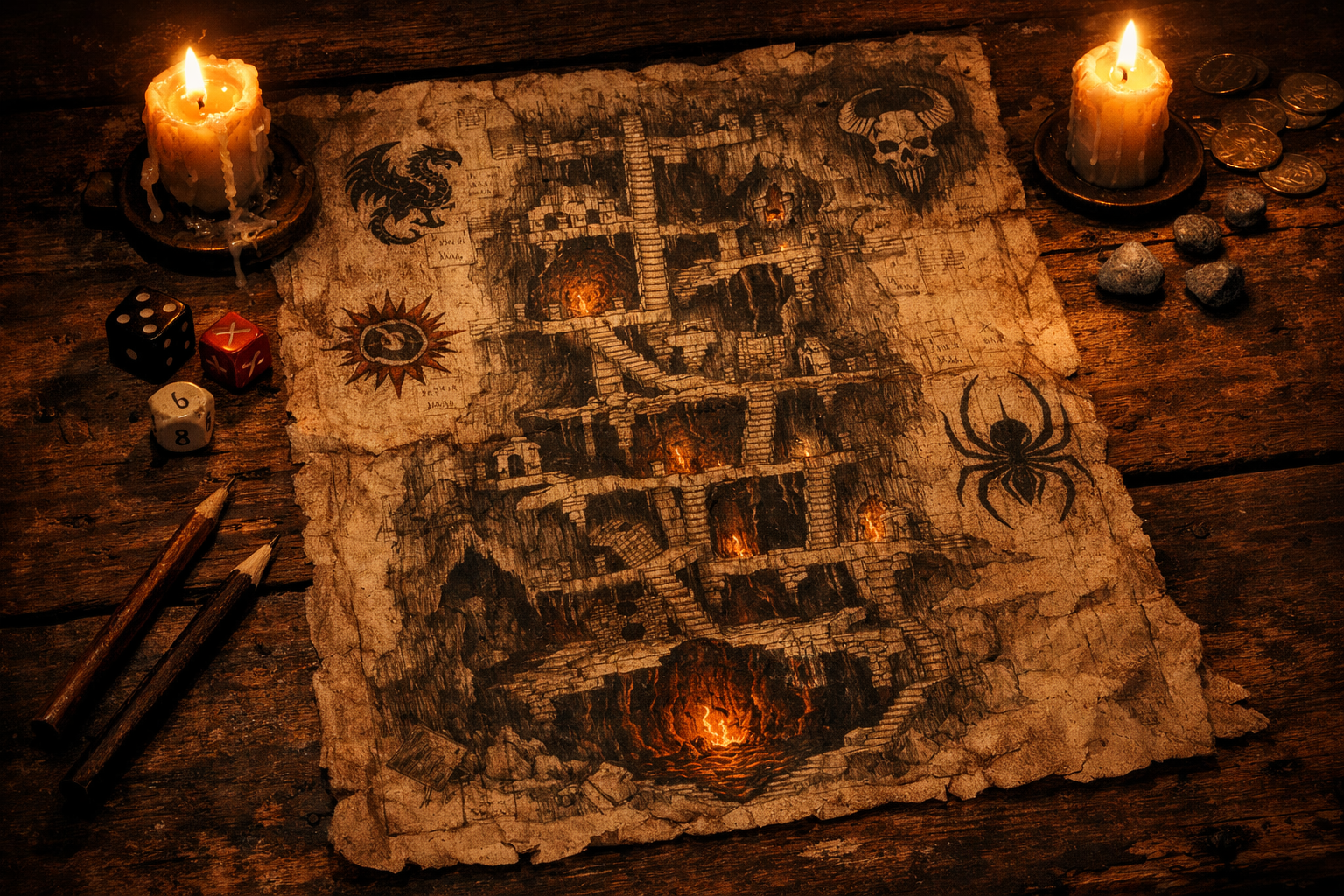
An illustrative thirty-session megadungeon campaign set in the Deepfall Chasm, showing where a GM's first plan tends to break down and which lessons about tracking, factions, prep rhythm, and player agency hold up over months of play.
Theory prepares you to start. Sustained play is where megadungeon campaign lessons actually show up.
This article follows the Deepfall Chasm, the recurring example used throughout this week's articles, through an illustrative thirty-session campaign. It is a worked scenario, not a report of a real table: the numbers and events are constructed to show how the principles from earlier in the week tend to play out over months, including where a GM's first plan breaks down and what replaces it. Treat each lesson as a pattern to test at your own table, not as a universal law.
The Campaign Context
The Deepfall Chasm is a vast canyon near the edge of settled territory. Its walls hold natural caves, ancient ruins, abandoned mines, and forgotten temples, joined by rope bridges, stairways, tunnels, and ancient lifts. In this scenario the Chasm has seven major levels and roughly 280 rooms, stocked by theme with scattered random elements. Four players meet weekly for three-hour sessions, and their characters advance from 2nd to 9th level over seven months of real time.
The GM prepares the first two levels completely before session one, sketches level three in outline, and leaves levels four through seven as structural frameworks. The campaign uses 5E-compatible rules, theater-of-mind exploration with grid maps for combat, and the town of Crestfall on the canyon rim as its home base.
Three factions operate inside the Chasm. The Ironclad Guild, a company of dwarven prospectors, holds part of the upper Chasm. The Hollowborn, undead remnants of the civilization that built the oldest ruins, guard tombs in the deeper levels. The Deeplight Cult, a band of surface exiles, wants to awaken something in the depths.
Lesson One: Players Map the Dungeon You Did Not Prepare
By session twelve, the players have explored about 60% of level one and 30% of level two, found both of the secret passages the GM placed deliberately, and located three connections the GM had sketched only as "maybe a passage here."
They also create a route nobody planned.
In session nine, the party's rogue notices that a collapsed ceiling on level one lines up with a flooded chamber on level two, part of the Drowned Passage. She proposes digging through the rubble to bypass a level-one chokepoint. The GM allows the attempt, assigns skill checks and a time cost, and the party now has a vertical passage that was never on the map.
This changes their exploration pattern. They start treating structural damage and environmental features as potential routes rather than obstacles, and by session fifteen they have opened two more connections between levels through cracks, chimneys, and weak floors.
The lesson: Megadungeons are not static spaces. Preparing every room fully before play commits you to a structure that players will actively reshape. Outlining major areas and completing rooms just ahead of play adapts better. When players create routes through creative problem-solving, the dungeon becomes theirs in a way pre-authored spaces rarely achieve.
A practical response is to plan for this: mark some passages as "player-discoverable" and stock rooms with environmental features that reward creative thinking.
Lesson Two: Tracking Systems Fail When They Exceed Weekly Maintenance
The GM starts with an elaborate tracking system: faction movement spreadsheets, time-stamped event calendars, detailed room status logs, and NPC disposition tracking. By session eight, half of it has stopped being updated.
The system needs 45 to 60 minutes of maintenance between sessions. After a work week and session prep, the updates get skipped, the information goes stale, and by session twelve the NPC tracker contradicts the session notes.
At session fifteen the GM rebuilds the system around one question: what can be updated during the session itself? The new version tracks three things only:
- Room status: cleared, occupied, altered by the party, or unvisited, marked on the map with simple symbols during play.
- Active faction moves: one action per faction per session, recorded in a single sentence at the end of the session.
- Changed consequences: what this session's actions mean for the next one, in two to four bullet points written immediately after play.
This takes about five minutes after each session and nothing in between, and it holds up for the rest of the campaign.
The lesson: A tracking system has to fit the time you actually have, not the time you intend to have. Over-engineered tracking creates prep debt that collapses under real schedules. The most sustainable system is the one you can maintain during and immediately after play.
Lesson Three: Faction Play Matters More Than Expected
The factions are planned as encounter variety: potential allies or enemies depending on how the party behaves. By session eighteen, faction dynamics are the main driver of the campaign.
The party strikes a deal with the Ironclad Guild in session seven that gives them a safe camp in the upper Chasm and access to the Guild's supplies. They fight the Hollowborn twice before discovering that the Hollowborn are guarding their tombs against Deeplight Cult excavations. That recontextualizes the conflict: by session fourteen, the party is helping the tomb guardians hold a collapsing gallery in exchange for information about unexplored areas.
The Ironclad Guild moves from rival to reluctant ally to employer, funding expeditions into dangerous sections in exchange for mapping data and ore samples.
These relationships produce stories nobody scripted, and they keep the table invested through slower sessions. In session twenty-two, the party spends most of the evening surveying ore seams for the Guild and stays engaged, because the fiction now matters to relationships they built.
The lesson: Factions turn a megadungeon from a static environment into a dynamic ecosystem. They supply goals beyond "explore the next room" and carry the consequences of player choices across sessions. Even simple factions, a group with goals and resources, add depth that monster-room-treasure stocking alone cannot. Three active factions, each with goals the players can help or hinder, is a sensible minimum.
Lesson Four: Preparation Rhythm Matters More Than Preparation Volume
Early on, the GM prepares for two to three hours before each session. By session ten that drops to 30 minutes or less, and the sessions do not suffer.
What changes is the focus of the prep, not the effort. The early material (detailed room descriptions, NPC dialogue, contingency plans for multiple approaches) mostly goes unused, because the players take unexpected routes. By session ten, the GM prepares:
- Five likely encounters: rooms or situations the party might reach this session, based on where they stopped.
- One faction complication: what one active faction does this session, whether or not the party meets them.
- Three discoverable details: clues, lore, or connections the party can uncover by asking good questions or searching carefully.
- One setback or pressure: a time limit, a hazard, or a faction move that closes an opportunity.
This takes 20 to 30 minutes and supports a three-hour session. When players go somewhere unprepared, the GM improvises from the dungeon framework and the factions' goals, then formalizes the improvisation before the next session.
This closely mirrors Mike Shea's Lazy DM approach, which asks what scenes might occur in a session and treats secrets and clues as the heart of prep. Shea now suggests carrying forward the secrets players have not yet found instead of writing a fresh list each session (Shea, 2023), which suits a megadungeon, where clues can sit undiscovered for weeks.
The lesson: Megadungeon prep is sustainable when it focuses on likely next steps and dynamic elements (factions, consequences, complications) rather than exhaustive coverage. Light, consistent prep before every session maintains momentum better than occasional deep prep followed by burnout.
Lesson Five: Player-Driven Discovery Requires Prepared Secrets
The Chasm's backstory concerns the civilization that built its oldest structures and the thing the Deeplight Cult wants to awaken, which ancient inscriptions call the Resonance Engine. The GM does not prepare a plot. Instead, lore is scattered across levels and factions for the players to assemble.
This works, but only because far more secrets are prepared than any one session reveals. By session twenty, the party has found about 40% of the seeded lore. They know the Chasm's deepest ruins are not natural, suspect the Deeplight Cult is digging toward something, and have found references to "the Resonance Engine" in three places, but they have not yet connected the fragments.
Some sessions they ignore lore entirely to focus on faction problems. Other sessions they chase leads hard. That uneven pace means the world would feel thin during investigative sessions unless there is a deep reserve of prepared material.
Justin Alexander's Three Clue Rule is the guideline here: "For any conclusion you want the PCs to make, include at least three clues" (Alexander, 2008). That redundancy protects the campaign when players miss an obvious clue or take a route that bypasses a prepared reveal.
The lesson: Player-driven discovery requires prepared depth. You cannot improvise a satisfying mystery from nothing when players suddenly decide to investigate in session fifteen. Seed secrets early, distribute them redundantly, and make them reachable by multiple paths. Prepare discoverable lore generously and linear plot sparingly: the first supports agency, the second fights it.
Lesson Six: Long Campaigns Need Structural Variety
By session twenty-five, the party is 8th level and deep into level four after six months of play. Engagement is flagging: combats feel routine and exploration has become procedural.
The GM introduces a structural change: a rival adventuring party, hired by the Ironclad Guild to explore competing routes. It adds time pressure (the rivals are mapping areas the party has not reached), social complications (the rivals are competitors, not enemies), and variety (sometimes rooms are already looted, sometimes the party arrives mid-fight, sometimes the two groups negotiate territory).
Engagement returns. The players plan around the rivals' movements and race them to key locations.
The lesson: Even a working megadungeon needs structural variation across dozens of sessions. Time pressure, a rival group, an environmental shift, or a new complication resets the pacing. Planning a shift of this kind every eight to ten sessions is a reasonable rule of thumb.
Lesson Seven: Exit Routes Matter as Much as Depth
The Chasm starts with one practical way in: the main descent from Crestfall. No alternate exits are prepared until session sixteen, when the party asks whether they can climb out through a ventilation shaft they found on level three.
The GM says yes and improvises an exit into the wilderness several miles from town. That opens new play patterns: the party caches supplies at the new exit, plans expeditions that enter by one route and leave by another, and uses passages to outmaneuver factions.
The lesson: Multiple entry and exit points, discovered or created through play, add strategic depth and keep the dungeon from feeling like a linear descent. Preparing at least two discoverable exits from the start would have enriched play earlier.
Lesson Eight: Not All Rooms Need Equal Detail
The GM first tries to prep every room with equal care. It is unsustainable and unnecessary: players cross some rooms in under a minute and spend whole sessions in others. A tiered approach replaces it:
- Key rooms (faction hubs, major encounters, lore-rich locations): full prep, several details, planned complications.
- Standard rooms (typical dungeon spaces): a brief description and a single feature or encounter, with detail improvised if players investigate.
- Transit rooms (corridors, empty chambers, connectors): minimal description, noted mainly for structural connections.
This roughly halves prep time, and the players experience richness where it matters.
The lesson: Focus detail on locations that serve a mechanical or narrative function (encounters, discoveries, decision points) and keep connective space light.
Lesson Nine: Player Maps Become Shared Campaign Memory
The GM does not hand out maps. One player volunteers to map during play, and her hand-drawn map becomes the party's shared reference, annotated with notes, warnings, and faction territories.
The map is often inaccurate: misjudged spatial relationships, missing passages, rooms drawn too large or too small. It does not matter. The map represents the party's understanding of the space, and their decisions come from that understanding. Getting lost because of a mapping error becomes part of the story, and correcting the map after finding a missed passage feels like a small victory. The act of mapping also keeps that player engaged through quiet exploration stretches.
The lesson: Player-made maps are campaign assets even when they are wrong. If your group enjoys mapping, let them map, and correct errors only when an error would cause a real problem at the table.
Lesson Ten: The Campaign End Point Is Unpredictable
The GM expects the campaign to end when the party reaches level seven and confronts the Resonance Engine. That is not what happens.
By session twenty-eight, the party is 9th level, has explored parts of five levels, and has decided their goal is to stabilize the Chasm rather than loot it. They broker an agreement under which the Ironclad Guild stays out of the Hollowborn tombs, help the tomb guardians seal the Deeplight Cult's excavation, and secure Crestfall's access to the upper Chasm.
They never reach level seven. The campaign ends at session thirty because the party has achieved goals they defined through play. The Resonance Engine remains unexplored, contained by diplomacy and control of the approaches rather than by direct confrontation.
The lesson: Players define victory conditions through play, and those conditions may have nothing to do with reaching the lowest level or defeating a final threat. Prepare deep content, but hold it loosely.
Example: The Deepfall Chasm at a Glance
The illustrative campaign runs thirty three-hour sessions over seven months. Four players take characters from 2nd to 9th level through seven major levels and roughly 280 rooms, of which they explore about 120.
- Levels prepared: two fully detailed before session one, three outlined by session ten, two left as frameworks.
- Factions active: three from the start (Ironclad Guild, Hollowborn, Deeplight Cult) and one added mid-campaign (a rival adventuring party).
- Player-created routes: three major passages engineered through play.
- Prepared secrets: about forty lore fragments seeded across all levels, of which the players find roughly sixteen.
- Tracking system: room status marks on the map, one-sentence faction moves per session, and two to four consequence notes after each session.
- Preparation rhythm: 20 to 30 minutes before each session after session ten, covering five likely encounters, one faction move, three discoverable details, and one complication.
The campaign ends not at the dungeon's deepest point but when the party secures the region through diplomacy and faction alliances. The elements that carry it are the faction relationships, the routes the players engineer, and the sense that their choices shape the region's future. None of these are what the initial design emphasized; all of them emerge through sustained play.
What Transfers to Your Campaign
This is one scenario with one group and one structure. Your table will differ. What may transfer:
Prepare for modification. Players will reshape your dungeon through creative problem-solving. Design structural flexibility and treat player-engineered routes as features.
Track minimally. Elaborate systems collapse under schedule pressure. Track only what you can update during or immediately after play.
Invest in factions. Even simple factions create emergent narrative and sustain interest through slower sessions. Prepare at least three with clear objectives players can help or hinder.
Prep rhythm over volume. Consistent light preparation before every session sustains a campaign better than occasional deep prep followed by burnout.
Seed redundant secrets. Player-driven discovery needs more prepared lore than any single session reveals. Use the Three Clue Rule: at least three clues for every conclusion you want players to be able to reach (Alexander, 2008).
Introduce structural variety. Plan a pacing shift every eight to ten sessions: rival groups, time pressure, or environmental change.
Prepare multiple exits. Alternate routes support strategic play and creative problem-solving.
Tier your room prep. Put deep prep into key locations and keep transit spaces light.
Support player mapping. Player maps, even inaccurate ones, create engagement and shared ownership of the space.
Hold conclusions loosely. Let the campaign end when players achieve goals that matter to them, not necessarily when they complete your design.
Final Reflection
The Deepfall Chasm scenario makes one point repeatedly: megadungeon play is less about the dungeon than about the play. The structure matters, but player agency, emergent narrative, and sustainable preparation matter more.
A megadungeon offers a framework large and sturdy enough to support months of emergent play, if you prepare flexibly, track minimally, and let the table shape the space. If you are considering one, prepare the framework, stock the factions, seed the secrets, and expect the players to take the campaign somewhere you did not plan.
Sources and Further Reading
Alexander, J. (2008, May 8). Three Clue Rule. The Alexandrian. https://thealexandrian.net/wordpress/1118/roleplaying-games/three-clue-rule
Shea, M. E. (2023, October 23). The Eight Steps of the Lazy DM: 2023 Review. Sly Flourish.
Play 5E at your own table
Dice and character math run in code, and an optional AI Dungeon Master can run the game for you. Free to start, no card required.
Related reading
- Designing Hit Point Systems That Support Your Table's Fiction
Hit points work differently at every table because they serve the fiction you create together. Understanding design choices behind hit point systems helps you run them with confidence and customize them when your game needs it.
- Narrating Hit Point Loss: Techniques for Describing Damage at the Table
Hit point totals drive combat, but your descriptions make them meaningful. Learn practical techniques to narrate damage that respects the fiction, supports player engagement, and keeps combat moving.
- Hit Points Under Stress: What the Numbers Actually Tell You During Play
Hit point totals shift meaning as combat unfolds. Understanding what those numbers signal helps you pace encounters, adjudicate rulings, and narrate outcomes that respect both the fiction and the mechanics.