Megadungeon vs. West Marches: Campaign Structures Compared
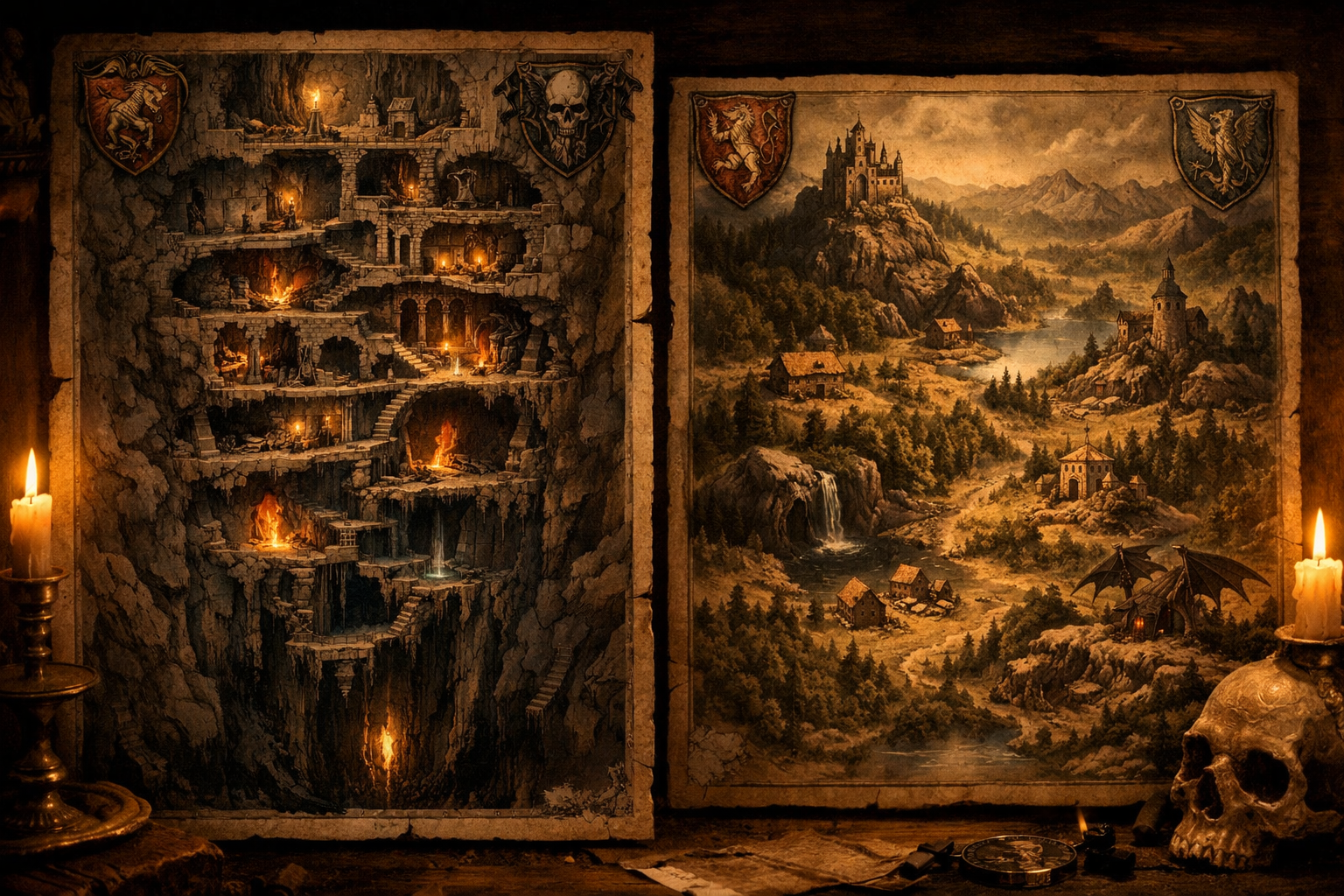
Megadungeons and West Marches campaigns share deep roots in player-driven exploration, but they demand different preparation, tracking, and table management. Learn how these two influential structures compare, where they overlap, and which framework serves your group's goals.
Megadungeons and West Marches campaigns both promise sustained player-driven exploration, minimal plot dependency, and campaigns that scale across months or years. Yet they solve different problems at the table, demand different preparation workflows, and create distinct play experiences. Understanding where these structures overlap and diverge helps you choose the framework that fits your group's scheduling constraints, player preferences, and your own preparation bandwidth.
This article compares the two structures across design principles, preparation requirements, session management, player experience, and long-term sustainability. It assumes you already understand what a megadungeon is (covered in earlier articles this week) and have at least passing familiarity with the West Marches concept.
Structural Foundations
Both frameworks reject linear adventure paths in favor of spatial exploration and player choice. Both treat the Game Master as architect and referee rather than storyteller. Both reward careful resource management and support emergent narrative. The similarity ends there.
A megadungeon centers on a single large location, typically vertical or layered, with interconnected levels that grow more dangerous as parties descend or advance. That depth-scaled danger goes back to the original 1974 rules, which scaled the monsters a party might meet to the dungeon level it was exploring (Gygax & Arneson, 1974). The structure is stable. The same hallways exist whether players visit on session three or session thirty. Factions may shift, wandering monsters patrol, and consequences accumulate, but the architecture itself remains fixed. Players build spatial understanding over time, mapping routes, identifying shortcuts, and learning environmental hazards.
A West Marches campaign, named for the game Ben Robbins ran for a little over two years and described on his blog in 2007, distributes exploration across a horizontal wilderness (Robbins, 2007). The structure is modular. Individual adventure sites function like dungeon levels, but they scatter across a map players explore between sessions. The campaign accommodates rotating casts, player-initiated scheduling, and asynchronous group formation. No single location dominates; the wilderness itself becomes the connective tissue.
The megadungeon asks, "How deep can you go?" The West Marches asks, "What lies over the next ridge?" That difference shapes every downstream decision.
Preparation and Design
Megadungeons demand high upfront architectural investment. You design (or acquire) a spatial structure before play begins, stock its major regions, establish factions and ecology, and create navigable connections between levels. You may leave sections sparse and detail them just ahead of the players, but the skeleton exists from the start. Justin Alexander's "Xandering" (named for the non-linear dungeons of Jennell Jaquays) is the usual advice for that skeleton: build in loops, multiple paths, and more than one connection between levels so players have real route choices (Alexander, 2010). This front-loaded work pays dividends across dozens of sessions. Once the structure is established, session-to-session preparation focuses on reacting to player choices, updating faction status, and restocking cleared areas.
West Marches campaigns distribute preparation across time. You create a base town, sketch a regional map with landmarks and rumored sites, and prepare a handful of initial adventure locations within a few days' travel. As players explore, you add new sites, expand the map outward, and develop areas they show interest in. Preparation happens in response to player decisions, often between sessions as you learn which direction they plan to explore next. The initial load is lighter, but ongoing prep remains steady.
Both structures benefit from random generation tools and modular content. Megadungeons use random encounter tables, procedural room stocking, and faction behavior systems to reduce rote preparation. West Marches campaigns use hex procedures, travel encounter tables, and point-crawl node design to generate wilderness content without exhaustive advance mapping. The difference lies in when you generate. Megadungeon preparation tends to cluster early; West Marches preparation spreads across the campaign lifespan.
Session Management and Scheduling
Megadungeons work best with consistent groups meeting on regular schedules. The same players return to the same location, building institutional knowledge about its layout, factions, and dangers. Session endings often leave parties mid-delve, relying on next week's session to continue from the same corridor or campsite. Consistent attendance matters. When a player misses a session, the group either plays without that character (handwaving their absence) or postpones the delve.
West Marches campaigns were designed explicitly for inconsistent schedules and rotating casts. Robbins built the structure around a large player pool, with each game drawing different players from "a pool of around 10-14 people," and every session "scheduled by the players on the fly" (Robbins, 2007). Expeditions set out from and return to a fortified frontier town, where characters rest up, trade information, and plan their next foray between sorties. Players organize sessions themselves, proposing expedition goals and recruiting fellow adventurers by emailing the group. The Game Master responds to player initiative rather than scheduling sessions centrally. Multiple groups may explore different regions simultaneously, returning with information that benefits the wider player community.
This scheduling flexibility comes at a cost. West Marches campaigns require player buy-in for self-organization, a communication platform for session scheduling and information sharing, and a larger player pool to sustain momentum. They work poorly for groups of four friends who meet every Tuesday. Megadungeons thrive in exactly that context.
Information Flow and Cartography
Megadungeons consolidate information. The map is the primary knowledge artifact. Players sketch corridors, mark trap locations, note faction territories, and record shortcuts. Over time, their map becomes authoritative, a record of explored space and hard-won understanding. The Game Master tracks time, wandering monsters, and faction movements, but the spatial information lives primarily with the players. New players joining an established megadungeon campaign inherit existing maps and must learn the structure from veterans.
West Marches campaigns distribute information across the player community. Individual groups map specific sites (dungeons, ruins, lairs), but the wilderness map itself grows through shared reporting. In Robbins's game, players traded that information in the town's tavern between sorties and on the group's email list (Robbins, 2007); modern tables often use a shared document or chat server for the same job. Information asymmetry becomes a feature. Groups that venture northeast learn different things than groups exploring southwest. Returning parties share findings, creating collaborative world-building. The Game Master remains the sole authority on undiscovered content but encourages players to become experts on explored regions.
This difference affects table dynamics. Megadungeons reward sustained engagement with a single space, building mastery through repetition. West Marches campaigns reward communication, collaboration, and synthesis across multiple groups. Megadungeons support territorial thinking ("our dungeon"). West Marches campaigns support collective mapping ("our wilderness").
Player Agency and Goal-Setting
Both structures prioritize player agency, but they distribute decision-making across different timescales.
Megadungeon players make tactical and strategic choices within sessions. They decide which corridor to explore, whether to push deeper or retreat, which faction to negotiate with, and how to allocate resources. Goals emerge organically: retrieve the idol, clear the goblin warren, map the third level, find the underground river. Between sessions, players plan next steps, review maps, and discuss strategies. The Game Master prepares reactions but rarely imposes objectives.
West Marches players make logistical and social choices between sessions. They decide which rumor to pursue, who to recruit, when to schedule the expedition, and which direction to explore. The Game Master provides hooks (rumors, NPC requests, returning adventurers' tales) but does not dictate goals. Players drive session scheduling, expedition composition, and exploratory priorities. Within sessions, play often resembles traditional adventure design: travel to site, explore site, return home.
Megadungeons integrate planning into the play loop. West Marches campaigns integrate planning into the social fabric. Both reduce Game Master narrative control, but West Marches campaigns demand higher player initiative outside session time.
Sustainability and Campaign Arc
Megadungeons sustain themselves through vertical progression and deepening mystery. As parties explore deeper levels, they encounter stronger challenges, richer rewards, and stranger phenomena. The structure naturally gates content by difficulty. Players build power, unlock new areas, and uncover secrets buried in the dungeon's history. Campaigns often climax when parties reach the deepest level, confront the central threat, or achieve a long-term goal (clear all levels, claim the treasure hoard, defeat the ancient evil). The structure supports clear endpoints, though many megadungeons remain open-ended.
West Marches campaigns sustain themselves through horizontal expansion and emergent plot. As players explore farther from the base town, they discover new regions, factions, and threats. The wilderness grows outward, limited only by the Game Master's willingness to develop new content and players' appetite for exploration. Campaigns may never climax in a traditional sense. Instead, they evolve, shift focus as players pursue different goals, or wind down naturally when the group exhausts interest. The structure resists closure, which can be a feature or a liability depending on table preference.
Both structures risk stagnation. Megadungeons stall when exploration feels repetitive, danger becomes predictable, or players lose motivation to delve deeper. West Marches campaigns stall when players stop initiating sessions, when information overload fragments the community, or when the wilderness feels too vast and unstructured. Sustainability depends less on the framework itself than on Game Master responsiveness, player engagement, and the table's tolerance for open-ended play.
Hybrid and Intermediate Approaches
Many tables blend elements from both structures. A campaign might feature a central megadungeon within a West Marches-style wilderness, allowing players to choose between delving the dungeon or exploring regional sites. This hybrid preserves the megadungeon's architectural depth while offering West Marches-style variety and scheduling flexibility.
Alternatively, a table might run a megadungeon with West Marches scheduling principles, allowing a rotating cast to explore the same dungeon across inconsistent sessions. Each session begins and ends at the dungeon entrance or nearby base camp. Players share maps and findings but form different parties each week. This preserves megadungeon structure while accommodating irregular attendance.
Another approach treats each level of a megadungeon as a discrete "site" in a layered vertical wilderness. Players choose which level to explore each session, navigating between levels as they would travel between hexes in a West Marches campaign. This modularizes the megadungeon, reducing inter-session dependencies while retaining architectural continuity.
These hybrids demonstrate that megadungeon and West Marches frameworks are not mutually exclusive. They represent different points on a spectrum of player-driven, exploration-focused campaign design. Tables can adopt principles from either structure based on group needs, preparation capacity, and play preferences.
Choosing Between Structures
Megadungeons suit tables that:
- Meet regularly with consistent attendance.
- Enjoy sustained engagement with a single location.
- Prefer tactical, session-by-session decision-making.
- Want clear progression and discoverable depth.
- Can invest preparation time upfront for long-term payoff.
West Marches campaigns suit tables that:
- Struggle with consistent scheduling or attendance.
- Have a larger player pool with rotating participants.
- Enjoy exploration, discovery, and variety.
- Want player-driven session planning and goal-setting.
- Prefer distributed preparation over time.
Neither structure is inherently superior. Megadungeons offer focused, architecturally rich exploration within a stable framework. West Marches campaigns offer flexibility, variety, and community-driven discovery across a dynamic landscape. Your choice depends on logistical constraints, player temperament, and the kind of campaign experience you want to cultivate.
If your group values routine, depth, and mastery of a single space, the megadungeon delivers. If your group values autonomy, asynchronous play, and collaborative exploration, the West Marches framework provides the scaffolding. If you want elements of both, hybrid approaches exist and often thrive.
Example: The Deepfall Chasm
The Deepfall Chasm, this week's recurring example, uses a megadungeon structure: a vast canyon whose walls hold caves, ruins, mines, and forgotten temples, connected by rope bridges, stairways, tunnels, and ancient lifts. In this version, eight players meet every other Tuesday and set out from the town of Crestfall. The Game Master prepared the upper regions, the three factions (the Ironclad Guild's dwarven prospectors, the undead Hollowborn, and the Deeplight Cult), and the major set-pieces before session one. Ongoing prep focuses on faction reactions, restocking cleared areas, and developing deeper levels as parties descend.
After twelve sessions, three players face scheduling conflicts. Rather than convert the entire campaign to West Marches, the Game Master sketches a regional map around Crestfall. The Chasm remains the central feature, but players now choose between delving the dungeon or exploring wilderness sites (bandit camps, ancient shrines, monster lairs). Every session now begins and ends in Crestfall, adopting West Marches-style bookends. Players share maps and rumors, but the core group continues the megadungeon push.
This hybrid preserves the Chasm's architectural identity while offering variety when attendance fluctuates. Players with consistent availability delve deeper. Players with irregular schedules join wilderness expeditions. Both contribute to a shared campaign without forcing either group to abandon their preferred play style.
Sources and Further Reading
Alexander, J. (2010). Xandering the Dungeon. The Alexandrian. https://thealexandrian.net/wordpress/13085/roleplaying-games/xandering-the-dungeon
Gygax, G., & Arneson, D. (1974). Dungeons & Dragons, Volume 3: The Underworld & Wilderness Adventures. Tactical Studies Rules.
Robbins, B. (2007, October 17). Grand Experiments: West Marches. Ars Ludi. https://arsludi.lamemage.com/index.php/78/grand-experiments-west-marches/
Play 5E at your own table
Dice and character math run in code, and an optional AI Dungeon Master can run the game for you. Free to start, no card required.
Related reading
- Designing Hit Point Systems That Support Your Table's Fiction
Hit points work differently at every table because they serve the fiction you create together. Understanding design choices behind hit point systems helps you run them with confidence and customize them when your game needs it.
- Narrating Hit Point Loss: Techniques for Describing Damage at the Table
Hit point totals drive combat, but your descriptions make them meaningful. Learn practical techniques to narrate damage that respects the fiction, supports player engagement, and keeps combat moving.
- Hit Points Under Stress: What the Numbers Actually Tell You During Play
Hit point totals shift meaning as combat unfolds. Understanding what those numbers signal helps you pace encounters, adjudicate rulings, and narrate outcomes that respect both the fiction and the mechanics.